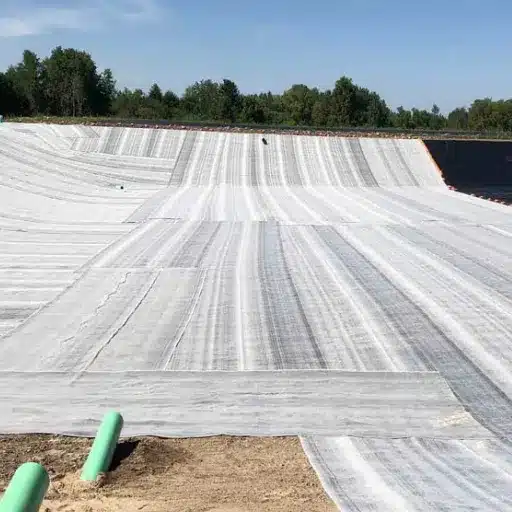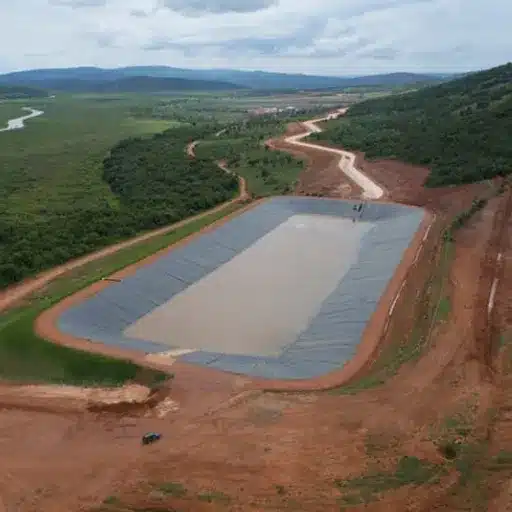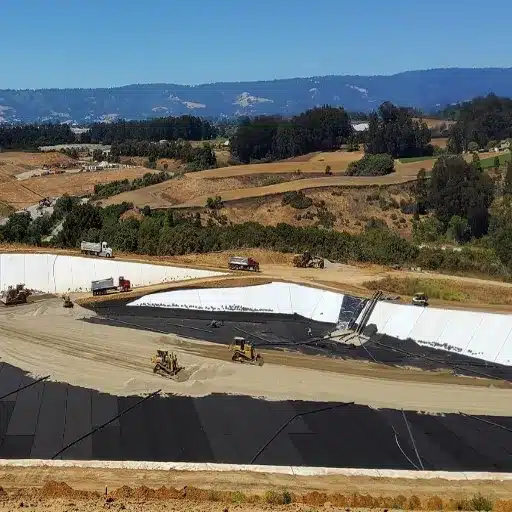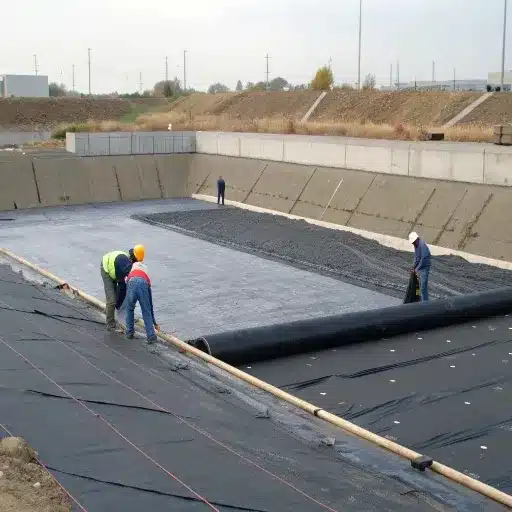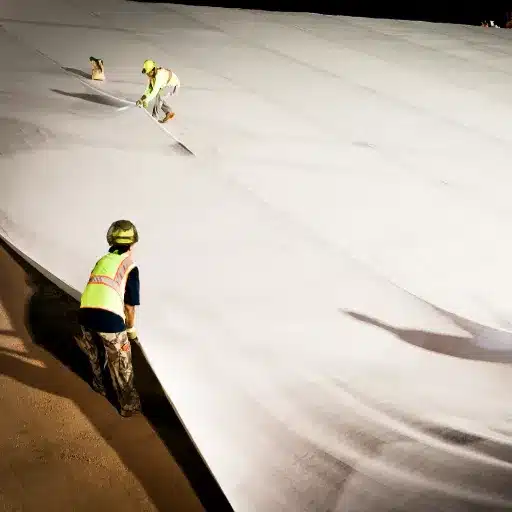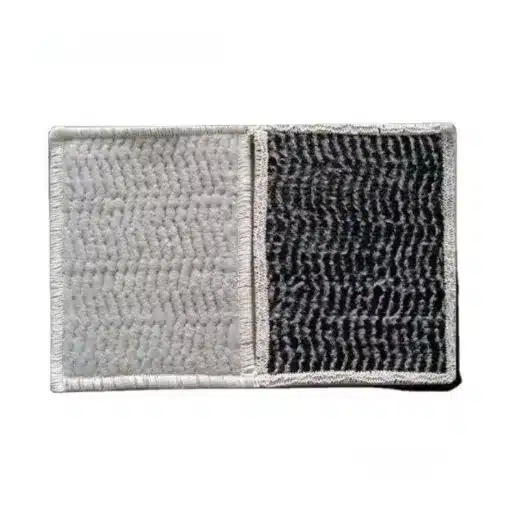
Geotextile erosion control uses permeable synthetic fabrics to stabilize soil, filter water, separate layers, and prevent washout on slopes, channels, and shorelines. When the right fabric is selected and installed correctly, it can extend the life of earthwork structures and reduce maintenance costs. When the wrong fabric is used—or the right one is installed poorly—the result is often undermining, piping, or slope failure.
Engineers and procurement buyers face two common problems. First, the market offers many products labeled “erosion control fabric,” but not all of them perform the same function. Second, installation details such as overlap direction, anchor trench depth, and pinning density are often treated as afterthoughts, even though they determine whether the system survives the first major storm.
This guide explains how geotextile erosion control works, when to choose woven or nonwoven, how AASHTO M288 classifies erosion-control geotextiles, and how to install them for slopes, channels, and riprap underlayment. If you need help specifying geotextile erosion control for a project, our engineering team can review your site conditions and recommend the right fabric class. Request a technical consultation today.
Key Takeaways
- Geotextile erosion control combines separation, filtration, drainage, and protection to stabilize soil against water and wind erosion.
- Nonwoven geotextiles work best for filtration, drainage, and vegetated slopes; woven geotextiles work best under riprap and armor where strength matters.
- AASHTO M288 Class 1 is for severe erosion-control conditions; Class 2 is for moderate conditions.
- Always overlap rolls shingle-style, anchor edges in trenches, and pin on steep slopes.
- Geotextiles are permanent filter layers; erosion control blankets are temporary surface covers for vegetation establishment.
What Is Geotextile Erosion Control?
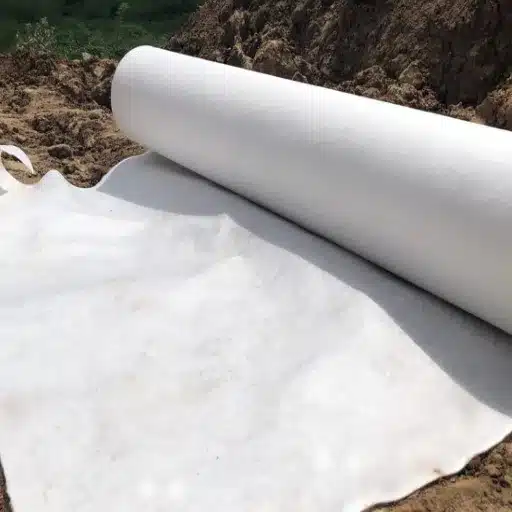
Geotextile erosion control is the engineered use of permeable fabrics to protect soil surfaces and subgrades from displacement by water, wind, or construction activity. Unlike erosion control blankets, which are typically laid on the surface to support vegetation, geotextiles are usually placed at the interface between soil and armor materials such as riprap, gabions, or aggregate.
In this role, the geotextile performs four coincident functions:
- Separation: Keeps fine subgrade soil from mixing with coarse armor stone.
- Filtration: Allows water to pass while retaining soil particles.
- Drainage: Dissipates pore water pressure that could destabilize the slope.
- Protection: Cushions and supports the armor layer during placement and service.
Common applications include highway embankments, streambanks, shoreline revetments, drainage channels, and cut slopes on construction sites. For a broader overview of geotextile functions and material types, see our geotextile fabric pillar guide. For the underlying separation and filtration mechanics, see our geotextile separation and filtration guide.
Why Erosion Control Fails Without a Geotextile
Unprotected soil under riprap or aggregate is vulnerable to two failure modes. The first is piping, where flowing water carries fines out through voids in the armor. The second is mixing, where repeated wetting and drying cause the subgrade and armor to blend, reducing drainage capacity and increasing weight.
A properly specified geotextile stops both. It keeps the soil in place and keeps the armor layer clean and free-draining.
Woven vs Nonwoven Geotextile for Erosion Control
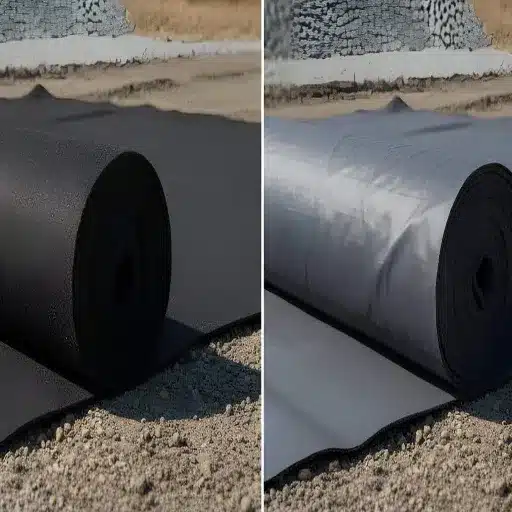
The choice between woven and nonwoven geotextile for erosion control depends on the application, the soil, and the armor system. Neither is the default for every site. The full comparison is covered in our geotextile fabric guide; below is the erosion-control summary.
Woven Geotextiles: Strength Under Armor
Woven geotextiles are made by interlacing polypropylene or polyester tapes or filaments. They have high tensile strength, low elongation, and high modulus. These properties make them ideal for placement beneath riprap, gabions, and other rigid armor where puncture and tensile loads are high.
Use woven geotextiles when:
- A large angular stone will be placed over the fabric.
- The slope or channel has high flow velocity.
- The armor system is heavy, and concentrated loads are expected.
- Long-term dimensional stability is required.
Nonwoven Geotextiles: Filtration and Soil Contact
Nonwoven geotextiles are needle-punched or heat-bonded. They have higher permeability, better conformability to irregular surfaces, and better filtration characteristics than most woven fabrics. They are preferred for vegetated slopes, low-energy channels, and sites where soil retention and drainage are more important than armor puncture resistance. For drainage-specific design guidance, see our nonwoven geotextile drainage guide.
Use nonwoven geotextiles when:
- The surface is irregular or requires close soil contact.
- Vegetation will be established through or over the fabric.
- Flow velocities are moderate, and armor is light.
- Filtration efficiency is the primary concern.
Selection Summary Table
| Factor | Woven Geotextile | Nonwoven Geotextile |
|---|---|---|
| Strength | High | Moderate |
| Elongation | Low | High |
| Permeability | Lower | Higher |
| Soil contact | Moderate | Excellent |
| Best use | Riprap, armor, high stress | Vegetated slopes, filtration |
For heavy-duty woven use cases, specify fabrics with high grab tensile strength, CBR puncture resistance, and low elongation.
AASHTO M288 Erosion Control Requirements
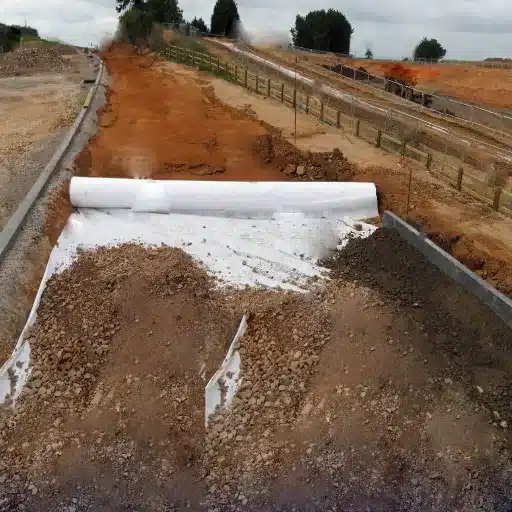
AASHTO M288 is the specification most often referenced by U.S. state DOTs for highway geotextile applications. It divides geotextiles into survivability classes and assigns minimum physical and hydraulic properties measured by ASTM test methods.
Survivability Classes for Erosion Control
AASHTO M288 uses three main survivability classes for geotextiles:
- Class 1: Severe conditions, such as heavy riprap placement, steep slopes, or high-energy channels.
- Class 2: Moderate conditions, the default for many erosion-control applications when site data is limited.
- Class 3: Mild conditions, such as protected slopes with light cover.
For permanent erosion control under riprap or armor, Class 1 or Class 2 is usually specified. Class 3 is generally acceptable only for low-stress, protected applications.
Key Test Methods for Erosion Control Geotextiles
| Property | ASTM Method | Why It Matters |
|---|---|---|
| Grab tensile strength | D4632 | Resistance to localized stress during installation |
| Trapezoidal tear | D4533 | Resistance to tear propagation after minor damage |
| CBR puncture | D6241 | Resistance to concentrated loads from stone |
| UV resistance | D4355 | Performance after sun exposure during construction |
| Apparent opening size | D4751 | Soil retention versus permeability |
| Permittivity | D4491 | Drainage capacity through the fabric |
Representative AASHTO M288 Requirements
The table below shows typical mechanical requirements. Always confirm exact values against the edition referenced by your project.
| Property | Class 1 (min) | Class 2 (min) | Class 3 (min) |
|---|---|---|---|
| Grab tensile strength | 1,400 N | 1,100 N | 800 N |
| Tear strength | 500 N | 400 N | 300 N |
| CBR puncture | 3,500 N | 2,700 N | 1,900 N |
| UV resistance retained | 50% | 50% | 50% |
For permanent erosion control under riprap, Class 1 woven geotextiles are commonly specified because they survive stone placement better than lighter classes.
Common Erosion Control Applications
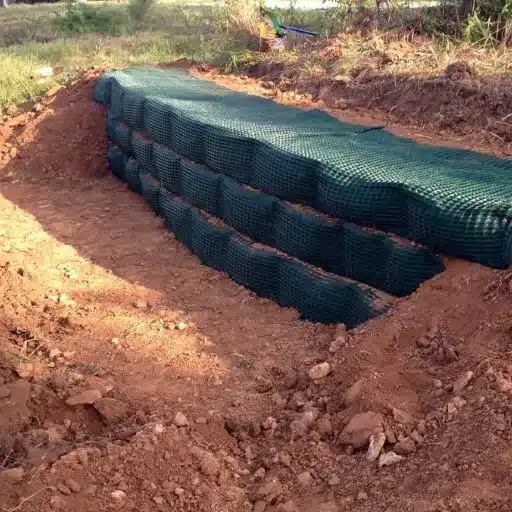
Geotextile erosion control appears in many project types. The same fabric does not fit all of them. Site-specific conditions such as slope gradient, flow velocity, soil gradation, and armor type should drive selection.
Slope Stabilization
On embankments and cut slopes, geotextiles prevent surface soil from sliding or washing away. This is the core of geotextile slope stabilization: holding the soil in place while allowing water to drain and vegetation to establish. Geotextiles are often combined with erosion control blankets, turf reinforcement mats, or vegetation. Steeper slopes require closer pinning and deeper anchor trenches.
For slopes steeper than 3:1 (25%), engineers often add terraces, benches, or additional reinforcement. In these cases, geotextiles may work alongside geogrids or retaining-wall systems. Our geotextile retaining wall guide covers reinforced wall applications.
Channel and Ditch Lining
Channels carry concentrated flow, which increases the risk of scour. A geotextile filter under riprap or concrete lining prevents the channel bed and banks from eroding beneath the armor. The fabric must withstand the velocity and turbulence of the design flow.
Shoreline and Riprap Underlayment
Shorelines experience wave action, fluctuating water levels, and freeze-thaw cycles. A geotextile placed under riprap on a shoreline acts as a riprap geotextile filter that prevents soil loss while allowing water movement. High-energy shorelines typically require Class 1 woven geotextiles.
Roadside Embankments
Roadside slopes are exposed to runoff from pavement, concentrated outfalls, and maintenance traffic. Geotextiles under riprap or aggregate protect the embankment and reduce the frequency of repairs. AASHTO M288 is the usual specification framework for these projects.
Erosion Control Geotextile Installation Steps
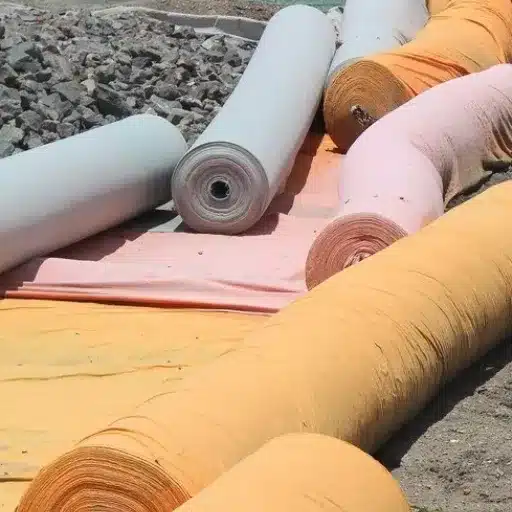
Proper erosion control geotextile installation is where many projects succeed or fail. Even the correct fabric will underperform if it is not anchored, overlapped, or protected properly.
Step 1: Site Preparation
Clear the area of debris, vegetation, loose soil, and sharp objects. Grade the surface smoothly so the geotextile makes continuous contact with the soil. Soft or wet spots should be addressed before placement; a fabric placed over a void or mud pocket will bridge and eventually tear.
Step 2: Surface Conditioning
For vegetated slopes, apply topsoil, seed, and fertilizer before laying the erosion control blanket if one is used. For riprap underlayment, compact the subgrade to the specified density. A smooth, firm surface reduces the risk of puncture and improves load distribution.
Step 3: Unroll the Geotextile
Unroll the fabric in the direction specified by the engineer. On slopes, rolls are typically placed perpendicular to the direction of water flow or down the slope. In channels, rolls are usually placed parallel to the flow. The correct orientation prevents water from running into seams.
Step 4: Overlap Seams Shingle-Style
Adjacent rolls must overlap. A typical minimum overlap is 12 inches (300 mm), with more required in soft soils or high-flow areas. The upstream or upslope roll should overlap on top of the downstream roll, like roof shingles. This prevents water from lifting the edge and entering the seam.
Step 5: Anchor Trenches and Pinning
Bury the top and bottom edges of the geotextile in anchor trenches. A common trench size is 6 inches by 6 inches, though specifications may require more. Backfill and compact the trench firmly.
On slopes, pin or staple the fabric at regular intervals. Typical spacing is every 2–4 feet, with closer spacing on steep slopes or loose soils.
Step 6: Place Armor Carefully
Place riprap or aggregate over the geotextile with minimal drop height. Dropping large stones from a height can puncture even Class 1 fabrics. Use smaller bedding stone first if the specification calls for it, then place larger armor stone carefully.
Installation Quick Reference
| Item | Typical Requirement |
|---|---|
| Minimum overlap | 12 inches (300 mm) |
| Anchor trench depth | 6–8 inches (150–200 mm) |
| Pin spacing on gentle slopes | Every 3–4 feet |
| Pin spacing on steep slopes | Every 2 feet |
| Maximum stone drop height | 12 inches or less |
Erosion Control Blanket vs Geotextile
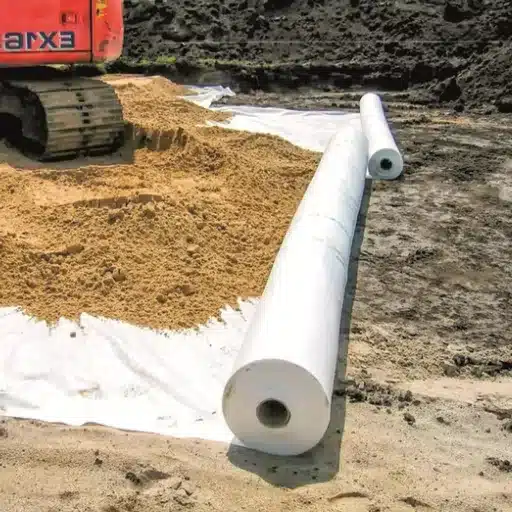
Buyers often confuse erosion control blankets with geotextiles. The distinction matters because they serve different purposes and have different service lives.
Erosion Control Blankets and Mats
Erosion control blankets are surface products made from straw, coconut fiber, wood fiber, or synthetic materials. They are designed to:
- Protect bare soil from raindrop impact.
- Slow runoff velocity.
- Hold seed and moisture in place until vegetation establishes.
- Degrade after a few years once plants take over.
Blankets are temporary or transitional. They are not designed to carry structural loads or act as filters under stone armor.
Geotextiles
Geotextiles are permanent synthetic fabrics placed within the soil structure. They are designed to:
- Separate soil layers.
- Filter water while retaining soil particles.
- Drain excess pore pressure.
- Protect and support armor systems.
Geotextiles do not biodegrade. They remain in place for the design life of the project.
When to Combine Both
On a vegetated slope, a nonwoven geotextile may be placed as a separation and filtration layer beneath topsoil, while an erosion control blanket is placed on the surface to protect the seed and soil until grass establishes. This erosion control blanket vs geotextile combination is common, but the two products are not interchangeable.
Common Geotextile Erosion Control Failures and How to Avoid Them
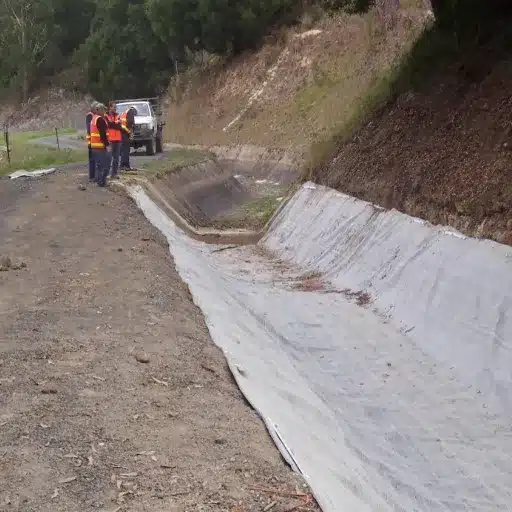
Real-world geotextile erosion control failures usually trace back to specification, material selection, or installation. Below are three representative examples.
Mini-story: A contractor in North Carolina installed geotextile on a 2:1 highway embankment before seeding and mulching. The crew unrolled the fabric parallel to the contour instead of down the slope, and the seams faced upslope. After the first heavy rain, runoff collected at the upper edges of each roll, lifted the fabric, and washed soil out beneath it. The slope had to be regraded and reinstalled.
This failure was avoidable. Unrolling down the slope and overlapping shingle-style directs water over the seams rather than under them.
Mini-story: On a streambank project in Kenya, the engineer specified riprap directly over clay soil to save cost. Within one rainy season, water seeping through the riprap carried clay fines out from under the stones. The channel widened, the riprap settled, and the bank required a full rebuild with a geotextile filter layer.
Placing riprap without a filter is a false economy. The geotextile prevents piping and preserves the armor layer.
Mini-story: A procurement team in Southeast Asia selected a Class 2 nonwoven geotextile for a tidal shoreline revetment because it was readily available and cheaper than the Class 1 woven alternative. During placement of 6-inch armor stone, several rolls tore under the concentrated loads. The replacement and delay cost more than the original specification upgrade would have.
High-energy shorelines and heavy stone placement require Class 1 woven geotextiles with higher puncture and tensile resistance.
Erosion Control Geotextile Procurement Checklist
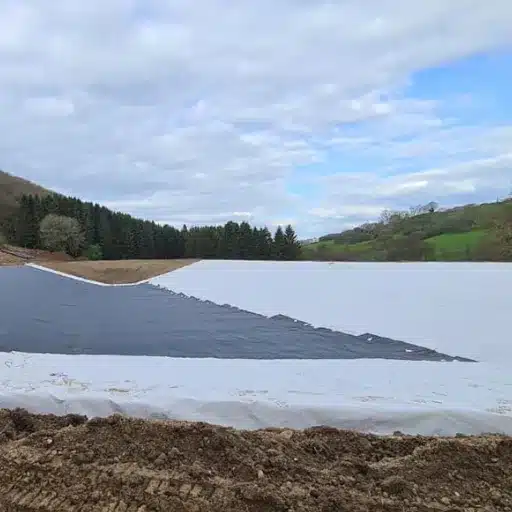
Use this checklist to make sure the geotextile you order matches the project requirements.
Define Site Conditions
- Measure slope gradient or channel side slope
- Identify soil type and gradation
- Estimate design flow velocity or wave energy
- Determine armor type and maximum stone size
- Assess exposure to sunlight during construction
Select the Right Fabric
- Choose woven for riprap, armor, and high-stress sites
- Choose nonwoven for filtration, drainage, and vegetated slopes
- Confirm AASHTO M288, survivability class
- Verify AOS and permittivity match soil conditions
Verify Quality and Documentation
- Request MARV values for mechanical properties
- Confirm ASTM test methods used in certified test reports
- Check UV resistance for exposed construction periods
- Verify the ISO 9001 quality management system
Plan Installation
- Confirm overlap width and orientation
- Specify anchor trench dimensions
- Plan pin or staple spacing
- Arrange for careful stone placement to avoid puncture
- Schedule an inspection after the first major storm
Frequently Asked Questions
Can geotextile fabric be used for erosion control?
Yes. Geotextiles are widely used for erosion control beneath riprap, aggregate, and armor systems. They separate soil layers, filter water, and prevent washout on slopes, channels, and shorelines.
What is the difference between an erosion control blanket and a geotextile?
An erosion control blanket is a temporary surface cover that protects soil and supports vegetation establishment. A geotextile is a permanent synthetic fabric placed within the soil structure for filtration, separation, drainage, and protection under armor.
Should I use woven or nonwoven geotextile under riprap?
Woven geotextile is usually the better choice under riprap because it has higher tensile strength, lower elongation, and better puncture resistance than nonwoven fabrics. Nonwoven geotextiles are preferred for filtration and vegetated slopes.
How much overlap is needed for geotextile erosion control?
A minimum overlap of 12 inches is common for erosion control applications. More overlap may be required in soft soils, steep slopes, or high-flow areas. The upstream or upslope roll should always overlap on top.
What AASHTO M288 class is needed for erosion control?
Class 1 is used for severe conditions such as heavy riprap, steep slopes, and high-energy shorelines. Class 2 is the default for moderate conditions. Class 3 may be used only for protected, low-stress applications.
Conclusion: Build Erosion Control That Lasts
Geotextile erosion control is not just about laying fabric on the ground. It is about matching the right fabric class to the site conditions, installing it with proper overlap and anchoring, and protecting it during armor placement. Nonwoven geotextiles excel at filtration and soil contact on vegetated slopes. Woven geotextiles provide the strength needed under riprap and armor.
AASHTO M288 gives engineers a clear framework for specifying survivability classes, while ASTM test methods verify the properties that matter. The most common failures—undermining, piping, and tearing—usually come from skipping one of those steps.
If you are planning a slope, channel, or shoreline project, our team can help you select the right geotextile erosion control fabric, confirm AASHTO M288 compliance, and arrange export delivery to your site. Request a tailored quote or specification review today.