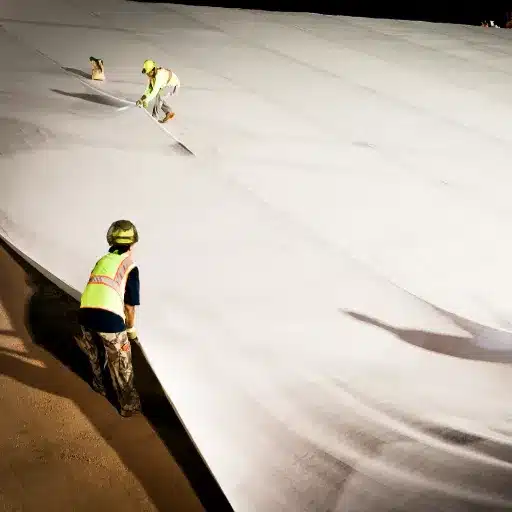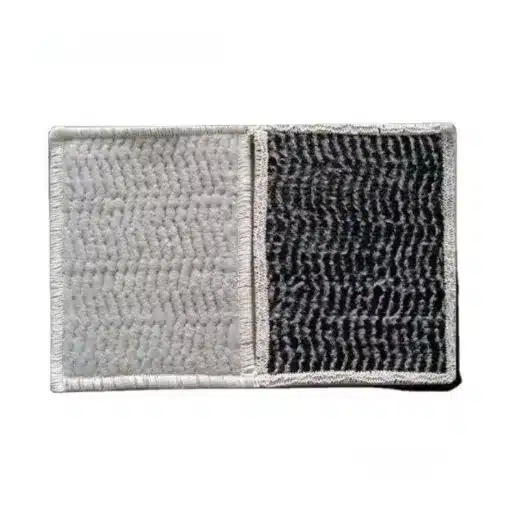
A geotextile retaining wall uses geotextile fabric as a separation, filtration, and drainage layer behind the wall structure. The right fabric prevents soil loss, reduces hydrostatic pressure, and extends wall life. The wrong fabric — or no fabric at all — is one of the most common causes of retaining wall failure.
Most retaining wall failures start with water, not masonry. When drainage behind a wall is inadequate, hydrostatic pressure builds and pushes the wall beyond its design capacity. Contractors and engineers who treat geotextile as an afterthought often end up rebuilding walls that should have lasted decades. This guide explains how to specify, size, and install geotextile behind retaining walls to engineering standards.
Key Takeaways
- Nonwoven geotextile is the correct choice for drainage layers behind retaining walls.
- Hydrostatic pressure adds 62.4 psf for every foot of water trapped behind a wall.
- Fabric weight should increase with wall height: 3.5 oz for walls under 2 ft, up to 10 oz for walls over 10 ft.
- A proper drainage system includes geotextile, clean drainage stone, and a perforated pipe sloped to daylight.
- Geogrid reinforcement is required for structural walls over 4 ft or walls with heavy surcharge loads.
What Is a Geotextile Retaining Wall?
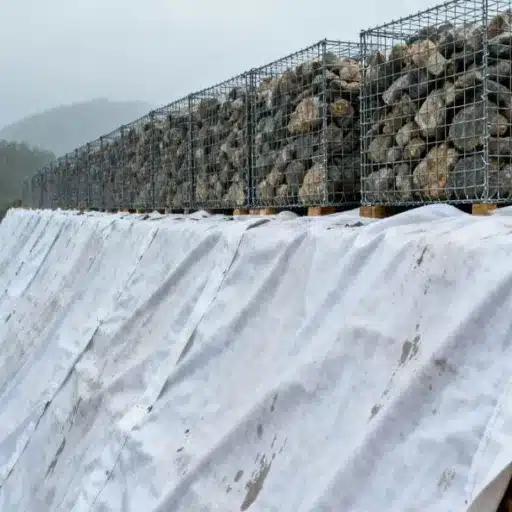
A geotextile retaining wall is any retaining wall system that uses geotextile fabric between the backfill soil and the drainage layer or wall structure. The fabric is not the wall itself. It is a supporting layer that helps the wall perform as designed by separating soil from drainage stone, filtering fines, and transmitting water.
Four Functions Behind a Wall
Geotextile behind a retaining wall typically performs four related functions:
- Separation — keeps backfill soil from mixing with the clean drainage stone.
- Filtration — allows water to pass while retaining soil particles.
- Drainage — works with drainage stone and pipe to relieve hydrostatic pressure.
- Protection — cushions and protects waterproofing or geomembrane layers on some wall types.
Where Geotextile Sits in the Wall Cross-Section
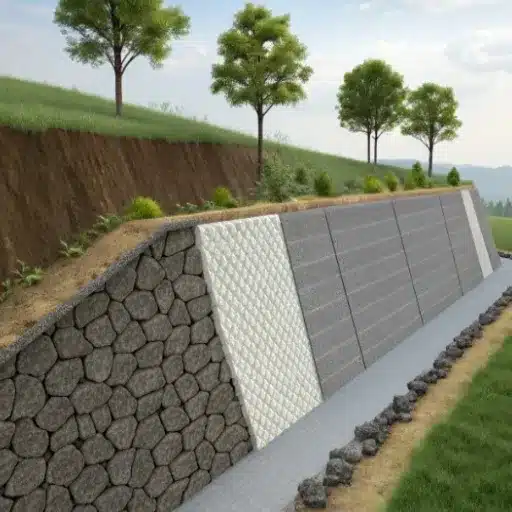
In a typical segmental retaining wall, the layers from back to front are:
- Undisturbed native soil or engineered backfill.
- Geotextile filter fabric.
- Clean crushed drainage stone.
- Perforated drainage pipe at the base.
- Retaining wall block or facing.
The geotextile separates the backfill from the drainage stone while letting water move freely toward the pipe and weep holes. For a complete overview of geotextile functions and selection, see our geotextile fabric guide.
Why Drainage Is the #1 Factor in Retaining Wall Failure
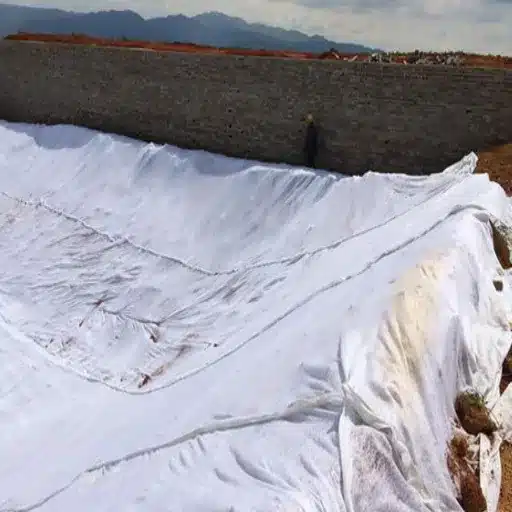
Hydrostatic Pressure Basics
Water trapped behind a retaining wall exerts lateral pressure. The pressure increases with depth at a rate of 62.4 pounds per square foot for every foot of water. A 6-foot saturated backfill can add more than 1,100 psf of force against the wall — often double or triple the pressure the wall was designed to resist.
This is why most retaining wall failures are drainage failures. The masonry, concrete, or segmental block may be strong enough. The foundation may be adequate. But once water builds up behind the wall, the structure is overloaded.
How Nonwoven Geotextile Reduces Pressure
Nonwoven geotextiles have high permittivity, typically 1.5–2.2 sec⁻¹, and porosity of 75–85%. These properties let water move through the fabric into the drainage stone instead of accumulating against the wall. When combined with a sloped perforated pipe, a nonwoven drainage layer can reduce hydrostatic pressure by more than 85%. This is why retaining wall drainage geotextile specification is critical from the design phase.
For a deeper explanation of how nonwoven geotextiles handle drainage, see our guide to nonwoven geotextile drainage.
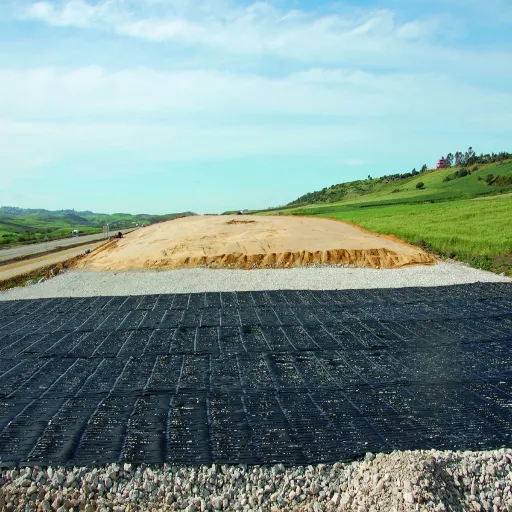
Woven vs. Nonwoven Geotextile for Retaining Walls
Why Nonwoven Is the Right Choice for Drainage Layers
Nonwoven geotextiles are made from randomly oriented fibers that create a porous, three-dimensional structure. This makes them ideal for filtration and drainage behind retaining walls. They allow water to pass while retaining soil particles, and their thickness provides cushioning and protection.
Key properties of nonwoven geotextiles for retaining walls:
- High permittivity for rapid water flow.
- Wide pore-size distribution for good soil retention.
- High porosity to resist clogging.
- Good conformability to irregular excavation surfaces.
When Woven Geotextile Has a Role
Woven geotextiles are stronger in tension and stiffer than nonwovens. They can be used in reinforced soil walls where the fabric itself carries tensile load. However, woven fabrics have low permittivity and poor filtration performance compared with nonwovens. They should not be used as the drainage filter behind a conventional retaining wall because they can seal and trap water.
For a full comparison of the two fabric types, see our article on geogrid vs geotextile reinforcement systems. For an independent perspective on woven vs nonwoven selection, see this retaining wall geotextile comparison.
Geotextile Selection by Wall Height and Load
Fabric Weight Selection Table
The weight of the nonwoven geotextile should match the wall height and the expected load. The table below provides a starting framework.
| Wall height | Fabric weight | Typical grab tensile | Typical puncture strength |
|---|---|---|---|
| Under 2 ft | 3.5–4.0 oz/yd² (120–140 g/m²) | 100–140 lbs | 200–300 lbs |
| 2–3 ft | 4.5–5.0 oz/yd² (150–170 g/m²) | 140–180 lbs | 300–400 lbs |
| 3–6 ft | 6.0–7.0 oz/yd² (200–240 g/m²) | 180–220 lbs | 400–500 lbs |
| 6–10 ft | 8.0 oz/yd² (270 g/m²) | 220–260 lbs | 500–650 lbs |
| Over 10 ft | 10.0 oz/yd² (340 g/m²) or higher | 260+ lbs | 650+ lbs |
Higher loads, poor drainage conditions, or silty backfill may require a heavier fabric than the height alone suggests.
AASHTO M288 Class Guidance
For retaining walls in highway or heavy civil applications, AASHTO M288 provides survivability classes based on installation stress and service conditions. Heavy civil designs should also reference FHWA geosynthetic design guidelines for drainage and filtration criteria.
| Property | Class 1 (min) | Class 2 (min) | Class 3 (min) |
|---|---|---|---|
| Grab tensile strength | 1,400 N | 1,100 N | 800 N |
| Tear strength | 500 N | 400 N | 300 N |
| CBR puncture | 3,500 N | 2,700 N | 1,900 N |
| UV resistance retained | 50% | 50% | 50% |
Class 1 is recommended for walls with heavy backfill, sharp aggregate, poor access, or severe exposure. Class 2 is acceptable for typical residential and light commercial walls. Class 3 is limited to protected, low-stress applications.
Step-by-Step Geotextile Installation Behind Retaining Walls
Site Preparation
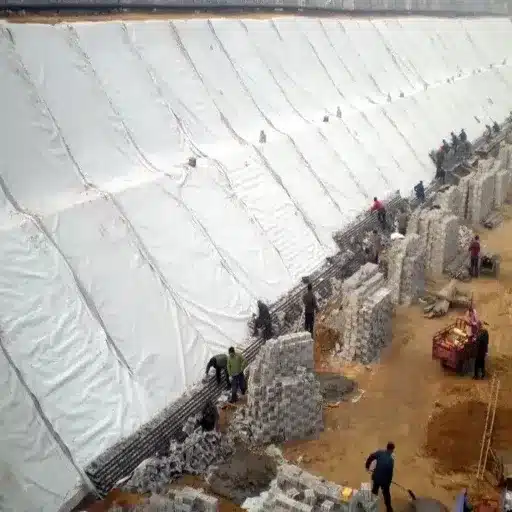
Excavate behind the wall to the width specified by the design engineer, typically 12–24 inches for drainage layers on small walls and more for taller structures. Compact the subgrade and remove loose soil, organic material, and sharp objects. Slope the excavation as needed to direct water toward the drainage outlet.
Fabric Placement
Unroll the nonwoven geotextile along the back of the wall with the fabric in direct contact with the soil. Place it so the roll extends from the base of the wall up to the top of the backfill zone. Leave enough fabric at the base to overlap with the next course and to wrap the drainage pipe if required by the design.
Overlap and Seaming
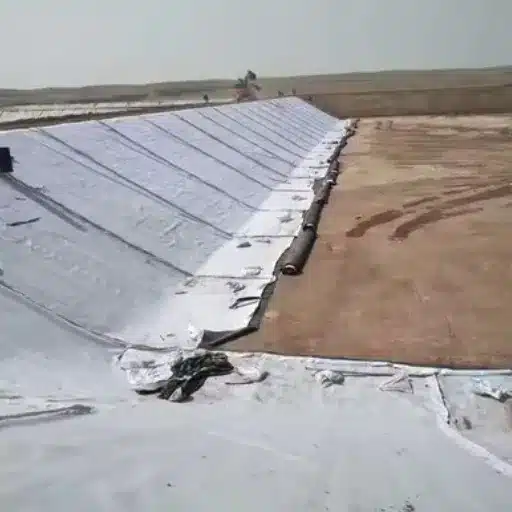
Overlap adjacent rolls by at least 18 inches. On slopes, place the upper roll over the lower roll in shingle fashion, so water cannot enter the seam. Secure the fabric with U-pins or staples spaced approximately every 3 feet. Seams parallel to water flow are more likely to allow soil migration, so orient overlaps perpendicular to flow where possible.
Drainage Stone and Pipe Integration
Place clean, angular crushed stone behind the fabric. The stone should meet ASTM D448 gradation requirements with less than 5% passing the No. 200 sieve. Install a perforated PVC or HDPE drainage pipe at the base, sloped 0.5–1% toward an outlet. The retaining wall drainage geotextile should extend below the pipe invert to prevent soil intrusion into the stone zone. In high-rainfall areas, add weep holes through the wall every 4 feet to supplement the pipe.
For universal installation guidance, see our geotextile installation guide.
Backfill and Compaction
Backfill in lifts of 8–12 inches and compact each lift before adding the next. Avoid dumping fill from heights greater than 5 feet, which can damage the fabric or displace the drainage stone. Use lightweight compaction equipment near the wall to avoid overstressing the facing.
Geotextile Reinforcement vs. Geogrid: When to Upgrade
Geotextile behind a retaining wall is primarily a drainage and separation layer. It does not provide structural reinforcement for tall or heavily loaded walls. Once wall height exceeds 4 feet, or when the wall supports slopes, roadways, or buildings, geogrid reinforcement is usually required.
| Factor | Geotextile only | Geogrid required |
|---|---|---|
| Wall height | Under 4 ft | Over 4 ft |
| Load | Light surcharge | Heavy surcharge or live loads |
| Soil | Stable, granular | Weak or cohesive soils |
| Seismic risk | Low | Moderate to high |
| Slope | Flat or gently sloping | Steep slopes above the wall |
For a deeper comparison, see our article on geogrid vs geotextile.
Mini-story: A contractor in Malaysia built a 5-foot segmental retaining wall for a commercial parking lot. To save cost, the crew used a lightweight woven geotextile behind the wall instead of nonwoven. Within three weeks, fines from the silty backfill clogged the woven fabric. Water could not drain, and after a heavy storm the wall bowed outward and cracked along two courses. The repair required removing the facing, replacing the woven fabric with 6 oz nonwoven geotextile, and rebuilding the drainage layer.
This example shows why geotextile behind retaining wall drainage layers must be specified for filtration and flow, not just tensile strength.
Common Geotextile Retaining Wall Failures and How to Avoid Them
Failure 1 — Woven Fabric Clogging
Woven geotextiles have a low open area and a uniform pore structure. When placed behind a retaining wall, they can seal quickly in fine-grained backfill. The result is saturated soil, increased hydrostatic pressure, and wall movement.
Prevention: Specify nonwoven geotextile with permittivity greater than 1.0 sec⁻¹ for drainage layers.
Failure 2 — Inadequate Overlap
Seams with insufficient overlap, or seams oriented parallel to water flow, allow soil to migrate into the drainage stone. The stone clogs, the pipe fills with sediment, and the drainage system fails.
Prevention: Use an 18-inch minimum overlap in shingle fashion. Orient seams perpendicular to the direction of water flow where possible.
Failure 3 — Missing or Clogged Drainage Pipe
A drainage layer without an outlet is not a drainage system. Water collects in the stone zone with nowhere to go. Over time, the stone itself becomes a reservoir that increases pressure on the wall.
Prevention: Install a perforated pipe at the base of the drainage layer, sloped to daylight or a storm drain. Inspect and flush the outlet during construction.
Retaining Wall Geotextile Procurement Checklist
Use this checklist when ordering geotextile for a retaining wall project:
- Define wall height, backfill soil type, and surcharge loads.
- Select a nonwoven geotextile weight class by wall height and load.
- Confirm the AASHTO M288 survivability class for the project type.
- Request MARV values for grab tensile, tear, CBR puncture, and permittivity.
- Verify ASTM test methods in certified reports.
- Plan overlap, pinning, and pipe integration details.
- Schedule backfill lifts and compaction sequence.
- Arrange for prompt covering to limit UV exposure.
For projects that also need reinforced embankments or road subgrades, our geotextile soil stabilization guide covers related design principles. For slope protection and erosion control, see our geotextile erosion control guide.
Frequently Asked Questions
What geotextile do you put behind a retaining wall?
Use a nonwoven needle-punched geotextile behind a retaining wall. It provides the filtration and drainage needed to prevent hydrostatic pressure buildup. Woven geotextiles are not suitable for drainage layers because they can clog and seal.
How much overlap should geotextile have behind a retaining wall?
A minimum overlap of 18 inches is standard. On slopes, place the upper roll over the lower roll in shingle fashion to prevent water from entering the seam.
Can I use woven geotextile behind a retaining wall?
Woven geotextile should not be used as the drainage filter behind a conventional retaining wall. It has low permittivity and can clog with fines. Woven fabrics are appropriate only in reinforced soil walls where they carry tensile load by design.
How do you stop hydrostatic pressure behind a retaining wall?
Install a nonwoven geotextile drainage layer, clean crushed drainage stone, and a perforated pipe sloped to an outlet. Proper drainage can reduce hydrostatic pressure by more than 85%.
What is the best fabric weight for a 6-foot retaining wall?
For a 6-foot retaining wall, a 6.0–7.0 oz/yd² nonwoven geotextile is typically appropriate. Increase the weight for silty backfill, heavy surcharge, or poor drainage conditions.
When should geogrid be used instead of geotextile?
Geogrid is required for structural walls over 4 feet tall, walls with heavy surcharge, steep slopes, weak soils, or seismic zones. Geotextile alone is suitable only for drainage, separation, and filtration.
Conclusion: Design the Drainage First
A geotextile retaining wall is only as good as the drainage system behind it. The fabric must separate soil from drainage stone, filter fines without clogging, and transmit water to the outlet pipe. Proper geotextile retaining wall installation prevents the drainage failures that cause most wall collapses. Nonwoven geotextile is the right material for this job. Woven geotextile and inadequate overlap are two of the most common causes of premature wall failure.
Start by sizing the fabric to the wall height and load. Add a properly graded drainage stone and a sloped perforated pipe. Upgrade to geogrid when the wall exceeds 4 feet or supports a significant surcharge. Follow AASHTO M288 survivability classes for heavy civil work, and always request MARV values instead of average test results.
If you need help specifying geotextile behind retaining walls, Shanxi Shengxing supplies nonwoven and woven geotextiles with certified MARV test reports, ISO 9001 quality management, and export packaging for global projects. Request a technical specification or quote today.