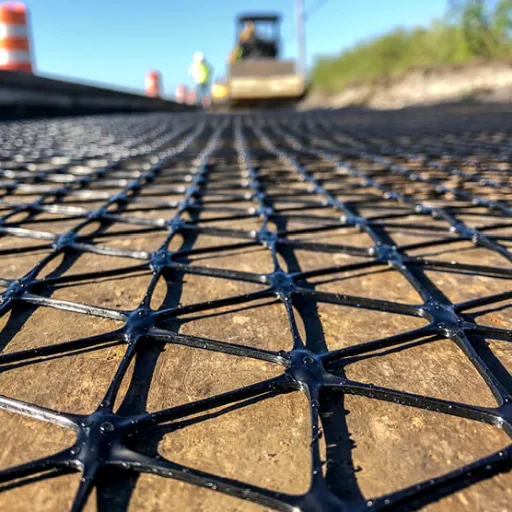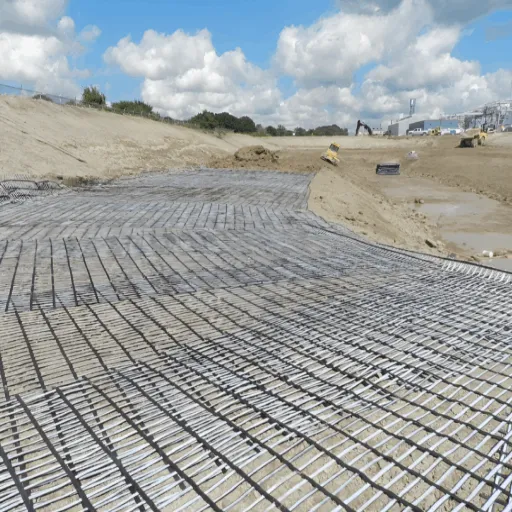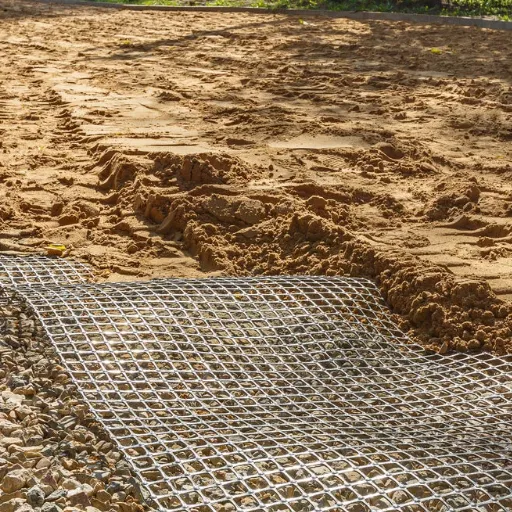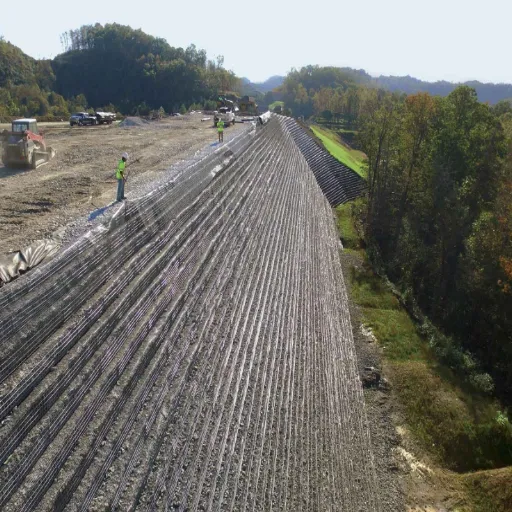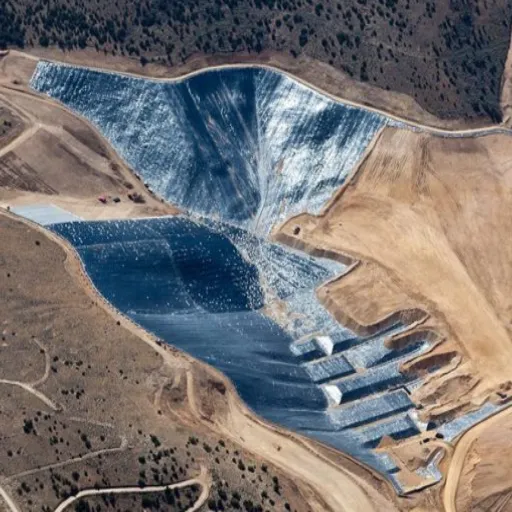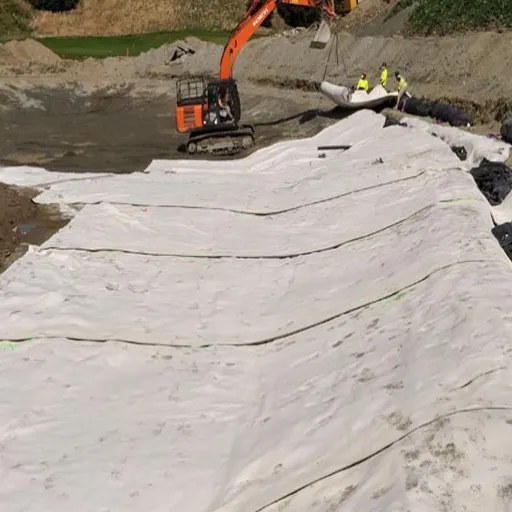
Temporary roadway design converts vehicle envelopes, ground conditions, and traffic patterns into a mat layout that is safe, drainable, and cost-effective. The key decisions are lane width, turning radius, gradient limits, drainage, joint pattern, and transition zones. Get any one of these wrong and the road narrows at curves, ponds water at low points, or fails where the modular surface meets native ground.
Many projects treat mat placement as an afterthought. They order panels by the square meter and start laying them where the first truck arrives. That approach works for light, short-term access, but it creates conflict points, alignment problems, and unnecessary panel wear on real haul roads. This guide shows how to design a temporary roadway before the first mat is placed.
For the full overview of temporary roadway systems, see our complete temporary roadway mats guide.
Key Takeaways
- Temporary roadway design must account for lane width, turning radius, gradient, drainage, joints, and transitions as one system.
- Single-lane haul roads need at least 3.0 m (10 ft); two-way roads need 6.0 m (20 ft) plus shoulders for heavy trucks.
- Large articulated trucks and crawler cranes need turning radii of 12–15 m (40–50 ft) on temporary access roads.
- Maximum recommended grade for loaded heavy trucks is 10%; minimum drainage grade is 0.5%.
- Staggered joints, edge restraint, and transition plates keep a modular road aligned under traffic.
Temporary roadway design turns individual panels into a continuous haul road by matching lane width, radius, grade, and drainage to the design vehicle.
What Is Temporary Roadway Design?
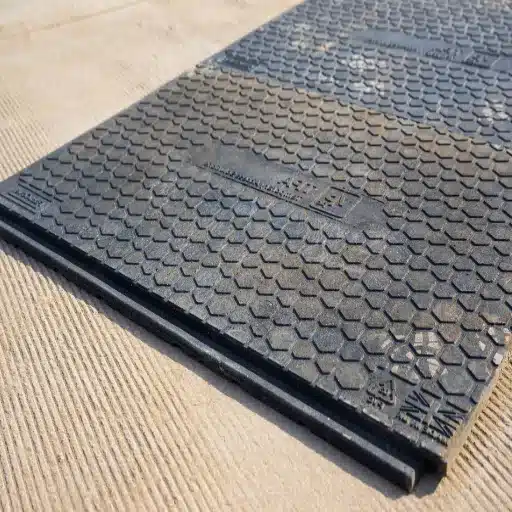
Temporary roadway design is the process of sizing and arranging a modular access road so that every expected vehicle can travel safely without damaging the surface or the subgrade. It is different from product selection. You can buy the right mats and still build a poor road if the layout does not match the traffic.
The design inputs are:
- Design vehicle: the widest, heaviest, or least maneuverable machine that will use the road
- Traffic volume: whether the road is one-way, two-way, or mixed with pedestrians and light vehicles
- Ground condition: firm subgrade, saturated clay, peat, sand, or mixed fill
- Weather and duration: wet season, freeze-thaw, or long-term repeated use
- Connection system: pins, tongue-and-groove, cam-lock, or overlap flanges
These inputs apply whether you are planning a construction access road design for a quarry or a wetland crossing for a pipeline. For equipment-specific load envelopes, see our guide to temporary roadway mats for heavy equipment.
Temporary Roadway Width
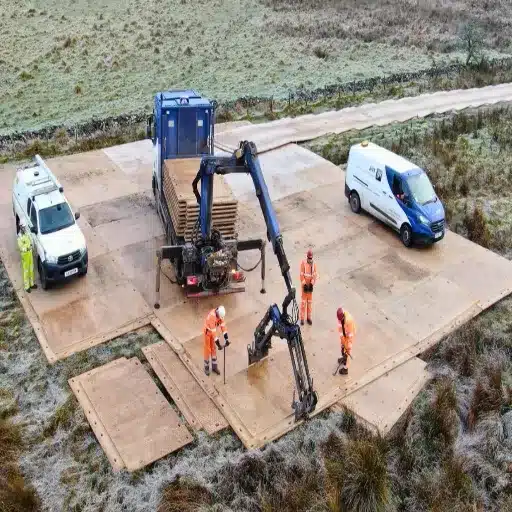
Choosing the right temporary roadway width is the first step in any temporary roadway design. Too narrow and trucks rub shoulders or run off the edges. Too wide, and the project pays for panels, subgrade preparation, and maintenance it does not need.
Single-Lane Roads
A single-lane temporary haul road for standard trucks needs a minimum of 3.0 m (10 ft) of clear running width. That width assumes slow speed, good visibility, and a designated passing or turnout location where two vehicles can meet. For heavy dump trucks or concrete mixers, add 0.5 m of shoulder on each side. This is the starting point for temporary haul road design when only one vehicle travels at a time.
Two-Way Roads
Two-way traffic needs 6.0 m (20 ft) of running width as a practical minimum. Some work-zone standards accept two 3.0 m lanes, but heavy trucks need more clearance. State DOT work-zone detours often specify 22 ft for two-lane operation to accommodate snowplows and wide construction vehicles. (NYSDOT Highway Design Manual)
Width by Design Vehicle
| Design Vehicle | Minimum Single-Lane Width | Minimum Two-Way Width |
|---|---|---|
| Light SUV / pickup | 2.5 m (8 ft) | 4.5 m (15 ft) |
| Single-unit dump truck | 3.0 m (10 ft) | 6.0 m (20 ft) |
| Articulated dump truck | 3.5 m (11.5 ft) | 7.0 m (23 ft) |
| Concrete mixer | 3.2 m (10.5 ft) | 6.5 m (21 ft) |
| Crawler crane (transport) | 3.5–4.0 m (12–13 ft) | 7.5 m (25 ft) |
The width must also match the mat thickness. A wider road with thin panels can deflect too much under point loads. For thickness guidance and HDPE ground protection mats that work in temporary roadways, see our temporary roadway mat thickness guide.
Temporary Roadway Turning Radius and Swept Path
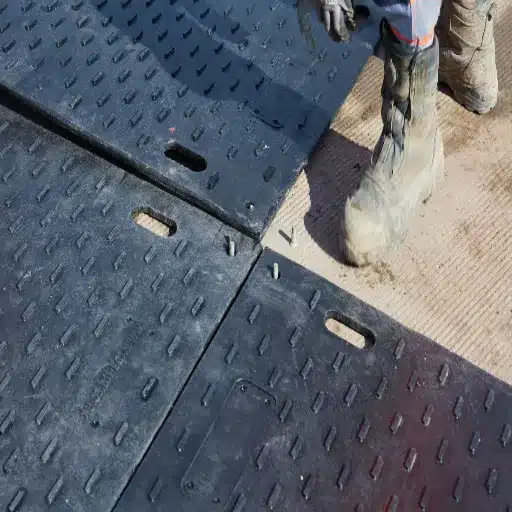
Temporary roadway turning radius is not the same as the width of a straight road. Every vehicle has a swept path that is wider than its body when it turns. A crawler crane trailer or rear-steer concrete mixer can swing outside a lane that looked adequate on paper.
Minimum Radius by Vehicle
Large articulated trucks and crawler cranes on temporary access roads need a minimum inner turning radius of 12–15 m (40–50 ft). Smaller single-unit trucks can manage 10–12 m. Light vehicles can turn in 7–8 m.
Curve Widening
Curves tighter than 30 m radius typically need extra width. A common rule is to add 0.5 m of lane width on the inside of curves for articulated vehicles. On very tight turns, designers use wider panels or cut panels to maintain the running bond without creating unsupported wedge shapes.
Hammerheads and Turnarounds
Dead-end temporary roads need a turnaround. A hammerhead T-shape with a 60 ft long top and 40 ft centerline radius lets most construction equipment reverse direction without multiple backing maneuvers.
Gradient Limits and Slope Design
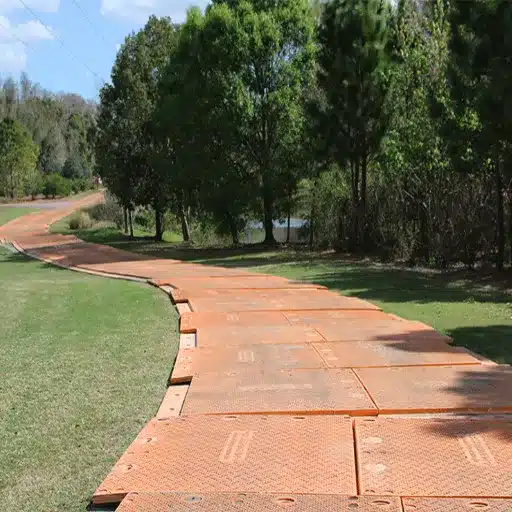
Grade controls traction, braking distance, and the lateral force that tries to push mats downhill.
Maximum Grades
For loaded heavy trucks on temporary mat roads, 10% is the practical maximum. General construction access roads can reach 15% in some jurisdictions, but that exceeds the reliable grip of many mat surfaces when wet. (FHWA MUTCD)
Mat Orientation
On slopes, orient mats perpendicular to the fall line so that gravity does not pull panels along their joints. Interlocked rows running across the slope resist downhill shear better than rows running down the slope.
Connection and Anchoring
Above 5%, pinned and tongue-and-groove systems should be supplemented with edge bars or corner anchors. Above 10%, cam-lock or bolted systems are recommended. For connection details, see our guide to temporary roadway mat connection systems.
Passing Bays and Traffic Control
Single-lane temporary roads need places for vehicles to pass. Without them, a loaded truck may have to reverse hundreds of meters when it meets an opposing vehicle.
When Passing Bays Are Needed
Add passing bays whenever single-lane traffic runs more than a few hundred meters and two-way movement is expected. On pipeline or transmission corridors, bays every 200–300 m are common.
Passing Bay Dimensions
A typical turnout is 3.0 m wide × 9.0 m long with 7.5 m tapers at each end. The bay should be on the outside of curves where possible so drivers can see oncoming traffic.
Drainage, Crown, and Crossfall
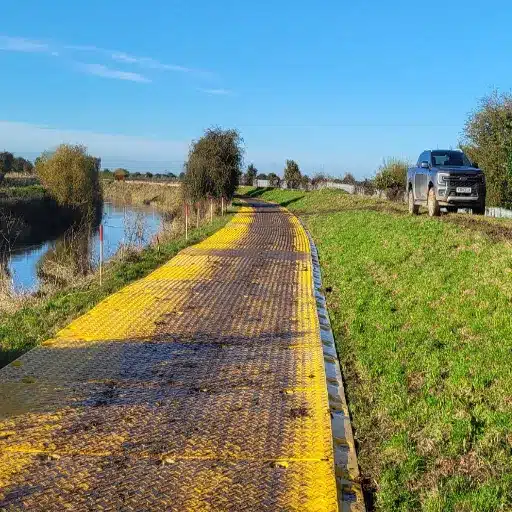
Water is one of the fastest ways to destroy a temporary road. It softens the subgrade, pumps fines through joints, and creates hydroplaning risk.
Minimum Grade for Drainage
A flat road will pond. The minimum desirable grade for drainage is 0.5%. On truly flat sites, build a crowned cross-section so water runs laterally to side ditches.
Crown Percentage
Unpaved temporary roads commonly use a 1.5–2.0% crown on the running surface. That slope is enough to move water off the centerline without making steering uncomfortable.
Ditches and Outlets
Side ditches should carry water away from the road footprint. On soft ground, line ditches with geotextile to prevent erosion. Outlet the water into existing drainage at natural low points, not directly onto unstabilized fill.
Temporary Road Layout and Joint Patterns
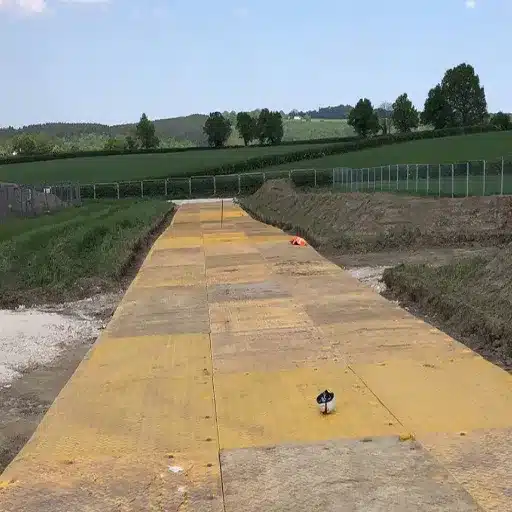
The way panels are arranged determines how loads move across seams. A continuous straight joint creates a weak line where rutting starts. A good temporary road layout balances panel orientation, joint stagger, and traffic direction.
Staggered Joints
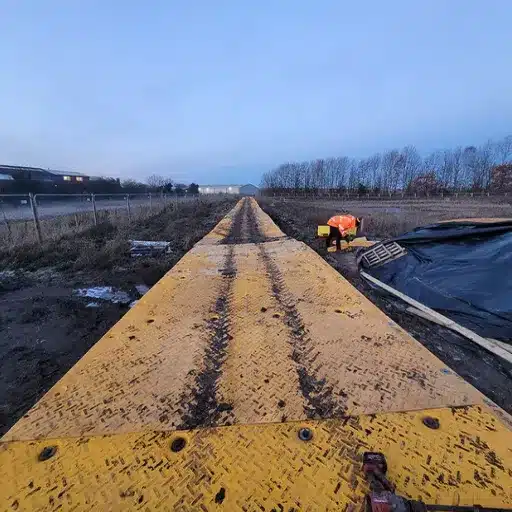
Lay panels in a running-bond pattern so transverse joints do not line up across the road. Offset end joints by at least half a panel width. Staggered joints distribute loads and stop a single failure from propagating across the whole width.
Panel Orientation
Run panels in the direction of traffic. On curves, rotate or cut panels to follow the centerline. Avoid narrow wedge-shaped offcuts that have a connection on only one side.
For the full install sequence, see our temporary roadway mat installation guide.
Transition Zones and Edge Restraint
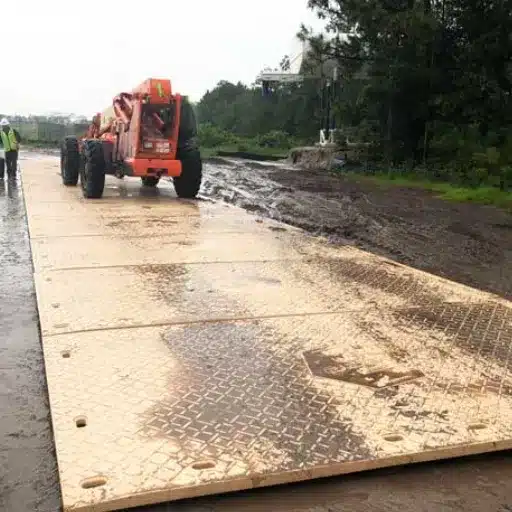
Where the mat road meets aggregate, pavement, or native ground, the stiffness change creates a failure point. The boundary also needs protection from uplift and edge damage.
Entry and Exit Ramps
Use timber or composite ramps at the start and end of the mat road. They reduce the step between surfaces and prevent vehicles from lifting the first panel as they enter.
Wash Boards
Place washboards where the mat road meets native ground. They distribute braking loads and prevent the end panels from being pushed off the road.
Edge Bars and Anchoring
Install edge bars or timber curbs along the perimeter. They prevent lateral migration under turning traffic and contain the outer panels. On slopes, anchor the upslope and downslope edges with driven pins or bolted plates.
Design Checklist and Common Mistakes
Use this checklist before placing the first panel:
- Confirm the design vehicle and its width, turning radius, and axle loads.
- Select single-lane or two-way width based on traffic volume.
- Add curve widening and check swept path on all turns.
- Limit grade to 10% for heavy haul traffic.
- Provide at least 0.5% longitudinal grade or a 1.5–2.0% crown.
- Design side ditches and outlets that move water away from the road.
- Use staggered joints across the full road width.
- Plan passing bays on single-lane routes.
- Detail entry/exit ramps and washboards at transitions.
- Add edge restraint and slope anchoring where needed.
Common Mistakes
- Ignoring dynamic loads: Braking and turning can add 20–40% to static wheel loads at joints.
- No crown or crossfall: Ponding softens the subgrade and shortens mat life.
- Continuous seams: Straight joints across the road create a rut line.
- No edge restraint: Outer panels migrate under turning traffic.
- Wrong connection system on slopes: Pinned mats on steep grades can slide downhill.
For the cost impact of width, thickness, and layout choices, see our temporary roadway mats cost guide.
Frequently Asked Questions
What is temporary roadway design?
Temporary roadway design is the process of sizing and arranging a modular access road so that design vehicles can travel safely without damaging the surface or subgrade. It covers lane width, turning radius, grade, drainage, joint patterns, and transitions.
How wide should a temporary haul road be?
A single-lane temporary haul road should be at least 3.0 m (10 ft) wide. Two-way traffic needs at least 6.0 m (20 ft), and heavy trucks often need 7.0 m (23 ft) or more.
What is the minimum turning radius for a temporary roadway?
Large articulated trucks and crawler cranes need a minimum inner turning radius of 12–15 m (40–50 ft) on temporary access roads. Smaller single-unit trucks can manage 10–12 m.
What is the maximum gradient for temporary roadway mats?
Loaded heavy trucks should stay at or below 10% grade on temporary mat roads. Some jurisdictions allow 15% for light or emergency traffic, but heavy haul operations need more conservative limits.
Do temporary roads need passing bays?
Single-lane temporary roads with two-way traffic need passing bays. A typical turnout is 3.0 m wide × 9.0 m long with 7.5 m tapers, spaced every 200–300 m.
How do you drain a temporary roadway?
Use a minimum 0.5% longitudinal grade or a 1.5–2.0% crown to move water off the surface. Add side ditches and outlets that carry water away from the road footprint.
How do you keep mats aligned on curves?
Use curve widening, rotate or cut panels to follow the centerline, and maintain staggered joints. Add edge bars on the outside of curves to resist lateral migration.
What is the best joint pattern for temporary roads?
A running-bond pattern with staggered transverse joints is best. Offset end joints by at least half a panel width so loads transfer across multiple panels instead of creating a continuous seam.
Conclusion
Temporary roadway design is what turns a stack of panels into a working haul road. The right temporary road layout brings together lane width, turning radius, grade, drainage, joint pattern, and transitions. A road that is wide enough but drains poorly will still fail. A road with good drainage but continuous seams will rut at the joints.
Start with the design vehicle. Fix the width and radius. Check the grade and drainage. Then lay out the panels with staggered joints, edge restraint, and proper transitions. The result is a temporary road that survives the project, not just the first week.
For project-specific recommendations, contact Shanxi Shengxing engineering support. We provide layout guidance, material selection, container-loading plans, and volume quotes for global delivery.
Request a technical quote or browse our HDPE temporary roadway mats catalog to get started.