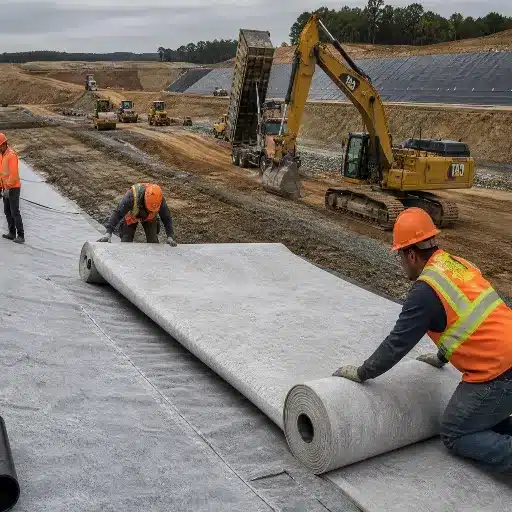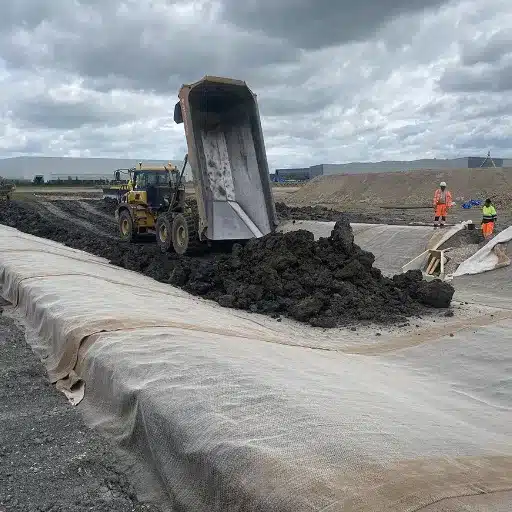
Geomembrane price typically ranges from $0.60 to $3.80 per m² for material-only HDPE or LLDPE sheets, while a fully installed system can run from $2.00 to $7.50 per m² depending on thickness, site conditions, and project size. The final number you receive in a quote depends on far more than the raw sheet price.
What if the quote you thought was competitive actually omitted welding, testing, and freight? It happens often. A procurement manager in Lagos once accepted a $1.90/m² material-only price for a 1.5 mm landfill liner, only to discover that delivery, seam testing, and CQA added another $4.20/m². The project budget did not fail because the liner was expensive; it failed because the quote was incomplete.
You are not just buying a sheet of polyethylene. You are buying a containment system that must perform for decades. This guide breaks down geomembrane price by material, thickness, application, and project cost drivers. You will learn how to compare material-only quotes with installed-system budgets, how quantity and certification affect cost, and how to ask suppliers for a number you can actually use.
For a complete overview of geomembrane materials and applications before budgeting, see our geomembrane products guide.
Key Takeaways
- Material-only HDPE/LLDPE geomembrane prices range from roughly $0.60–$3.80/m²; installed systems typically cost $2.00–$7.50/m².
- Thickness is the largest single price driver: each 0.5 mm step increases material cost by about 15–25%.
- Textured geomembrane costs 10–25% more than smooth; virgin resin costs 10–20% more than recycled but lasts longer.
- Bulk orders above 50,000 m² often reduce unit price by 15–30%; wider rolls reduce seam length and installation labor.
- Always specify whether a quote is ex-works, FOB, or CIF, and whether it includes installation, testing, and certification.
How Much Does Geomembrane Cost? Quick Answer
The fastest way to compare geomembrane price is to separate material cost from total project cost.
| Cost Type | Typical Range (USD/m²) | What It Includes |
|---|---|---|
| Material only | $0.60–$3.80 | HDPE/LLDPE/PVC sheet, ex-works or FOB |
| Delivered (CIF port) | $1.00–$4.50 | Material + ocean freight + insurance |
| Installed simple project | $2.00–$4.50 | Material + deployment + welding + basic QA |
| Installed complex project | $4.00–$7.50+ | Material + subgrade prep + welding + CQA + accessories |
For U.S. buyers, the equivalent per-square-foot ranges are roughly:
| Cost Type | Typical Range (USD/sq ft) |
|---|---|
| Material only | $0.06–$0.35 |
| Installed simple project | $0.20–$0.45 |
| Installed complex project | $0.40–$0.70+ |
These figures are indicative. Actual geomembrane price depends on resin grade, order volume, surface finish, freight distance, and whether the supplier is a manufacturer or trader.
Geomembrane Price by Material Type
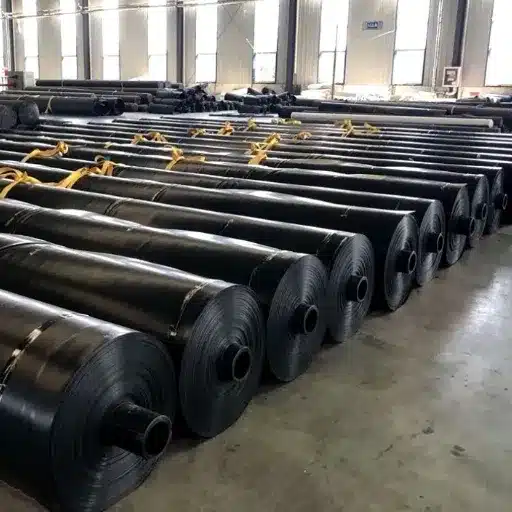
Different polymers serve different containment needs, and their prices reflect resin cost, manufacturing complexity, and performance characteristics. For a deeper look at how HDPE, LLDPE, and PVC compare, see our HDPE vs LLDPE geomembrane guide and PVC vs HDPE geomembrane comparison.
HDPE Geomembrane Price
HDPE geomembrane price depends on resin grade, thickness, surface finish, and order volume. HDPE is the most widely specified geomembrane for landfills, mining, and industrial containment. It offers high tensile strength, excellent chemical resistance, and long service life.
- Typical material-only range: $0.60–$3.50/m²
- Most common commercial range: $1.10–$2.80/m² for 1.0–1.5 mm
- Premium textured or conductive grades: $2.50–$7.50/m²
HDPE dominates the market because it balances performance and cost. Virgin resin HDPE certified to GRI-GM13 sits at the upper end of each range but is usually required for regulated landfill and mining projects. View our HDPE geomembrane specifications to compare certified thicknesses and roll dimensions.
LLDPE Geomembrane Price
LLDPE geomembrane price is often slightly higher than HDPE at the same thickness, but its flexibility can lower installation cost on irregular terrain. LLDPE is more flexible than HDPE and conforms better to uneven subgrades. It is commonly used for ponds, reservoirs, and caps where flexibility reduces field seams.
- Typical material-only range: $0.60–$2.50/m²
- Common range for 0.5–1.0 mm: $0.80–$1.80/m²
- Premium grades or wide rolls: up to $3.00/m²
See our LLDPE geomembrane range for available thicknesses, roll widths, and resin grades.
PVC Geomembrane Price
PVC geomembranes are lightweight, flexible, and easy to install. They are common in decorative ponds, canals, and some industrial applications where chemical exposure is moderate.
- Typical material-only range: $0.60–$2.00/m²
- Reinforced or fabric-backed PVC: $1.50–$3.50/m²
PVC is not typically used for municipal landfills or aggressive chemical containment, but it can be cost-effective for water features and short-term applications.
EPDM Geomembrane Price
EPDM is a rubber-based liner often used for decorative ponds and landscaping. It is generally more expensive than polyethylene options.
- Typical material-only range: $0.75–$2.50/m²
- Custom thicknesses or prefabricated panels: up to $4.00/m²
EPDM is valued for flexibility and ease of site fabrication, but it lacks the chemical resistance and regulatory acceptance of HDPE for industrial projects.
Geomembrane Price by Thickness
Thickness is the single largest driver of geomembrane price. More thickness means more resin, higher mechanical properties, and usually longer service life. For a complete thickness selection framework, see our geomembrane thickness guide.
HDPE Geomembrane Price by Thickness
| Thickness | USD/m² (material only) | USD/sq ft (material only) | Common Applications |
|---|---|---|---|
| 0.5 mm (20 mil) | $0.60–$1.20 | $0.06–$0.11 | Fish ponds, aquaculture |
| 0.75 mm (30 mil) | $0.90–$1.60 | $0.08–$0.15 | Irrigation reservoirs |
| 1.0 mm (40 mil) | $1.10–$2.00 | $0.10–$0.19 | Water storage ponds |
| 1.5 mm (60 mil) | $1.50–$2.80 | $0.14–$0.26 | Landfill liners, containment |
| 2.0 mm (80 mil) | $2.30–$3.80 | $0.21–$0.35 | Mining tailings, hazardous waste |
| 2.5–3.0 mm (100–120 mil) | $3.50–$5.50+ | $0.33–$0.51+ | Heavy mining, aggressive chemicals |
Each 0.5 mm increase typically raises material cost by 15–25%. A 2.0 mm HDPE liner uses roughly twice the resin of a 1.0 mm liner, so the cost scaling is roughly proportional.
When Thicker Pays Off
A thicker liner is not always the right economic choice. In 2022, a contractor in Kenya specified 1.0 mm HDPE for an irrigation reservoir because the subgrade was smooth and well-compacted. The thinner liner saved roughly $0.80/m², and a 300 g/m² geotextile cushion provided puncture protection for less than the upgrade to 1.5 mm would have cost.
In contrast, a mining engineer in Peru selected 2.0 mm HDPE over 1.5 mm for a heap leach pad in 2023. The subgrade was coarse, the ore load was high, and puncture analysis showed 1.5 mm did not meet the required factor of safety. The thicker liner added material cost but eliminated the risk of solution loss and repair.
Geomembrane Price by Application
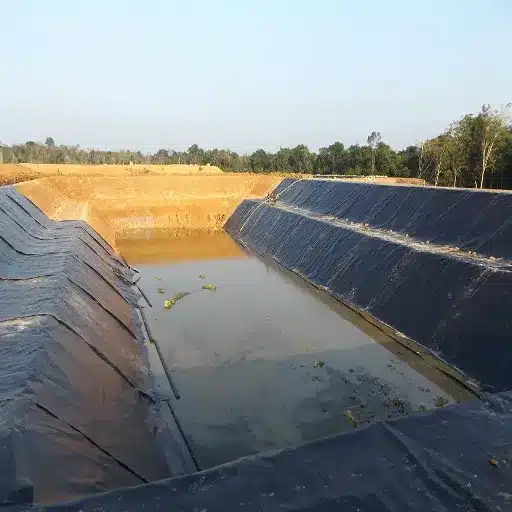
Application determines thickness, surface finish, certification requirements, and installation complexity. All of these affect the final geomembrane price.
Ponds and Aquaculture
Pond liners are usually the lowest-cost geomembrane application. Smooth HDPE or LLDPE in 0.5–1.0 mm is standard.
- Typical material-only range: $0.60–$1.80/m²
- Installed range: $1.50–$3.50/m²
- Most common specification: 0.5–0.75 mm HDPE or 0.75 mm LLDPE
Small decorative ponds may use PVC or EPDM, while commercial aquaculture and irrigation reservoirs usually prefer HDPE or LLDPE for durability.
Reservoirs and Water Storage
Larger reservoirs use thicker liners and often require more rigorous subgrade preparation.
- Typical material-only range: $1.00–$2.20/m²
- Installed range: $2.50–$4.50/m²
- Most common specification: 0.75–1.5 mm HDPE or LLDPE
Water storage projects often justify 1.0–1.5 mm because the design life is longer and the consequences of leakage are higher than in small ponds.
Landfill Liners and Caps
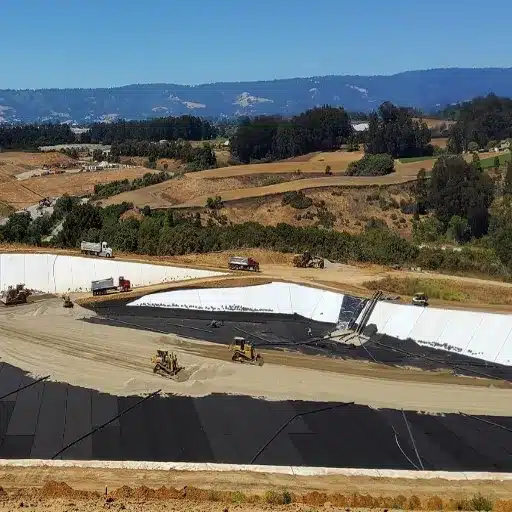
Landfill containment is the most price-regulated geomembrane application. Municipal solid waste base liners typically require 1.5 mm HDPE minimum, and side slopes often use textured HDPE for friction.
- Typical material-only range: $1.50–$3.20/m²
- Installed range: $4.00–$7.50+/m²
- Most common specification: 1.5–2.0 mm HDPE, smooth base, textured slopes
The installed cost is high because landfill projects require extensive subgrade preparation, leak detection, CQA testing, and regulatory documentation.
Mining and Industrial Containment
Mining heap leach pads and tailings storage facilities impose the highest mechanical and chemical stresses. Thicker HDPE is standard, and textured surfaces are common on slopes.
- Typical material-only range: $2.30–$5.50+/m²
- Installed range: $5.00–$10.00+/m²
- Most common specification: 1.5–3.0 mm textured HDPE
The total project cost includes not just the liner but also geotextile protection layers, drainage geocomposites, anchoring systems, and long-term CQA.
Wastewater Lagoons
Wastewater treatment ponds and industrial effluent containment balance chemical resistance with moderate cost.
- Typical material-only range: $1.10–$2.50/m²
- Installed range: $2.50–$4.50/m²
- Most common specification: 1.0–1.5 mm HDPE
Chemical compatibility with the effluent is critical; specifying the wrong resin grade can lead to premature failure even if the price looks attractive.
Cost Factors That Affect Geomembrane Price
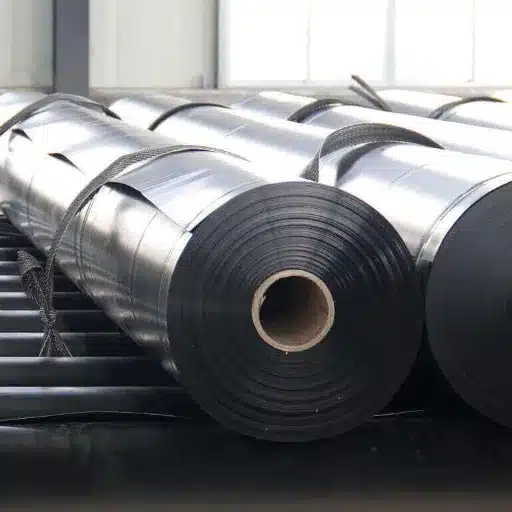
Understanding the drivers behind geomembrane price helps you compare quotes fairly and avoid surprises.
Raw Material and Resin Quality
Virgin HDPE or LLDPE resin costs more than recycled or blended material but delivers better UV resistance, chemical stability, and service life.
- Virgin resin premium: 10–20% above recycled
- Service life advantage: 20–30% longer in exposed or aggressive conditions
- Regulatory requirement: Most landfill and mining specifications require virgin resin
A lower unit price from blended resin is not a saving if the project requires recertification or early replacement.
Surface Type: Smooth vs. Textured
Textured geomembranes improve slope stability by increasing interface friction. The manufacturing process adds cost.
- Textured material premium: 10–25% above smooth
- Textured installation premium: 10–20% above smooth
- Common use: Landfill side slopes, heap leach pads, steep canals
Specifying texture where it is not needed adds cost without benefit. Smooth HDPE is sufficient for flat base liners and most ponds.
Order Quantity and Roll Width
Larger orders reduce unit cost through economies of scale and better production efficiency.
| Order Volume | Typical Unit Price Impact |
|---|---|
| 1,000–3,000 m² | Standard list price or small-order premium |
| 3,000–10,000 m² | Modest discount, 5–10% below list |
| 10,000–50,000 m² | Volume pricing, 10–20% below list |
| 50,000–100,000 m² | Bulk pricing, 15–25% below list |
| 100,000 m²+ | Project pricing, 20–30%+ below list |
Wider rolls also reduce installed cost. A 7.5 m wide roll creates fewer field seams than a 5 m wide roll, which lowers welding labor and testing.
Installation, Welding, and Testing
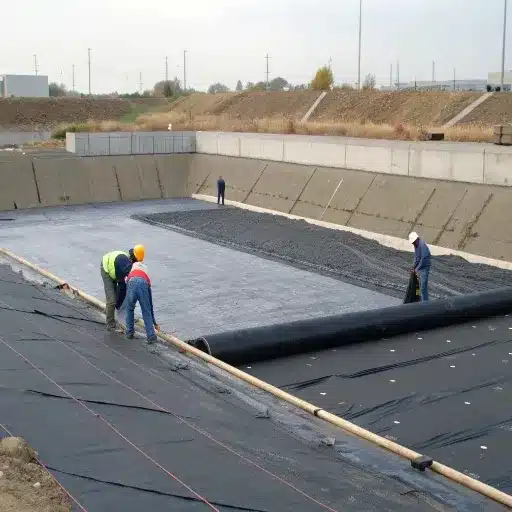
Geomembrane installation cost is often the second-largest component after the material itself. Installation includes subgrade acceptance, liner deployment, seam welding, and quality testing.
- Installation labor: $0.50–$1.50/m²
- Welding and seam preparation: $0.30–$1.00/m²
- Destructive and non-destructive testing: $0.20–$0.80/m²
- CQA and documentation: $0.20–$0.60/m²
Complex sites with steep slopes, many penetrations, or poor access can push installation cost above material cost.
Subgrade Preparation and Protection Layers
A well-prepared subgrade can allow a thinner, less expensive liner. A rough subgrade may require either a thicker liner or a geotextile cushion.
- Subgrade preparation: $0.20–$1.00/m² depending on soil conditions
- Geotextile protection layer: $0.30–$1.00/m²
- Upgrading liner thickness: often costs more than adding protection
In many projects, a 200–300 g/m² nonwoven geotextile cushion is the most cost-effective way to protect the liner.
Certifications and Standards
Compliance with recognized standards affects price but also protects project owners from material failure.
- GRI-GM13 certification: often standard for HDPE; may add 5–10% if third-party verified
- ASTM test reports: usually included by reputable manufacturers
- ISO9001 quality system: baseline expectation for export suppliers
- CE or project-specific testing: can add cost for European or regulated projects
Buyers should request mill test reports and verify that thickness, tensile, tear, and puncture values meet the specified standard.
Freight, Duties, and Incoterms
For international buyers, logistics can represent 10–30% of the total delivered cost.
- FOB (Free On Board): buyer pays ocean freight and insurance
- CIF (Cost, Insurance, Freight): supplier includes freight to destination port
- DDP (Delivered Duty Paid): supplier handles freight, duties, and delivery; highest upfront price but simplest for buyer
Always confirm which Incoterm a quote uses. A $1.80/m² FOB quote is not directly comparable to a $2.40/m² CIF quote without calculating the freight difference.
Quantity Breakpoints and Bulk Pricing
Understanding how geomembrane price changes with volume helps procurement teams plan orders and negotiate.
| Project Area | Approximate Rolls Needed (7 m × 100 m) | Price Tier |
|---|---|---|
| 1,000 m² | 2 rolls | Small order |
| 5,000 m² | 8 rolls | Medium order |
| 10,000 m² | 15 rolls | Volume order |
| 50,000 m² | 72 rolls | Bulk order |
| 100,000 m²+ | 143+ rolls | Project pricing |
At the small-order end, minimum order quantities and production setup costs keep per-m² prices high. At the bulk end, manufacturers can optimize production runs and offer significant discounts.
Practical tip: If your project requires 45,000 m², ask whether ordering 50,000 m² triggers the next price breakpoint. The extra material can be held as contingency or used for future phases.
Installed Cost vs. Material-Only Cost
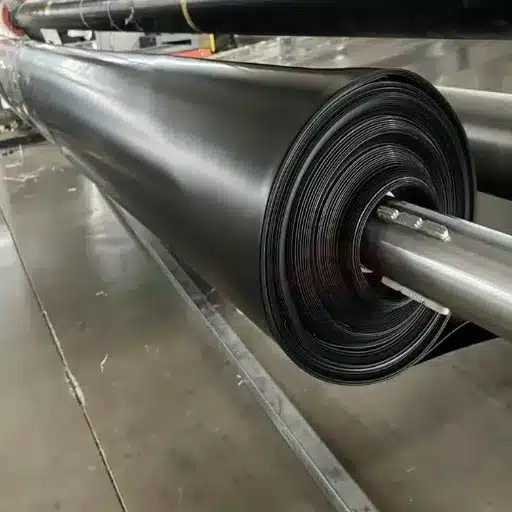
The biggest mistake in geomembrane price comparison is treating material cost as total project cost.
What Material-Only Cost Includes
- Geomembrane sheet
- Standard packaging
- Mill test report
- Ex-works or FOB loading
What Installed Cost Includes
- Material delivered to site
- Subgrade preparation and acceptance
- Liner deployment and positioning
- Wedge welding and extrusion welding
- Non-destructive seam testing
- Destructive seam testing and repair
- CQA documentation
- Anchor trenches and batten strips
- Geotextile or other protection layers
Example: 1.5 mm HDPE Landfill Liner
| Cost Component | USD/m² |
|---|---|
| 1.5 mm HDPE material (FOB) | $1.80 |
| Freight and insurance (CIF) | $0.40 |
| Subgrade preparation | $0.60 |
| Deployment and welding | $1.20 |
| Testing and CQA | $0.80 |
| Geotextile protection layer | $0.50 |
| Total installed cost | $5.30/m² |
This example shows why a material-only quote of $1.80/m² and an installed cost of $5.30/m² are both correct—but for completely different budgeting purposes.
How to Get an Accurate Geomembrane Quote
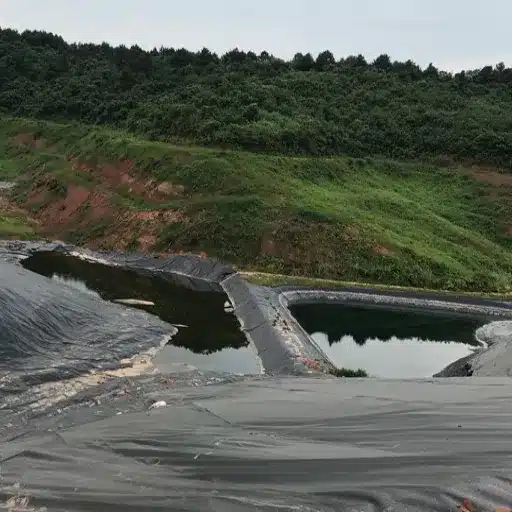
To receive a quote you can trust, provide the supplier with complete project information.
Information to Provide
- Project location — affects freight, duties, and local labor rates
- Application — pond, landfill, mining, wastewater, etc.
- Required thickness — in mm or mils
- Total area — in m² or square feet
- Surface finish — smooth or textured
- Order quantity — including contingency
- Required certifications — GRI-GM13, ASTM, ISO9001, CE
- Incoterm preference — FOB, CIF, DDP
- Installation scope — supply only, supply and install, or full turnkey
- Site conditions — slope steepness, subgrade type, access
Questions to Ask the Supplier
- Is the price ex-works, FOB, or CIF?
- Does the price include mill test reports and certification?
- What is the roll width and length?
- What is the lead time?
- Is the resin virgin or blended?
- What is the minimum order quantity?
- Are installation supervision and CQA available?
A reputable supplier will answer these questions clearly. Vague answers or prices that seem far below market range are red flags.
Real-World Cost Examples
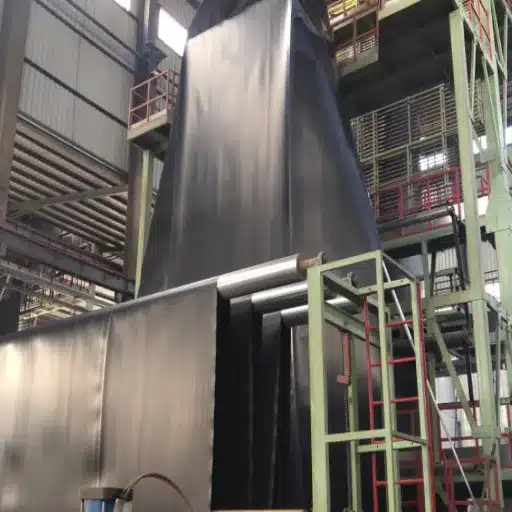
Example 1: 1-Acre Aquaculture Pond in West Africa
A fish farm needed to line a 4,000 m² pond. The subgrade was sandy and relatively smooth.
- Specification: 0.75 mm smooth HDPE
- Material-only price: $1.00/m²
- Geotextile cushion: $0.45/m²
- Local installation: $0.80/m²
- Total project cost: $2.25/m²
The farm chose HDPE over LLDPE because the local installer was more experienced with HDPE welding. The slightly higher material cost was offset by lower installation risk.
Example 2: Municipal Landfill in Southeast Asia
An environmental contractor specified a composite liner system for a 20,000 m² landfill cell.
- Specification: 1.5 mm smooth HDPE base + 2.0 mm textured HDPE slopes
- Material-only blended average: $2.20/m²
- Geotextile protection: $0.60/m²
- Installation, testing, CQA: $3.00/m²
- Total installed cost: $5.80/m²
The project used textured HDPE only on the slopes where friction was critical. Using smooth HDPE on the flat base saved material cost without compromising stability.
Example 3: Mining Heap Leach Pad in South America
A mining company ordered 60,000 m² of textured HDPE for a heap leach expansion.
- Specification: 2.0 mm textured HDPE
- Material-only price at volume: $2.60/m²
- Freight and duties: $0.50/m²
- Installation and CQA: $2.80/m²
- Total project cost: $5.90/m²
The large order qualified for project pricing. The mine also ordered 7.5 m wide rolls to minimize field seams, which reduced welding labor by an estimated 15%.
Common Geomembrane Pricing Mistakes
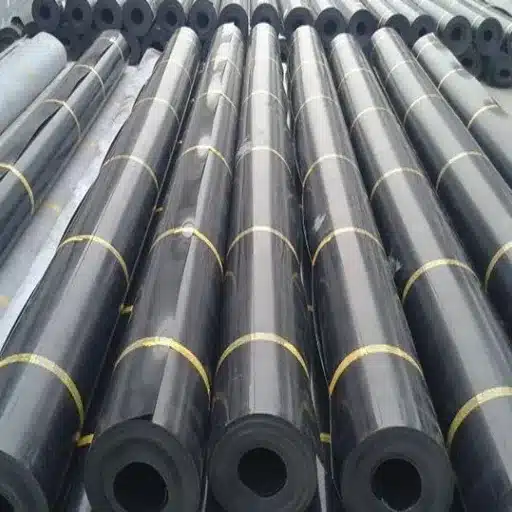
Even experienced buyers can misread a quote. Here are the most common errors.
Comparing Material-Only and Installed Quotes
A $1.50/m² material-only quote is not cheaper than a $4.50/m² installed quote if the first one requires you to add $4.00/m² of installation separately. Always compare the same scope.
Ignoring Incoterms
FOB, CIF, and DDP prices include different costs. A low FOB price can become expensive after freight, insurance, and import duties are added.
Choosing Price Over Certification
A non-certified liner may meet the thickness on paper but fail tensile, tear, or puncture tests. For regulated projects, certification is not optional.
Under-Specifying Thickness to Save Budget
A thinner liner may reduce upfront cost but increase puncture risk. In high-load applications, the cost of a single leak and repair usually exceeds the savings.
Over-Specifying for Low-Risk Projects
A 2.0 mm HDPE liner in a small, well-protected pond adds cost and welding difficulty without proportional benefit. Match thickness to risk.
Frequently Asked Questions
How much does geomembrane cost per m²?
Material-only HDPE or LLDPE geomembrane typically costs $0.60–$3.80/m². Installed systems range from $2.00–$7.50/m² depending on thickness, site conditions, and project size.
How much does geomembrane cost per square foot?
Geomembrane price per square foot typically ranges from roughly $0.06–$0.35/sq ft for material-only HDPE or LLDPE. Installed systems usually cost $0.20–$0.70+/sq ft.
What is the 1.5 mm HDPE geomembrane price?
1.5 mm HDPE geomembrane price typically ranges from $1.50–$2.80/m² material-only. Installed costs for landfill or containment projects usually range from $4.00–$7.50/m².
How much does HDPE liner price vary by thickness?
HDPE liner price scales almost proportionally with thickness. A 1.0 mm HDPE liner may cost 1.10–1.10–2.00/m², while a 2.0 mm HDPE liner reaches $2.30–$3.80/m². Each 0.5 mm step adds roughly 15–25% to material cost.
Is textured geomembrane more expensive than smooth?
Yes. Textured geomembrane typically costs 10–25% more for the material and 10–20% more to install than smooth geomembrane.
What is the cheapest geomembrane material?
For most applications, 0.5 mm HDPE or LLDPE is the cheapest option, with material-only prices starting around $0.60/m². However, the cheapest material is not always the right choice for the project.
How much does geomembrane installation cost?
Installation typically adds $0.50–$3.00/m² to material cost, or roughly 20–50% of the total project cost. Complex sites with steep slopes or poor access cost more.
Does buying in bulk reduce geomembrane price?
Yes. Orders above 50,000 m² often receive 15–30% discounts compared to small orders. Wider rolls can further reduce installation cost.
Conclusion
Geomembrane price is not a single number. It is a range shaped by material type, thickness, surface finish, order volume, certification, freight, and installation scope. Material-only HDPE or LLDPE prices typically run from $0.60–$3.80/m², while installed systems for demanding applications can reach $2.00–$7.50/m² or more.
The best procurement decision starts with a clear project specification. Define the application, thickness, surface finish, standards, and Incoterm before requesting quotes. Then compare like with like: material-only against material-only, installed against installed.
Shanxi Shengxing supplies HDPE, LLDPE, and PVC geomembranes in thicknesses from 0.5 mm to 3.0 mm, with options for smooth, textured, and factory-fabricated panels. We support global buyers with technical consultation, certified quality control, export logistics, and flexible order quantities.
Ready to budget your geomembrane project? Contact our engineering team or explore our geomembrane products guide to compare materials and applications. This geomembrane price guide covers HDPE geomembrane price, LLDPE geomembrane price, geomembrane cost per m², and geomembrane installation cost to help you plan your next containment project.