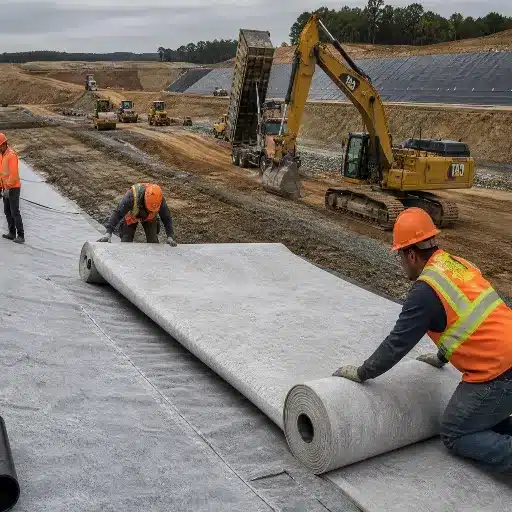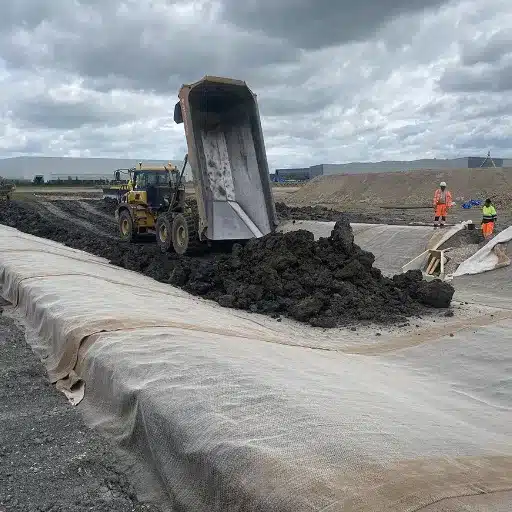
The best geotextile for French drain is a needle-punched nonwoven polypropylene geotextile in the 4-6 oz per square yard (135-200 gsm) range. It needs an apparent opening size (AOS) matched to your soil and a permittivity of at least 0.5 per second per ASTM D4491. That combination filters soil fines out of the water flow while still passing water quickly, and it’s the single most reliable choice for keeping a drainage trench working for decades.
If you’re shopping for drainage fabric right now, this guide is your shortcut. Most French drain failures don’t come from the pipe or the stone. They come from the fabric: the wrong type, no fabric at all, or a woven weed barrier that clogs within a season or two.
By the end of this article you’ll know exactly what to buy, what weight and specifications to look for, how to match the fabric to your soil, and how to install it so it stays clog-free. You’ll also know how to verify a supplier’s datasheet so you’re not paying for marketing numbers.
Key Takeaways
- Use a needle-punched nonwoven polypropylene geotextile, not woven fabric or landscape weed barrier, for a French drain.
- Choose 4-6 oz/yd² (135-200 gsm) for a typical residential drain; move to 6-8 oz for deep trenches, coarse stone, or heavy traffic.
- Match the apparent opening size (AOS) to your soil: roughly 0.15-0.21 mm (#70-#100 sieve) for silty sand, 0.43 mm (#40) for clean gravel.
- Require permittivity ≥ 0.5 s⁻¹ (ASTM D4491) and grab tensile ≥ 400 N (ASTM D4632) on the datasheet.
- Install with the burrito wrap method, overlapping the fabric a minimum of 12 inches at seams.
Why Nonwoven Geotextile Is the Best Choice for French Drains
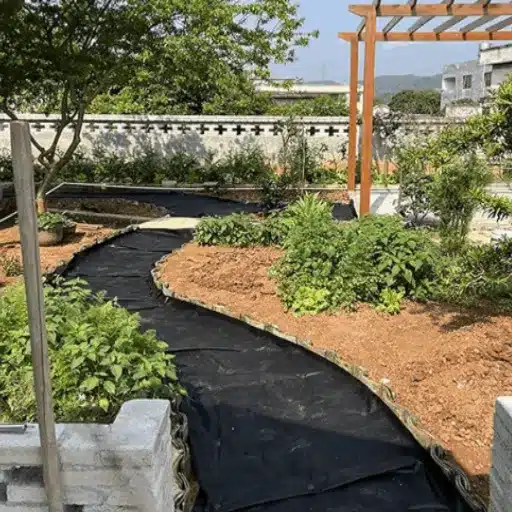
Nonwoven geotextile dominates French drain applications for one reason: it does two jobs at once. It lets water flow through freely, and it blocks the fine soil particles that would otherwise clog the stone and the pipe perforations. Woven fabrics and standard landscape weed barriers cannot do both reliably.
Permittivity: Nonwoven vs Woven
Permittivity is the technical term for how fast water passes through the fabric, measured in per second (s⁻¹) under ASTM D4491. This is where nonwoven geotextile separates itself from the field.
- Nonwoven geotextiles typically deliver a permittivity of 0.5 to 5.0 s⁻¹.
- Woven slit-film geotextiles typically deliver 0.05 to 0.2 s⁻¹.
That’s a 5 to 10 times difference in water flow. A 200 gsm nonwoven can transmit 50-300+ gallons per minute per square foot. A comparable woven fabric passes less than a tenth of that.
In a French drain, the whole point is to move water fast, so this gap matters enormously. For a deeper look at how the two fabric families compare across the board, see our woven vs nonwoven geotextile comparison.
How the Filter Works
Nonwoven fabric is made from randomly oriented fibers that are needle-punched into a felt-like mat. That tangled three-dimensional structure creates a tortuous path. Water pushes through the voids, while soil fines get trapped at the surface and build a thin, stable layer called a filter cake.
The filter cake is actually part of the system: it catches even finer particles over time while staying permeable.
A woven weed barrier, by contrast, has a tight, regular weave. Fine soil packs against it, blinds the surface, and the drain stops working. This is why landscape fabric from the hardware store is such a common cause of French drain failure.
When Woven Geotextile Can Work
Woven fabric isn’t automatically wrong. Monofilament woven geotextiles have a high percent open area and can filter in engineered applications. And woven geotextiles are the right call for road construction, where the priority is load-bearing reinforcement over soft subgrade rather than water flow.
If you’re working on that kind of project, our woven vs nonwoven geotextile for road construction guide explains the difference in detail. For a conventional drainage trench, however, nonwoven is the simpler, safer standard.
Price is often what pushes people toward woven in the first place. Woven slit-film fabric is cheaper per square yard, which looks good on the invoice. But the low flow rate is a false economy when the drain stops working. Our woven vs nonwoven geotextile cost comparison looks at whether that upfront saving is worth it, and for drainage it rarely is.
What Weight Geotextile Should You Use? (4 oz vs 6 oz vs 8 oz)
Weight is the most common question buyers ask, and it’s the right question. Fabric weight, measured in ounces per square yard (oz) or grams per square meter (gsm), tracks with strength, puncture resistance, and flow. Heavier isn’t automatically better: thicker fabric moves less water. The goal is to pick the lightest fabric that survives your installation.
Weight Comparison Table
| Weight | Approx. gsm | Water Flow | Grab Tensile (ASTM D4632) | Best Use |
|---|---|---|---|---|
| 4 oz | 135 gsm | ~140 gpm/ft² | ~100 lb (445 N) | Residential drains where max flow matters; light-duty |
| 6 oz | 200 gsm | ~110 gpm/ft² | ~160 lb (712 N) | The workhorse: deep trenches, coarse stone, heavy soil |
| 8 oz | 270 gsm | Lower flow | Highest strength | Aggressive installation, under driveways, commercial |
When 4 oz Is Right
Choose 4 oz nonwoven when water flow is the priority and the trench is protected from abuse. This is the standard specification for most residential French drains, and many suppliers recommend a 3-4.5 oz range for exactly this reason. It’s lighter, easier to fold and conform around pipe and stone, and it passes water at the highest rate. If an engineer hasn’t specified a weight, 4 oz is a sensible default.
When 6 oz Is Right
Choose 6 oz when durability matters more than the last bit of flow. It has roughly 60% more grab tensile strength than 4 oz, along with meaningfully better tear and CBR puncture resistance. That makes it the better pick for deeper trenches, angular or coarse stone that can snag the fabric during backfill, and fine clay soils that put more stress on the wrap. For most property drains, 6 oz is the balance point most installers prefer.
When 8 oz (or Class 1) Makes Sense
Go heavier when the drain runs under a driveway, a paved area, or anywhere heavy equipment will cross. The same logic applies to commercial installations and rocky, aggressive soil. In engineering terms, these are AASHTO M288 Class 1 conditions, which typically require fabric in the 400-800 gsm range. If you need to understand weight grades and survivability classes more deeply, our geotextile GSM weight guide walks through the full AASHTO mapping.
Need help matching the right grade to your project? Send us your soil type and trench depth and our engineers will recommend the exact fabric weight. Request a product datasheet with full AOS, permittivity, and tensile values.
How to Match AOS to Your Soil
Apparent opening size (AOS) is the fabric property that determines which soil particles it blocks. It is measured under ASTM D4751 as the sieve size at which 95% of the fabric openings are smaller. Getting AOS right is the difference between a drain that filters for decades and one that clogs in two years.
The Retention Rule
The basic rule is that AOS should be less than or equal to the d85 of the adjacent soil, meaning the particle size at which 85% of the soil is smaller. If the openings are too large, fines wash through and clog the stone. If they are too tight, the fabric surface blinds and water pools. Most residential and commercial French drains land in a fairly narrow AOS band.
AOS by Soil Type
| Soil Type | Recommended AOS | Sieve Size |
|---|---|---|
| Clean gravel, coarse sand | 0.43 mm | #40 |
| Medium to fine sand | 0.25 mm | #60 |
| Silty sand, loam | 0.15-0.21 mm | #70-#100 |
| Silty clay, high fines | 0.075-0.15 mm | #100-#200 |
Permittivity Minimums per AASHTO M288
AASHTO M288 ties the required permittivity to how much of the soil passes the No. 200 (0.075 mm) sieve. Soils with more fines need a lower flow target because there is more material to hold back.
- Less than 15% fines: minimum permittivity 0.5 s⁻¹
- 15-50% fines: minimum permittivity 0.2 s⁻¹
- More than 50% fines: minimum permittivity 0.1 s⁻¹
These are minimums, not targets. For high-flow drains behind retaining walls or in blanket drains, specifying permittivity above 1.0 s⁻¹ gives a comfortable safety margin. For soil classification and survivability requirements, AASHTO M288 is the governing standard to cite on your specification.
Geotextile Specifications to Check on a Datasheet
A good datasheet is your best defense against buying the wrong fabric. When you compare suppliers, do not compare marketing photos. Compare these four numbers.
| Property | Test Method | What to Look For | Why It Matters |
|---|---|---|---|
| Apparent Opening Size (AOS) | ASTM D4751 | 0.15-0.21 mm for typical drains | Determines which soil particles are blocked |
| Permittivity | ASTM D4491 | ≥ 0.5 s⁻¹; ≥ 1.0 s⁻¹ for high flow | Determines how fast water passes through |
| Grab Tensile Strength | ASTM D4632 | ≥ 400 N residential; ≥ 600 N commercial | Determines whether the fabric survives backfill |
| Weight | oz/yd² or g/m² | 135-200 gsm (4-6 oz) | Grade indicator and handling characteristic |
One more thing to verify: ask whether the listed values are Minimum Average Roll Values (MARV) or typical values. MARV is the conservative, roll-to-roll minimum you can spec around.
A supplier who only publishes “typical” numbers is giving you the best-case number, not the guarantee. This distinction is standard practice at ASTM, and it’s the difference between a spec you can enforce and one you can’t.
Installing Geotextile in a French Drain: The Burrito Wrap
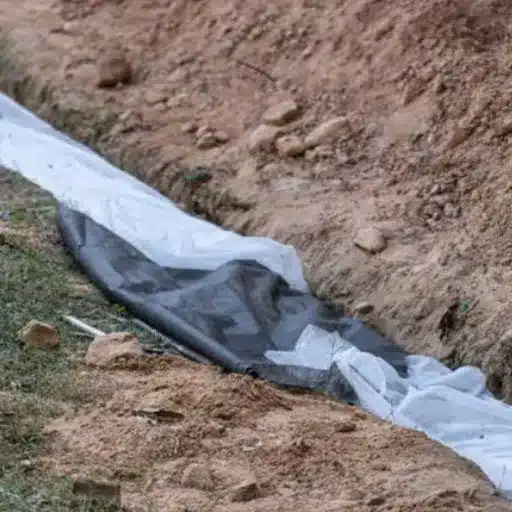
The best fabric in the world fails if it’s installed wrong. The burrito wrap method is the proven way to make the fabric do its job. It fully encapsulates the stone and pipe so soil can never wash into the system.
Step-by-Step
- Dig the trench with a steady fall of at least 1% (about 1 inch drop per 8-10 feet) toward the outlet.
- Line the trench with nonwoven geotextile, leaving 12-18 inches of excess fabric on each side so it can fold over the top later.
- Add a bedding layer of clean, washed angular stone, typically 1/2 to 1.5 inches. Angular stone moves water better than rounded gravel.
- Lay the perforated pipe with the holes facing down. Water enters from below, at the water table, so the holes belong on the bottom.
- Backfill with 4-6 inches of clean stone around and over the pipe.
- Fold the excess fabric over the top, overlapping the edges to seal the system. This is the “burrito.”
- Cover with permeable soil such as sand, topsoil, or sod, not the native clay you excavated.
Overlap and Anchoring
Overlap every seam by a minimum of 12 inches (300 mm) in trench applications. Pin or tuck the edges so they do not open during backfill. A gap at a seam lets fines in exactly where you do not want them, and it is one of the most common installation errors.
Filter Sock vs Full Burrito Wrap
A pre-wrapped filter sock is faster to install and fine for light-duty garden and foundation drains. The trade-off is real: a sock carries and stores less water than a gravel-bedded line, and it blinds faster in fine, dirty soils. When in doubt, the gravel bed with a full burrito wrap is the more durable system.
Common French Drain Fabric Mistakes (and the Cost of Getting It Wrong)
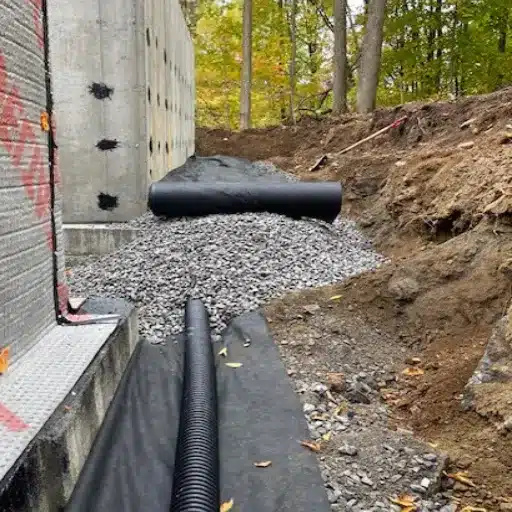
Fabric mistakes rarely announce themselves on day one. They show up a year or two later, when the ground above the drain stays soggy and the water has nowhere to go.
- Mistake 1: Using woven landscape fabric. The tight weave clogs and blinds. In fine sandy soils, this mistake has stopped drains working within 12-18 months of installation.
- Mistake 2: A pipe sock only, with no full wrap. Soil migrates into the stone around the sock, and the drain loses storage capacity.
- Mistake 3: The wrong AOS for the soil. Openings too large let fines through; openings too tight cause blinding. Flow can drop 50-80% within two to three years.
- Mistake 4: Inadequate overlap at seams. Every gap is a channel for soil fines.
- Mistake 5: Perforations facing up. Water is meant to enter from below; upward holes let surface sediment in.
A representative example. Consider what a typical failure looks like. A homeowner installs a perimeter French drain with woven landscape fabric instead of nonwoven geotextile. The fabric never tears, but it can’t pass water fast enough.
Within a year or two, hydrostatic pressure builds up behind the foundation, and in the worst cases it can crack a basement wall. Repair bills for that kind of damage routinely run into five figures, far more than the cost of the correct fabric would have been.
The long view. Research on drainage trenches exhumed after 18 years of service in the French Alps shows that properly designed geotextile filters kept working, while clogging drove failures where design was compromised. The long-term field study found that most long-term clogging came from chemical buildup on the filter face, which underlines why matching the fabric to the soil and keeping it off the pipe matters as much as the fabric type itself.
Frequently Asked Questions
Do I need geotextile in a French drain?
Yes. Without a filter fabric, fine soil washes into the stone and pipe perforations and silts the drain solid, often within a season or two.
Can I use landscape fabric instead of geotextile?
No. Standard landscape weed barrier is usually a woven material that clogs in drainage applications. Use a nonwoven drainage geotextile instead.
What weight geotextile do I need?
For a typical residential French drain, 4-6 oz/yd² (135-200 gsm) nonwoven. Use 6-8 oz for deeper trenches, coarse stone, heavy soil, or traffic loads.
How long does geotextile last in a French drain?
With the correct type, weight, and AOS, and a proper burrito-wrap installation, nonwoven geotextile typically lasts 20-25 years or more.
What about clay soil?
Clay needs a tighter AOS, around 0.15 mm (#100 sieve). Note that very heavy clay may still percolate slowly against the fabric; larger crushed stone around the drain increases surface area and helps.
How do I know the fabric is clogged?
Signs include pooling water above the drain, slow drainage after heavy rain, and water backing up at the outlet. If the fabric itself is clogged, the drain usually needs to be re-excavated and the fabric replaced.
Conclusion
The best geotextile for French drain is a needle-punched nonwoven polypropylene fabric, 4-6 oz (135-200 gsm), with an AOS matched to your soil and a permittivity of at least 0.5 s⁻¹. It outperforms woven fabric and landscape barrier in water flow by 5-10 times, and it filters the soil fines that clog most drains.
Install it with the burrito wrap method, overlap the seams by at least 12 inches, and check the datasheet for MARV values on AOS, permittivity, and tensile strength before you buy.
Getting the fabric right is the cheapest insurance your drainage system can have. It costs a few dollars per square yard, and it protects a trench you don’t want to dig twice.
If you’re ready to specify or buy, our engineering team can help you match the exact grade to your soil and project. Request a technical quote and we’ll respond with product datasheets, AOS and permittivity values, and flexible order options for projects of any size.