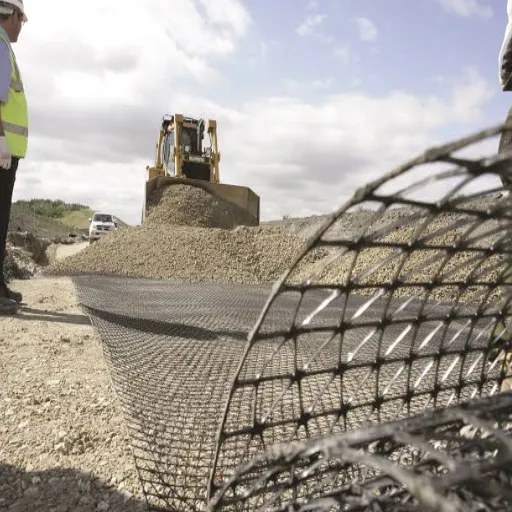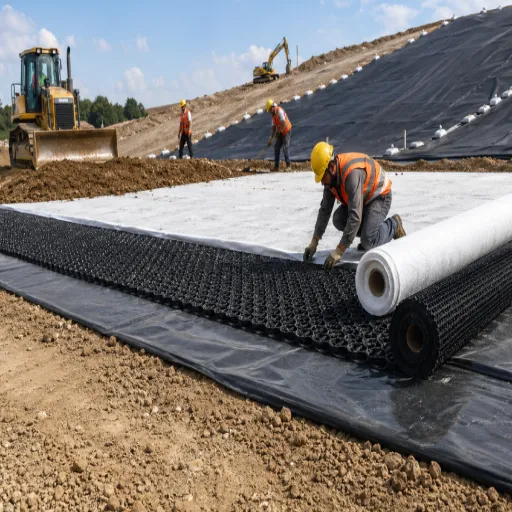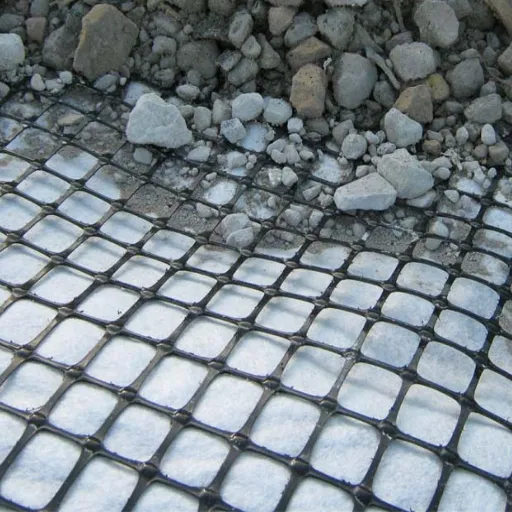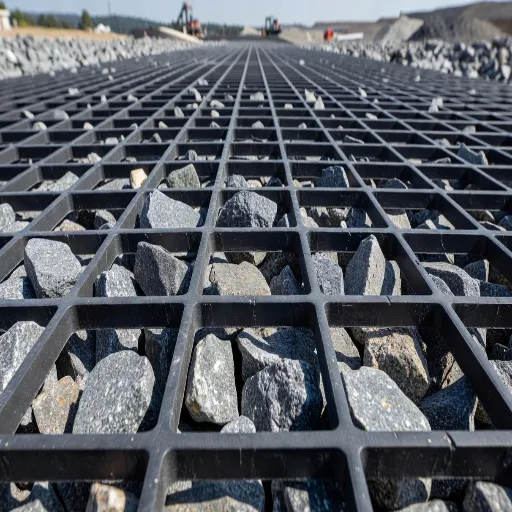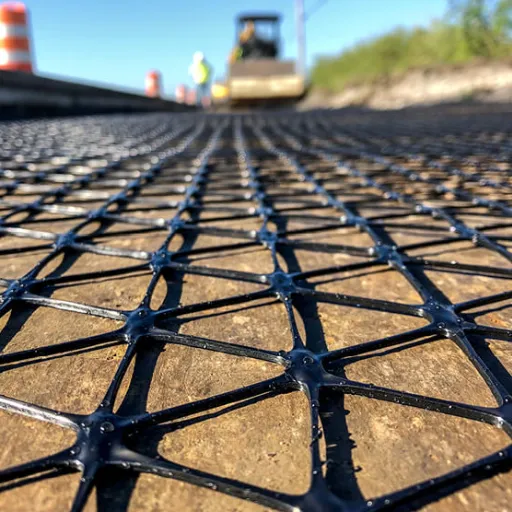
Geogrid is a polymer grid classed as extensible, and it lets reinforced soil reach an active earth pressure state. Steel strip and bar mat are inextensible, and they hold the mass closer to at-rest pressure. That single mechanical fact drives the design method, the embedment length, the connection detail, the backfill specification and the durability argument.
Both systems have delivered 75 to 120 year design lives in service. The geogrid vs steel reinforcement decision is therefore not modern versus old. It is a choice between two stiffness regimes, each with its own failure threat. Most buyers never learn this, because the pages that rank for this comparison are product pages that never mention the other material.
This guide covers the behavioural difference, the corrosion arithmetic behind steel’s allowance, the creep arithmetic behind geogrid’s, the backfill chemistry that eliminates one option before price is discussed, and when steel is genuinely the better specification. For the underlying mechanics, our guide to geogrid soil reinforcement covers the full design framework.
Key Takeaways
- Extensibility, not material, governs design. Steel strips and bar mats are inextensible; geogrids and geotextiles are extensible, and woven steel mesh is classed extensible despite being steel.
- Inextensible reinforcement drives at-rest (K0) pressure at the top of a wall, decreasing to active (Ka). Extensible reinforcement reaches active pressure throughout, so the two systems are designed against different loads.
- AASHTO assumes zinc loss of 15 microns per year for two years and 4 microns per year after, then carbon steel at 12 microns per year. From 86 micron galvanizing, that is about 1.42 mm of sacrificial section over 75 years.
- Steel imposes hard backfill limits: resistivity above 3,000 ohm-cm, pH 5 to 10, chlorides below 200 ppm, sulfates below 1000 ppm. Failing fill often decides the system before price is discussed.
- After long-term allowances, the strength gap is roughly 2:1 rather than the 1.2:1 the gross numbers suggest.
What Is the Difference Between Geogrid and Steel Reinforcement?
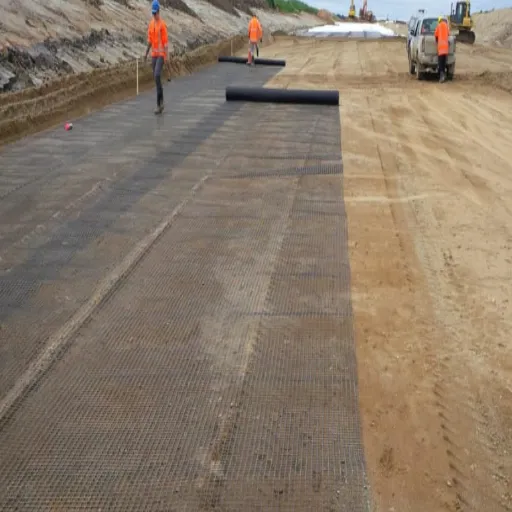
Geogrid is a planar polymer grid that reinforces soil through aggregate interlock and tensile restraint, and it is classed as extensible. Steel reinforcement, whether strip, bar mat or welded wire mesh, is classed as inextensible because it deforms far less than the surrounding soil at failure.
That classification, not the material name, governs design. It comes from FHWA guidance behind most modern MSE practice, set out in the Reinforced Soil Structures design guidelines.
- Inextensible: deformation at failure is well below that of the surrounding soil. Examples are steel strips and bar mats.
- Extensible: deformation at failure is comparable to or greater than the soil’s. Examples are geogrids, geotextiles and woven wire mesh, per the FHWA MSE inspection guidelines.
Read the second definition carefully. Woven steel wire mesh is made of steel but is classed extensible because of its geometry. Extensibility is a behavioural property, not a material one. Buyers who assume “steel means inextensible” get the design method wrong.
Typical steel strip geometry is a 50 mm by 4 mm ribbed galvanized section, spaced at roughly 0.75 m horizontally and bolted to precast panels or block facing. Geogrid for walls and slopes is usually uniaxial PET, HDPE or PP, with biaxial and triaxial grades for base stabilization.
Need a like-for-like comparison for your project? Send our engineering team your wall height, loading and fill source and we will return a recommendation with the design basis stated.
Extensible vs Inextensible Reinforcement: Why Stiffness Governs the Design
Horizontal reinforcement works by restraining lateral displacement of the fill. How much the reinforcement can stretch before the soil fails controls the horizontal stress state in the reinforced mass. This is the part of the comparison almost nobody publishes.
With inextensible reinforcement, the reinforced mass behaves as a relatively unyielding block. Horizontal stress approaches an at-rest, K0 condition at the top of the wall, then decreases toward active, Ka below. The line of maximum tensile force is modelled as a bilinear surface, vertical in the upper wall.
With extensible reinforcement, the fill can yield laterally, so an active, Ka condition develops throughout. The line of maximum tensile force coincides with the Coulomb or Rankine active failure plane.
The consequence is counterintuitive. A steel-reinforced wall is designed for a higher lateral pressure than a geogrid wall, but with a far stiffer reinforcement. The system is not over-designed. The stiff reinforcement is what creates the at-rest state it must then resist. Geogrid walls face a lower pressure but must control deformation with a lower modulus material, which is why geogrid design leans so heavily on creep.
Design method follows from the pressure state. Inextensible systems use the coherent gravity approach; extensible systems use the tieback wedge or simplified method. Match the wrong method to the reinforcement type and the design is wrong even when the arithmetic is correct.
Pullout and the scale-effect factor
The pullout resistance factor F* combines passive bearing and friction at the soil-reinforcement interface. The scale-effect correction factor, alpha, accounts for shear stress not being mobilised uniformly along the reinforcement length.
For inextensible reinforcement, alpha is approximately 1. For extensible reinforcement it can be substantially below 1, and FHWA recommends a default of 0.6 absent test data. Some published guidance quotes 0.6 to 0.8. The consequence is direct: a geogrid needs a longer embedment length to develop the same pullout resistance. That means more right-of-way, more excavation and more fill. Our guide to geogrid pullout resistance covers the design equations.
Displacement to pullout tells a similar story. Ribbed steel strips mobilise pullout at roughly 13 mm; geogrids typically need 25 to 50 mm. For settlement-sensitive structures such as abutments or walls over services, steel mobilises resistance at far smaller strain. For the mechanism from first principles, see how does geogrid work.
Geogrid vs Steel Reinforcement: Side-by-Side Comparison
| Property | Geogrid (extensible) | Steel strip and mesh (inextensible) |
|---|---|---|
| Material | PET, PP, HDPE, PVA, fiberglass; steel-plastic composite variants | Galvanized mild steel strip, bar mat, welded wire mesh |
| Behaviour class | Extensible | Inextensible for strip and bar mat; woven mesh is extensible |
| Stiffness and modulus | Low to moderate, product dependent | Very high |
| Elongation at peak load | Roughly 10% or more for polymer grids; about 3% for steel-plastic composite | About 1 to 2% to yield |
| Earth pressure state | Active (Ka) throughout | At-rest (K0) at top, active (Ka) at depth |
| Maximum tension line | Linear, coincident with the active failure plane | Bilinear, vertical in the upper wall |
| Load transfer | Friction plus passive resistance through apertures | Friction, or friction plus rib bearing |
| Pullout mobilisation | About 25 to 50 mm | About 13 mm for ribbed strip |
| Scale-effect factor alpha | Often below 1, default 0.6 | Approximately 1 |
| Primary durability threat | Creep, installation damage, hydrolysis or oxidation, UV before cover | Corrosion: zinc depletion, then carbon steel loss |
| Backfill sensitivity | Polymer specific pH limits, for example PET around pH 3 to 9 | Resistivity, pH, chlorides, sulfates |
| Connection to facing | Friction or interlock, or mechanical connector; more tolerant | Structural bolted connection; stress concentrates at the connection |
| Handling | Light, rolled, cut with hand tools | Heavy, rigid, handled in bundles |
| Typical best use | Walls, slopes, embankments, base stabilization, soft ground | Tall or high-load walls, abutments, tight deformation tolerance |
| Relative material cost | Lower per square metre | Higher per square metre, usually bundled with a facing system |
The decisive rows are earth pressure state and durability threat. Strength is the row everyone compares and the one that matters least, because both systems are reduced heavily for their respective long-term threat before they reach a design calculation.
Gross strength vs design strength
Illustrative arithmetic, not a design. It uses a 50 by 4 mm galvanized strip at 0.75 m spacing with specified yield of 450 MPa, against a geogrid at 100 kN/m ultimate tensile strength with long-term design strength at 40 percent of ultimate.
| Gross capacity | After long-term allowance | Per metre of wall | |
|---|---|---|---|
| Steel strip, 50 x 4 mm | 200 mm² x 450 MPa = 90 kN per strip | 2.58 mm remaining section gives 129 mm², so 58 kN per strip | About 77 kN/m |
| Geogrid, 100 kN/m UTS | 100 kN/m | About 40 kN/m | About 40 kN/m |
On gross numbers the ratio per metre of wall is roughly 1.2 to 1 in steel’s favour. After allowances it is closer to 2 to 1. Use project-specific mill certificates and the governing code rather than these assumptions.
Durability: Corrosion vs Creep Over a 75 to 120 Year Life
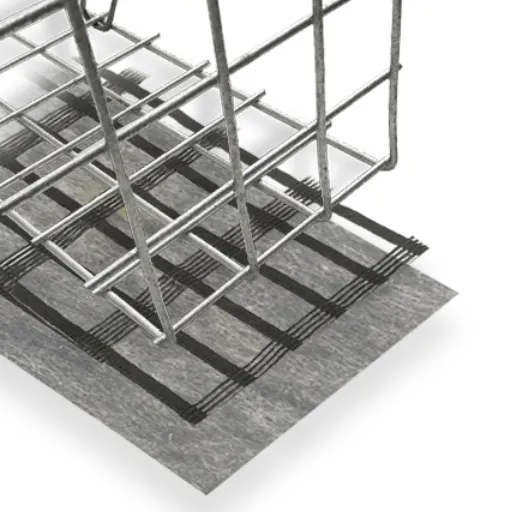
FHWA guidance sets 75 years for routine permanent structures and 100 years for abutments and other critical structures. Modern geogrid approvals commonly claim 100 to 120 years. Both materials reach those targets by completely different mechanisms.
The steel corrosion allowance
AASHTO design corrosion rates for mildly corrosive backfill are 15 microns of zinc per year for the first two years, then 4 microns per year until depletion, then 12 microns per year of carbon steel.
Standard galvanizing to ASTM A-123 is 86 microns, or 610 g/m². The first two years consume 30 microns. The remaining 56 microns go at 4 microns per year, taking 14 more years, so zinc is gone at about year 16. Carbon steel then loses 12 microns per year for the remaining 59 years, which is about 0.71 mm per surface, or 1.42 mm of total section over a 75-year life. Over 100 years the same arithmetic gives roughly 2.02 mm.
That loss comes straight out of the design section. A 4 mm strip is designed as a 2.58 mm strip. The allowance is deterministic, tabulated and easy to verify, which is a genuine procurement advantage for steel.
It is also conservative. The FHWA corrosion assessment reports NCHRP 24-28 field measurements showing long-term metal loss at roughly half the AASHTO model in soils meeting the electrochemical criteria.
Where steel loses outright is chloride exposure. FHWA notes that deicing salts and marine environments sit outside the standard corrosion model, and recommends a geomembrane below the road base tied into drainage. In a coastal or deiced structure, a polymer grid is the simpler answer.
The geogrid reduction factors
Geogrids do not corrode. Their long-term design strength comes from ultimate tensile strength divided by reduction factors for creep, installation damage and durability, typically leaving 33 to 50 percent of the ultimate value.
The trade is different in kind rather than severity. Steel’s allowance is fixed by code and easy to check. Geogrid’s allowance is product specific and must be evidenced by test data: creep per ASTM D5262, installation damage per ASTM D5818, UV per ASTM D4355, and qualification through AASHTO R69. Polymer chemistry sets its own limits. PET is vulnerable to hydrolysis and is generally restricted to roughly pH 3 to 9, while polypropylene depends on its antioxidant package and HDPE is chemically inert but oxidation limited. Our guides to geogrid durability and service life and geogrid creep cover the numbers.
Neither material is longer lasting in the abstract. Steel is limited by the corrosivity of its environment; geogrid is limited by sustained load, temperature and chemistry. The right question is which threat your site presents.
Backfill Chemistry Decides More Projects Than Price
This is where most procurement decisions are really made, and it rarely appears in a comparison article.
Steel reinforcement imposes hard electrochemical limits on the fill. Per FHWA, backfill must satisfy resistivity above 3,000 ohm-cm, pH between 5 and 10, chlorides below 200 ppm and sulfates below 1000 ppm. It also needs select granular fill with a plasticity index of 6 or less, plus drainage that prevents water ponding at the reinforcement. Geogrid imposes different and generally broader limits, governed by polymer rather than electrochemistry. PET’s pH window is the main constraint; HDPE and PP tolerate a wider range.
The commercial consequence is easy to underestimate. Consider a wall where the nearest approved granular source is 90 km from site and the borrow pit next door fails the chloride limit. The project now chooses between importing select fill at a haul cost that dwarfs the reinforcement budget, or changing reinforcement type. The design was never really about roll price.
Run electrochemical testing at the borrow-source stage, not after the design is frozen. A failed result at that point is a design input. A failed result after design freeze is a variation.
Site conditions that shift the decision:
- Chloride, marine or deicing exposure: geogrid
- Tight deformation tolerance, abutments, adjacent utilities: steel
- Very tall wall with high loads: steel, or a high-strength composite
- Soft foundation with expected settlement: extensible systems accommodate movement better, while steel-reinforced walls are more sensitive to differential settlement, which raises lower-layer tension and connection stress
- Aggressive chemistry: test both, and consider PVA geogrid or coated steel
For the wall design workflow itself, see our guide to uniaxial geogrid for MSE and retaining walls.
When to Choose Geogrid and When to Choose Steel
Choose geogrid when corrosion risk is real, meaning marine, saline, acidic, high-chloride or de-iced environments. Choose it when fill chemistry is uncertain or locally sourced fill is the only economic option, or for slopes, embankments, base stabilization and soft ground where planar tensile reinforcement is the requirement. It also suits remote sites where lightweight handling and fast deployment matter.
Choose steel reinforcement when loads are very high or the wall is very tall, and when deformation tolerance is tight, such as abutments or structures over services. Choose it where a proprietary panel-faced system with a structural bolted connection is specified, or where qualified electrochemically compliant fill sits at reasonable haul distance.
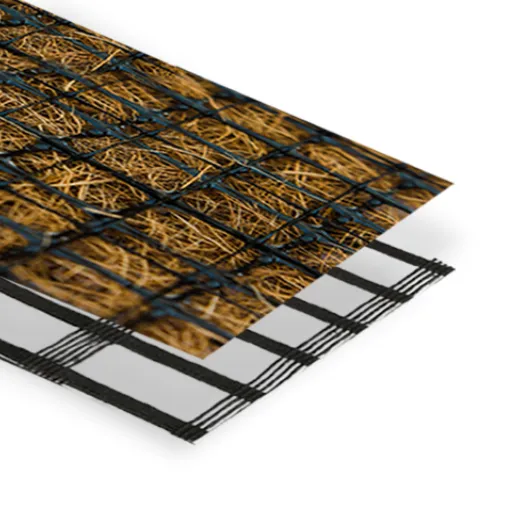
The middle path worth naming is steel-plastic composite geogrid: high-tensile steel wires with a polyethylene or HDPE jacket, ultrasonically welded into a grid. Vendor catalogues list grades at 100 kN/m or more with elongation at peak load of about 3%. That sits between a polymer grid and a steel strip on both strength and stiffness, with the jacket limiting corrosion. Treat those as catalogue figures and request independent test reports.
Combining them is possible but rarely in the same layer. A common arrangement puts steel or high-strength composite in the heavily loaded lower courses with polymer grid above. Combinations change the connection design and should be engineered.
Comparing cost fairly
Do not compare material price per square metre. Steel strip is sold by weight inside a proprietary system that includes panels, connectors and erection. Geogrid is sold by roll. The two unit prices are not commensurable.
Compare total installed cost of the reinforcement function: reinforcement, facing, connectors, backfill including haul, excavation, labour, inspection and whole-life maintenance.
Indicative anchors for planning only. Geogrid material runs roughly USD 0.15 to 4.60 per m² wholesale depending on polymer and grade. MSE walls are commonly quoted at USD 15 to 30 per square foot of face, rising to USD 30 to 75 for higher-specification walls. Steel strip is priced by weight plus system licensing, so request a system-level quote rather than a strip price.
The reinforcement is a minority of wall cost in every case. The real differences hide in backfill haul, embedment length driven by the scale-effect factor, connection hardware and the inspection regime. For pricing by type and strength, see our geogrid cost per square metre guide.
Frequently Asked Questions
Is geogrid better than steel reinforcement?
No. They solve different problems. Geogrid is extensible, immune to corrosion and lighter to handle. Steel is inextensible, far stiffer and mobilises resistance at much smaller strain. Site chemistry, load and deformation tolerance decide.
Does steel reinforcement corrode in soil?
Yes. Galvanizing protects it sacrificially, then carbon steel corrodes. AASHTO assumes zinc loss of 15 microns per year for two years and 4 microns per year after, then carbon steel at 12 microns per year. That is about 1.42 mm of section over 75 years.
What is the difference between extensible and inextensible reinforcement?
Inextensible reinforcement deforms far less than the soil at failure, as with steel strips and bar mats, and drives the mass toward at-rest pressure. Extensible reinforcement deforms comparably to the soil, as with geogrids and geotextiles, allowing active pressure throughout.
Can you use geogrid and steel reinforcement together?
Yes, typically in different layers rather than the same layer. Steel or high-strength composite often goes in the heavily loaded lower courses with polymer grid above. Combinations alter the connection design and should be engineered.
Is steel-plastic geogrid the same as steel reinforcement?
No. It is a polymer grid with high-tensile steel wires encapsulated in an HDPE or PE jacket. It installs like a geogrid and offers higher stiffness than a pure polymer grid at much lower steel content than a strip system.
The Bottom Line on Geogrid vs Steel Reinforcement
Extensibility, not material, is the variable that governs design. Steel strips and bar mats hold the reinforced mass near at-rest pressure; geogrids let it reach active pressure. Every downstream difference, from design method to embedment length to connection detail, follows from that.
Durability is a trade rather than a winner. Steel pays for its stiffness with a corrosion allowance of about 1.42 mm over 75 years, deterministic and easy to verify. Geogrid pays with creep and installation damage reduction factors that are product specific and must be evidenced by test data.
Backfill chemistry frequently decides the project before anyone compares prices, so test the borrow source early.
For most walls, slopes and base work, geogrid is the sensible default, particularly where corrosion risk or fill availability is a concern. Steel remains the right answer where stiffness and tight deformation control dominate. If you are weighing geogrid vs steel reinforcement for a live project, our engineering team can review your wall height, loading, design life and backfill test results and return a recommendation with the design basis stated.
Request a technical quote for geogrid reinforcement or send your backfill electrochemical results to our engineering support team for a like-for-like assessment.