A gravel driveway that held up all summer can turn into a rutted track after the first wet winter. If you’re searching for geogrid for a gravel driveway, you probably want one straight answer: will a sheet of plastic grid stop the stone from sinking into the mud?
Yes, on soft or wet ground. No, if the ground is already firm and the real problem is water. That distinction matters, because the grid costs money and the wrong diagnosis wastes it.
This guide answers the decision, not the theory. You’ll see how deep the gravel should sit over the grid, which of four similar products you actually need, and when another load of stone is the cheaper answer.
If you want the engineering method behind the numbers, the complete guide to geogrid for road bases and driveways covers design charts, base course reduction and grade selection in detail. This article stays with the driveway in front of you.
Key Takeaways
- Geogrid works best on soft, wet or clay subgrades. On firm, well-drained ground it rarely pays for itself.
- Minimum cover is 100 to 150 mm of compacted angular stone. Soft clay needs 200 to 250 mm plus a separator fabric.
- Geogrid is not geotextile, geocell or a gravel grid paver. Most failed driveway projects bought the wrong one.
- No grid fixes standing water. Drainage comes first, every time.
- A residential driveway usually needs biaxial geogrid rated 15 to 20 kN/m in each direction (grades 15-15 and 20-20), not the strongest grade on the price list.
Does Geogrid Work for a Gravel Driveway?
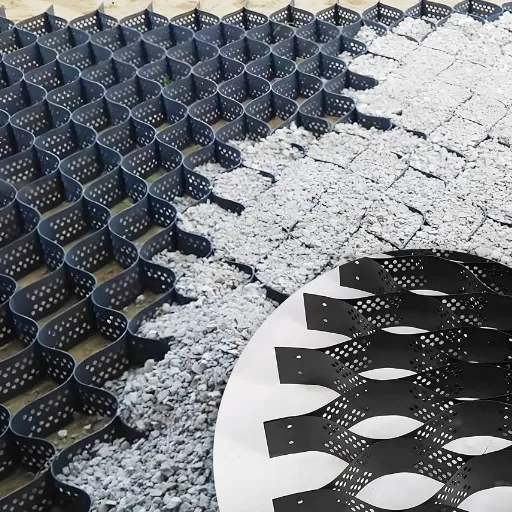
Yes. A geogrid under a gravel driveway works by confining the aggregate and spreading wheel loads over a wider area, which stops the stone from punching into a soft subgrade. It performs best on wet, clay or silt soils. On firm ground the benefit is small and may not cover the cost.
That’s the short answer to whether geogrid works for driveways. The longer answer depends on what is failing.
A grid does three jobs in a driveway. It restrains the stone laterally so the aggregate layer stays dense. It raises the bearing capacity of the subgrade beneath it. And it acts as a tensioned membrane when the ground deflects, transferring load sideways instead of downward.
Field trials on reinforced unpaved roads over soft subgrade have measured the same effect, with lower rut depth under repeated wheel loading (full-scale field tests).
What it doesn’t do is separate soil from stone, filter water, or drain a wet site. Those are different products and different problems, which is where most driveway budgets go wrong.
Geogrid, Geotextile, Geocell or Gravel Grid?
Four products are sold for gravel driveways, and they are not interchangeable. The search results blur them together, so it is worth ten minutes to separate them before you buy.
| Product | What it does | Where it sits | Best for |
|---|---|---|---|
| Geogrid | Reinforces and confines aggregate | Under the base layer | Weak subgrade, recurring ruts |
| Geotextile | Separates and filters | Under the grid or base | Clay, silt, fines migration |
| Geocell | Confines infill in 3D cells | Base or surface | Slopes, heavy loads, shallow cover |
| Gravel grid paver | Holds gravel at the surface | Surface | Aesthetics, light traffic, paths |
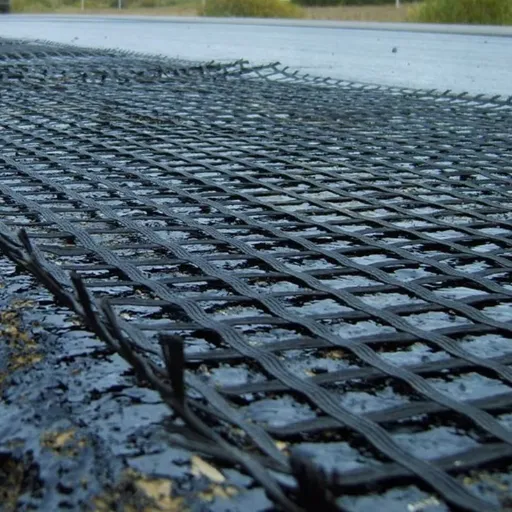
A gravel driveway geogrid is an open mesh with high tensile strength. It works only when aggregate interlocks with its apertures, which is why the stone specification matters as much as the grid.
A geotextile is a fabric. It keeps fine soil from pumping up into the stone while letting water pass. Geogrid for a driveway on clay is usually only half the job: fabric below, grid above.
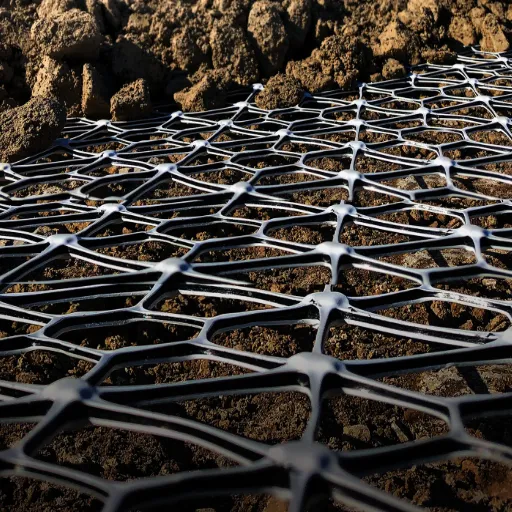
A geocell is a honeycomb of deep cells, usually 50 to 150 mm, filled with aggregate. It confines material in three dimensions and suits slopes and heavy loads. It’s a different tool with a different price.
A gravel grid paver is a surface panel that keeps loose stone in place. It improves appearance and reduces scatter. It doesn’t reinforce a weak subgrade.
If you’re unsure which side of the geogrid versus geotextile line your driveway sits on, the geogrid vs geotextile comparison walks through the decision by soil type. The short version: separation problem, use fabric. Strength problem, use grid. Soft clay, use both.
Geogrid Driveway Base Depth: How Deep Should the Gravel Be?
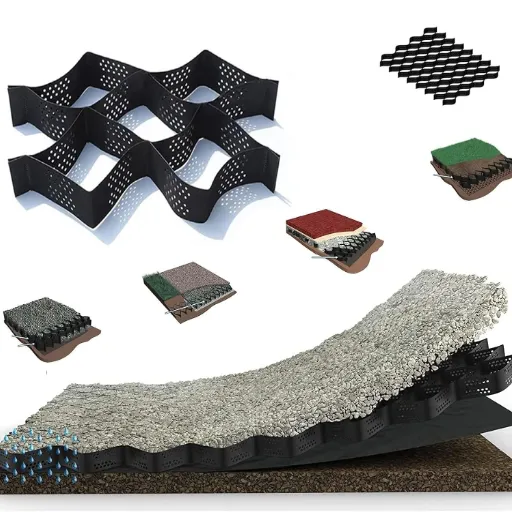
There is no single geogrid driveway base depth that suits every site. The gravel depth is set by the subgrade, not by the grid. The grid lets you reduce the thickness a competent design would otherwise require. It doesn’t let you skip the base layer.
Use this as a starting point for a residential driveway. Compacted depths assume proper compaction in 150 to 200 mm lifts.
| Subgrade condition | Approx. CBR | Compacted gravel over grid | Notes |
|---|---|---|---|
| Firm, well drained | 8 or higher | 100-150 mm (4-6 in) | Cars and light SUVs; grid optional |
| Medium | 4-8 | 150-200 mm (6-8 in) | Cars and light trucks; grid helps |
| Soft clay or silt | 2-4 | 200-250 mm (8-10 in) | Add a nonwoven separator |
| Very soft or organic | below 2 | 300 mm+ (12 in+) | Get geotechnical advice first |
The ranges follow USACE ETL 1110-1-189, the Corps’ guidance on geogrid in pavement construction, adjusted for residential traffic (USACE technical letter). CBR stands for California Bearing Ratio, a standard measure of how much load a soil can carry. You don’t need a lab test for a driveway. A simple field check helps: walk the stripped subgrade after rain. If your boots sink 25 mm or more, treat it as soft.
Three rules sit above the table.
Never go below 100 to 150 mm of cover. Below that, the grid is damaged during placing and by traffic, and it cannot develop tension.
Place the first lift before driving on the grid. Back-dump stone from the far end and push it forward. Tracked equipment directly on exposed grid tears it.
Order about 1.3 times the compacted volume. Loose stone settles as it compacts. A 200 mm compacted layer needs roughly 260 mm of loose material.
For the volume and tonnage math on a specific driveway size, see how much gravel over geogrid with worked examples and a compacted-to-loose conversion.
Is Geogrid Worth It for Your Driveway?
Geogrid is worth the money when the subgrade is weak and the failure keeps returning. It’s usually wasted money when the ground is firm and well drained.
Five conditions justify the cost:
- The driveway turns to ruts every wet season.
- Stone disappears into the ground and needs topping up each year.
- The subgrade is clay, silt or poorly drained.
- Vehicles include delivery trucks, trailers or a motorhome.
- The drive is long enough that stone volume is a real cost.
Four conditions argue against it:
- The ground is firm, sandy or gravelly and drains well.
- The problem is a puddle, not a rut. That’s grading and drainage.
- The surface has rounded pea gravel. The aggregate, not the grid, is the failure.
- The site has peat, springs or soft organic fill. Those need excavation or engineering, not a grid.
Cost is where the argument usually settles. Geogrid for a driveway typically runs a few dollars per square meter. The stone it can save costs many times that per cubic meter. On a weak subgrade, avoiding 50 to 100 mm of aggregate across a large drive can cover the grid several times over.
On firm ground, that math reverses. You pay for the grid and still place the full base, because the design never needed reduction in the first place.
Manufacturers quote savings up to 50 percent, and the figure is real in the right conditions. It applies to weak subgrades under repeated heavy loading, not to a suburban drive with two cars. Treat any savings claim as a question: what subgrade, what traffic, and what failure criterion?
Tensar publishes a case study of an InterAx-reinforced gravel road carrying heavy agricultural vehicles, which is the traffic profile where reinforcement makes sense (case study PDF). The design method behind these numbers is the modified Giroud and Han approach, which is available as a calculator.
For a full project budget including stone, haulage, excavation and labour, see what a geogrid driveway costs.
What Geogrid Fixes on a Gravel Driveway, and What It Doesn’t
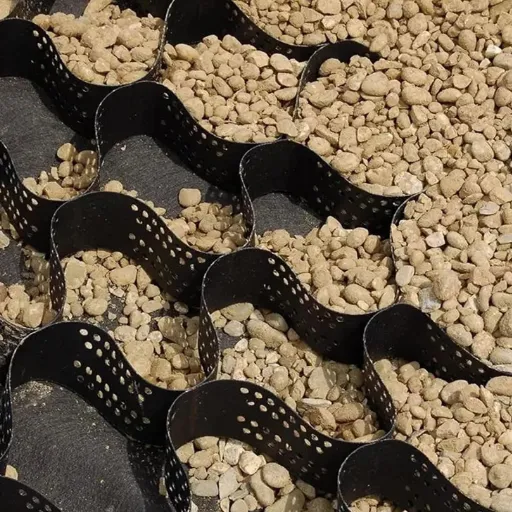
Most driveway failures look identical from the driver’s seat: ruts, mud and loose stone. They have different causes, and only some of them involve reinforcement.
Four problems geogrid genuinely fixes
Stone punching into a soft subgrade. The geogrid confines the aggregate and spreads load, so individual stones stop sinking.
Ruts that return every spring. Seasonal weakening is exactly the condition where reinforcement earns its cost.
Stone migrating into clay. This is a separation problem, so the fix is a nonwoven fabric under the grid, not a stronger grid.
Load spread at turning areas and aprons. Front wheels turning at low speed concentrate stress. Reinforcement helps here more than on the straight.
Three problems it does not fix
Standing water. If the drive has no fall, no ditch and no outlet, water will sit on top of any base. Regrade and drain first.
Peat, springs and organic fill. These soils can’t be reinforced economically at driveway scale. Excavate and replace, or get a geotechnical design.
Rounded gravel. Pea gravel does not interlock, with or without a grid. The grid needs angular, well-graded crushed stone to work.
Driveway shapes that change the answer
A sloped drive moves water fast, so edge scour matters more than grid strength. Protect the edges and slow the flow before the base.
A long drive, say 100 m or more, multiplies every material decision. Grid is usually justified because the stone saving scales with area.
A shared drive carries more traffic and more turning load than a single household. Move up a grade rather than adding grid layers.
Can you lay geogrid over existing gravel?
Only if you strip the old surface first. Grid laid on loose, contaminated gravel does nothing, because the aggregate cannot interlock and the subgrade is never prepared.
The workable version is a rebuild: remove the old stone, regrade the subgrade, proof-roll it, then place separator, grid and fresh base. If the existing stone is clean and angular, it can often be reused as the upper layer.
Choosing and Installing the Right Grid
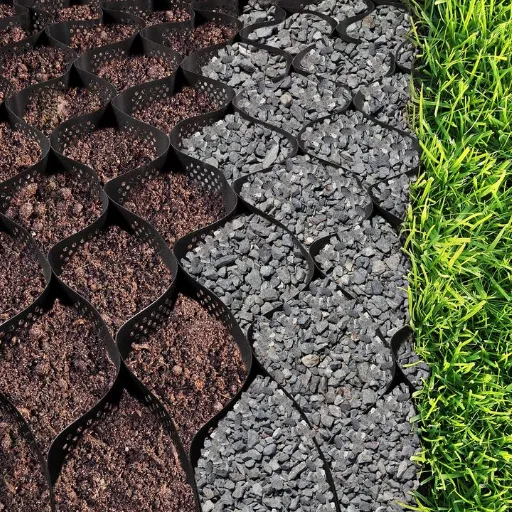
For a residential driveway, biaxial geogrid rated 15 to 20 kN/m in each direction is the normal choice. Move to 30-30 for heavy vehicles or commercial traffic. Triaxial grid is designed for heavy multidirectional loading and is usually unnecessary at home. For the grade that matches your traffic, see what geogrid for a driveway, which explains it in plain language.
Biaxial means the grid has similar strength in two perpendicular directions, which suits a driveway where loads move along and across. Triaxial adds a third axis and costs more.
Aperture size must suit the stone. As a rule of thumb, the median aggregate size should be roughly half the aperture. Too small a stone falls through. Too large a stone bridges and never interlocks.
The installation sequence is short but unforgiving:
- Strip vegetation and soft topsoil to the design depth.
- Proof-roll the subgrade and remove any soft spots.
- On clay or silt, place a nonwoven separator with 300 mm overlaps.
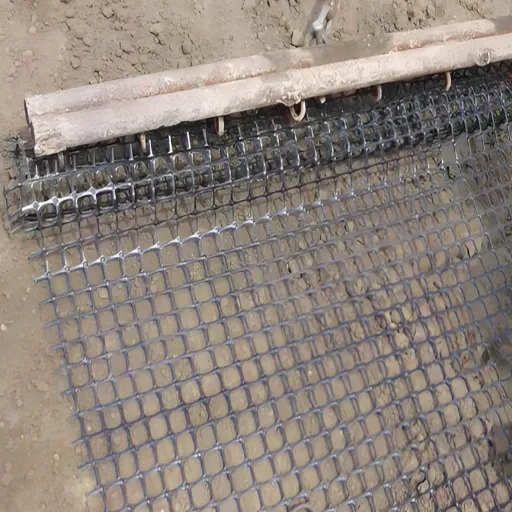
- Roll the grid across the traffic direction, pull it taut, and pin it every 1 to 2 m.
- Overlap seams 300 mm on firm ground, up to 900 mm on soft ground.
- Place the first lift, then compact in 150 to 200 mm layers.
- Add edge restraint and keep at least 150 mm of cover before plant traffic.
Two mistakes cause most callbacks: driving on exposed grid, and using rounded stone. Both are avoidable and both are expensive to fix after the base is down.
The full sequence, including tools and a pass-or-fail inspection checklist, is in how to install geogrid for a gravel driveway.
What to Expect After Installation
A correctly built reinforced driveway changes one thing: the stone stops disappearing. Ruts become less frequent and shallower, and spring break-up is reduced. Most homeowners notice the difference in the first wet season.
It doesn’t change everything. Weeds still grow through gravel. Water still pools if the fall is wrong. The surface still dusts in dry weather and still needs occasional raking.
Expect the first year to settle. A small top-up after the first wet season is normal, even with geogrid for a gravel driveway. After that, many driveways go several years between top-ups.
The grid itself is designed to last decades. The gravel surface is the wear layer and will always need maintenance. Budget for stone, not for replacement grid.
In cold climates, frost is the variable that catches people out. Grid spreads load but doesn’t stop frost heave, and spring thaw weakens the subgrade. If your drive fails every March, the guide to geogrid and frost heave covers the drainage and depth details that matter.
Frequently Asked Questions
Does geogrid really work under a gravel driveway?
Yes, on soft or wet subgrades. The grid confines the aggregate and spreads wheel loads, which reduces rutting and stone loss. On firm, well-drained ground the benefit is modest and may not justify the cost.
How deep should the gravel be over geogrid?
At least 100 to 150 mm of compacted angular stone for cars on firm ground. Use 150 to 200 mm on medium soil, and 200 to 250 mm on soft clay with a separator fabric. Never place less than 100 mm.
Can I put geogrid over existing gravel?
No, not directly. Grid needs a prepared subgrade and aggregate that can interlock. Strip the old surface, regrade and proof-roll the subgrade, then rebuild with separator, grid and fresh base.
Do I need geotextile as well as geogrid?
On clay, silt or any fine-grained soil, yes. The fabric stops fines pumping into the stone while the grid provides reinforcement. On clean, free-draining ground, a separator is often optional.
What geogrid should I buy for a driveway?
Biaxial geogrid rated 15 to 20 kN/m in each direction suits most residential driveways. Choose 30-30 for heavy vehicles or shared drives. Match the aperture to an angular, well-graded crushed stone.
Will geogrid stop weeds or fix drainage?
No. Geogrid is a reinforcement layer, not a weed barrier or a drain. Weeds need a separate membrane, and standing water needs regrading, a ditch or an underdrain before any grid goes down.
The Bottom Line
Geogrid for a gravel driveway is a targeted fix, not a universal upgrade. It earns its cost on soft, wet or clay ground where stone keeps disappearing. It rarely pays on firm, well-drained soil.
Three decisions carry most of the result. Diagnose the failure before buying anything. Set the base depth from the subgrade, not from the product label. And fix drainage before you bury a single roll.
If you send us your driveway dimensions, soil description and traffic type, our engineering team will recommend a grade, a base depth and a quantity. Request a technical quote and we will confirm what your site actually needs.