For most gravel driveways, the product you need is a separation geotextile, not a geogrid.
A geotextile separator sits on the prepared subgrade and stops fine soil from pumping up into the stone. A geogrid sits higher, inside the base layer, and stiffens that stone so it carries more load with less depth. You need both only when the ground under the drive is soft enough that separation alone will not stop rutting.
Driveway owners usually meet these products at the worst possible moment: after a winter of ruts, standing in a builder’s merchant, holding two rolls that cost about the same and look nothing alike. The labels do not explain the difference, and the staff often do not either.
This guide settles the geogrid vs geotextile question for a driveway in the order a buyer needs it answered. You will get a direct answer in one table, a symptom-based decision you can apply to your own drive, the correct layer order for a soft site, and 2026 cost ranges for both products. It also covers the case nobody likes to hear: when neither product earns its money.
Key Takeaways
- Most gravel driveways over fine-grained soil need a nonwoven separation geotextile on the subgrade. A geogrid is added above it only when the subgrade is too weak to carry the load with a practical stone depth.
- The signal for separation is fines content. When subgrade soils carry more than roughly 10% to 15% fines, stone migrates downward without a separator.
- Layer order is fixed: subgrade, then fabric, then grid (if used), then angular crushed stone. Fabric over grid is a mistake.
- Material costs sit close together, at roughly $0.30 to $0.90/m² ex-works for either product. The wrong choice costs far more than the roll.
If you already have dimensions and a soil description, you can skip the guesswork: send your driveway details to our technical team and we will recommend a product and a layer order rather than a single number.
Geogrid vs Geotextile for a Driveway: The Short Answer
The short answer is that they do not compete. A geotextile handles water and fines. A geogrid handles load.
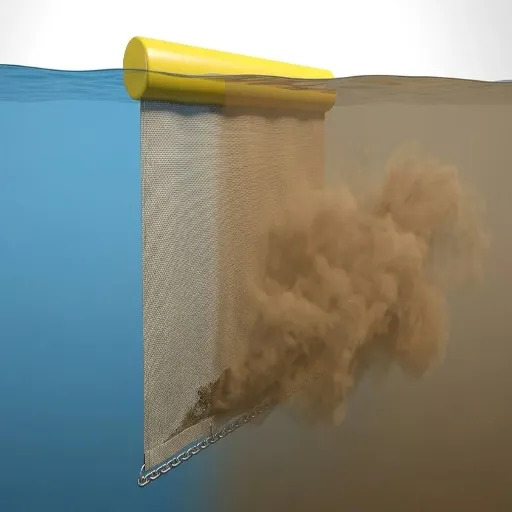
A geotextile is a permeable fabric. On a driveway it works as a separator: it keeps the subgrade soil and the aggregate base from mixing, while letting water pass through. It does not add meaningful structural stiffness to the pavement.
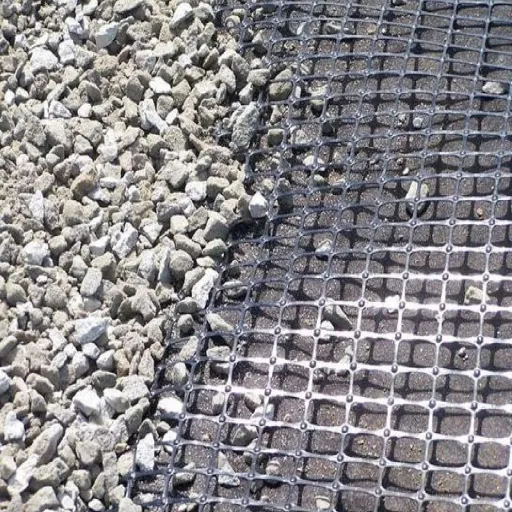
A geogrid is an open mesh with large apertures. On a driveway it works as reinforcement: angular stone locks into the openings, and the grid restrains that stone laterally so the base behaves like a stiffer, stronger layer. It does not filter, because its design is holes.
| Question | Geotextile (separator) | Geogrid (reinforcement) |
|---|---|---|
| What it does | Keeps fines out of the stone, lets water drain | Restrains and confines the aggregate base |
| Where it sits | Directly on the prepared subgrade | Inside the base, typically 100 to 150 mm above the fabric |
| Typical driveway spec | Nonwoven, 200 to 300 g/m² (6 to 8 oz/yd²), Class 2 per AASHTO M 288 | Biaxial polypropylene, 20-20 to 30-30 kN/m, aperture 25 to 40 mm |
| What it fixes | Pumping, contamination, stone loss | Rutting on soft ground, excessive base depth |
| What it cannot do | Add structural stiffness | Separate soil from stone |
| Material cost, 2026 | About $0.30 to $0.80/m² for separator grades | About $0.30 to $0.90/m² ex-works, higher at retail |
Read the last two rows together. Each product fails at the other’s job, which is why the “which is stronger” question has no useful answer. The useful question is what your subgrade is doing.
Geotextile vs Geogrid: What Each One Does
The geogrid vs geotextile comparison becomes simple once you separate the two functions, so start with what each product is doing under the stone.
What a geotextile does on a driveway
A separation geotextile is a filter with a tensile job on the side. It holds back soil particles while water passes, and it keeps the boundary between subgrade and aggregate intact under repeated wheel loads.
That boundary matters more than most owners expect. When fine soil migrates upward into the base, the stone loses its grading, the layer thins, and the surface starts to rut and pothole. According to Solmax technical guidance, as much as 100% of the base aggregate can be lost into a soft subgrade over time without a separator.
A separator does not make weak ground strong. It stops the base from getting weaker.
What a geogrid does on a driveway
A geogrid changes how the aggregate layer behaves under load. Stone particles strike through the apertures and lock in place. Under a wheel, the grid takes tension and spreads the load over a wider area, which reduces the stone depth needed for the same traffic.
The mechanism is well established in unpaved road design. Giroud and Han’s method uses a bearing capacity factor of about 5.71 for a reinforced layer against 3.14 unreinforced, which is why reinforced sections can be built thinner. The practical range on soft subgrade is a base course reduction of roughly 20% to 50%, shrinking as the subgrade gets stronger.
Why the order of layers matters
Fabric goes on the soil. Grid goes in the stone. This is not a preference, it is the only arrangement in which both products work.
Fabric placed above the grid can be punctured by the grid during compaction, and it no longer sits at the soil interface where separation happens. Grid placed below the fabric cannot interlock with the aggregate, so it acts as a buried sheet rather than a reinforcing element.
For the design basis behind the thickness numbers, the geogrid for road base guide covers CBR charts, traffic benefit ratios, and the proof-roll method.
Decide by Symptom: Four Driveway Problems and the Right Product
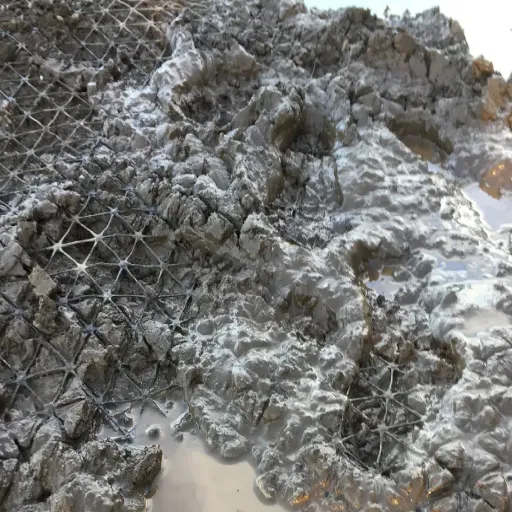
Most driveway owners do not know their subgrade CBR. They know what their drive does in February, so apply the geogrid vs geotextile decision by symptom instead. Start there.
| What your driveway does | What is happening | Product to use | Where it goes |
|---|---|---|---|
| Stone sinks and disappears; ruts refill with mud | Fines pumping upward into the base | Nonwoven separation geotextile | On the subgrade, under all the stone |
| Ruts deeply in spring, spongy underfoot, worse each year | Weak, saturated subgrade | Fabric plus biaxial geogrid | Fabric on subgrade, grid 100 to 150 mm into the base |
| Firm, clean base that still ruts under a loaded trailer or truck | Aggregate not confined under load | Geogrid only | In the base, over the compacted subgrade |
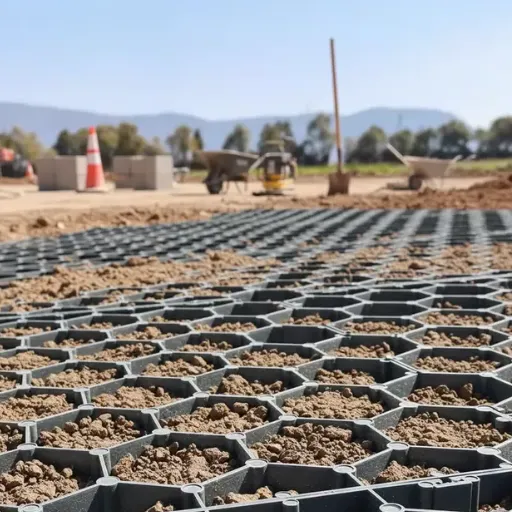
| Surface gravel wanders and spreads; no structural rutting | Surface stabilization problem, not a subgrade problem | Cellular gravel grid or paver (not structural geogrid) | At the surface, filled with stone |
The first row is the commonest, and it is the one buyers most often get wrong. A geogrid does not stop fines migration, so a grid-only fix on a silty subgrade usually looks fine for a season and then fails in the same place.
Dan, a homeowner in southern Ohio, learned this with a 60 m farm lane. He spread 40 tonnes of crushed stone over two winters without fixing the ruts. The stone was not disappearing, it was mixing into the clay below. A woven separator and a single re-gravelling solved it, at less cost than his third top-up would have been.
Row four catches another frequent confusion. A “geogrid driveway” search often returns plastic cellular panels, which are surface stabilizers, not structural geogrid. If your stone is sound and the problem is at the surface, that is the right family of product. For the load-carrying decision, see the geogrid for gravel driveway guide.
When You Only Need One
Geotextile only: fine-grained subgrade, adequate stone
Choose a separator alone when the subgrade is fine-grained or silty, traffic is domestic or light commercial, and you can afford a proper base depth of 150 to 200 mm of angular crushed stone.
The specification that matters is survivability plus filtration, not tensile strength. A Class 2 nonwoven per AASHTO M 288, with a grab tensile around 700 N, is the usual residential choice. It survives installation, retains fines, and drains freely.
Nonwoven is the default for separation because it filters in three dimensions and cushions stone. Woven fabrics are stronger in tension and suit high-stress stabilization, but they filter less finely and can hold moisture against a fine subgrade in freezing conditions. Which fabric to buy is a separate decision, and it deserves its own read.
Geogrid only: firm subgrade, heavy loads
Choose a geogrid alone when the subgrade is firm and well drained, the loads are heavy relative to the section, and the stone is angular and well graded. The grid then earns its cost by letting you build a thinner base, or by extending the life of the thickness you can afford.
A biaxial polypropylene grid rated 20-20 to 30-30 kN/m covers most residential and light commercial driveways. Higher grades exist, and buying them for a car driveway is usually money spent on nothing.
Two conditions break this option. Wet, fine-grained ground needs separation first. Rounded gravel, pea gravel, or single-size stone cannot interlock, so the grid has nothing to grip.
Priya, who runs a small landscape supply yard, keeps a 40-40 grid in stock because contractors ask for “the strong one.” On a well-drained sand subgrade under a family car, that grid performs no better than a 20-20, and it costs about twice as much. She now asks two questions before selling either: what is under the drive, and what drives on it.
When You Need Both, and What Goes Down First
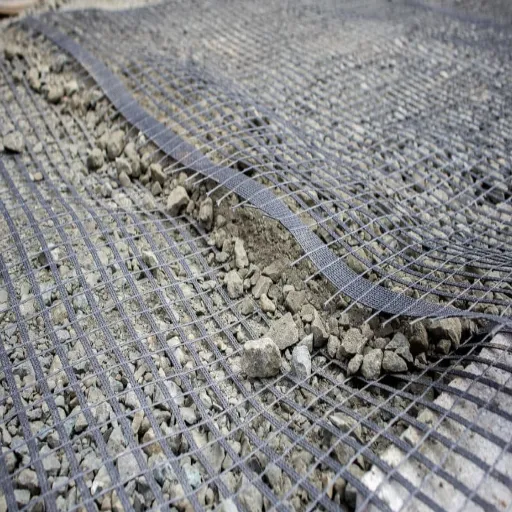
When a driveway needs both, the geogrid vs geotextile question turns into a question about order. That order is fixed, and it is the build-up that works on clay, silt, and any subgrade that stays wet:
- Prepared, compacted subgrade. Strip topsoil, proof roll, and repair soft spots before anything is laid.
- Separation geotextile. Overlap 300 mm on firm ground, up to 900 mm on soft ground, and lap in the direction of stone spreading.
- Biaxial geogrid. Roll out under tension, pin at the edges, and butt adjacent rolls without overlapping, unless the manufacturer specifies otherwise.
- First aggregate lift. Angular, well-graded crushed stone placed over the grid to a minimum 100 to 150 mm cover before any trafficking.
- Remaining lifts and surface course. Compact in layers, then finish with the wearing course and edge restraint.
One without the other underperforms in a predictable way. Fabric alone separates but adds no stiffness, so a weak, saturated subgrade still ruts. Grid alone stiffens the stone but lets fines migrate into it, so the reinforced layer slowly loses the grading it depends on.
There is a genuine disagreement in the industry about whether a geogrid can separate at all. Solmax and TenCate state that a grid cannot separate any fill. Tensar argues that a stiff grid over properly graded aggregate can satisfy a piping-ratio criterion, which makes a separate fabric unnecessary in some designs. The practical rule for a driveway: if you cannot demonstrate that your stone meets the filter criterion for your soil, use fabric. The cost is small and the risk is not.
For the full diagnosis on heavy clay, including the failure modes and the clay-specific installation rules, read geogrid for driveway clay soil.
Note: Separation governs at roughly CBR 3 to 8, while stabilization governs below about CBR 3. That framing comes from the AASHTO M 288 and guidance lineage, and it is a design aid, not a substitute for a site assessment.
What Each Costs, and What Choosing Wrong Costs
Material prices for the two products are closer than most buyers expect.
| Item | Typical range, 2026 | Basis |
|---|---|---|
| Nonwoven separator, 200 to 300 g/m² | $0.30 to $0.80/m² | Ex-works, separator grades |
| Biaxial geogrid, 20-20 to 30-30 kN/m | $0.30 to $0.90/m² | Ex-works, standard grades |
| Geogrid at retail, small rolls | $0.35 to $0.50/sq ft | US builder’s merchant pricing |
| Geogrid installed as a line item | $1 to $4/m² | Public bid data, in-place |
On a 100 m² driveway, the material difference between the three build-ups is small, and that is the first thing to understand about the geogrid vs geotextile cost comparison:
- Separator only: roughly $30 to $80
- Geogrid only: roughly $30 to $90 ex-works
- Both: roughly $60 to $170
Retail buyers see a wider gap, because small-roll pricing per square foot is several times the export rate. Even so, the product is rarely the expensive part of the decision.
The expensive part is doing it twice. A failed separator means the stone is contaminated and has to be excavated, not topped up. On the same 100 m² drive, replacing 150 mm of contaminated base plus disposal plus a new separator typically runs into the thousands, against a material cost under $200. That asymmetry is the real argument for getting the layer order right the first time.
If you want the full project budget rather than the material line, our driveway cost breakdown covers stone, excavation, labour, and the DIY vs contractor split.
Ready to price this properly? Request a technical quote with your driveway area, soil description, and traffic type. We will return a grade recommendation and an itemized budget with the basis shown.
Installation Rules That Decide the Result
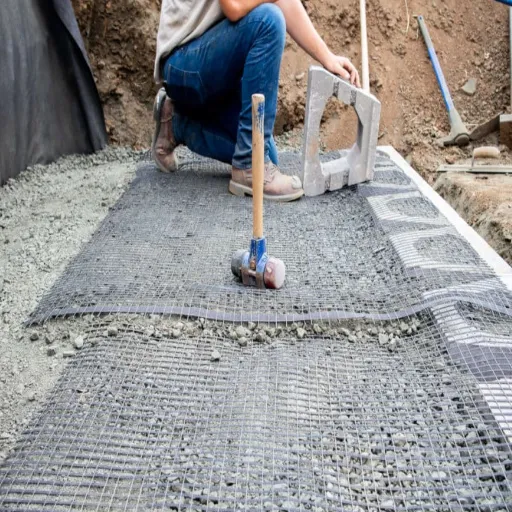
Three differences between the products decide most outcomes.
Tension and pinning. Geogrid must be pulled taut and pinned before stone is placed. A wrinkled grid does not tension under load, and its reinforcement value drops sharply. Fabric needs to be laid flat without tension or wrinkling, because stretching it reduces its ability to conform.
Overlap. Fabric laps 300 mm on firm ground and up to 900 mm on soft ground. Geogrid rolls are usually butted rather than overlapped, because a double thickness of grid can create a hard spot and a plane of weakness.
Cover before trafficking. Both products need stone over them before anything drives on them. For a grid, 100 to 150 mm is the usual minimum first lift. For fabric, any exposed strip will tear at the edges within a season.
Two mistakes ruin either product. Burying the grid below the subgrade interface turns it into a useless sheet. Trafficking exposed fabric tears it at exactly the point where separation matters most.
The full sequence, including tools, timing, edge restraint, and a pass or fail inspection checklist, is in how to install geogrid for gravel driveway.
Frequently Asked Questions
Do I need geotextile under a gravel driveway?
Usually yes, if the subgrade contains fine soil. A nonwoven separator stops fines from pumping into the stone and extends the life of the base. On clean sand or gravel subgrade with good drainage, the benefit is much smaller.
Can I use geogrid without geotextile?
Yes, on firm, well-drained subgrade with angular stone. Not on soft, fine-grained ground, where the grid cannot stop fines migration and the base will contaminate anyway.
What goes first, geotextile or geogrid?
Geotextile first, directly on the prepared subgrade, then the geogrid inside the base layer. Reversing them defeats both products.
Is geogrid or geotextile cheaper for a driveway?
Material costs are close, at roughly $0.30 to $0.90/m² ex-works. A separator alone is usually the cheaper build because it lets you keep a normal stone depth without reinforcement.
Will geogrid stop my driveway turning to mud?
Only if the mud comes from weak bearing capacity rather than fines migration. If the stone is mixing with subgrade soil, a grid alone will not fix it, and a separator is the first requirement.
Is landscape fabric the same as driveway geotextile?
No. Landscape fabric is light, UV-exposed, and not designed for installation survivability under aggregate and traffic. It tears during compaction and is the wrong product under a driveway.
Do I need either product if my subgrade is firm and well drained?
Often not. Correct grading, a proper base depth, and suitable aggregate do most of the work. A geogrid may still pay if you are reducing base depth or carrying heavy loads.
The Bottom Line
The geogrid vs geotextile decision for a driveway comes down to one question: is the problem water and fines, or is it load?
If fines are migrating into your stone, start with a nonwoven separator on the subgrade. If the subgrade is firm and the base is rutting under load, a biaxial geogrid inside the stone is the right call. If the ground is soft and wet, you need both, in that order, and the order is not optional.
What you should not do is buy a heavy grid to solve a separation problem, or a fabric to solve a bearing problem. Both mistakes look identical from the surface for the first season and cost the same to repair.
Send us your driveway area, a description of the soil, and what drives on it. We will tell you which product you need, or whether you need either, and quote the material against your actual dimensions.