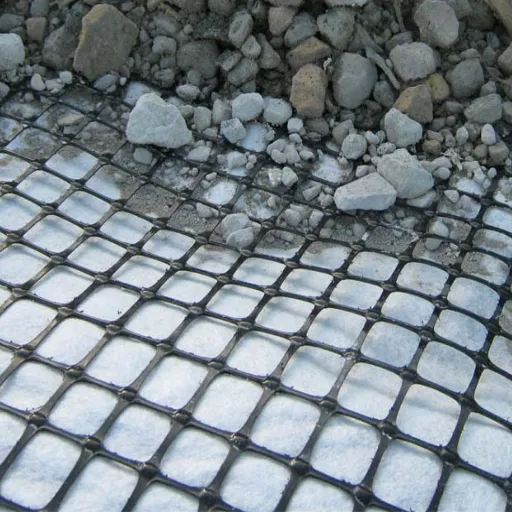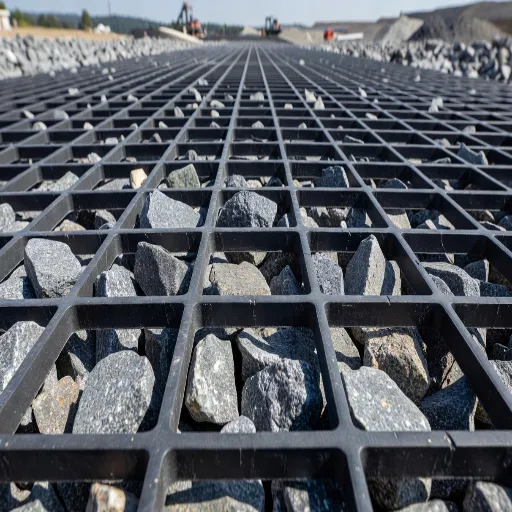
One contractor in Southeast Asia had to bear more than $150,000 in losses last year, due to the absence of specifications for a geotextile fabric. The selected geotextile was a lightweight woven one for a subsurface drainage system. In six months, they clothed themselves, clogged up, and water came back, while the road base failed. It was a specification correlation problem, not an error with fabrication.
If you are a construction engineer, project manager, or procurement specialist, you have already found yourself in exactly this case. In 2033, the global geosynthetics market is projected to be valued at about $15.8 billion, but currently, choosing the right geotextile is still largely determined by a narrow set of technical variables: the fiber type, the fabric structure, consistency with ASTM standards, and how it should be installed.
All of the above will be covered in this guide. How geotextile works-geotextiles, how to specify woven versus nonwoven, how to read ASTM and AASHTO standards, and the installation mistakes that usually reflect failures in the field. Hence, a definitive approach for the confident specification of geotextile fabric will be acquired when it is finished.
What Is Geotextile Fabric?
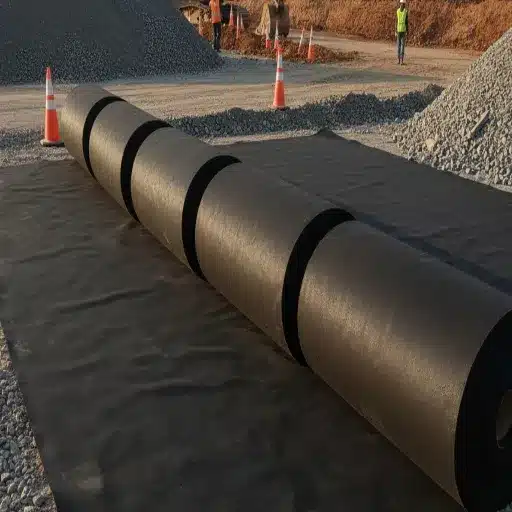
Ordinary geotextile is usually a permeable synthetic material that is installed between layers of soil. This is to stabilize the ground, prevent erosion, manage drainage, separate aggregates, and filter sediment.
Typically, unlike plastic sheeting, it does not block the passage of water; instead, geotextiles are designed in such a way to permit water passage but at a reduced rate while holding back soil particles. It is this quality or property of permeability that makes them necessary in civil works, environmental containment, road construction, or drainage infrastructure.
Mostly, the most commonly used raw materials for geotextiles are:
- Polypropylene (PP): About 62% of global production is polypropylene. It has high tensile strength, good chemical resistance, and excellent UV stability.
- Polyester (PET): Naturally, it resists UV more than polypropylene and performs very well in high pH soils.
These raw materials are then made into two critical constructions.
- Woven Geotextiles: These are synthetic yarns woven about in an interlocking way to make a mesh, creating excellent tensile strength and low elongation for reinforcement and stabilization of the foundation.
- Non-woven geotextiles: Fibers needling or heat-bonded, thereby getting bonded to the felt-like sheet. They are highly permeable and filter-absorbent; therefore, they are used in drainage and erosion control to considerable effect.
The global market for geotextile fabrics was around $9.5 billion as of 2026. The Asia-Pacific area made up approximately 34.5% of this total, at $3.2 billion in 2026. This growth is viewed by analysts as delinquent Infrastructure Progression, which measures the ever-restricting erosion control legislation, has allowed awareness of recycled polypropylene to go from being discarded. The market would grow at a 7.4% compound annual growth rate until 2033, according to Coherent Market Insights.
Woven vs. Nonwoven Geotextile Fabric: How to Choose
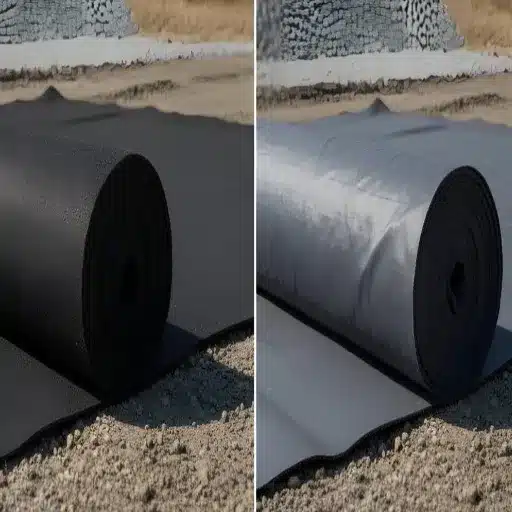
The most common mistake in specification is choosing the wrong construction type. The basic reason is that the woven and nonwoven types of geotextiles are not interchangeable. They are used to solve fundamentally different engineering problems.
Construction and Fiber Structure
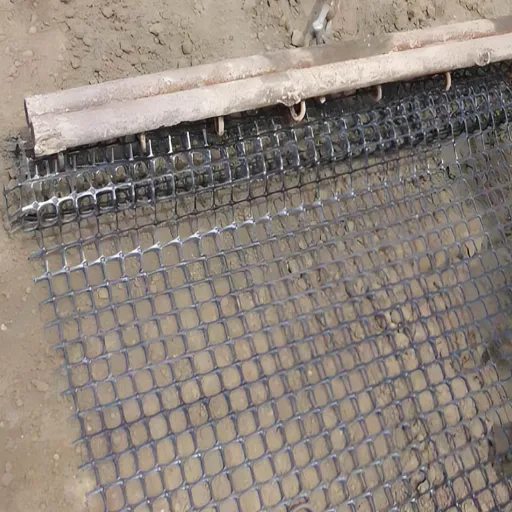
Woven geotextiles are produced on looms by interlacing monofilament, multifilament, or slit-film yarns at right angles to form a stiff grid-like fabric with relatively high tensile strength but low permeability.
Nonwoven geotextiles are produced by attaching loose fibers through needle punching or thermal fusion or chemical bonding. The construction becomes totally random, flexible or very porous.
Performance Comparison
| Feature | Woven Geotextile | Nonwoven Geotextile |
|---|---|---|
| Tensile strength | High (20–400 kN/m) | Moderate (8–120 kN/m) |
| Elongation | Low (<15%) | High (>50%) |
| Permittivity | Low (0.02–0.1 sec⁻¹) | High (0.5+ sec⁻¹) |
| Filtration efficiency | Moderate | Excellent |
| UV resistance | Higher | Lower (requires faster cover) |
| Flexibility | Rigid, less comfortable | Soft, molds to uneven surfaces |
| Typical cost | Higher for heavy-duty grades | Generally more economical |
When to Specify Woven Geotextile
For structural support and load distribution purposes, woven geotextile should be selected as the primary engineering requirement:
- Road construction and railway construction over weak sub-grades indoors
- Embankments and Retaining Walls
- Parking lots and heavy-weight areas
- Long-term soil stabilization
When to Specify Nonwoven Geotextile
While considering water resource management, filtration, or protection of the project, go for the nonwoven geotextile fabric:
- French drains and undersurface drainage
- Landfill liner protective layers
- Sediment control and silt fences
- Erosion control on complex slopes.
Can They Be Used Together?
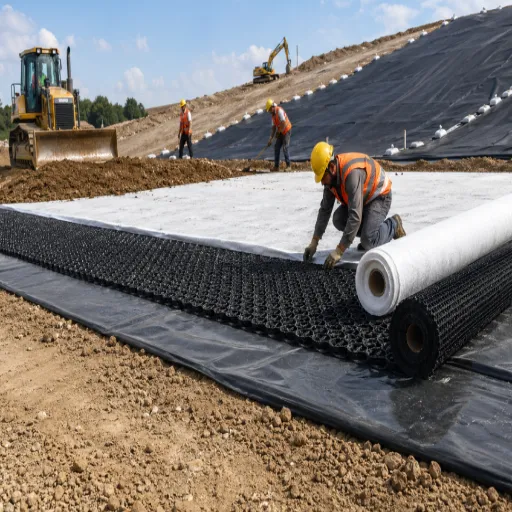
Agree. In these situations, most engineers opt to specify a combination of the two designs-engineered assemblages in complex ground burial structures, highway foundation plans, for example, in which the fabric layer gives reinforcement and a tension-reducing covering, and a nonwoven fabric provides movement of water and oils.
She designed a leachate collection mat for a municipal solid waste landfill that she laid upon a 400 gsm nonwoven geotextile directly above the geomembrane liner, a woven geotextile above that accommodates equipment loads during construction. Dual-layer construction eliminated punctures from occurring and simultaneously provided a high level of draining efficiency. Three years later, monitoring wells confirm no leaking.
Need help matching the right geotextile construction to your soil conditions and load requirements? Contact our engineering support team for a tailored recommendation →
The Five Core Functions of Geotextile Fabric
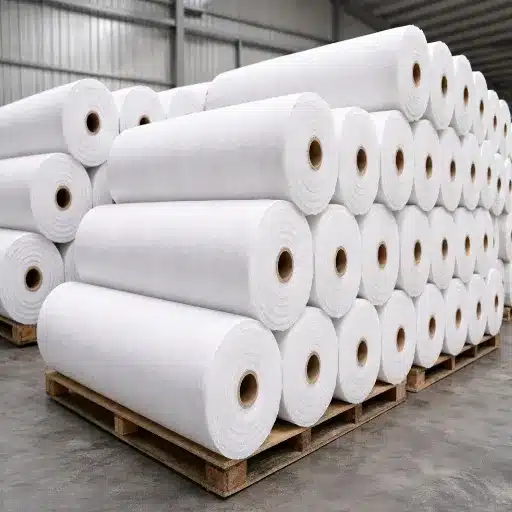
There is always an aspect of these five basic functions in the application of geotextiles. Conceiving a proper understanding of these functions is critical in specification.
1. Separation
This check is done by a geotextile fabric over the dissimilarity of two soil layers. In road networks, for example, a woven geotextile between subgrade soil and aggregate base, it is conceiving the migration of fine soil up into the gravel. It is also matched with the filtration of geotextile in multi-layer systems.
2. Filtration
This keeps water away from the soil. Here, nonwovens perform at their utmost because the random fiber structure provides a tortuous path that contains fines without clogging. Crucial in French drains, under ripraps, and shoreline protection, this is also what makes drainage facilities.
3. Drainage
Alas, while filtration retains soil, the geotextile drainage functions allow water to flow efficiently around and along the fabric plane. Nonwoven geotextiles with high permittivity create a passive drainage path seat that relieves the pressure behind the retaining wall and under the roadway.
4. Reinforcement
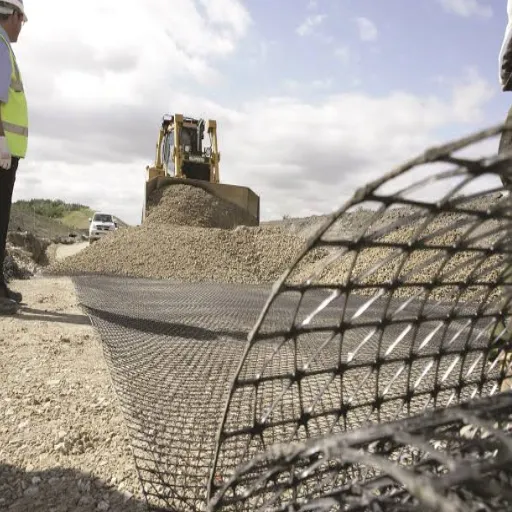
Reinforcement increases the load-bearing capacity of the soil by putting a high-tension element within the soil matrix. Woven geotextiles with tensile strengths of 100 kN/m or higher are frequently utilized to shore up soft soils, embankments, and differential settlement control.
5. Erosion Control
Geotextile fabric provides an effective erosion control mechanism that works on open soil. Coastal and riverbank applications often call for placement of the nonwoven geotextile below gabions or riprap, providing a level of erosion resistance while also allowing free flow of groundwater.
Each requirement has its own. Such is the case with fabric chosen for reinforcement; they are inadequate filters. Fabric picked to serve as a drainage will get torn under heavy-use loads. So are ASTM and AASHTO standards.
Geotextile Fabric Specifications and Standards
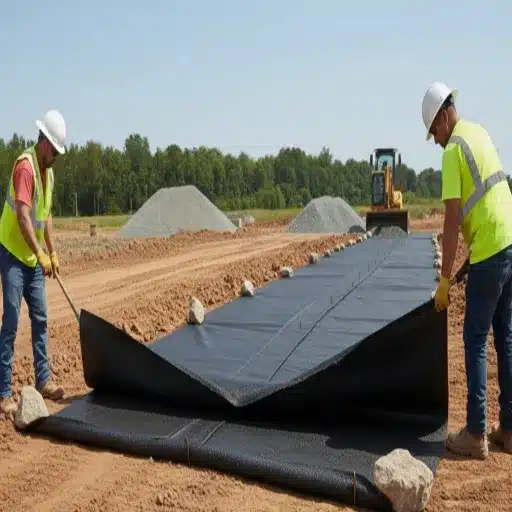
Engineering buyers should never specify geotextile fabric by weight alone. True performance is defined by standardized test methods that measure tensile strength, permittivity, apparent opening size, puncture resistance, and UV stability.
Key ASTM Standards
The relevant ASTM International standards for the specification of geotextiles are:
- ASTM D4439: Terminology for Geosynthetics – Definition of Terms and Properties
- ASTM D4595: Wide Width Strip Tensile Strength
- ASTM D4632: Grab Tensile Strength
- ASTM D4491: Water Permeability (Permittivity)
- ASTM D4751: Apparent Opening Size (AOS / o₉₅)
- ASTM D4833: Index Puncture Resistance
- ASTM D4355: Degradation of UV Resistance.
AASHTO M288 Classification
AASHTO M288 is the standard specification for geosynthetics in highway applications. It divides geotextiles into classes based on application and performance requirements:
| Application | Class | Min. Permittivity | Max. AOS | Min. UV Stability |
|---|---|---|---|---|
| Subsurface drainage | 1, 2 | 0.5 sec⁻¹ | 0.22 mm | 50% |
| Separation | 1 | 0.02 sec⁻¹ | 0.60 mm | 50% |
| Stabilization | 1 | 0.05 sec⁻¹ | 0.43 mm | 50% |
| Permanent erosion control | 1, 2 (woven); 1 (nonwoven) | 0.1 sec⁻¹ | 0.22 mm | 50% |
Class 1 fabrics are designed for harsh, unprotected conditions with minimal stone drop height. Class 2 fabrics require a protective gravel layer and are suitable for less severe environments.
Typical Performance Specifications
| Parameter | Woven Range | Nonwoven Range |
|---|---|---|
| Tensile strength | 20–400 kN/m | 8–120 kN/m |
| Permittivity | 0.02–0.1 sec⁻¹ | 0.5–2.0 sec⁻¹ |
| Puncture resistance | 500–1,500 N | 200–1,200 N |
| Weight (GSM) | 100–800 g/m² | 80–800 g/m² |
| UV resistance | 70–90% retention | 50–80% retention |
For procurement, always request certified test data from your supplier. A reputable manufacturer should provide third-party test reports for grab tensile strength, permittivity, and UV resistance upon request.
Applications by Industry
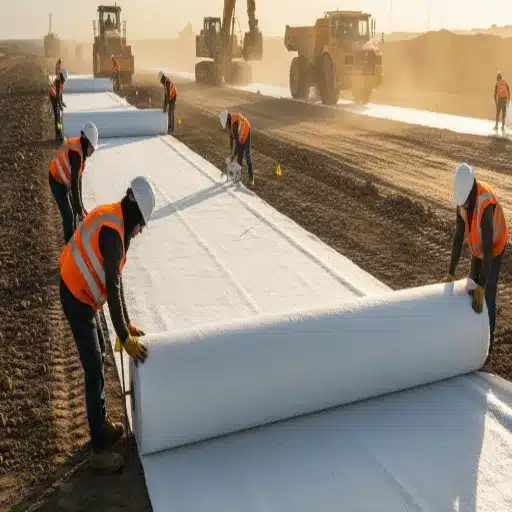
Geotextile fabric appears in nearly every sector of civil and environmental engineering. Here is how different industries apply it in practice.
Road Construction and Geotextile Soil Stabilization
The demand for geotextiles in the whole world for roads and highways is 42%. In this use, woven geotextiles act as a safe working platform in the case of subgrades that are low and quickly saturated. This pattern dissipates the strength of the traffic while retarding already developed ruts, inhibiting the pounding of soft soil into the aggregate base under traffic.
For example, all CBRs less than one never out with a specification to use in the subgrade in the woven geotextile Class 1 type of fabric that has a minimum grab tensile strength of 1100 N and at least 36 inches overlap.
Retaining Walls and Embankments
Behind retaining walls, non-woven geotextile works as a filter and allows the establishment of a full drainage system. As a rule, it stands out by preventing soil fines from flushing through the weep holes and allowing hydrostatic pressure to dissipate. In steep embankment areas, the woven geotextiles with reinforcement go toward stabilizing the structure of the soil structure within, and they reduce the probability of slope failure happening.
Drainage Systems and French Drains
Non-woven geotextiles are the default choice for underground drainage. That combination wraps these perforated tubes and thus ensures a cleaner, smaller aperture opening in amount than less contact between clean gravel and the under-tile soil, thus controlling gravel clogging of the pipes. For fine-grained soils with more than 40% clay content, a heavier non-woven fabric (270+ gsm) with smaller apparent opening sizes is recommended.
Landfill and Environmental Containment
In the case of landfill liner systems, nonwoven geotextiles act as stress-relieving devices placed between the spaced geomembrane barrier and the overlying soil or waste. It acts as a shield against sharp aggregates, hence preventing punctures, and also offers a route for leachate collection.
Coastal and Slope Erosion Control
Erosion control in general employs nonwoven geotextiles underneath riprap, gabion elements, or even articulated concrete blocks. Usually, the fabric stabilizes the underlying soil, assists in decreasing the chances of scour, and allows water collected into ground water spaces without increasing uplift pressure caused by the armor layer.
Geotextile Fabric Installation: Best Practices
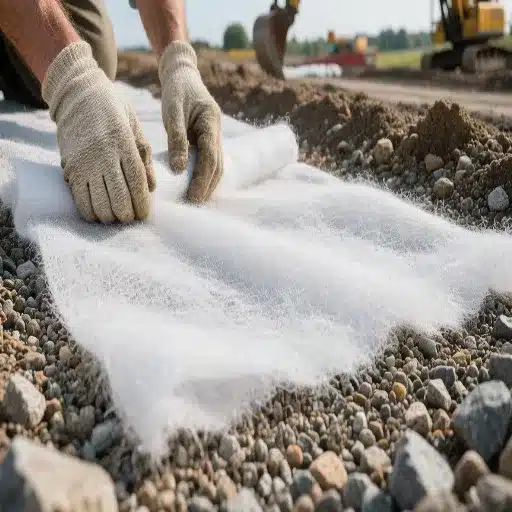
The best specification of geotextile fabric cannot perform well if the material is badly installed. Good field performance will depend on subgrade preparation, proper overlap, secure anchoring, and timely covering.
Subgrade Preparation
Removal of all sharp rocks, roots, organic debris, and protrusions likely to puncture the textile; level the surface to a deviation of no more than 5 cm. In road and heavier load applications, compact to at least 95% Modified Proctor dry density; for very soft soils (CBR < 1), a leveling oxide of thin sand is placed before the fabric.
Laying and Overlapping
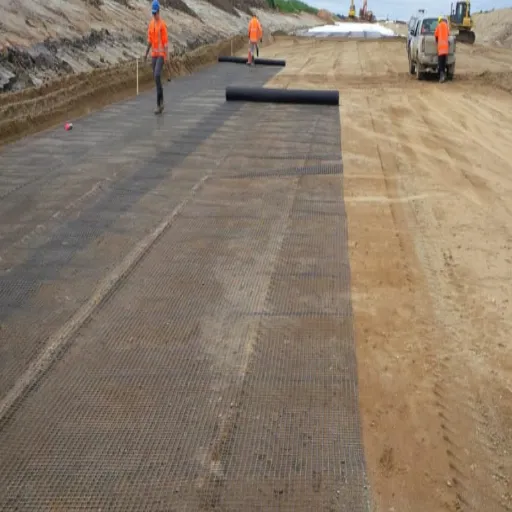
Roll out the textile with mechanical spreading equipment for commercial rolls. Manual dragging of heavy rolls may cause damage to the needled punched structure of the nonwoven fabric and also reduce permeability. Apply tension force on an average of 10 to 15 lb per foot to keep the fabric taut, but do not overstretch it. Allow a slack of a maximum of 1 inch per 10 ft.
Follow these overlap guidelines based on soil conditions:
| Soil Condition (CBR) | Minimum Overlap | Joint Treatment |
|---|---|---|
| Solid subgrade (>3) | 12–18 inches | Overlap only |
| Medium soil (1–3) | 24–36 inches | Overlap only |
| Ultra-soft soil (<1) | 36 inches minimum | Sewn joints required |
When sewing is required, use a Federal Standard Type 401 double-thread chain stitch with high-strength polypropylene thread. Stitch density should be 3–7 stitches per inch, positioned 2–4 inches from the fabric edge.
Anchoring and UV Exposure
Secure the fabric with galvanized U-staples driven flush to the surface using a 16–24 oz rubber mallet. On steep 2:1 slopes, place anchors every 1.5 feet. On flatter ground, use at least 4 staples per 10-foot joint section.
Polypropylene degrades rapidly under UV exposure. Cover the fabric with aggregate or soil within 24–48 hours of installation. Maximum unprotected exposure should not exceed:
- 3–4 oz fabric: 14 days
- 6–8 oz fabric: 21 days
- 10–12 oz carbon-black stabilized: 30 days
Aggregate Placement
Maintain a minimum 6-inch clean aggregate cover over the fabric. On soft soils, compact the first lift using a 10-ton static roller only. Do not use vibratory compaction until the second lift reaches 6 inches thick. Early vibration can pump fine silt into the fabric pores, causing immediate clogging.
Common Installation Mistakes and How to Avoid Them
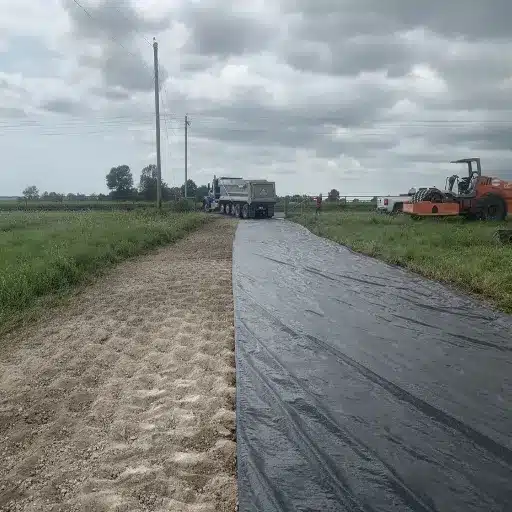
Field failures are nearly always avoidable as such. Remember what those mistakes are that we most often see and how to avoid them.
Using the Wrong Fabric
A woven geotextile does not belong in a drainage application because it will tend to clog. A nonwoven geotextile cannot withstand being thrown around beneath a heavy haul road. Match the fabric construction to the primary engineering function.
Inadequate Overlap on Soft Soils
On CBR < 1 soils, a 12-inch overlap is not enough. Soil migration will infiltrate the gap, clogging the aggregate and creating a weak point. Use 36-inch overlaps with sewn joints on soft ground.
Prolonged UV Exposure
Light nonwoven weight geotextile was exposed for three weeks in Eastern Africa by a project team as they waited for the delivery of the aggregates. The moment they returned, the tensile testing proved that the tensile strength of the sample had suffered a 35% reduction. This fabric had to be removed or else replaced. Whenever possible, backfill within 48 hours.
Vibratory Compaction on Weak Subgrades
The vibration of the first layer of aggregate induces joints in ultraweak soil and pumps the fines into a geotextile. The seep-hole influx is instantaneous. An immediate stop of the strained soil drainage through the use of static rollers for the first lift on CBR less than one soil.
Using Contaminated Aggregate
Sand, soil, or debris inclusion mixed with the aggregate will plug the geotextile and reduce hydraulic flow. Require clean, washed gravel and check the load every time currents are introduced.
Geotextile Fabric Cost Factors
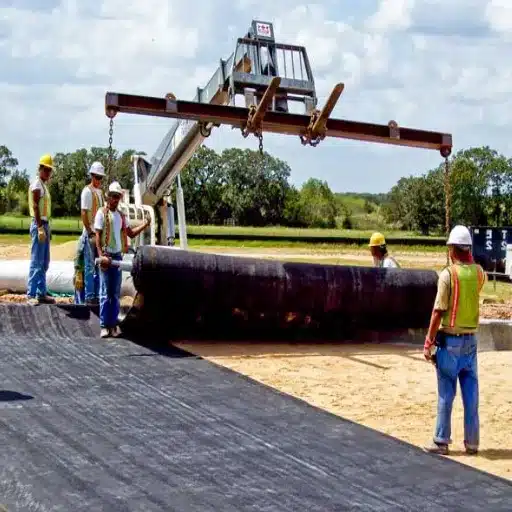
Pricing for geotextile fabric varies based on material type, weight, roll dimensions, certifications, and order volume.
Typical Cost Ranges
- Light Nonwoven (80 to 140 gsm): $0.25 to $0.50 per square meter
- Common Nonwoven (200 to 270 gsm): $0.50–1.00 per square meter
- Heavy Woven-made (400 to 800 gsm): $1.00–2.5 per square meter
- Specialized wovens high-strength: > $2.50 to sometimes even > $5.00 per square meter
Key Cost Drivers
- GSM/weight: Heavier fabrics require more raw material and come at a higher cost.
- Material type: Woven monofilaments and high-tensile qualifiers are considered cost tradeoffs.
- Roll dimensions: Wider rolls and longer rolls lead to less labor per running meter of material placed
- Certifications: An AASHTO M288, NTPEP, and so on certified material costs a little bit more than uncertified material.
- Order volume: Ordering in large quantities can provide volume discounts of around 15–30%.
Lifecycle Value
The cost of a geotextile is so minimal when well specified that frequently, that is just a couple of percent of the total project expense, but the cost of a failure, including the rework, aggregate replacement, schedule delay, and potential liability, could escalate up to around 50 to 100 times the first material cost. It is extremely cheap when accurate.
Conclusion
There are numerous geotextile fabric types available, and each is not comparable to the other. The appropriate choice of fabric is ultimately contingent upon matching fabric design, specifications, and installation protocol to the demands of specific projects.
Here are key learnings:
- Match function to fabric type: woven for reinforcement and stabilization; non-woven for filtration and drainage.
- Specify by standards, not just weight: Reference ASTM D4439, ASTM D4632, and AASHTO M288 for verifiable performance.
- Protect from UV exposure: Fill within 24-48 hours to avoid early degradation.
- Prepare the subgrade properly: A clear, level, and compacted base for fabric placement.
- Avoid common field mistakes: Do the same measures for overlaps, static compaction of soft soils, and clean aggregate.
These fabric-made products enhance soil stability, extend the life of infrastructures, and protect against costly failures, once installed and applied according to specification.
Ready to specify geotextile fabric for your next project?
Request a technical quote → and our engineering team will help you select the optimal material, weight, and certification package for your application.