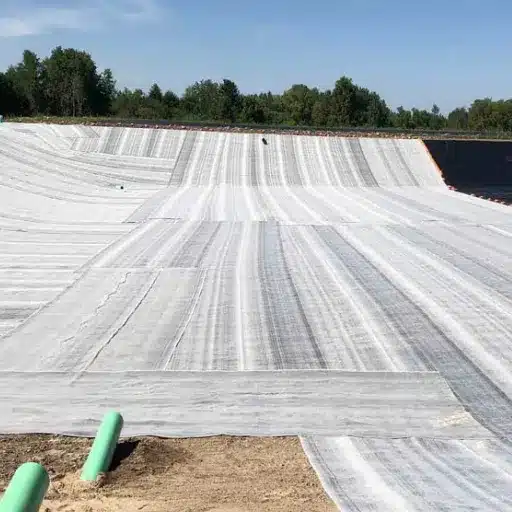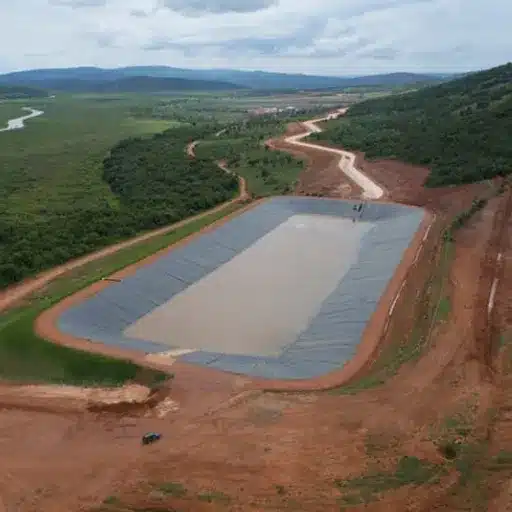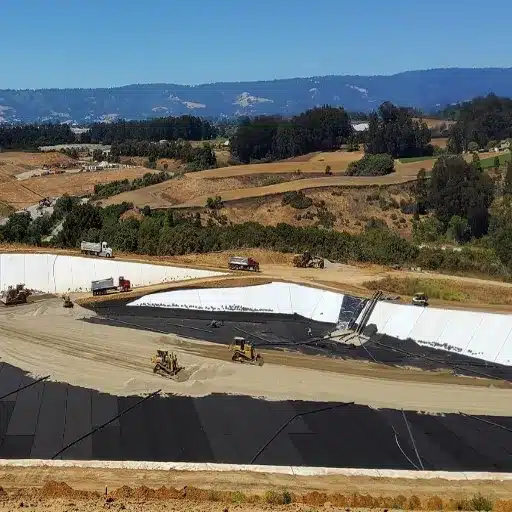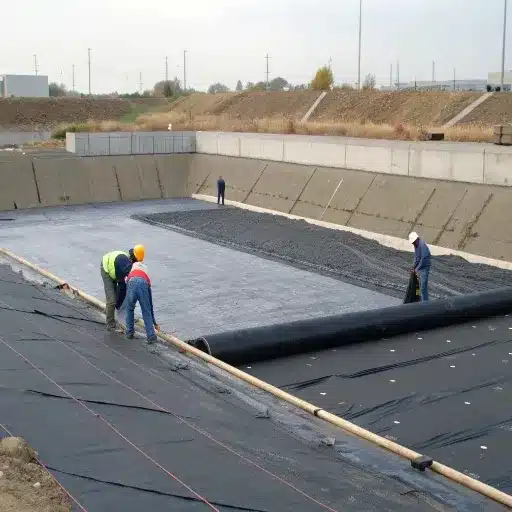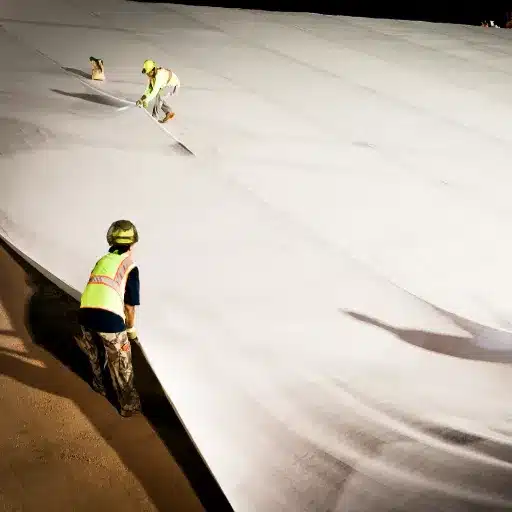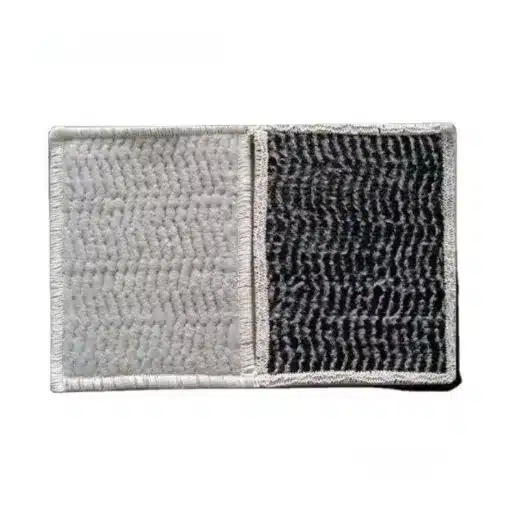
Geotextile separation and filtration are two of the five core functions that make geotextile fabric indispensable in civil engineering. Separation keeps dissimilar soil layers from mixing under load. Filtration allows water to pass while retaining soil particles. Most road base, landfill, and coastal projects rely on one or both of these functions to extend service life and reduce maintenance.
Engineers and procurement buyers often confuse the two functions. A fabric selected for separation alone may fail in filtration applications, and a fabric optimized for filtration may lack the strength needed for separation under heavy loads. This guide explains how each function works, when they overlap, and how to specify the right geotextile for your project. For a complete overview of geotextile functions and selection, see our geotextile fabric guide.
Key Takeaways
- Geotextile separation prevents intermixing of soil layers under traffic or surcharge loads.
- Geotextile filtration allows water to drain while retaining soil particles through a natural filter cake.
- Nonwoven geotextiles are usually preferred for filtration; woven geotextiles are often preferred for separation under high loads.
- AASHTO M288 survivability classes and FHWA filtration criteria provide the design framework.
- Common failures are caused by clogging, underspecified strength, or hydraulic mismatch.
What Is the Geotextile Separation Function?
The Separation Mechanism
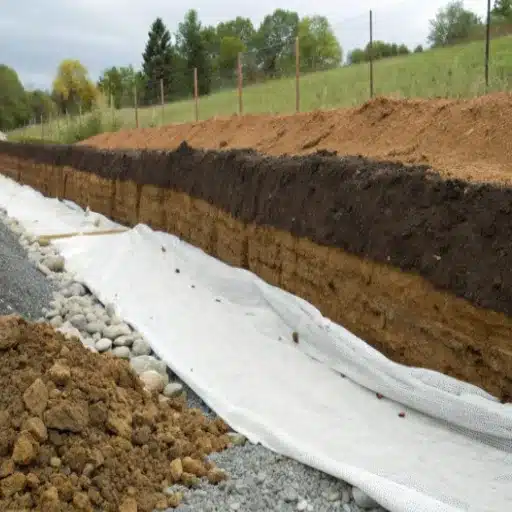
The geotextile separation function is the physical barrier function. A geotextile layer is placed between two materials with different particle sizes — typically a fine subgrade soil and a coarse aggregate base. Without the fabric, repeated traffic loads pump fines upward into the aggregate, contaminate the drainage layer, and reduce bearing capacity.
The geotextile does not need to be impermeable. In fact, it should allow water to pass. Its primary job is to maintain the integrity of each layer so the pavement or structure performs as designed. The geotextile separation function is especially critical on weak subgrades where the California Bearing Ratio (CBR) is below 3%.
Where Separation Is Required
Common separation applications include:
- Road and highway subgrades — between subgrade soil and aggregate base course.
- Railway trackbeds — between sub-ballast and ballast to prevent contamination.
- Landfill liner systems — between the geomembrane and drainage media to protect the membrane.
- Airfield pavements — where heavy wheel loads concentrate stress on the subgrade.
- Construction platforms — over soft or variable soils.
What Is the Geotextile Filtration Mechanism?
The Filtration Mechanism and Filter Cake
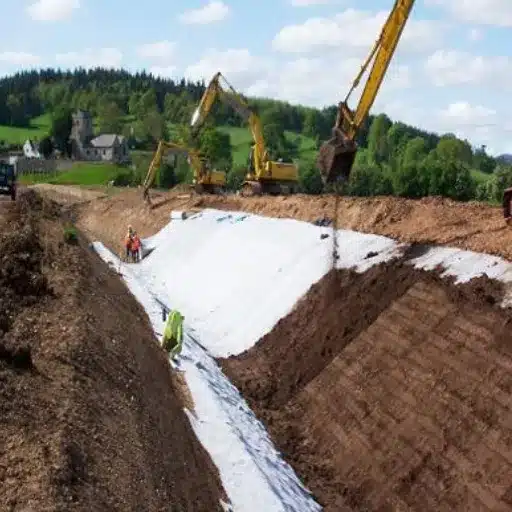
Geotextile filtration allows water to move through the fabric while preventing soil particles from migrating with the flow. The mechanism relies on three zones:
- The geotextile provides an initial pore structure that retains larger soil particles.
- The bridging or filter cake layer — a thin, naturally graded zone of soil particles that forms against the fabric.
- The undisturbed soil — behind the filter cake, soil remains in place, and hydraulic gradients stabilize.
Once the filter cake forms, the geotextile and the soil work together. The fabric must be permeable enough to prevent water pressure buildup, but fine enough to retain the base soil. This balance is controlled by apparent opening size (AOS) and permittivity, two of the most important properties in geotextile filtration design.
Where Filtration Is Required
Filtration applications include:
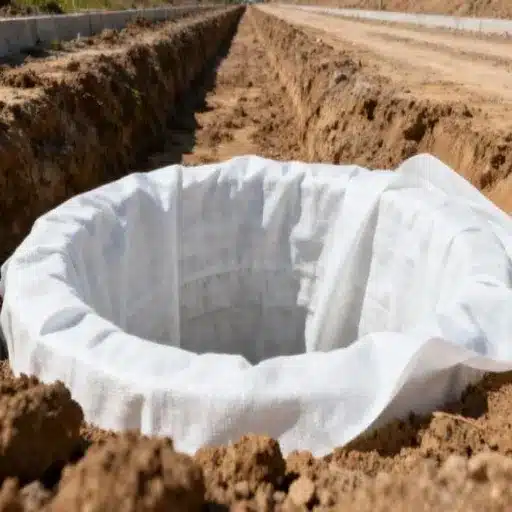
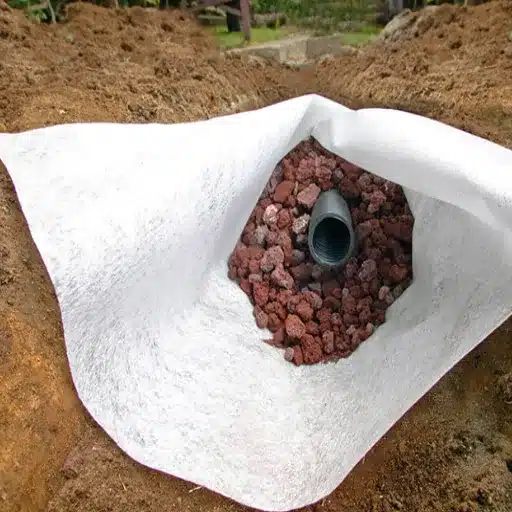
- Trench and edge drains — wrapping aggregate to keep the surrounding soil out.
- Retaining wall drainage — placed behind walls to relieve hydrostatic pressure.
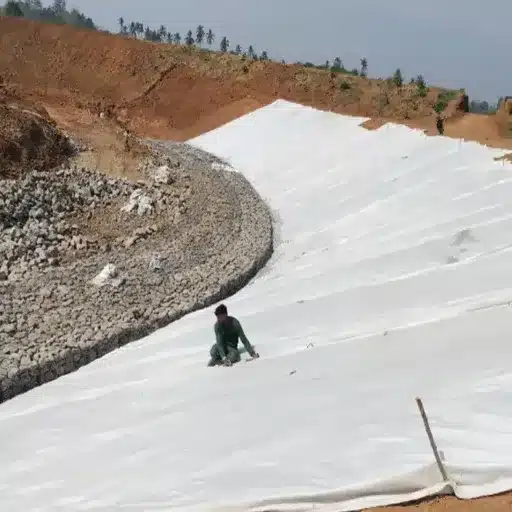
- Riprap and shoreline revetment — beneath armor stone to prevent soil loss.
- Landfill leachate collection — protecting drainage layers while transmitting liquid.
- French drains and blanket drains — long-term subsurface drainage systems.
For drainage-focused design, see our guide to nonwoven geotextile drainage applications.
Separation vs. Filtration: Key Differences
The two functions are related but not interchangeable. The table below summarizes the distinction.
| Factor | Separation | Filtration |
|---|---|---|
| Primary purpose | Prevent layer intermixing | Allow water flow while retaining soil |
| Water flow | Incidental passage | Designed flow rate |
| Critical property | Tensile strength, puncture resistance | AOS, permittivity, porosity |
| Typical fabric | Woven geotextile or heavy nonwoven | Nonwoven needle-punched geotextile |
| Key standard | AASHTO M288 survivability | FHWA retention and permeability criteria |
| Failure mode | Pumping, rutting, contamination | Clogging, blinding, piping |
Some applications require both functions. A road subgrade over a silty soil needs separation to preserve the aggregate base and filtration to prevent water pressure buildup beneath the pavement. In these cases, a heavy nonwoven geotextile often provides the best balance between geotextile separation and filtration.
Woven vs. Nonwoven: Which Fabric for Which Function?
Nonwoven Geotextiles for Filtration
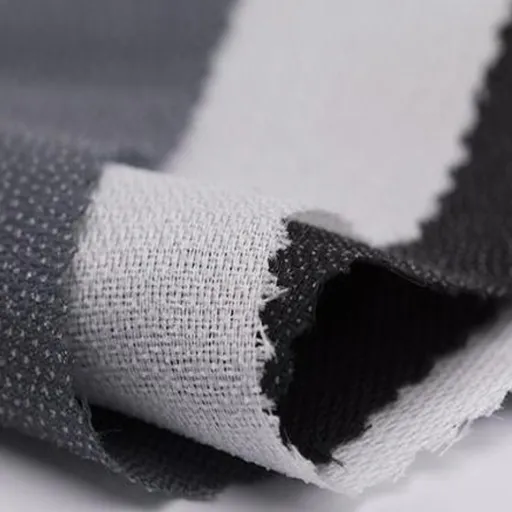
Nonwoven geotextiles are manufactured by needle-punching, heat-bonding, or chemically bonding random fibers. The resulting pore structure has a wide distribution of openings that is ideal for filtration. Nonwovens typically offer:
- High permittivity (water flow capacity)
- Good soil retention across a range of particle sizes
- Better conformability to irregular surfaces
- Thickness that protects geomembranes and provides cushioning
For filtration, the fabric must satisfy three FHWA criteria: retention, permeability, and clogging resistance. A properly specified nonwoven geotextile will form a stable filter cake and continue to drain for the design life. This is why nonwoven geotextile filtration is the default choice for most drainage and environmental applications.
Woven Geotextiles for Separation
Woven geotextiles are made by interlacing polypropylene or polyester yarns. They offer high tensile strength, low elongation, and good dimensional stability. These properties make them well-suited for separation under load, such as beneath road bases, railway ballast, and construction platforms.
The limitation of woven geotextiles is their relatively uniform pore structure. Slit-film wovens have low open area and poor filtration performance. Monofilament wovens offer better filtration but still lag behind nonwovens for fine-grained soils.
For a deeper comparison, see our article on woven vs. nonwoven geotextiles.
PET vs. PP Polymer Considerations
Polypropylene (PP) geotextiles are hydrophobic, lightweight, and resistant to most chemicals. They are widely used for drainage and separation. Polyester (PET) geotextiles offer higher tensile strength, lower creep, and better long-term performance under sustained loads. PET is often preferred for permanent retaining structures and landfill applications where design life exceeds 50 years.
Mini-story: A contractor in Vietnam installed a woven slit-film geotextile beneath a coastal access road to separate the sandy subgrade from the crushed-stone base. The fabric had adequate tensile strength for the traffic loads, but its small open area restricted water flow. After several monsoon seasons, excess pore pressure built up under the pavement. The road surface cracked and required a full reconstruction using a nonwoven separation and filtration layer.
This case shows why geotextile separation and filtration design must be evaluated together when water is present.
Geotextile Separation and Filtration: Design Standards and Specifications
AASHTO M288 Survivability Classes
AASHTO M288 is the standard specification for geotextiles used in highway applications. It assigns survivability classes based on installation stress and service conditions. Higher classes are required for sharp aggregate, heavy loads, and difficult placement.
| Property | Class 1 (min) | Class 2 (min) | Class 3 (min) |
|---|---|---|---|
| Grab tensile strength | 1,400 N | 1,100 N | 800 N |
| Tear strength | 500 N | 400 N | 300 N |
| CBR puncture | 3,500 N | 2,700 N | 1,900 N |
| UV resistance retained | 50% | 50% | 50% |
Class 1 is appropriate for severe separation and filtration applications such as heavy riprap, railway ballast, and weak subgrades. Class 2 covers typical road base separation. Class 3 is limited to protected, low-stress applications.
FHWA Filtration Design Criteria
The Federal Highway Administration (FHWA) provides three criteria for geotextile filtration design:
- Retention criterion: The geotextile opening size (O95) must be small enough to retain the base soil. For cohesionless soils, common guidance is O95 ≤ d85 of the soil.
- Permeability criterion: The geotextile permeability should exceed the soil permeability. This prevents water pressure buildup at the soil-fabric interface.
- Clogging resistance criterion: The fabric must not blind or clog under the expected hydraulic gradient and soil conditions. Nonwovens with high porosity generally perform better for fine or silty soils.
These criteria ensure the geotextile filters function effectively without creating a new failure plane.
ASTM Test Methods
Engineers specify geotextiles using ASTM test methods:
- ASTM D4751 — Apparent Opening Size (AOS) for retention design.
- ASTM D4491 — Permittivity for flow capacity.
- ASTM D4595 — Wide-width tensile strength for structural applications.
- ASTM D4533 — Trapezoidal tear resistance.
- ASTM D6241 — CBR puncture resistance.
Always request Minimum Average Roll Values (MARV) rather than average test values. MARV provides a conservative basis for design.
Common Geotextile Separation and Filtration Mistakes
Clogging and Blinding
Clogging occurs when soil particles block the fabric’s pores. Blinding occurs when a layer of fine soil seals the fabric surface. Both reduce drainage capacity and can lead to water pressure buildup.
Prevention starts with proper soil gradation analysis and AOS selection. For silty or gap-graded soils, a nonwoven geotextile with high porosity and adequate permeability is usually safer than a woven fabric.
Survivability Failures
A geotextile can be chemically and hydraulically correct but still fail because it is not tough enough for installation. Sharp aggregate, heavy placement equipment, and high-drop placement can tear or puncture lightweight fabrics.
Match the AASHTO M288 class to the site conditions. When in doubt, specify Class 1. The small additional material cost is far less than the cost of repair or replacement.
Hydraulic Mismatch
Hydraulic mismatch happens when the geotextile is less permeable than the soil it is meant to drain. Water cannot exit as fast as it enters, so pressure builds. This is common when designers specify a fabric with adequate retention but insufficient permittivity.
The fix is to design for flow rate, not just opening size. Check the required permittivity against the expected inflow and factor in long-term clogging potential.
Project Applications
Road Subgrade Separation and Filtration
Roads over fine-grained or saturated subgrades need both functions. The geotextile keeps the aggregate base clean while allowing water to drain. On weak subgrades with CBR below 3%, a Class 1 heavy nonwoven geotextile is usually the best choice for combined geotextile separation and filtration.
Benefits include reduced aggregate thickness, longer pavement life, and lower lifecycle maintenance cost. Separation geotextiles can extend pavement service life by reducing pumping and rutting.
Landfill Leachate Collection and Drainage
Modern landfills use composite liner systems. The geotextile protects the geomembrane from puncture and acts as a filter for the leachate collection layer. It must resist chemical exposure, survive installation over drainage media, and maintain permeability under load.
PET nonwoven geotextiles are commonly used here because of their chemical compatibility, strength, and long-term creep resistance.
Coastal Protection and Riprap Underlayment
Riprap and armor stone protect shorelines from wave energy. Beneath the stone, a geotextile prevents the underlying soil from washing through the armor joints. In this application, the fabric provides both filtration and separation.
Monofilament woven or thick nonwoven geotextiles are typically used. The fabric must resist puncture from large stones, UV exposure during construction, and cyclic wave loading. For related design guidance, see our article on geotextile erosion control solutions.
Frequently Asked Questions
What is the difference between separation and filtration in geotextiles?
Separation prevents two soil or aggregate layers from mixing under load. Filtration allows water to pass through the fabric while retaining soil particles. Many road and drainage applications require both geotextile separation and filtration functions.
Which geotextile is best for filtration?
Nonwoven needle-punched geotextiles are usually best for filtration because of their high permeability, wide pore-size distribution, and ability to form a stable filter cake.
Which geotextile is best for separation?
Woven geotextiles or heavy nonwoven geotextiles are preferred for separation. Woven fabrics offer higher tensile strength and lower elongation, making them ideal for loads from traffic, ballast, or armor stone.
What is AOS in geotextile filtration design?
AOS stands for Apparent Opening Size, measured by ASTM D4751. It represents the approximate largest particle that can pass through the fabric and is the main property used for retention design.
How do you prevent geotextile clogging?
Prevent clogging by matching the fabric AOS to the soil gradation, choosing nonwovens for silty or gap-graded soils, and ensuring the fabric permeability exceeds soil permeability. Field monitoring during construction also helps.
Can woven geotextiles be used for filtration?
Monofilament woven geotextiles can be used for filtration in coarse-grained soils, but they are generally less forgiving than nonwovens. Slit-film wovens are rarely suitable for filtration.
Conclusion: Design for Both Functions
Geotextile separation and filtration are foundational to modern civil, environmental, and coastal engineering. Separation preserves the structure of soil and aggregate layers. Filtration protects drainage paths and prevents soil loss. When a project involves both loads and water flow, the fabric must be specified for both functions.
Start with the project conditions. Identify the soil type, load, hydraulic gradient, and design life. Then select the fabric type, AOS, permittivity, and AASHTO M288 class that match those conditions. Nonwoven geotextiles dominate filtration and combined applications. Woven geotextiles excel in high-load separation.
If you need help selecting the right separation or filtration geotextile for roads, landfills, retaining walls, or coastal works, Shanxi Shengxing supplies both woven and nonwoven geotextiles with certified MARV test reports, ISO 9001 quality management, and export packaging. Request a technical specification or quote today.