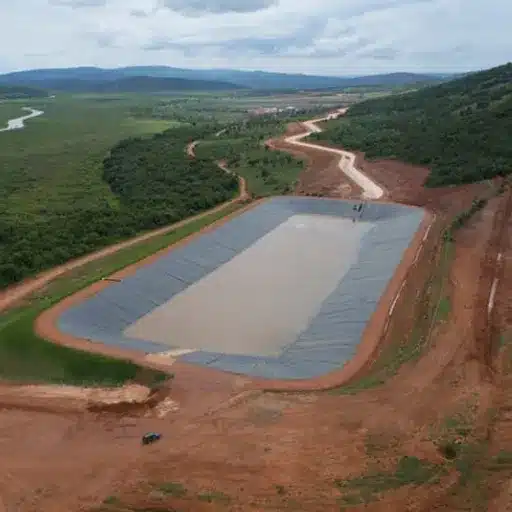
To choose the right GCL, work through one sequence: characterise the contained liquid, confirm the permitted flux, set the hydraulic head and confining stress, assess slope and shear demand, fix the design life, then select the type, the bentonite mass per unit area, and the index flux before you qualify a supplier. Change the order and you start solving the wrong problem.
Choosing the wrong geosynthetic clay liner is one of the quietest ways to lose a containment project. The liner still installs. The panel still overlaps. The failure shows up three years later, in a permit resample that no longer meets the design flux.
When Daniel specified the liner for a four-hectare irrigation reservoir in 2023, the winning quote was the cheapest per square metre: a standard sodium-bentonite GCL at 3,000 g/m². Eighteen months later the reservoir was drawing from a mildly saline source, and calcium and magnesium had begun displacing sodium in the bentonite. Retesting showed conductivity had climbed roughly an order of magnitude. The six percent he saved on material was repaid many times over in a retrofit.
You probably already know a GCL is a thin bentonite barrier between geotextiles, and that it’s fast and cheap to install compared with hauling clay. What most datasheets never tell you is how to move from your project conditions to a complete, specifiable liner.
This guide gives you that path: an eight-step framework, a selection matrix, a printable checklist, and an honest note on when a GCL is the wrong answer. For the broader picture, start with our complete geosynthetic clay liner guide.
Key Takeaways
- Chemistry, not price or thickness, is the decisive selection input. Divalent cations (Ca²⁺, Mg²⁺) can raise GCL conductivity by 0.5 to 1 order of magnitude over 1 to 3 years, and by up to 4 orders of magnitude in concentrated CaCl₂.
- Anchor every specification to a number you can test: index flux (ASTM D5887, max 1 × 10⁻⁸ m³/m²/s), swell index (ASTM D5890, ≥24 mL/2g), fluid loss (ASTM D5891, ≤18 mL), and bentonite mass (ASTM D5993, typically 3,000–6,000 g/m²).
- Design slopes to residual shear strength (roughly 5–8°), not peak (16–18°), and hold a factor of safety of at least 1.5.
- A geomembrane placed directly over a GCL is the highest-performing containment build-up, dropping leakage from ~860 L/ha/day to 0–4 L/ha/day, but only with direct layer contact.
- Verify bentonite mass, swell index, and fluid loss on every quote. Comparing headline permeability alone is how you buy a thinned spec.
How to Choose a GCL: The 8-Step Framework
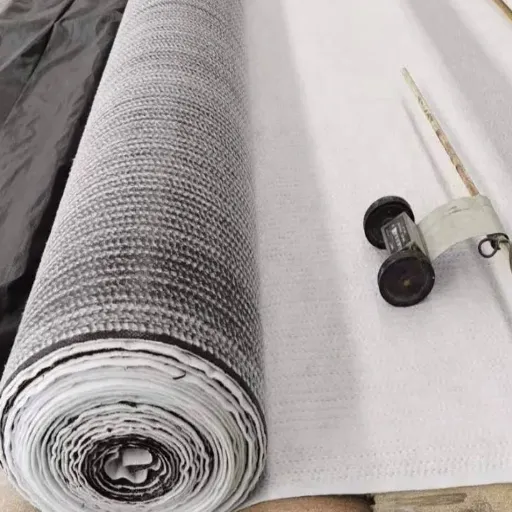
The framework below turns project conditions into a specifiable liner. Each step narrows the options, and each one links to the section that covers it in depth.
- Characterise the contained liquid and its chemistry risk.
- Confirm the regulatory requirement and permissible flux.
- Establish the hydraulic head and confining stress.
- Assess the slope angle and shear demand.
- Fix the design life and wet-dry exposure.
- Select the GCL type: reinforcement, bentonite form, and lamination.
- Set the bentonite mass per unit area and the index flux.
- Decide single GCL versus composite, then qualify the supplier.
Run the eight steps in order. Steps 1 through 5 describe your project. Steps 6 and 7 describe the product. Step 8 describes who you buy it from.
Step 1: Characterise the Contained Liquid
Chemistry is where most GCL selection errors begin, and it is the step buyers skip most often. Sodium bentonite works because it swells on hydration, expanding to roughly 10 to 16 times its dry volume and sealing the space between granules. That swelling depends on the sodium ions held between the clay layers.
Divalent cations break that mechanism. When calcium (Ca²⁺) or magnesium (Mg²⁺) replaces sodium in the bentonite, the clay loses swell capacity and permeability rises. In field studies, this sodium-to-calcium exchange raised conductivity by roughly 0.5 to 1 order of magnitude over 1 to 3 years. Permeation with concentrated CaCl₂ pushed conductivity up by about four orders of magnitude. The most aggressive leachates sit below about pH 3 or above about pH 11.
The practical test is the ratio of monovalent to divalent cations in your pore fluid. As that ratio falls, conductivity rises. Bench compatibility testing (ASTM D6766) tells you where your liquid falls.
Route the result before you look at products:
- Benign water (freshwater ponds, canals, clean reservoirs) keeps a standard sodium-bentonite GCL viable.
- Mild leachate (non-hazardous municipal waste) suits a standard GCL, paired with long-term monitoring.
- Aggressive chemistry (mine leachate, brine, high divalent loading) calls for polymer-modified or dense-prehydrated bentonite, or a design in which the geomembrane is the primary barrier.
If chemistry is your main constraint, the deeper discussion lives in our guide to sodium bentonite and chemical compatibility.
Step 2: Confirm the Regulatory Requirement and Permissible Flux
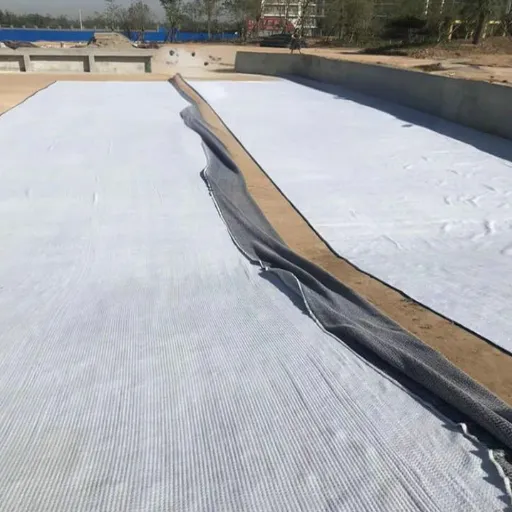
A GCL has to satisfy a permitted flux, not a marketing number. Landfill regulations such as US EPA Subtitle D set a design permeability and leachate head target that your liner must meet over its service life.
Work backwards from two benchmarks. Under GRI-GCL-3, the accepted limits are a maximum index flux of 1 × 10⁻⁸ m³/m²/s and a maximum permeability of 5 × 10⁻⁹ cm/s. As a design reference, the EPA used a GCL conductivity of about 1 × 10⁻⁹ cm/s at roughly 7 mm, compared with 1 × 10⁻⁷ cm/s for a 0.6 m compacted clay liner.
Those two numbers tell you how much barrier you need before you look at a single product. Our GCL hydraulic conductivity and index flux reference covers the full test-method detail.
Step 3: Establish Hydraulic Head and Confining Stress
Head drives flux, but confining stress decides whether the GCL stays tight. The two interact, and together they set the worst-case performance you should design for.
Conductivity falls as confining stress rises. Conventional GCLs typically run about 3 × 10⁻¹⁰ to 1 × 10⁻⁹ cm/s at 100 to 1,000 kPa, but can exceed 1 × 10⁻⁷ cm/s at around 1 kPa. That low-stress condition is where thin covers fail.
Self-sealing needs cover. Bentonite re-seals reliably under more than 0.75 m of cover, giving roughly 15 to 20 kN/m² of stress, and preferably under 1.0 m. Below about 15 kN/m², desiccation risk climbs sharply. For shallow ponds and low-cover applications, plan for a higher bentonite mass, polymer modification, or a composite system rather than assuming the standard roll will hold.
Step 4: Assess Slope Angle and Shear Demand
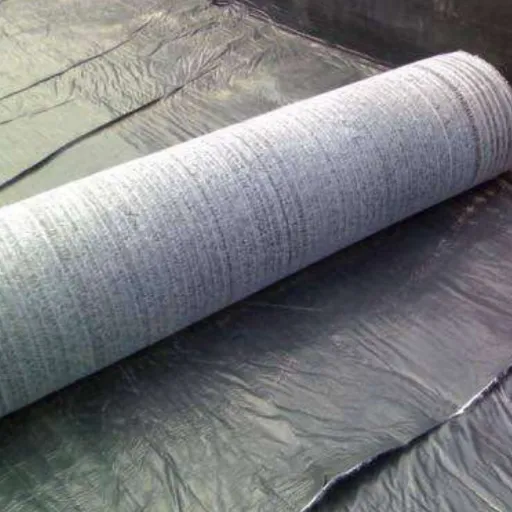
On slopes, the controlling values are usually the GCL’s internal shear strength and its interface friction against neighbouring layers. Design to the lowest strength along any failure plane, and hold a factor of safety (FS) of at least 1.5.
The type-to-slope logic is straightforward. Non-reinforced GCLs are for near-flat work, generally gentler than 10:1. Internally reinforced products (needle-punched or scrim-reinforced) suit 3:1 slopes, and heavy-duty canyon-landfill grades reach 1.5:1. In practice, 2:1 is a common maximum and 3:1 to 4:1 is the everyday range.
One number trips up most specifications: residual shear strength. Reinforced GCLs show peak internal friction angles of roughly 16 to 18 degrees, but residual values of only about 5 to 8 degrees. Design to the residual. In a composite, the geomembrane-to-bentonite interface is often the weakest plane of all, with reported peak angles as low as 8 to 12 degrees when saturated. Confirm it with project-specific testing.
| Application / geometry | Typical slope | Recommended GCL | Properties to prioritize |
|---|---|---|---|
| Pond or reservoir floor, canal | Near-flat | Non-reinforced, standard bentonite | Low conductivity, high bentonite mass |
| Pond or reservoir side slopes | 3:1–4:1 | Reinforced (needle-punched) | Internal residual shear |
| MSW landfill side slope | 3:1 | Reinforced | Shear, long-term chemistry |
| Steep canyon landfill cell | 1.5:1–2:1 | High-friction reinforced, textured composite | Residual shear, FS ≥ 1.5 |
| Heap leach, tailings slope | Variable | Reinforced, chemical-resistant bentonite | Chemistry and shear |
For the taxonomy behind those choices, see types of geosynthetic clay liner.
Step 5: Fix the Design Life and Wet-Dry Exposure
Service life for containment liners is commonly specified above 25 years, with 50-year projections modelled through ISO TR 20432. Three aging threats decide whether your GCL can reach that life.
The first is divalent-cation exchange, covered in Step 1. The second is desiccation and wet-dry cycling, which in field studies raised permittivity by four to five orders of magnitude once cracks formed and failed to re-close. The third is the loss of gas-barrier performance: a dry, unhydrated GCL doesn’t block gas at all.
Location decides how hard those threats bite. A covered, saturated, moderate-climate cell ages far more slowly than an exposed, arid cover that cycles wet and dry. A widely cited study found that even a 750 to 1,000 mm soil cover did not prevent ion exchange over time, so specify conservatively for covers.
Step 6: Select the GCL Type
Three product axes follow directly from Steps 1 through 5.
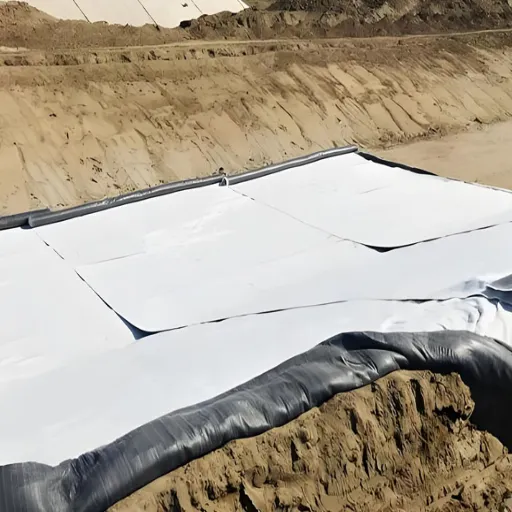
Reinforcement is set by slope and shear demand. Non-reinforced GCLs use needle-punched or stitch-bonded geotextiles. Internally reinforced products add a scrim that raises shear strength and, importantly, resists the shrinkage that unrestricted GCLs can show over time, where unrestrained panels have contracted up to several hundred millimetres without cover.
Bentonite form is set by subsoil moisture and application. Powdered bentonite generally produces lower conductivity and suits lower-stress installations. Granular bentonite can hydrate and install more easily in some field conditions.
Lamination or coating is set by chemistry and gas-barrier need. A geotextile-encapsulated GCL is the standard barrier. A geomembrane-laminated or coated GCL adds a gas barrier and moves you toward a composite system, which is the subject of Step 8.
Step 7: Set Bentonite Mass Per Unit Area and Index Flux
Bentonite mass is the “how much barrier” number, and it is the specification buyers let slip most often. The standard range is 3,000 to 6,000 g/m² (3.0 to 6.0 kg/m²), with a recommended minimum around 4,000 g/m² measured at 0% moisture. Index flux falls by roughly 50 percent when bentonite rises from 3,000 to 6,000 g/m², even though measured conductivity stays roughly constant.
Match mass to duty rather than to habit:
- 3,000 g/m² for ponds, canals, and decorative lakes.
- 4,000 g/m² for reservoirs and secondary containment.
- 4,500 g/m² for landfill base liners and caps, a common specification.
- 5,000 to 6,000 g/m² for landfill, tailings, and tougher chemistry.
Three numbers on any quote tell you whether the product is what you asked for: bentonite mass (ASTM D5993), swell index (ASTM D5890, ≥24 mL/2g), and fluid loss (ASTM D5891, ≤18 mL). Specify index flux per ASTM D5887 on top of those. Higher loading costs more, so match mass to the duty. Our GCL cost per square meter guide shows how that plays out in a quote.
Step 8: Decide Single vs Composite, and Qualify the Supplier
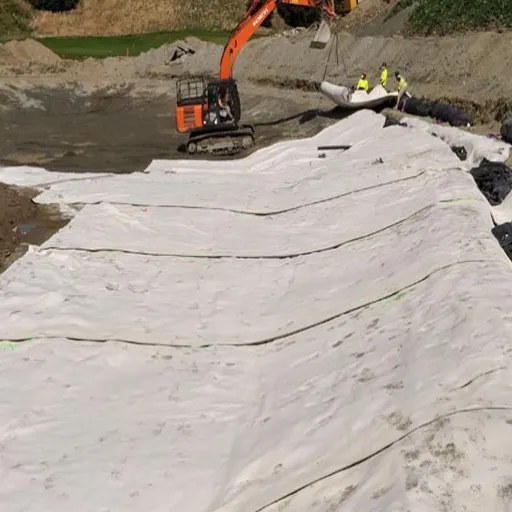
A single GCL works for many water-containment projects, but where leakage limits are tight, the composite geomembrane-over-GCL build-up is the strongest option. The leakage evidence is stark: a geomembrane alone leaks 100 to 1,000 L/ha/day, a GCL alone roughly 860 L/ha/day, and a true composite just 0 to 4 L/ha/day.
That performance depends on one condition. The geomembrane must sit in direct contact with the clay, with no sand or geonet between the layers. Where contact is poor, a GCL beneath a primary geomembrane may not measurably reduce leakage at all. The design detail is in our composite liner system guide.
Once the system is decided, write the spec rather than the product name. Send your supplier the contained liquid and chemistry, the required flux, head, confining stress, slope and FS, design life, type, bentonite mass, index-flux method, overlap, and cover, plus roll width, length, and delivery.
Then qualify the supplier against documentation: GRI-GCL-3 conformance, ASTM D5887, D5890, D5891, D5993, and D6243 test reports, ISO 9001 quality control, sample retention, and export documentation. This is the stage where an export-ready GCL range and a responsive technical team save the most time.
Ready to turn your project conditions into a liner spec? Request a technical GCL quotation and we will match the type, mass, and index flux to your site.
GCL Selection Decision Matrix
Use this matrix as a screenshot-and-share summary. Confirm each row against your own design and certified test data.
| Application | Chemistry risk | Typical slope | Recommended GCL | Bentonite mass |
|---|---|---|---|---|
| Landfill base liner | Moderate–high (leachate) | 3:1 | Reinforced, composite GM/GCL | 4,500–5,000 g/m² |
| Landfill final cover | Moderate (desiccation) | Near-flat–3:1 | Reinforced, chemically robust | 4,500 g/m² |
| Pond / reservoir | Low–moderate | 2:1–4:1 | Reinforced or non-reinforced | 4,000–4,500 g/m² |
| Canal / ditch | Low | Near-flat–3:1 | Non-reinforced | 3,000–4,000 g/m² |
| Mining heap leach | High (acidic, saline) | Variable | Reinforced, polymer-modified or DPH | 5,000–6,000 g/m² |
| Tailings containment | High | Variable | Reinforced, chemical-resistant | 5,000–6,000 g/m² |
| Secondary containment | Low–moderate | Near-flat | Non-reinforced or laminated | 4,000 g/m² |
If your project is water containment, the GCL pond liner guide covers the pond-specific seam and cover requirements, including the general rule that GCLs are not recommended for ponds smaller than about 2,000 m².
GCL Selection Checklist
Take this list into your next specification meeting.
- What liquid will the GCL contain, and what is its chemistry: divalent cations, salinity, pH, and the monovalent-to-divalent ratio?
- What flux or permeability does the regulation or permit require?
- What is the hydraulic head, and what cover thickness sets the confining stress?
- What is the maximum slope angle, and what factor of safety applies (≥1.5)?
- What design life and wet-dry exposure must the liner survive?
- Which GCL type, in reinforcement, bentonite form, and lamination, matches those answers?
- What bentonite mass per unit area does the duty require?
- What index flux, swell index, and fluid-loss values will I specify?
- Single GCL or composite, and is direct geomembrane-to-clay contact achievable?
- Am I comparing verified test reports and total installed cost from a qualified supplier?
Common GCL Selection Mistakes (and When a GCL Is the Wrong Answer)
The same errors recur across projects. Choosing on price or datasheet thickness alone. Ignoring leachate chemistry. Specifying to peak rather than residual shear strength. Under-specifying bentonite mass. Skipping a low-confining-stress strategy. Assuming a dry GCL is a gas barrier. Leaving the cover and hydration control to the installer. Comparing quotes without verifying bentonite mass, swell index, and fluid loss.
There are also projects where a GCL is simply not the right tool. An engineer at a copper mine learned this the expensive way. The site had acidic, high-divalent process solution, and a conventional sodium-bentonite GCL was specified to save cost beneath a low cover. Within two years, permeability at the sample points had moved outside the design range, and the fix meant over-lining the affected cells.
Treat these conditions as stop signs: very aggressive leachate below about pH 3 or above pH 11, or high divalent loading that needs a geomembrane-primary or polymer-modified system; arid sites with severe wet-dry cycling; high puncture loading without adequate cover; ponds smaller than about 2,000 m²; and any project where long-term chemical attenuation, not just containment, is the goal. On that last point, a GCL vs compacted clay liner comparison explains when clay is the better barrier.
Frequently Asked Questions
What type of GCL do I need?
It depends on four inputs: the contained liquid’s chemistry, the permitted flux, the slope and shear demand, and the design life. Start with chemistry, then match reinforcement and bentonite form to the site. Non-reinforced GCLs suit near-flat work; reinforced grades suit 3:1 slopes and steeper.
What bentonite mass per unit area should a GCL have?
Standard GCLs carry 3,000 to 6,000 g/m², with a recommended minimum of about 4,000 g/m² at 0% moisture. Ponds and canals sit at the lower end; landfill, tailings, and aggressive chemistry sit at the upper end. Verify mass per ASTM D5993 on every quote.
Reinforced vs non-reinforced GCL, which should I use?
Use reinforced GCLs on slopes and wherever shear or shrinkage matters, typically 3:1 and steeper. Use non-reinforced GCLs for near-flat work gentler than about 10:1. The decision follows the slope and the required factor of safety.
Can a GCL go on a 2:1 slope?
Yes, with an internally reinforced product. Design to residual internal friction, roughly 5 to 8 degrees, and hold FS ≥ 1.5. Check the geomembrane-to-GCL interface, which can be the weakest plane in a composite at peak angles as low as 8 to 12 degrees when saturated.
Is a GCL chemically compatible with my leachate?
Run a compatibility test (ASTM D6766) before you commit. Divalent cations such as calcium and magnesium, high salinity, and pH below 3 or above 11 all degrade sodium bentonite. If your leachate is aggressive, specify polymer-modified or dense-prehydrated bentonite, or make the geomembrane the primary barrier.
What index flux should I specify?
Specify a maximum index flux of 1 × 10⁻⁸ m³/m²/s and a maximum permeability of 5 × 10⁻⁹ cm/s per GRI-GCL-3, tested to ASTM D5887. Anything the supplier cannot document is a number, not a specification.
Choosing Your GCL With Confidence
Learning how to choose a GCL comes down to sequence, not product brochures. Characterise the contained liquid. Confirm the permitted flux. Set head and confining stress. Assess slope and shear, design to residual strength, and hold FS ≥ 1.5. Fix the design life. Then select type, bentonite mass, and index flux, and finally qualify the supplier against real test reports.
Do it in that order and you’ll avoid the two failures that account for most GCL problems: a liner that meets the mechanics but not the chemistry, and a quote that looks standard but isn’t. The right answer is often a system, a geomembrane directly over a GCL, and the right supplier is one who will confirm the numbers with you.
Shanxi Shengxing supplies export-ready GCLs, geomembranes, and composite systems with technical consultation and flexible order quantities. Request a technical quote or explore our geosynthetic clay liner range to finalise your specification. For the complete background on GCLs, start with our complete geosynthetic clay liner guide.