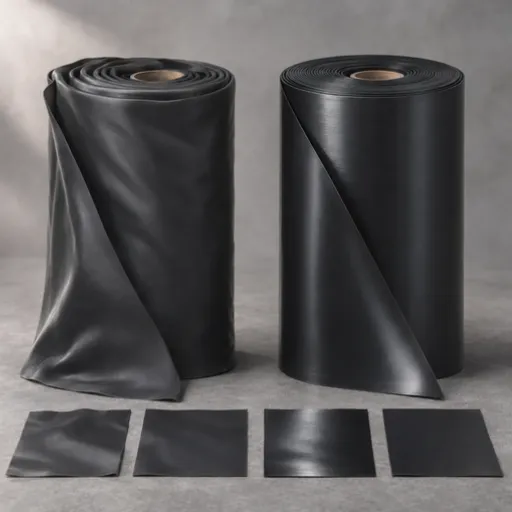
An fMLDPE geomembrane is not a defined product. No GRI specification reviewed for this article uses the name, and neither does the federal liner rule. The letters most likely stand for flexible metallocene linear low-density polyethylene, which is a real material family, but the acronym is supplier shorthand rather than a specification.
That matters because an undefined name can’t be enforced. A quote that says “fMLDPE” tells you nothing about density, thickness, stress crack resistance or seam strength.
A quote that cites GRI-GM17 Rev 17 and names the resin, gauge and test methods gives you something to inspect. You can test it. You can reject it.
This guide separates the name from the material. You’ll see what the letters probably mean, which polyethylene names do have definitions, what an fMLDPE geomembrane specification actually controls, and how to write a clause a supplier can’t reinterpret.
Key Takeaways
- An fMLDPE geomembrane is not an ASTM, GRI or regulatory designation. Treat the name as shorthand for flexible metallocene LLDPE, or as a typo for mLLDPE.
- GRI-GM17 defines LLDPE by density, not by catalyst: formulated sheet at 0.939 g/ml or lower, resin generally at 0.926 g/ml or lower, melt index at 1.0 g/10 min or less.
- GM17 deliberately omits stress crack resistance. If ESCR matters, your specification has to add ASTM D5397 or D1693.
- Revision 17 moved seam values into GM17 and withdrew the GM19a reference. A datasheet still citing GM19 for LLDPE seams is out of date.
What fMLDPE Is Probably Meant to Say
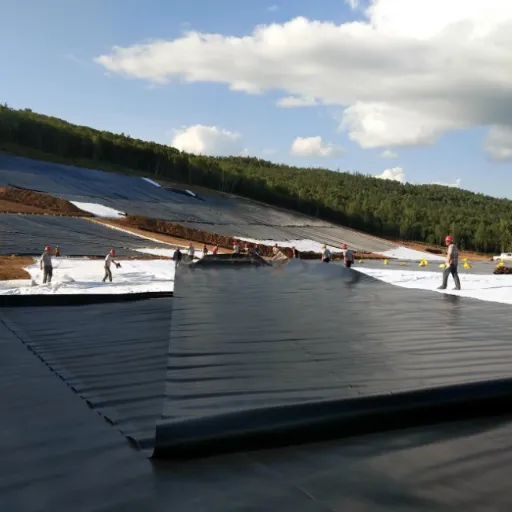
The most defensible expansion is flexible metallocene linear low-density polyethylene. Each word carries information, and each one tends to get dropped somewhere in the supply chain.
Flexible describes a property, not a polymer. Metallocene describes the catalyst that made the resin. LLDPE describes the molecular structure and the density band. Together they point at a low-density polyethylene sheet made from a single-site catalysed resin.
Two other readings are possible. The writer may have meant mLLDPE and added a stray letter. Or the name may be a collision between FML, the regulatory term for flexible membrane liner in 40 CFR 258.40, and LDPE, the older low-density material.
None of the GRI specifications reviewed for this article uses the term. GRI-GM17, GM13 and GM25 contain no occurrence of fMLDPE, metallocene or single-site catalyst. ASTM D7613 covers a different polymer altogether, flexible polypropylene, so it says nothing about a polyethylene sheet either way.
A datasheet crossed a procurement desk in 2025 with “fMLDPE 1.5 mm” in the material line and nothing else. The buyer assumed the density and test values matched LLDPE. They didn’t. The sheet was a blended polyethylene with no stated melt index, and the project had no clause to test against.
The example is illustrative, not a client record. The failure mode is common all the same: the name did the work the specification should have done.
Holding a datasheet that says fMLDPE? Send the material line and the application. We’ll check it against GM17 before you order.
The Polyethylene Names That Do Have Definitions
Polyethylene naming runs on density and comonomer, with a catalyst label bolted on when a supplier wants to differentiate. Here is what each name claims and what it actually enforces.
| Name | What it claims | What it enforces | Standard |
|---|---|---|---|
| LDPE | Low-density polyethylene, long-chain branched | No dedicated specification among the polyolefin GRI standards reviewed here | None identified |
| LLDPE | Linear low-density polyethylene | Formulated sheet ≤0.939 g/ml; resin generally ≤0.926 g/ml; MI ≤1.0 g/10 min | GRI-GM17 |
| mLLDPE | LLDPE made with a metallocene catalyst | Same GM17 table; the catalyst isn’t named in the standard | GRI-GM17, by test results |
| VLDPE | Very low-density polyethylene | Falls under the GM17 ceiling if the formulation qualifies | GRI-GM17 |
| MDPE | Medium-density polyethylene | Resin category, not a separate geomembrane standard | None identified |
| HDPE | High-density polyethylene | Formulated sheet ≥0.940 g/ml; resin ≥0.932 g/ml; MI <1.0 g/10 min | GRI-GM13 |
| LLDPE-R | Reinforced LLDPE with a fabric scrim | Four thickness categories, density ≤0.939 g/ml | GRI-GM25 |
| fPP | Flexible polypropylene | A distinct polymer class with its own standard | ASTM D7613 |
| FML | Flexible membrane liner, a regulatory term | Minimum 30 mil, or 60 mil where the FML is HDPE | 40 CFR 258.40 |
Two rows deserve emphasis. mLLDPE is not a separate specification. A metallocene resin qualifies under GM17 only by passing the same property table as any other LLDPE.
fPP is a separate specification. It has its own ASTM standard because it’s a different polymer, not because it’s more flexible.
That’s where most of the confusion starts for an fMLDPE geomembrane buyer. A supplier can call any polyethylene sheet flexible. Only the density, modulus and elongation values make the word mean something.
The LLDPE geomembrane guide takes those values through thickness selection and applications.
What an fMLDPE Geomembrane Specification Actually Controls
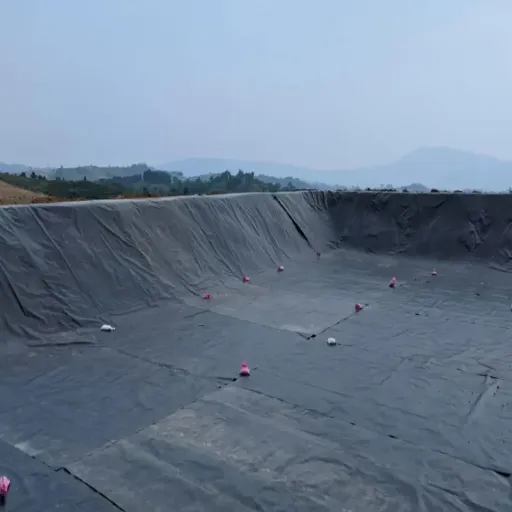
The GRI-GM17 standard is the LLDPE specification. Revision 17, dated 11 June 2025, is current. Its scope is narrow and specific, and it applies to an fMLDPE geomembrane exactly as it applies to any other LLDPE sheet.
The five formulation rules:
- Formulated sheet density must be 0.939 g/ml or lower.
- The natural resin will generally be 0.926 g/ml or lower.
- Melt index must be 1.0 g/10 min or less by ASTM D1238.
- Resin must be virgin, with no more than 10% same-formulation rework.
- No post-consumer resin of any type may be added.
The standard covers smooth and textured sheet from 0.50 mm to 3.0 mm, or 20 to 120 mil. At every gauge it sets a minimum 800% break elongation, a 2% secant modulus no higher than 414 MPa, and carbon black between 2.0% and 3.0%.
The full property table lives in the LLDPE geomembrane specifications guide.
What GM17 doesn’t do is just as important. Note 5 names the tests deliberately left out, and environmental stress crack resistance is one of them. ASTM D1693 and D5397 both sit on that omission list. A supplier claiming metallocene ESCR is claiming a property the standard doesn’t police.
Revision 17 also changed the seam picture. Seam strength moved into GM17, replacing the older GRI-GM19a reference. At 1.50 mm, hot wedge seams must reach 394 N/25 mm in shear and 328 N/25 mm in peel, with 50% shear elongation and no more than 25% peel separation. Extrusion fillet peel at that gauge is 290 N/25 mm.
Need an fMLDPE geomembrane quote checked against the current revision? Send the application, gauge and finish. Request a technical review.
What Metallocene Resin Changes in an fMLDPE Geomembrane
Metallocene catalysts are single-site catalysts. Compared with the Ziegler-Natta catalysts used for most LLDPE, they produce a narrower molecular weight distribution and more uniform comonomer placement.
The documented effects are real. A 2018 International Conference on Geosynthetics paper by Lou, Tay and Lim describes metallocene polyethylene as having better mechanical and sealing properties than Ziegler-Natta polyethylene.
In geomembranes, the same paper reports limited adoption. The narrow molecular weight distribution causes poor melt stability during extrusion, especially in blown film. The resin also costs more.
The practical route around those limits is a coextruded sheet. A metallocene core can improve flexibility and puncture resistance. Outer layers keep the chemical resistance and welding behaviour of a conventional polyethylene.
That’s a formulation decision, not a material category, and it belongs in the datasheet.
Density shifts too. The same paper notes that typical mLLDPE density can be much lower than Ziegler-Natta LLDPE, which helps explain the softer feel. One resin distributor lists a hexene mLLDPE grade at 0.933 to 0.935 g/cm³, a 0.5 g/10 min melt index and an ESCR above 1,000 hours by ASTM D1693. Treat those as grade-specific figures, not a family average.
What the resin doesn’t change is the specification. For an fMLDPE geomembrane, the sheet still has to meet the GM17 density ceiling, elongation floor and modulus cap. It still has to pass the seam values.
An illustrative composite. A liner contractor switched a landfill cap to a metallocene grade, expecting better puncture performance on rocky subgrade. Puncture values improved. The welding crew then found a narrower processing window, and the first trial welds failed peel.
The project recovered by re-qualifying the weld procedure. Resin changes and welding procedure changes travel together.
“Flexible” Is a Property, Not a Polymer
Flexible appears in almost every LLDPE datasheet, and it rarely carries a number. GM17 gives it two.
The first is break elongation, with a minimum of 800% at every gauge. The second is 2% secant modulus, capped at 414 MPa. A sheet that’s too stiff fails the modulus cap, because it’s no longer behaving like the flexible material the standard was written for.
Density is related but not equivalent. VLDPE sits below LLDPE on density and generally feels softer. HDPE sits above 0.940 g/ml and feels stiffer at the same gauge.
A low-density sheet with poor carbon black dispersion can still fall short on elongation. That’s why the test values matter more than density alone.
PVC gets its flexibility from plasticizer instead, which is why the LLDPE vs PVC geomembrane comparison turns on service exposure rather than density.
Two phrases should trigger a question. “Flexible HDPE” contradicts GM13’s 0.940 g/ml density floor. “High-flex LLDPE” means something only when the datasheet gives modulus and elongation values, and states the gauge they were measured at.
How to Write an fMLDPE Geomembrane Clause
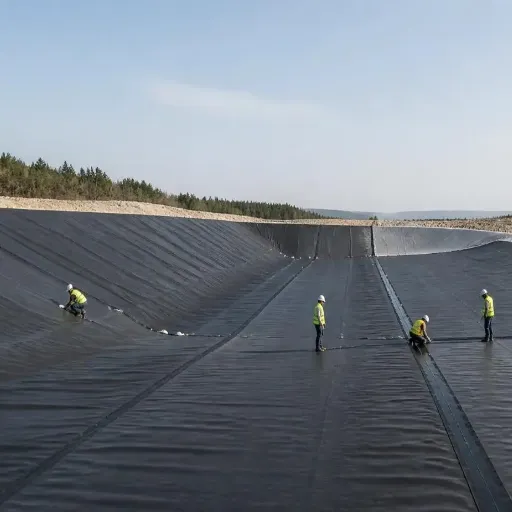
The fix for an ambiguous name is a specification with six parts.
| Clause | What it says |
|---|---|
| 1. Standard and revision | GRI-GM17 Rev 17, dated 11 June 2025, for smooth, single-sided textured or double-sided textured sheet |
| 2. Formulation rules | Density ceiling, virgin resin, 10% rework limit, no post-consumer content |
| 3. Gauge and finish | Both SI and mil, with the surface texture named |
| 4. Property values at that gauge | Break strength, elongation, tear, puncture and 2% modulus, each with its ASTM method |
| 5. ESCR, where the application needs it | ASTM D5397 or D1693 and the acceptance value, because GM17 doesn’t set one |
| 6. Seam values from GM17 Table 3 | Seaming method plus shear, peel and elongation requirements |
Then ask three questions of any supplier who quotes fMLDPE. What does the name expand to? Which standard and revision does the sheet meet? And what are the density, melt index and ESCR results for the production lot?
A supplier with a real product answers all three. A supplier selling a name answers none.
Red Flags on a Datasheet
- fMLDPE with no expansion and no standard. The name isn’t defined, so the datasheet isn’t a specification.
- LLDPE with a density of 0.94 g/cm³ or higher. That’s HDPE territory, and it fails the GM17 ceiling.
- “Metallocene” with no resin grade or test data. The catalyst isn’t a property. Ask for the grade and lot results.
- “GM17 compliant” with no revision named. Older revisions remain in circulation, and Rev 17 changed the seam requirements.
- An ESCR claim with no D5397 or D1693 result. GM17 doesn’t require the test, so the number has to come from somewhere.
- “Flexible” with no modulus or elongation. The word is doing marketing work, not engineering work.
Frequently Asked Questions
Is an fMLDPE geomembrane a real product? No standard defines it. It’s most likely shorthand for flexible metallocene LLDPE, or a typo for mLLDPE. The material family is real, but the name isn’t a specification.
Is fMLDPE the same as FML? No. FML means flexible membrane liner, the regulatory term in 40 CFR 258.40. It sets a minimum 30 mil thickness, or 60 mil where the FML is HDPE. It says nothing about resin or catalyst.
Does metallocene LLDPE meet GRI-GM17? It can, but only by passing the same property table as any other LLDPE. GM17 doesn’t name a catalyst or a resin grade. Ask for test results at the ordered gauge.
Is metallocene LLDPE stronger than standard LLDPE? The literature reports better mechanical and sealing properties, plus lower density capability. It also reports a narrower processing window and higher cost, which is why adoption in geomembranes has been limited. Strength claims need lot-specific data, not a resin family name.
What should I ask for instead of fMLDPE? GRI-GM17 Rev 17, the density ceiling, the resin rules, the gauge and finish, the property values at that gauge, the seam values, and ESCR by ASTM D5397 or D1693 if your project needs it.
Conclusion
An fMLDPE geomembrane is a name in search of a specification. The likely material, flexible metallocene LLDPE, is real and has documented advantages in flexibility, puncture and sealing. The acronym doesn’t carry those advantages on its own.
Three checks close the gap. Expand the name and see whether the supplier can. Match the resin claim to GM17’s density and melt index rules. Then add the tests GM17 leaves out, especially ESCR and the seam values from Rev 17.
Do that, and the sheet you receive is the sheet you specified. Skip it, and the name is the only thing holding the order together.
Working with a vague fMLDPE geomembrane datasheet? Send the material line, the application and the gauge. We’ll map it to GRI-GM17 Rev 17 and tell you which clauses need to be added before you order. Request a technical quote.