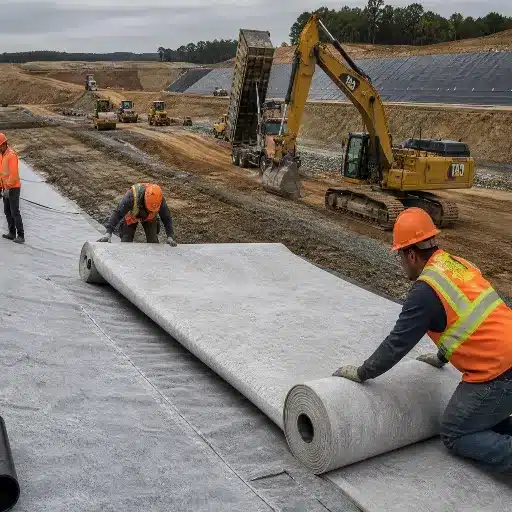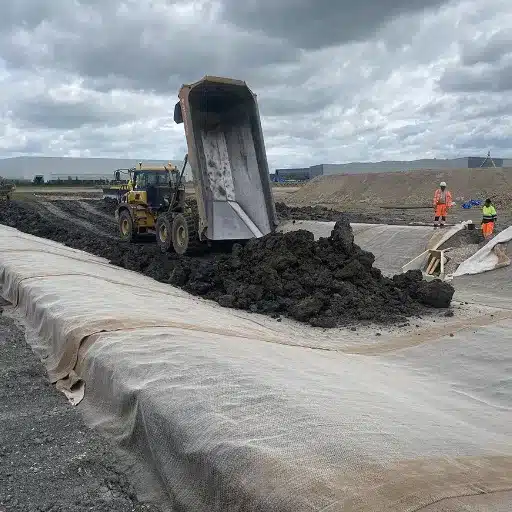
Ground protection mats for heavy equipment must be specified by point load, not total machine weight. A 100-ton crawler crane can exert 45 tons of force on a single outrigger pad. A 30-ton excavator concentrates load through narrow track pads. The mat does not fail because the machine is too heavy. It fails because the concentrated pressure exceeds the mat’s capacity, or the ground beneath it cannot support the distributed load.
Most procurement buyers make the same error. They read the equipment manual, find the total operating weight, and order mats rated for that number. They ignore point loads, dynamic forces, and ground bearing capacity. The result is mat deflection, subgrade failure, and expensive downtime.
This guide explains how to calculate actual loads for excavators, cranes, bulldozers, and drilling rigs. It provides an equipment-specific selection framework, a dynamic load multiplier table, and a step-by-step outrigger pad sizing formula. For the complete overview of mat types and applications, see our complete ground protection mats buyer’s guide.
Key Takeaways
- Ground protection mats for heavy equipment must be sized by point load, not total machine weight; outrigger reaction forces often exceed 40 tons per pad.
- Dynamic load multipliers raise effective load by 20-50% during braking, turning, and lifting operations.
- Standard 18-20 mm HDPE mats handle most excavators and dump trucks; cranes and drilling rigs need 25-40 mm HDPE or UHMWPE with 500-750 PSI ratings.
- Ground conditions reduce effective capacity by 30-50% on soft soils; always add a 15-20% safety margin above calculated maximum loads.
- Interlocking connection systems prevent panel separation under tracked equipment turning loads.
Ground protection mats for heavy equipment are engineered load-distribution panels placed between machinery and the ground surface. Typically manufactured from HDPE, UHMWPE, or composite materials, these mats spread concentrated equipment loads across a wider footprint. They prevent rutting, protect subgrade integrity, and create stable temporary roadways and work platforms for machinery ranging from 15-ton excavators to 300-ton crawler cranes.
How Ground Protection Mats Handle Heavy Equipment Loads
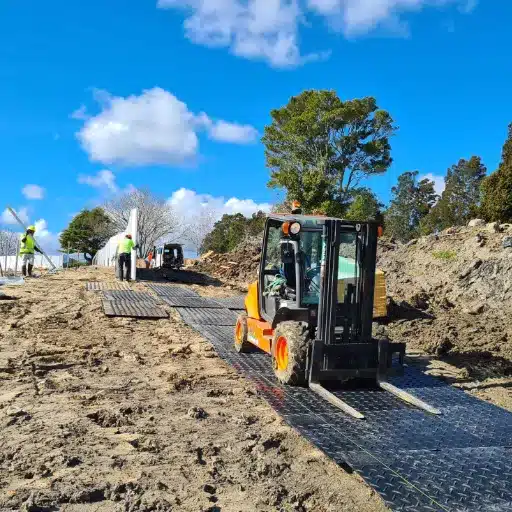
Total Weight vs Point Load: The Critical Distinction
The total operating weight of a machine is not the number that governs mat selection. Total weight is the static load distributed across all contact points. Point load is the concentrated force at a single contact point.
Consider a crawler crane. A 100-ton model may weigh 80 tons and lift 100 tons. The total load on the ground includes the crane weight plus the lifted load, distributed across four outrigger pads. Each pad carries a reaction force that depends on boom angle, load radius, and counterweight position. In practice, the heaviest-loaded outrigger can see 40-50 tons while the lightest sees 15-20 tons.
A site engineer named Viktor deployed standard 20 mm HDPE mats under a 90-ton crawler crane in Poland. The mats were rated for 120 tons. He assumed this provided a safety margin. What Viktor did not calculate was the outrigger reaction force: 42 tons on the front-left pad due to boom position. The mat itself did not break. But the ground beneath it was wet clay with a bearing capacity of only 25 PSI. The mat punched through the subgrade, tilting the crane and forcing a three-day shutdown while geotechnical crews reinforced the pad area with geotextile and crushed stone.
The lesson: mat rating tells you the mat’s capacity. Ground bearing capacity tells you what the ground can support. You need both numbers.
Quick calculation: Outrigger reaction force varies with configuration, but a conservative estimate is 40-50% of total load (crane weight + lifted load) on the heaviest outrigger. For a 100-ton lift with an 80-ton crane, assume 90 tons total, with 40-45 tons on the critical outrigger.
Dynamic Load Factors
Manufacturer load ratings are static. Real equipment moves. Dynamic forces multiply the effective load beyond the static number.
| Dynamic Condition | Multiplier | Example Effect |
|---|---|---|
| Braking | 1.2x | 30-ton excavator becomes 36-ton effective |
| Turning | 1.3x | Concentrates the load on the outer tracks |
| Lifting | 1.5x | Maximum multiplier; governs crane outrigger design |
| Swinging boom | 1.4x | Off-center load shifts during rotation |
| Vibration (drilling) | 1.1-1.3x | Cyclic loading fatigues the mat-subgrade interface |
These multipliers explain why a 15-20% safety margin above calculated maximum load is standard engineering practice. A mat rated for exactly your static load has no margin for the dynamic forces that occur during normal operation.
Ground Protection Mats for Heavy Equipment by Type
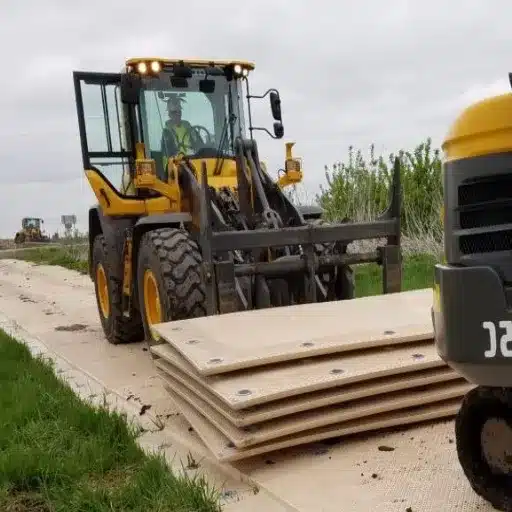
Selecting the right ground protection mats for heavy equipment requires matching mat specifications to each machine’s load characteristics. The sections below cover the five most common equipment classes found on construction and infrastructure sites.
Ground Protection Mats for Excavators (15-50 Tons)
Excavators distribute load through two continuous steel tracks. A 30-ton machine with 5-meter tracks concentrates roughly 6 tons per meter of track length on firm ground. This is well within the capacity of standard 18-20 mm HDPE mats rated for 80-120 tons.
However, point loads rise during turning. The outer track carries up to 1.3x the static load as the machine pivots. On soft ground, track grousers can sink through thin mats, especially at the turn radius where ground pressure peaks.
For standard construction excavators, 18-20 mm HDPE ground mats for construction equipment provide sufficient capacity. For machines above 40 tons or working on marginal soils, step up to 20-25 mm. Interlocking connections prevent separation when the machine turns across panel joints.
Ground Protection Mats for Cranes (50-300+ Tons)
Crawler cranes present the most complex loading scenario in construction. The machine weight is significant, but the lifted load dominates the outrigger reaction forces. Ground protection mats for cranes must handle both distributed track loads during travel and concentrated outrigger point loads during lifting.
Outrigger pad sizing formula:
Required pad area (square inches) = Outrigger reaction force (lbs) / Ground bearing capacity (PSI)
Example: A 50-ton outrigger reaction (100,000 lbs) on soil with 50 PSI bearing capacity requires:
100,000 / 50 = 2,000 square inches minimum pad area
A standard 4×8-foot HDPE mat provides 4,608 square inches. This is sufficient on firm ground. On soft clay with 25 PSI effective capacity, the same mat is undersized unless the subgrade is reinforced.
Understanding crane outrigger pad load rating is essential for safe crane operations. PSI ratings for crane outrigger pads:
- Standard HDPE (20 mm): 200 PSI crush rating
- Heavy-duty HDPE (25-30 mm): 400 PSI
- Composite systems: 600 PSI
- UHMWPE industrial pads: up to 750 PSI, handling 300,000+ lbs
For extreme crane lifts or poor ground conditions, timber crane mats remain the industry standard. A 12-inch hardwood crane mat distributes outrigger loads across a larger footprint and bridges gaps that HDPE panels cannot span.
Bulldozers and Tracked Loaders (20-100 Tons)
Bulldozers concentrate enormous pressure through narrow track pads. A 50-ton dozer with 3-meter tracks can generate 15-20 tons per meter of track. The blade-down position adds forward load concentration.
Standard 20-30 mm HDPE mats handle most bulldozer applications on firm ground. The key consideration is bridging. Dozers often work on freshly cut terrain with uneven surfaces. Thicker 25-30 mm panels bridge gaps up to 50 mm without cracking. Rigid mats with anti-slip surfaces prevent track slippage on slopes.
Drilling Rigs and Piling Equipment (30-100 Tons)
Drilling rigs combine static weight with vibration and jack-foot point loads. A piling rig may weigh 60 tons but concentrate 30+ tons on each of four jack feet during operation. The vibration from rotary drilling creates cyclic fatigue at the mat-subgrade interface.
For drilling rigs, specify 25-38 mm HDPE or composite mats with overlapping flanges. The flanges prevent jack-foot alignment errors from landing on panel edges. Vibration dampening improves with thicker mats that absorb cyclic energy rather than transmitting it to the subgrade.
Dump Trucks and Haulers (30-80 Tons)
Dump trucks distribute load across multiple axles. A 40-ton articulated hauler carries roughly 10 tons per axle. This is moderate compared to crane outriggers, but haul roads see repeated passes, turning loads, and braking forces.
For haul roads, 18-25 mm HDPE mats with interlocking connections handle standard traffic. Turning areas need additional attention: the outer wheels of a turning truck generate lateral shear forces that can push panels apart unless the connection system resists horizontal displacement.
Ground Protection Mat Load Capacity Chart by Equipment
This chart provides heavy equipment ground protection mats load capacity data, matching typical loads to materials and PSI ratings.
| Equipment Type | Weight Range | Point Load | Mat Thickness | Material | PSI Rating |
|---|---|---|---|---|---|
| Excavators | 15-50 t | 10-25 t/track | 18-20 mm | HDPE | 200 PSI |
| Crawler Cranes | 50-300 t | 30-80 t/outrigger | 25-40 mm | HDPE/UHMWPE | 500-750 PSI |
| Bulldozers | 20-100 t | 15-40 t/track | 20-30 mm | HDPE | 200-400 PSI |
| Drilling Rigs | 30-100 t | 20-50 t/jack | 25-38 mm | HDPE/Composite | 400-600 PSI |
| Dump Trucks | 30-80 t | 15-25 t/axle | 18-25 mm | HDPE | 200 PSI |
All ratings assume firm, dry ground. Reduce effective capacity by 30-50% on soft or saturated soils. For the full thickness specifications behind these ratings, see our ground protection mat thickness guide.
Outrigger Pad Selection: A Deeper Dive
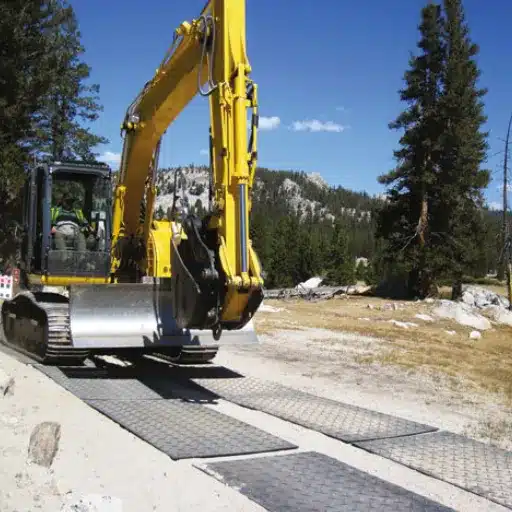
PSI Ratings Explained
The PSI rating on an outrigger pad or ground protection mat is the crush rating of the material itself. It indicates the maximum pressure the mat can withstand before the material compresses or fails. This is different from ground bearing capacity, which is the maximum pressure the soil can support.
A mat with a 200 PSI crush rating placed on soil with a 50 PSI bearing capacity will not crush. The soil will fail first. The mat simply distributes the load. If the distributed load still exceeds 50 PSI, the mat sinks into the soil regardless of its own strength.
For crane work, both numbers matter. The mat must not crush under the outrigger load, and the ground must support the distributed pressure. UHMWPE pads at 750 PSI handle the highest outrigger loads without material failure.
When to Use Timber vs HDPE vs UHMWPE
| Material | Best For | Limitations |
|---|---|---|
| Timber/Hardwood | Extreme point loads, bridging gaps, crane mats | Heavy (1,200+ lbs each), absorbs moisture, limited reuse |
| HDPE | Standard construction, reusable, chemical-resistant | Lower PSI than UHMWPE, can deform under extreme point loads |
| UHMWPE | Highest PSI loads, extreme environments, chemical exposure | Heavier than HDPE, higher cost per panel |
For most construction applications, HDPE provides the best balance of load capacity, weight, and cost. Step up to UHMWPE for oil rig platforms, chemical plants, or extreme crane lifts. Use timber only when bridging significant gaps or handling loads beyond engineered plastic capacity.
Ground Conditions and Heavy Equipment Mats
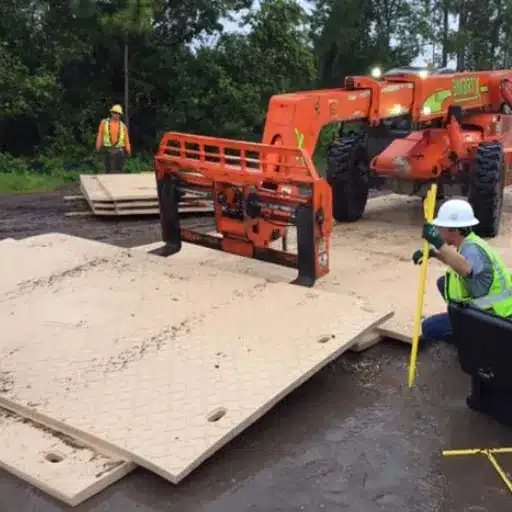
Firm Ground (Gravel, Compacted Soil)
On dry, compacted gravel or asphalt, manufacturer load ratings apply as published. Standard 18-20 mm HDPE ground protection mats for construction equipment handle the majority of excavators, trucks, and light cranes. Add the standard 15-20% safety margin for dynamic loads.
Soft Ground (Clay, Mud, Saturated Soils)
A contractor named Amara learned this lesson on a pipeline project in Nigeria. She deployed 20 mm HDPE mats for a 35-ton excavator on firm ground. After three days of rain, the same mats sank into saturated laterite soil. The excavator’s tracks punched through, rutting the access road and forcing a shutdown.
Amara’s crew added a geotextile separation layer plus 150 mm of crushed stone subgrade beneath the mats. The reinforced system distributed loads across a wider footprint, and work resumed without further incidents.
Soft ground reduces effective capacity by 30-50%. Options include:
- Upsize mat thickness: Move from 20 mm to 25-30 mm HDPE
- Reinforce subgrade: Geotextile + gravel working layer
- Reduce ground pressure: Use larger mats or timber crane mats to spread the load
Slope and Uneven Terrain
Mats on slopes experience both vertical and lateral forces. Thicker 25-30 mm panels resist sliding better than thin mats. Anti-slip surfaces and connection systems prevent panel migration under braking and turning loads.
Connection Systems for Ground Protection Mats for Heavy Equipment
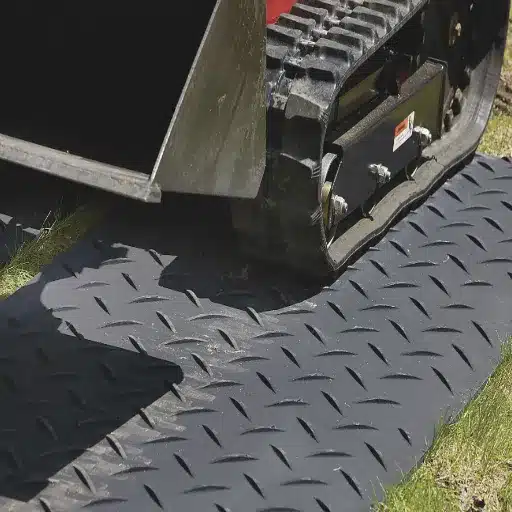
Interlocking Systems
Two-way or four-way interlocks connect mats at the edges, preventing separation under turning and braking forces. Four-way locks provide the strongest connection, resisting both tension and shear at the joint. Best for tracked equipment and areas with frequent turning.
Overlapping Flanges
Overlapping edges create a continuous surface without gaps. Flanged systems work well for haul roads and temporary roadways where panel alignment is critical. For the complete roadway layout guidance, see our ground protection mats for construction sites guide.
Bolted Connections
Bolted systems provide semi-permanent installation for oil rigs and long-term infrastructure. They resist all directional forces but require more installation time and specialized hardware.
Material Selection for Ground Protection Mats for Heavy Equipment: HDPE vs Composite vs Timber
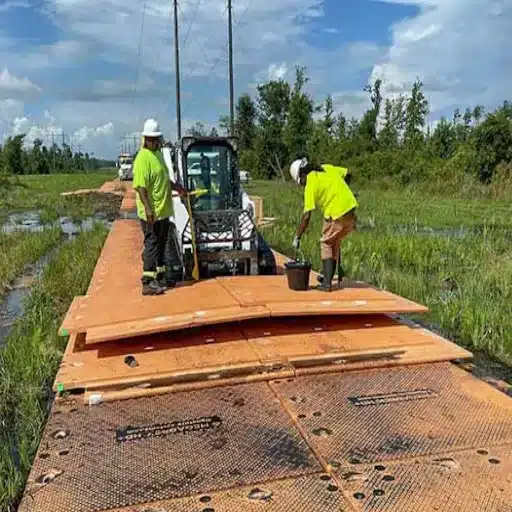
The choice of material for ground protection mats for heavy equipment depends on load, environment, and reuse requirements. For a detailed material comparison, see our HDPE vs composite ground protection mats analysis.
HDPE dominates the market because it balances load capacity, weight, and cost. UV-stabilized HDPE resists chemical exposure and handles repeated loading cycles. For standard construction equipment, HDPE is the default choice.
Composite systems with cross-ribbed interiors distribute weight more evenly than solid panels. Rated at 600 PSI, they handle heavy point loads from crane outriggers and drilling jack feet.
Timber remains essential for extreme loads and bridging applications. No engineered plastic matches the spanning capability of a 12-inch hardwood mat over a trench or soft spot.
How to Size Ground Protection Mats for Heavy Equipment in 3 Steps
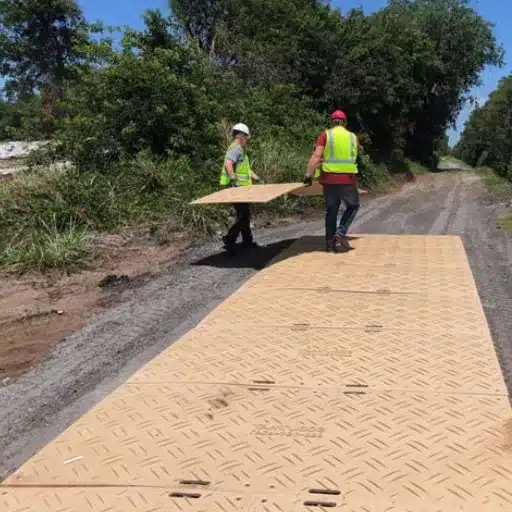
Step 1: Calculate the Maximum Point Load
Identify the heaviest single contact point on your equipment. For cranes, use the outrigger reaction force formula. For tracked equipment, estimate the load per meter of track. For trucks, use load per axle. Apply dynamic multipliers: 1.2x for braking, 1.3x for turning, 1.5x for lifting.
Step 2: Check Ground Bearing Capacity
Test or estimate the soil bearing capacity at your site. Dry compacted gravel supports 150-300 PSI. Firm clay supports 50-100 PSI. Wet clay or mud may drop below 25 PSI. Reduce the manufacturer’s mat rating by 30-50% on soft soils.
Step 3: Match Mat Specification to Load and Ground
Select a mat with a PSI rating and thickness that exceeds your calculated point load with a 15-20% safety margin. Use interlocking connections for tracked equipment. Reinforce soft subgrade with geotextile and gravel if the mat rating exceeds ground capacity.
Frequently Asked Questions About Ground Protection Mats for Heavy Equipment
What thickness mat do I need for a 50-ton excavator?
On firm ground, an 18-20 mm HDPE mat handles a 50-ton excavator comfortably. The static load rating for 20 mm panels is 80-120 tons, and excavator track distribution keeps point loads well below the mat’s limit. On soft or wet ground, step up to 20-25 mm to compensate for reduced effective bearing capacity.
Can I use standard HDPE mats under a crawler crane?
Standard 20 mm HDPE mats handle crawler cranes during travel and setup on firm ground. For lifting operations, outrigger point loads often require dedicated outrigger pads rated at 400-750 PSI. Do not rely on standard access mats as crane outrigger pads unless an engineer verifies the load distribution.
What is the difference between a crane mat and a ground protection mat?
Crane mats are typically thick hardwood timbers (6-18 inches) designed for extreme point loads and bridging. Ground protection mats are thinner engineered panels (10-40 mm) made from HDPE, UHMWPE, or composite materials for general equipment access and roadway construction.
How do I calculate outrigger pad size?
Divide the outrigger reaction force (in pounds) by the ground bearing capacity (in PSI). The result is the minimum pad area in square inches. Add 20% for dynamic loads. Example: 100,000 lb reaction / 50 PSI soil = 2,000 sq in minimum. With safety margin: 2,400 sq in.
Do I need different mats for tracked vs wheeled equipment?
Tracked equipment generates lower ground pressure than wheeled equipment of the same weight because the load spreads across a larger contact area. However, tracked machines create shear forces during turning that wheeled machines do not. Use interlocking connections for tracked equipment to prevent panel separation.
Conclusion
Ground protection mats for heavy equipment fail for one of two reasons: the mat is undersized for the point load, or the ground cannot support the distributed pressure. The solution requires engineering math, not guesswork.
Calculate outrigger reaction forces. Apply dynamic multipliers. Check the ground bearing capacity. Size mats by point load, not total weight. Add a 15-20% safety margin. Verify material standards.
The 20 mm HDPE segment leads the market because it solves most standard construction scenarios. But cranes, drilling rigs, and extreme loads demand thicker panels, higher PSI ratings, or timber alternatives. Ground conditions modify every rating.
At Shanxi Shengxing, we manufacture HDPE ground protection mats tested to ASTM D4020 and ISO 527 standards. We retain production samples for five years and provide load calculations with every technical quote.
Need to specify mats for your heavy equipment fleet? Browse our HDPE ground protection mats for detailed load and thickness specifications, or request a technical quote with your equipment list and ground conditions. Our engineering team provides point load calculations, mat sizing recommendations, and export-optimized container loads for construction and infrastructure projects worldwide.