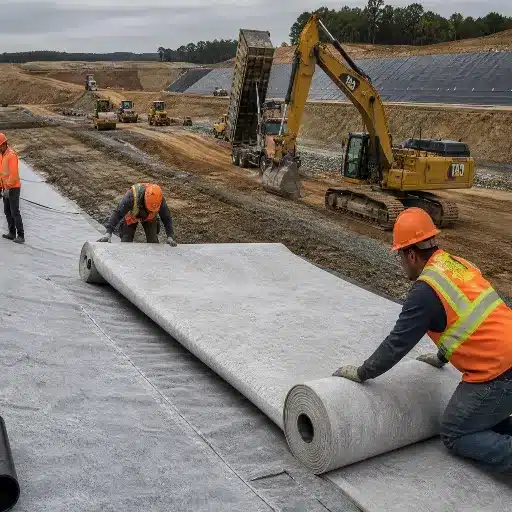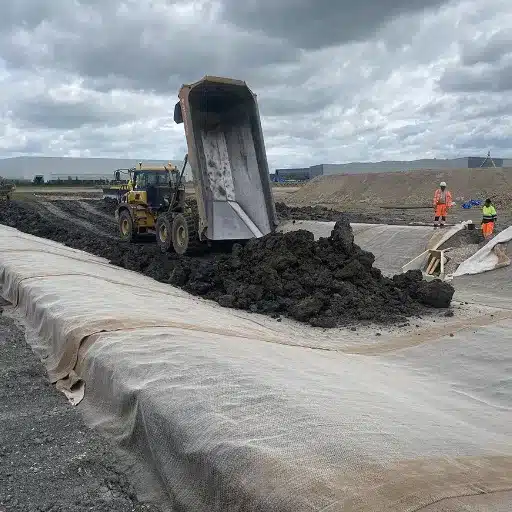
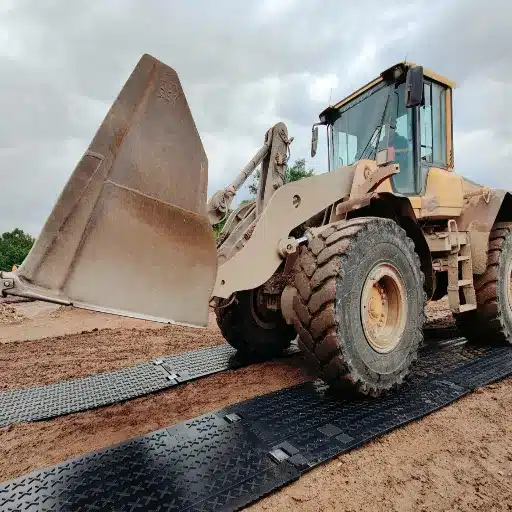
Temporary roadway mats are interlocking ground protection panels that create stable, load-bearing haul roads over soft, unstable, or sensitive ground. A procurement manager named Emeka ordered 500 tons of crushed aggregate for a 3 km temporary haul road at a solar farm site in Nigeria. Monsoon rains arrived two weeks ahead of forecast. The aggregate sank into the clay subgrade, creating ruts 30 cm deep. Heavy trucks could not pass. The project lost 18 days and $47,000 before Emeka switched to HDPE temporary roadway mats laid over geotextile fabric. The mats went down in 48 hours. The road stayed passable through the wet season.
Emeka’s experience is not unusual. Construction, energy, and infrastructure projects worldwide face the same problem: how to move heavy equipment across ground that cannot support it. Aggregate roads work on firm soil but fail on soft clay, peat, sand, and saturated ground. Temporary roadway mats solve this by distributing equipment loads across a wide surface area, protecting the subgrade while creating a drivable surface. For a complete overview of all mat types and applications, see our complete ground protection mats buyer’s guide.
Key Takeaways
- Temporary roadway mats create stable haul roads over soft ground where aggregate fails; HDPE mats handle 30-120 tons, composite mats 100-250+ tons, and timber mats accommodate steel tracks.
- Road design matters as much as mat selection: plan for width (3 m single lane, 6 m two-way), passing bays, turn radius, and gradient before ordering panels.
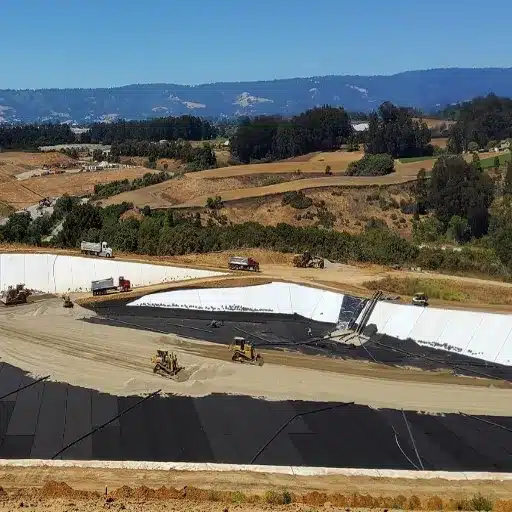
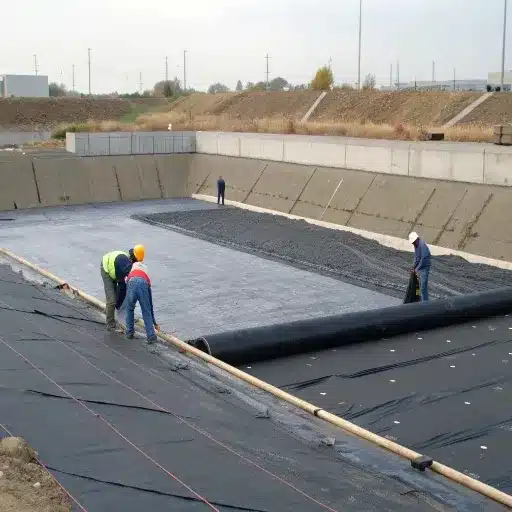
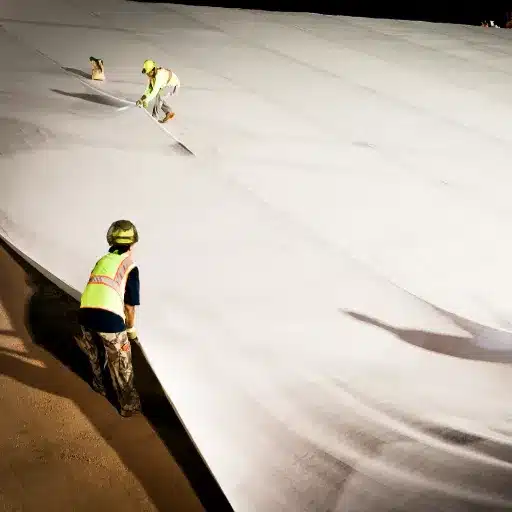
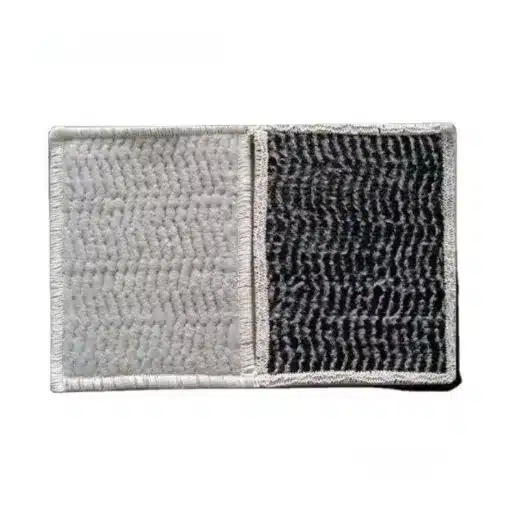
- Geotextile underlayment beneath mats on soft ground prevents mud migration and maintains bearing capacity over wet clay and peat.
- Mats break even against aggregate roads at approximately 500-800 meters of road length when reuse across 2+ projects is factored in.
- The global temporary access mat market reached $1.2 billion in 2025 and is projected to grow at 8.5% CAGR through 2034.
What Are Temporary Roadway Mats?
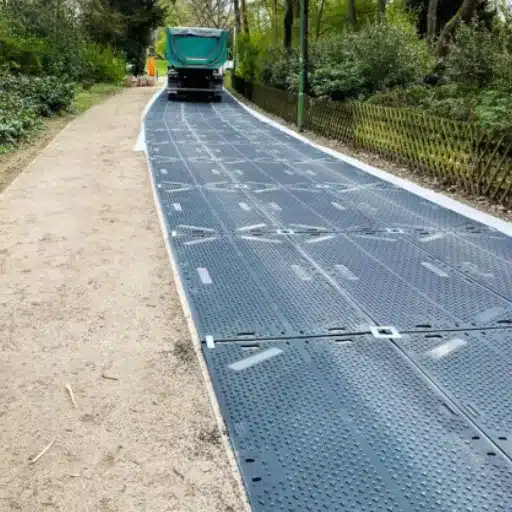
Temporary roadway mats are engineered panels laid end-to-end and side-by-side to form a continuous drivable surface over ground too weak to support unprotected vehicle traffic. They are also called trackway panels, bog mats, access mats, haul road mats, and temporary roadway panels. Unlike general ground protection mats used as discrete work pads or crane pads, temporary roadway mats function as a connected system designed specifically for moving traffic.
The key difference is continuity. A crane pad protects a single stationary location. A temporary roadway creates a travel corridor. This requires interlocking edges, consistent thickness across the full width, and connection hardware that prevents panel separation under turning and braking loads. For buyers new to mat selection, our How to Choose Ground Protection Mats guide covers the full decision framework.
Types of Temporary Roadway Mats: HDPE, Composite, and Timber
No single material works for every road application. Construction site access mats come in three primary categories that serve different equipment, ground conditions, and project durations.
| Mat Type | Load Capacity | Weight (4×8 ft) | Steel-Track Compatible | Best For |
|---|---|---|---|---|
| HDPE (plastic) | 30-120 tons | 25-45 kg | No | Rubber-tired vehicles, medium-duty access, rapid deployment |
| Composite | 100-250+ tons | 40-65 kg | No | Heavy cranes, drilling rigs, and long-term installations |
| Hardwood timber | 50-250+ tons | 80-150+ kg | Yes | Steel-tracked dozers, extreme loads, traditional sites |
HDPE Temporary Roadway Mats
HDPE mats dominate the temporary roadway market because they balance load capacity, portability, and cost. A standard 4×8-foot panel at 20 mm base thickness weighs 40-45 kg. Two workers carry and place it by hand. Interlocking systems use four-way connectors or locking pins at each corner. HDPE is impervious to water, chemicals, and UV degradation. It does not rot like timber or corrode like metal.
The limitation is the steel tracks. The concentrated point loading from steel caterpillar tracks cuts into HDPE surfaces over time. For rubber-tired and rubber-tracked equipment, HDPE is the optimal choice.
Composite Mats
Composite mats use fiberglass-reinforced polymers or engineered plastic blends to achieve higher stiffness than standard HDPE. They often integrate built-in connection systems with overlapping flanges. Load ratings reach 250+ tons on firm ground. The weight penalty is moderate: 40-65 kg per panel, still manually portable but at the upper limit.
Composite mats suit projects where the heaviest equipment exceeds 100 tons or where the road will remain in place for more than 12 months. The higher upfront cost pays back through extended service life and reduced replacement frequency.
Timber Bog Mats
Hardwood timber mats, traditionally called bog mats or swamp mats, remain the standard for steel-tracked equipment. Oak and mixed hardwood species distribute concentrated track loads without cutting or gouging. Timber mats weigh 80-150+ kg per panel and require machinery to place. Their lifespan is 3-5 years under heavy use, shorter than HDPE’s 10+ year service life.
Timber also absorbs moisture, which increases weight and can promote decay if not dried before storage. For projects with steel-tracked fleets and no reuse requirement, timber is practical. For multi-project reuse and export shipping, HDPE or composite is more cost-effective.
How to Plan a Temporary Access Road
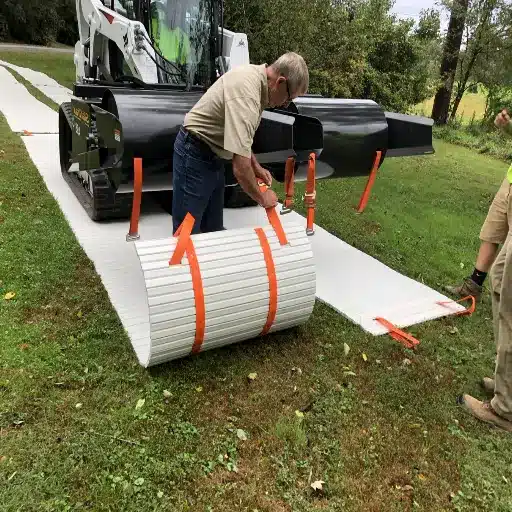
A temporary roadway is a civil engineering structure, not just a product purchase. Proper planning prevents the most common failure mode: mats that perform correctly but are deployed in a layout that creates bottlenecks, instability, or subgrade damage.
Site Assessment
Before selecting mats, evaluate four site factors:
- Ground bearing capacity: Test the subgrade bearing capacity using a California Bearing Ratio (CBR) test or estimate from soil type. Clay with CBR below 3% requires geotextile reinforcement beneath mats. Sand with CBR above 15% may need minimal preparation. ASTM D1883 provides standardized CBR testing procedures for subgrade evaluation.
- Soil type and moisture: Saturated soils reduce effective bearing capacity by 30-50%. Seasonal water tables, drainage patterns, and recent rainfall all affect performance.
- Heaviest equipment: Identify the maximum axle load and gross vehicle weight for all traffic using the road.
- Traffic frequency: A road used twice daily by light trucks needs different specifications than a haul road with 200 passes per day by 40-ton dump trucks.
Road Design
A well-designed temporary access road accounts for vehicle dimensions and turning requirements:
- Width: Single-lane roads need a minimum of 3 meters. Two-way traffic requires 6 meters. For frequent heavy truck traffic, add 0.5 meters of shoulder on each side.
- Passing bays: On single-lane roads longer than 200 meters, install passing bays every 100-150 meters. A passing bay is a widened section 6-8 meters long where one vehicle can pull aside.
- Turn radius: Large articulated trucks and cranes need an inner turn radius of 12-15 meters. Plan curves before installing mats; cutting mats to fit curves wastes material and weakens connections.
- Gradient: Keep grades below 10% for loaded heavy trucks. On slopes, orient mats with the long dimension perpendicular to the gradient for maximum stability.
For the complete site planning framework, see our ground protection mats for construction sites guide.
Installation Best Practices for Temporary Roadway Mats
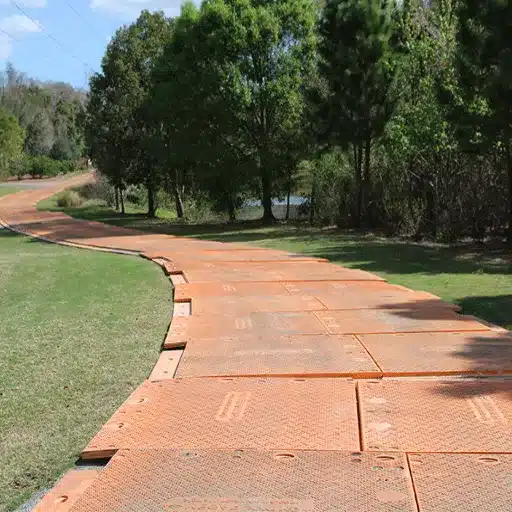
Site Preparation
Clear the route of rocks, stumps, debris, and protruding objects that could create point-loading stress or puncture the mats. Grade the surface to shed water; standing water beneath mats accelerates subgrade softening. On soft or wet ground, lay a non-woven geotextile fabric beneath the mats. This separation layer prevents mud from migrating upward through panel joints and maintains a firm footing.
A road engineer named Sven was tasked with building a 1.5 km access road across a peat bog in Norway. The ground bearing capacity was effectively zero. Sven’s team laid a 200 mm gravel working layer over geotextile, then placed 20 mm HDPE mats on top. Without the geotextile, the gravel would have sunk into the peat within days. With it, the road carried 25-ton timber trucks for six months without significant rutting.
Layout and Connection
Establish a straight starting line along one edge of the road. Lay the first row end-to-end to create a continuous baseline, then build outward row by row. Secure all connection points with the manufacturer’s recommended hardware before any vehicle drives onto the surface. Four-way connectors at every corner create a unified roadway that resists lateral movement.
On slopes, never align mats with the gradient. The long edge should run across the slope. This orientation prevents downhill sliding and maximizes the number of connection points resisting shear forces.
Edge Transitions and Safety
Install ramped edge accessories where the temporary road meets the existing ground. Ramps prevent tire damage, reduce trip hazards for pedestrians, and protect mat edges from chipping under vehicle entry and exit. Post speed limits appropriate to the surface: 20 km/h for HDPE mats, 15 km/h on curves and ramps. For detailed temporary road mat installation procedures, refer to our ground protection mat installation guide.
Load Capacity by Equipment Type
Matching mat thickness and material to equipment is critical. The table below provides standard recommendations for firm ground conditions. Reduce capacity by 30-50% on soft or saturated soils.
| Equipment Type | Approximate Weight | Recommended Mat | Thickness |
|---|---|---|---|
| Light vehicles, utility trucks | 2-5 tons | HDPE | 10-12.7 mm |
| Pickups, small excavators | 5-15 tons | HDPE | 12.7-15 mm |
| Dump trucks, concrete mixers | 20-40 tons | HDPE | 18-20 mm |
| Crawler cranes (rubber track) | 50-100 tons | HDPE or composite | 20-25 mm |
| Heavy cranes, piling rigs | 100-200 tons | Composite | 25-38 mm |
| Steel-tracked dozers, draglines | 50-300+ tons | Timber bog mats | 150-200 mm |
Ground Pressure Reduction
Temporary roadway mats reduce ground pressure by distributing concentrated wheel or track loads over a wider area. A 40-ton dump truck with dual rear wheels exerts approximately 80-100 PSI at each tire contact patch. A 20 mm HDPE mat spreads that load across the full panel surface, reducing peak ground pressure to 15-25 PSI. This is the fundamental engineering principle that makes temporary roadways work: the mat carries the load, so the subgrade does not have to. Engineering research on portable matting systems confirms that ground pressure reduction is the primary performance metric for evaluating temporary roadway mats on soft soils.
Cost Comparison: Mats vs. Aggregate Roads
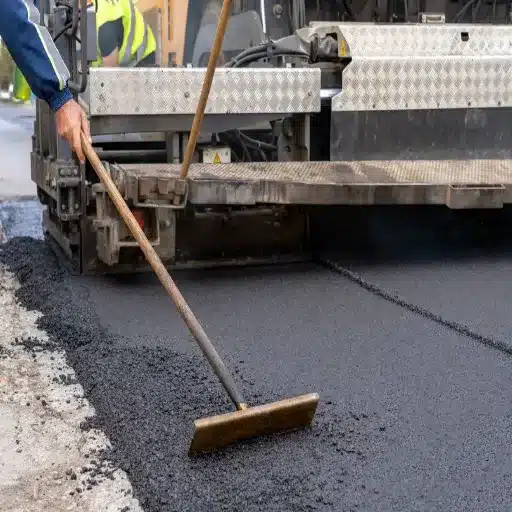
The choice between temporary haul road mats and crushed aggregate is not obvious. Each has advantages depending on project length, duration, and ground conditions.
Upfront Cost
Aggregate is cheaper per meter for short roads on firm ground. A 500-meter gravel road on stable subgrade costs less in material than an equivalent mat road. However, this comparison ignores three hidden costs: subgrade preparation, removal and restoration, and the risk of weather-related failure.
Installation and Labor
Mats install faster. A crew of four workers can lay 300-500 square meters of HDPE mat per day. Spreading and compacting aggregate for the same area requires earthmoving equipment, a larger crew, and multiple passes with a roller. On remote sites where equipment rental is expensive, the labor advantage shifts toward mats.
Removal and Restoration
This is where Mats win decisively. At project completion, mats lift cleanly, and the site returns to its original condition. Aggregate must be excavated, hauled away, and the ground restored. On environmentally sensitive sites, aggregate removal can cost more than the original installation. Mats also eliminate the disposal problem: contaminated aggregate from oil and chemical spills requires special handling.
Reuse and Break-Even
A project manager named Mei ran the numbers for a pipeline project in Southeast Asia. The temporary haul road was 2 km long. Aggregate would cost $28,000 installed, but $12,000 to remove. HDPE mats cost $45,000 purchased new, but have zero removal cost and full reusability on the next pipeline segment. At the third reuse, the mats became cheaper than three separate aggregate roads. The break-even point for HDPE mats against aggregate typically falls between 500 and 800 meters of road when reuse across two or more projects is possible.
Weather and Ground Condition Considerations
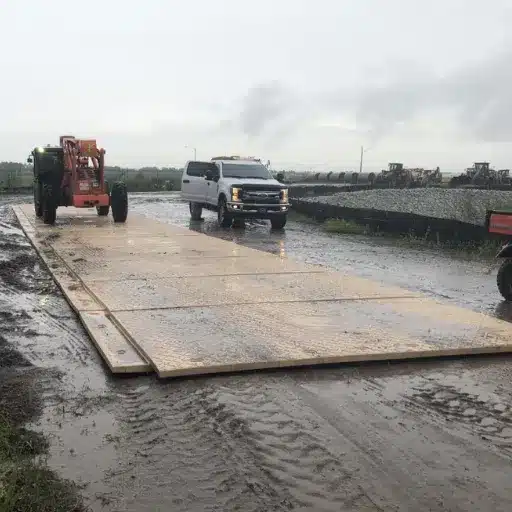
Soft Ground, Mud, and Wet Clay
Saturated soils are the primary reason soft ground access mats are specified. On wet clay, even light vehicles sink without protection. The engineering solution is a separation and distribution system: geotextile fabric prevents mud from pumping upward, while the mats distribute loads across a wider footprint. On extremely soft ground, add a 100-200 mm gravel working layer between the geotextile and the mats. This creates a composite structure: fabric stabilizes the soil, gravel provides a firm base, and mats protect the surface.
Sandy and Unstable Soils
Desert sand and loose granular soils present a different problem. Vehicles sink not because the soil is weak but because it shifts under dynamic loading. Mats create a rigid surface that prevents rutting and maintains traction. The interlocking connection system is especially important on sand; unsecured panels drift apart under repeated traffic.
Freeze-Thaw Cycles
In cold climates, freeze-thaw cycles degrade unpaved roads by creating frost heave and thaw weakening. Temporary roadway mats insulate the subgrade, reducing temperature fluctuation at the surface. They also provide a stable driving surface during the spring thaw when native soils are at their weakest. This seasonal advantage makes mats particularly valuable for winter construction in northern regions.
Frequently Asked Questions About Temporary Roadway Mats
What thickness should temporary roadway mats be?
For mixed construction traffic on firm ground, 18-20 mm base thickness is the standard specification. At 20 mm, HDPE mats handle dump trucks, concrete mixers, and standard crawler cranes up to 120 tons. For haul roads with frequent heavy truck traffic or soft subgrade, specify 25 mm with interlocking connections to prevent panel separation under turning loads.
Can I use HDPE mats for steel-tracked equipment?
No. Steel caterpillar tracks concentrate enormous pressure through narrow grouser bars that cut and gouge HDPE surfaces. For steel-tracked dozers, excavators, and loaders, use hardwood timber bog mats or specialized composite systems rated for steel track contact.
How many temporary road mats fit on a delivery truck?
Approximately 70-80 HDPE panels per standard flatbed truck, depending on panel dimensions and truck regulations. For international export, a 40-foot container holds 300-350 mats at 20 mm thickness. Timber mats, due to their weight and bulk, ship at roughly 30-40 panels per container.
Are temporary roadway mats cheaper than gravel roads?
For short, single-use roads on firm ground, gravel is usually cheaper upfront. For roads longer than 500-800 meters, multi-project reuse, soft ground conditions, or environmentally sensitive sites, mats become the more economical choice when the total cost, including removal and restoration, is calculated.
How long do temporary roadway mats last?
HDPE mats last 10+ years under normal use with proper cleaning and flat storage. Composite mats have similar or longer lifespans. Timber bog mats last 3-5 years, depending on species, moisture exposure, and loading intensity. UV-stabilized HDPE does not rot, rust, or degrade from chemical exposure.
Conclusion
Temporary roadway mats transform sites with challenging ground conditions into workable construction environments. The key to success is treating the road as an engineered system, not a commodity purchase. Site assessment, road design, proper installation, and correct material selection matter more than buying the thickest or most expensive panels.
HDPE mats solve the majority of temporary road challenges for rubber-tired and rubber-tracked equipment. Composite mats step in for extreme loads and long-term installations. Timber remains the choice for steel tracks. In every case, geotextile underlayment on soft ground and proper interlocking during installation separate successful roads from failed ones.
Ready to design a temporary access road for your project? View our ground protection mat specifications for load-rated thicknesses and panel dimensions, or request a technical quote from our engineering team. We provide road design consultation, load calculations, and export-optimized container shipments for infrastructure projects worldwide.