Choosing the right ground protection mat comes down to seven factors: equipment load, ground type, project duration, climate, portability, connection system, and certification. Match these seven inputs to the correct mat specification, and you eliminate costly site failures, equipment downtime, and budget overruns.
Most buyers do not get this right on the first attempt. A procurement manager named Dmitri ordered 200 standard HDPE mats for a highway project in Central Asia, confident that 15 mm panels would handle his 35-ton excavators. What he forgot to check was the ground bearing capacity. The site sat on saturated clay. Within two days of deployment, the mats began sinking at the edges. His crew lost four days reinforcing the subgrade with geotextile and gravel before the mats could perform as intended. The delay cost more than the mats themselves.
Dmitri’s mistake was skipping Factor 2 in the framework below. This ground protection mat selection guide prevents exactly that kind of error. For a complete overview of all mat types and applications, see our complete ground protection mats buying guide. You will learn how to evaluate each of the seven factors, match them to specific mat specifications, and make a procurement decision that holds up under real site conditions. Whether you are choosing ground protection mats for construction, events, or utility work, this framework applies.
Key Takeaways
- The seven factors for choosing ground protection mats are: equipment load, ground type, project duration, climate, portability, connection system, and certification.
- Point loads from crane outriggers create 3-5x more ground pressure than rolling wheels; always calculate point loads separately from total vehicle weight.
- Soft ground reduces effective load capacity by 30-50%; always add 15-20% safety margin and consider geotextile underlayment on saturated soils.
- HDPE mats pay back against rental costs in 8-14 months for active contractors; rent only for short-term or one-off projects under three months.
- Always request ASTM D4020 material verification and a Certificate of Conformance for large infrastructure projects.
The sections below walk through each factor in the order you should evaluate them during procurement. If you are learning how to choose ground protection mats for the first time, work through all seven factors sequentially. Experienced buyers can jump to the specific factor where they need clarification.
What Are Ground Protection Mats?
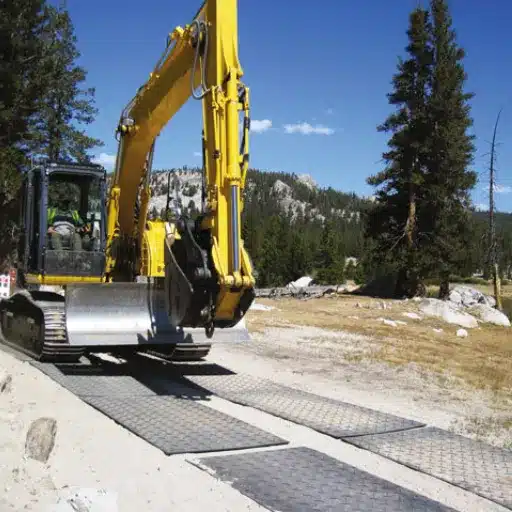
Ground protection mats are portable, interlocking panels placed over soil, turf, or paved surfaces to distribute equipment loads and prevent ground damage. They create temporary work platforms, haul roads, and equipment staging areas on sites where the native ground cannot support machinery traffic without rutting, compaction, or contamination.
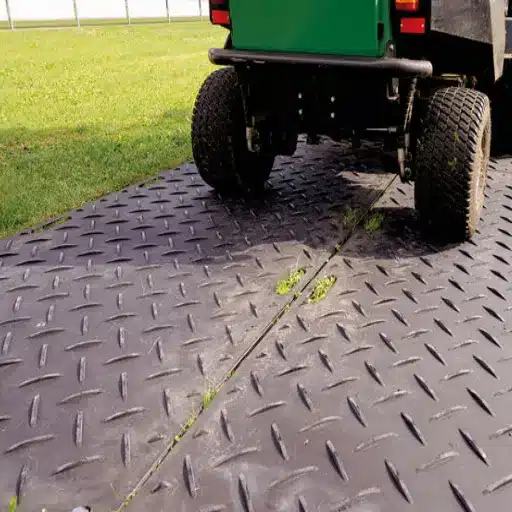
The most common type is the HDPE (high-density polyethylene) mat, a solid or hollow-core polymer panel that weighs 32-45 kg per 4×8-foot sheet. HDPE mats are 100% recyclable, UV-stabilized, and rated for loads from 30 tons (light duty) to over 150 tons (heavy duty). For a detailed breakdown of HDPE material grades and performance characteristics, see our HDPE ground protection mats overview.
Other options include composite mats (polymer plus fiberglass reinforcement for extreme loads), timber mats (traditional hardwood for crane pads), and rubber mats (pedestrian and light-vehicle applications).
Factor 1: Match the Mat to Your Equipment Load
Total Weight vs. Point Load
The heaviest machine on your site is not necessarily the one that dictates mat specification. A 100-ton crawler crane distributes its weight across two wide tracks. That is a distributed load, and it behaves very differently from a crane outrigger pad that concentrates 50 tons through a contact area smaller than one square meter.
Point loads create extreme stress concentrations that can punch through mats rated well above the machine’s total weight. For the majority of construction equipment, excavators, dump trucks, concrete mixers, and tracked dozers operate within the 60-120 ton range that standard HDPE handles comfortably. Point loads from crane outriggers, piling rig jack feet, and heavy lift pads are the exceptions that demand thicker mats or composite materials.
Equipment-Specific Load Reference Table
Use this table as your starting point for selecting mat thickness and material based on the heaviest equipment on site.
| Equipment | Typical Weight | Mat Type | Thickness | Static Load Rating |
|---|---|---|---|---|
| Pedestrian / light utility | 5-20 tons | Light-duty HDPE | 10-12 mm | 30-60 tons |
| Excavators (20-40 ton class) | 20-40 tons | Standard HDPE | 15-20 mm | 60-100 tons |
| Dump trucks / concrete mixers | 30-60 tons | Heavy-duty HDPE | 20-25 mm | 80-120 tons |
| Crawler cranes | 60-120 tons | HDPE / UHMWPE | 25-38 mm | 120-200 tons |
| Crane outriggers / piling rigs | Extreme point loads | Composite or timber | 38-50 mm | 200+ tons |
For detailed load calculations by machinery class, see our ground protection mats for heavy equipment guide.
The 15-20% Safety Margin Rule
Never specify a mat at its rated limit. Soft ground, wet conditions, and dynamic loading all reduce effective capacity. Add a 15-20% buffer above your calculated maximum load. If your heaviest point load is 80 tons, specify a mat rated for 96-100 tons minimum. This margin absorbs the variables you cannot fully measure during procurement.
Factor 2: How to Choose Ground Protection Mats for Your Ground Conditions
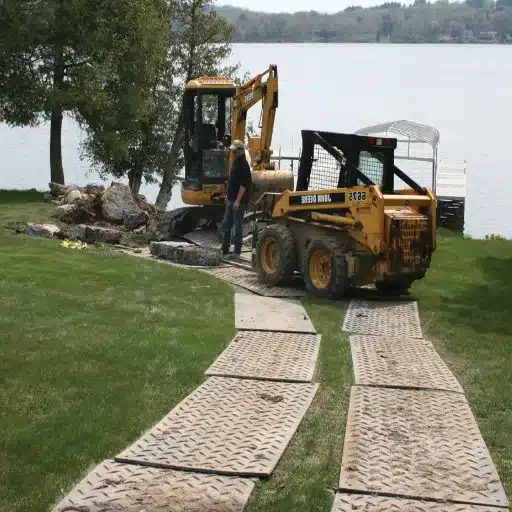
Firm, Level Surfaces
On compacted gravel, asphalt, or dry turf, standard 4×8 HDPE site access mats at 15-20 mm thickness handle most construction equipment without issue. The primary concern is surface protection rather than load support. Focus on preventing rutting, staining, or scuffing rather than structural failure.
Soft Ground, Mud, and Wet Clay
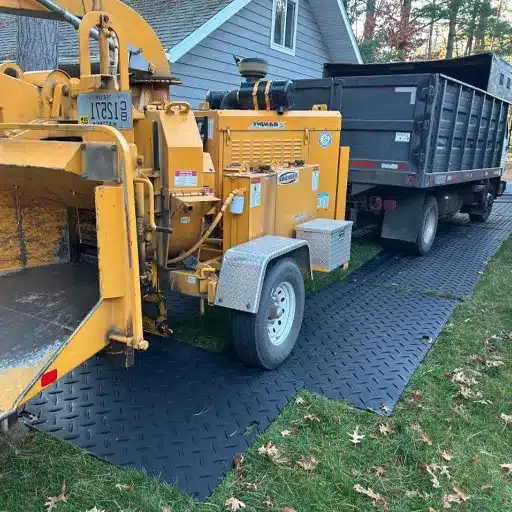
Soft ground is the single most common cause of mat underperformance. Saturated soils reduce bearing capacity by 30-50% compared to dry, compacted ground. A mat rated for 100 tons on firm soil may only support 50-60 tons on wet clay. The solution is not always a thicker mat. Often, subgrade preparation delivers better results than upsizing the mat. Industry guidance from pipeline projects confirms that even the best mat system cannot perform effectively if the subgrade beneath it is unstable.
Ground protection mat thickness selection depends on both the equipment weight and the ground bearing capacity. For soft ground projects, consider:
- A geotextile underlayment to separate the mat from the soil
- A 100-200 mm gravel working layer to distribute the load
- HDPE mats at a minimum 20- 25 mm thickness
- Interlocking connection systems to prevent edge sinking
Uneven or Sloped Terrain
Mats placed on uneven ground experience differential loading. One corner may carry twice the design load while another corner floats free. For slopes, specify mats with aggressive anchoring. For uneven terrain, use flexible systems or narrower 2×8 mats that conform to contours better than rigid 4×8 panels.
Sensitive Surfaces
Golf courses, stadium turf, and residential lawns require a different approach. Clear or light-colored HDPE mats minimize visual disruption. Turf protection mats at 10-12 mm thickness distribute pedestrian and light vehicle loads without crushing root systems. For decorative pavers or stamped concrete, use thick barrier mats that prevent point-load cracking.
Factor 3: How to Choose Ground Protection Mats by Project Duration
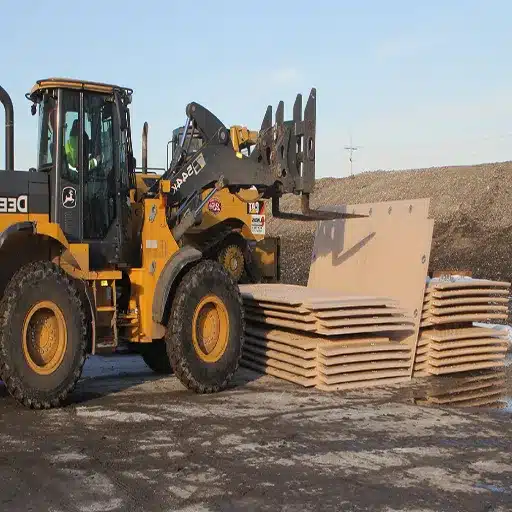
Short-Term Projects (Under 3 Months)
Rental makes sense when the project is single-site and short-duration. A three-month construction phase does not justify the capital outlay, storage space, and transport logistics of owning a mat fleet. Rental also eliminates maintenance responsibility. Many rental suppliers deliver, install, and retrieve the mats, which reduces labor overhead.
Multi-Site or Long-Term Projects (Over 1 Year)
Purchase delivers dramatically lower cost-per-use for contractors who deploy mats across multiple projects. A fleet manager named Elena ran the numbers for her civil engineering firm in Eastern Europe. She was renting 150 HDPE mats four times per year at a cost that exceeded the purchase price after 18 months. She bought the fleet outright. After three years, her cost-per-use was 60% lower than rental, and she had full control over deployment timing.
Buy vs. Rent Decision Matrix
| Scenario | Recommendation | Break-Even Point |
|---|---|---|
| One-time / 1-2 months | Rent | N/A |
| 3-6 months, single site | Rent or buy | 6-10 months |
| Ongoing / multi-site | Buy HDPE | 8-14 months |
| Extreme loads/crane pads | Rent composite | Per-project |
For a full 10-year total cost of ownership breakdown, see our ground protection mats cost and TCO analysis.
Factor 4: Climate and Environment in Ground Protection Mat Selection
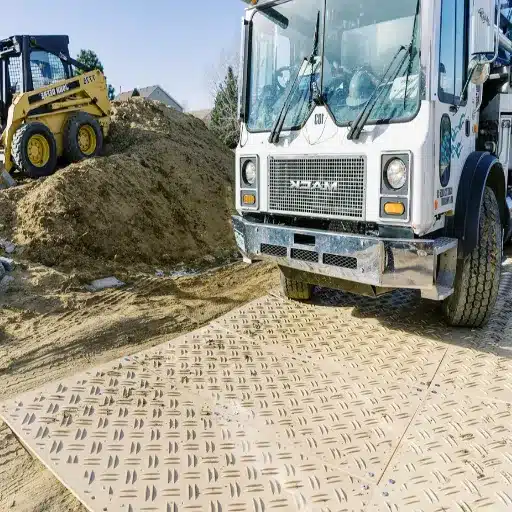
UV Exposure and Temperature Extremes
HDPE mats with UV-stabilized formulations retain over 90% of original tensile strength after 5,000 hours of accelerated exposure testing per ASTM D2565. Standard operating range for premium HDPE is -40 °C to +80 °C. If your project sits in sustained desert sun or Arctic winter, verify that your supplier specifies UV-stabilized virgin or recycled HDPE, not generic polyethylene that will embrittle within two seasons.
Wet and Muddy Conditions
Anti-slip surface texture is not optional in wet environments. Aggressive tread patterns on HDPE mats reduce slippage for both equipment and workers. Interlocking edges prevent panels from separating under turning loads. In sustained rain or mud, inspect connection pins before each shift. A single failed pin can allow a panel to shift under a turning excavator, creating a safety hazard.
Chemical Exposure
HDPE offers excellent resistance to hydrocarbons, acids, and salts. This makes it the preferred choice for oil and gas sites, chemical plants, and road salt environments. Timber mats, by contrast, absorb petroleum products and can become saturated with contaminants. Composite mats with exposed fiberglass cores can trap chemicals in the fiber matrix. For projects with chemical exposure risk, specify HDPE and verify material composition with your supplier.
Factor 5: How to Choose Ground Protection Mats: Portability and Handling
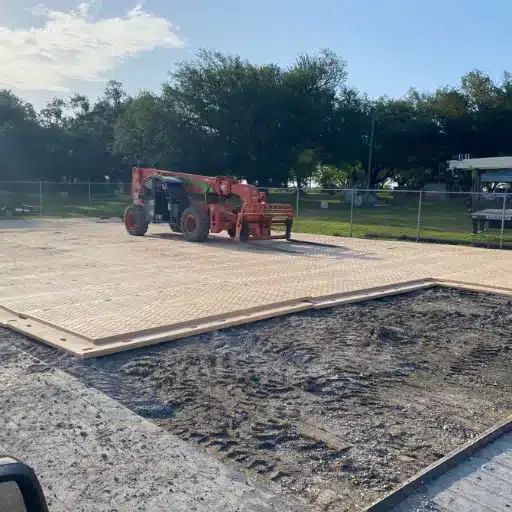
Manual Handling (HDPE)
A standard 4×8 HDPE panel weighs 32-45 kg. Two workers can carry and position it by hand in 30-60 seconds. No forklift. No crane. No operator. This is the primary reason HDPE dominates general construction, utilities, and event applications. When site conditions change, crews reposition mats instantly without waiting for machinery.
Machinery-Dependent Placement (Composite / Timber)
True composite mats at 100-150 kg per panel require a forklift or crane for every move. Timber crane pads at 2,000-4,000 kg require heavy lifting equipment. This dependency cascades through the entire project. Setup takes 5-15 minutes per panel instead of under a minute. Every repositioning requires equipment rental and operator time.
Transport Economics
Weight directly affects freight cost. HDPE delivers 2-2.5x more surface area per truckload than composite mats. For international buyers, the gap is even more significant. A 40-foot container holds roughly 300-350 HDPE mats versus 120-150 composite mats. The per-unit landed cost for heavier materials rises accordingly. For export-optimized container loads, HDPE is the clear choice. For a full material comparison, see our HDPE vs composite ground protection mats guide.
Factor 6: Choose the Right Connection System
Tongue-and-Groove Edges
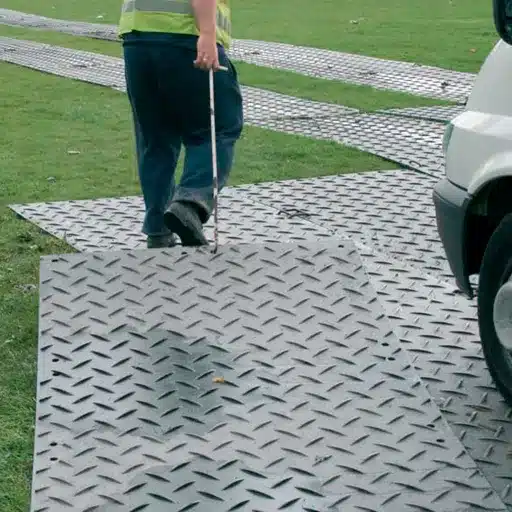
Tongue-and-groove systems are the fastest to deploy. Mats slide together along their long edges without additional hardware. They work well for temporary roadways, equipment staging areas, and event flooring on level ground. The limitation is slope performance. On inclines or under aggressive turning loads, tongue-and-groove joints can separate unless supplemented with pins.
Steel Pin Fasteners
Steel pins lock mats together through pre-drilled holes along the edges. They add 10-15 seconds per connection but deliver significantly more security than tongue-and-groove alone. Pins are replaceable if bent or lost. This system is the industry standard for construction sites with mixed equipment traffic and moderate slope conditions.
Cam-Lock and Bolted Flange Systems
Composite mats often use heavier connection hardware: cam-lock mechanisms, bolted corner plates, or overlapping flanges. These systems provide maximum security for semi-permanent installations like crane pads and oil rig platforms. The trade-off is slower assembly, higher wear rates, and more frequent hardware replacement. Field reports indicate composite connection systems need inspection 2-3x more often than HDPE pin systems.
Connection System Selection Guide
| Application | Recommended Connection |
|---|---|
| Temporary roadway, level ground | Tongue-and-groove |
| Equipment staging, mixed traffic | Tongue-and-groove + pins |
| Slope or wet ground | Pins with anchoring stakes |
| Crane pads/outriggers | Bolted flanges or cam-lock |
| Event flooring, pedestrian | Smooth edges or tongue-and-groove |
Factor 7: Certification and Quality Standards When Choosing Ground Protection Mats
Material Standards to Request
Large infrastructure projects and government contracts increasingly require documented material verification. Request the following from your supplier:
- ASTM D4020: UHMWPE material quality standard
- ISO 527: Tensile strength verification
- ASTM D2565: UV resistance testing (5,000+ hours accelerated exposure)
These standards ensure the polymer meets mechanical and environmental performance claims. Generic “HDPE” without test documentation may be recycled material with inconsistent properties.
Safety and Slip Resistance
For wet-condition projects, verify slip resistance ratings. DIN 51130 and ANSI B101.1 provide standardized slip ratings. R9 or R10 minimum is recommended for construction sites where mud, rain, or morning dew create slip hazards. Anti-slip texture is not just about equipment traction. Worker safety depends on it.
Certificate of Conformance (CoC)
A Certificate of Conformance from your supplier confirms that the delivered mats match the quoted specifications for thickness, density, and load rating. For projects requiring environmental compliance or warranty coverage, the CoC is essential documentation. Suppliers operating under ISO9001 quality management systems should provide this routinely. At Shanxi Shengxing, we retain production samples for five years to ensure traceability and consistency across batches.
Quick-Reference: Ground Protection Mat Selection Matrix
Use this matrix as a final check before placing your order.
| Project Type | Ground Condition | Duration | Best Mat | Thickness | Connection |
|---|---|---|---|---|---|
| Residential lawn + light equipment | Firm turf | 1-4 weeks | Recycled HDPE | 10-15 mm | Tongue-and-groove |
| Wet/muddy construction access | Soft/muddy | 3-12 months | HDPE | 20 mm | Interlocking pins |
| Crane outriggers/piling | Any | Project duration | Composite or timber | 38-50 mm | Bolted flanges |
| Golf course/stadium event | Turf | 1-7 days | Clear HDPE | 12-15 mm | Smooth edges |
| Utility easement / tight gate | Firm/uneven | 1-6 months | 2×8 HDPE | 15-20 mm | Pins |
| Tracked vehicles / daily traffic | Firm/soft | 6+ months | HDPE / UHMWPE | 25-30 mm | Heavy-duty pins |
| Export / international shipment | Varies | Ongoing | HDPE | 15-25 mm | Pins |
Frequently Asked Questions About How to Choose Ground Protection Mats
What thickness ground protection mat do I need?
For light utility vehicles and pedestrian traffic, 10-12 mm HDPE is sufficient. For standard construction equipment up to 40 tons, specify 15-20 mm. For heavy equipment and cranes up to 120 tons, use 25-38 mm HDPE or UHMWPE. Crane outriggers and extreme point loads require 38-50 mm composite or timber mats. For a complete thickness breakdown, see our ground protection mat thickness guide.
How many ground protection mats do I need for my site?
Calculate your coverage area in square meters, then divide by the mat size. A standard 4×8-foot panel covers 2.97 square meters. Add 10-15% for overlap and perimeter extension. For a 500-square-meter haul road, you need approximately 185-200 panels. Narrow 2×8 mats cover half the area and are better for tight corridors.
Should I buy or rent ground protection mats?
Rent for projects under three months or one-off deployments. Buy HDPE mats if you run multiple projects per year. The break-even point is typically 8-14 months of active use. After that, ownership delivers 40-60% lower cost-per-use than rental.
What is the best ground protection mat for soft ground?
Heavy-duty HDPE at 20-25 mm thickness, combined with a geotextile underlayment and a 100-200 mm gravel working layer. The gravel distributes load across a wider area, while the geotextile prevents the gravel from mixing with the native soil. Thicker mats alone cannot compensate for an unstable subgrade.
Do ground protection mats need a geotextile underlayment?
On firm, dry, compacted ground, mats can be placed directly. On soft, wet, or loose soils, a geotextile underlayment significantly improves performance by separating the mat from the soil and distributing load. It is strongly recommended for clay, saturated turf, and loose fill sites.
What size ground protection mats do I need?
The size of ground protection mats I need depends on your equipment footprint and coverage area. Standard 4×8-foot (1.2×2.4 m) panels suit most construction equipment and provide the best handling efficiency. For narrow utility corridors or tight gate access, 2×8-foot (0.6×2.4 m) mats work better. For crane outriggers and piling rigs, specify custom 4×4-foot or 3×3-foot pads to concentrate load-bearing capacity under the jack foot. Always add 10-15% extra panels for overlap and perimeter extension.
What connection system is best for heavy equipment?
Steel pin fasteners offer the best balance of security and deployment speed for mixed heavy equipment traffic. For crane pads and semi-permanent installations, bolted flanges or cam-lock systems provide maximum stability. Tongue-and-groove alone is sufficient only for light equipment on level ground.
Conclusion
Learning how to choose ground protection mats is not a guessing game. This ground protection mats selection guide gives you a structured evaluation of seven factors that every procurement team can complete in under an hour. Start with your heaviest equipment load, including point loads from outriggers. Evaluate your ground conditions honestly. Soft ground demands subgrade preparation, not just thicker mats. Factor in project duration to decide between rental and purchase. Account for climate, portability needs, connection requirements, and certification standards.
The buyers who get this right follow the framework. The buyers who get it wrong skip one of the seven factors and pay for the oversight in delays, replacement orders, or site remediation. Whether you are choosing ground protection mats for construction, events, or utility projects, the same seven-factor process delivers the correct specification every time.
Ready to specify ground protection mats for your project? Browse our HDPE ground protection mats for detailed specifications and export-optimized container loads, or request a technical quote from our engineering team. We provide load calculations, material recommendations, and customized specifications for construction and infrastructure projects worldwide.