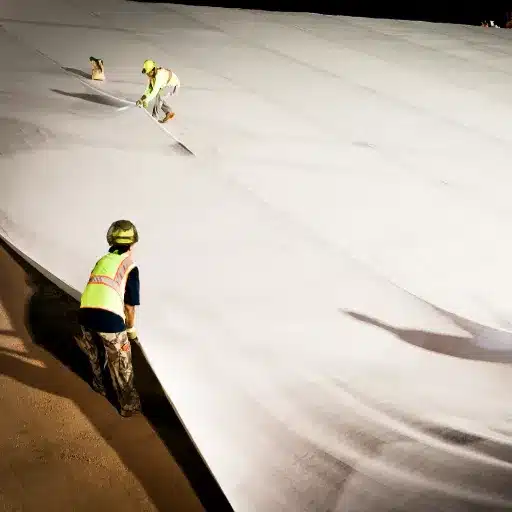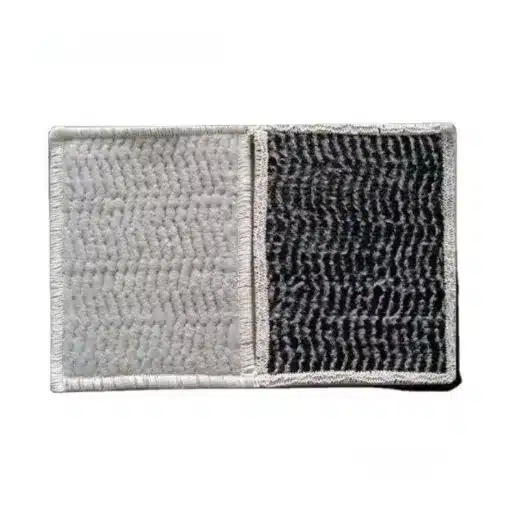
Geotextile ASTM standards are the test methods and terminology rules that turn a specification sheet from a list of numbers into an engineering decision. When you know what ASTM D4632, D6241, D4491, and D4751 actually measure, you can choose the right fabric for drainage, separation, stabilization, or erosion control without guessing.
Most buyers and engineers have seen those designations on a datasheet. Fewer can explain why one project needs ASTM D6241 CBR puncture while another accepts ASTM D4833 index puncture. That gap costs time and money. A submittal with the wrong test method gets rejected. A roll with “typical” values instead of MARV can underperform in the field. This guide closes that gap. If you need a broader foundation on fabric types and functions, see our geotextile fabric pillar guide.
By the end, you will understand the core ASTM geotextile test methods, how AASHTO M288 assembles them into survivability classes, how to read a geotextile specification sheet line by line, and what to verify before you accept a supplier’s certified test report. If you need help applying these standards to your project, request a specification review from our engineering team.
Key Takeaways
- Geotextile ASTM standards define how properties are tested; AASHTO M288 defines which properties a highway project needs.
- ASTM D4439 is the terminology foundation every specification should reference.
- Mechanical tests include grab tensile (D4632), wide-width tensile (D4595), trapezoidal tear (D4533), and CBR puncture (D6241).
- Hydraulic tests include permittivity (D4491) and apparent opening size (D4751).
- AASHTO M288 Class 2 is the default for most subsurface drainage and separation applications.
- MARV, not typical value, is the compliance number that protects field performance.
What Are Geotextile ASTM Standards?
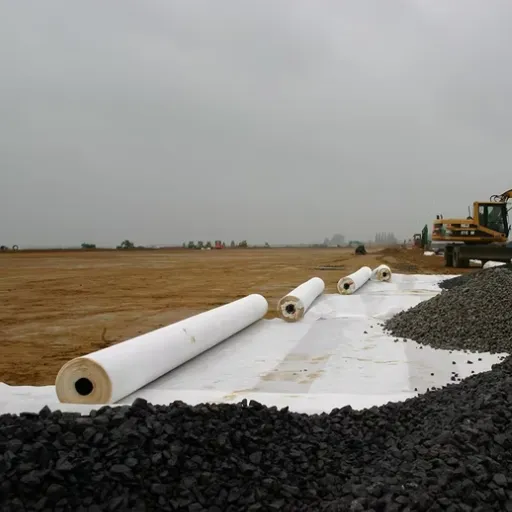
ASTM International publishes voluntary consensus standards for materials, products, systems, and services. For geotextiles, ASTM documents fall into three groups: terminology standards, test methods, and specifications. Terminology standards define the words engineers use. Test methods describe exactly how to measure a property so results from Lab A can be compared with results from Lab B. Specifications set minimum acceptable values for a given end use.
Geotextile ASTM standards matter because they create a common language between designers, contractors, suppliers, and inspectors. When a specification sheet says “grab tensile strength 800 N,” that number means nothing unless everyone agrees it was measured to ASTM D4632 under defined temperature, humidity, grip, and strain-rate conditions.
Why Standards Matter for Specification and Quality Control
Standards reduce three common project risks:
- Inconsistent testing: Without a standard method, two labs can report very different values for the same roll.
- Misaligned expectations: A buyer expecting CBR puncture may receive index puncture values that look stronger than they are.
- Submittal rejection: Public agencies often reject geotextile submittals that do not list the exact ASTM methods called out in the project specifications.
For international buyers, ASTM compliance also signals that a supplier can support North American and export specifications. Shanxi Shengxing supplies geotextiles with certified test reports (CTRs) and third-party laboratory documentation to back project-specific requirements.
ASTM vs. AASHTO vs. ISO: Which One Governs Your Project?
These three organizations overlap but serve different roles:
| Organization | Role | Typical Use |
|---|---|---|
| ASTM | Publishes test methods and terminology | Referenced by almost every geotextile specification |
| AASHTO | Publishes highway specifications, including M288 | Used by state DOTs and road agencies in the U.S. |
| ISO | Publish international test methods | Common outside North America; sometimes parallel to ASTM |
ASTM tells you how to measure. AASHTO M288 tells you which measurements a highway project needs and what the minimum values are. ISO methods are often technically similar but may use different specimen sizes or units. Always check the project specifications to see which standard governs acceptance.
ASTM D4439: The Terminology Foundation
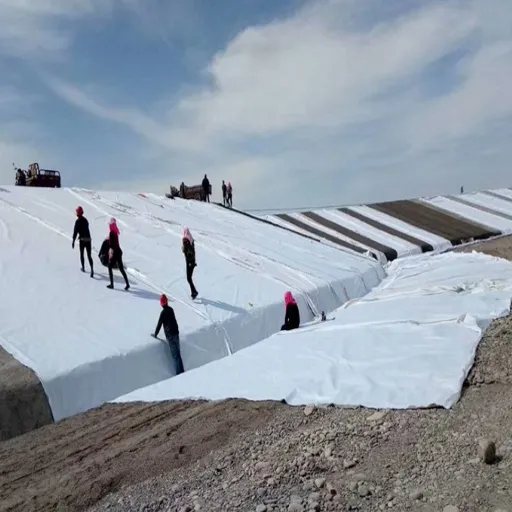
ASTM D4439 provides the geotextile terminology foundation that every specification should reference. The standard, Standard Terminology for Geosynthetics, defines the vocabulary used across geotextile specifications. It is not a test method. It is the dictionary that keeps every other standard consistent.
Key Terms Every Specification Should Use
- Geotextile: A permeable textile material used with soil, rock, earth, or other geotechnical engineering-related materials as part of a man-made project, structure, or system.
- Apparent Opening Size (AOS): A property indicating the approximate largest soil particle that would effectively pass through the geotextile.
- Permittivity: The volumetric flow rate of water per unit head per unit area normal to the geotextile plane.
- MARV (Minimum Average Roll Value): A quality control value representing the mean minus two standard deviations, meaning roughly 97.5% of rolls should exceed it.
- Grab Tensile Strength: The peak load required to rupture a specimen using a specific jaw width and grip separation.
- CBR Puncture Resistance: The force required to push a 50 mm diameter plunger through a geotextile, simulating a concentrated load such as a stone.
Using ASTM D4439 terminology in your project specifications prevents ambiguity. For example, saying “filter fabric” is vague; saying “filtration geotextile with AOS and permittivity per ASTM D4439 definitions” is precise.
Core Mechanical Test Methods
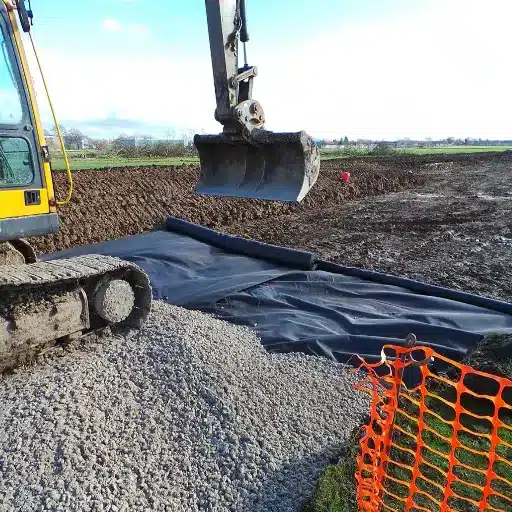
Mechanical geotextile test methods predict how a fabric survives installation and service loads. These are the properties most often checked during submittal review.
ASTM D4632 — Grab Tensile Strength and Elongation
ASTM D4632 measures the peak load and elongation of a 25 mm wide specimen gripped centrally. It simulates localized stress during installation, such as a worker pulling a corner or a stone pressing against a small area.
The result is reported as grab tensile strength (N or lbf) and grab elongation (%). Woven geotextiles usually show high strength and low elongation. Nonwoven geotextiles show lower strength and higher elongation. Neither is universally better; the right value depends on the application.
ASTM D4595 — Wide-Width Tensile Properties
ASTM D4595 uses a 200 mm wide specimen and measures tensile behavior over a broader width. This test is more representative of in-soil performance for reinforcement and stabilization applications where load is distributed across the fabric.
Wide-width tensile results include tensile strength at break (kN/m) and strain at break (%). Designers often check wide-width tensile when the geotextile contributes to structural capacity. For a deeper look at how fabric type affects strength, see our woven vs nonwoven geotextile guide.
ASTM D4533 — Trapezoidal Tear Strength
ASTM D4533 measures the force required to continue a tear in a trapezoid-shaped specimen with a pre-cut slit. It predicts resistance to tear propagation after the fabric is nicked during installation.
Tear strength is especially important for nonwoven geotextiles placed over rough or rocky subgrades. A small cut can grow quickly under load if the tear resistance is too low.
ASTM D6241 — CBR Puncture Resistance
ASTM D6241 measures geotextile CBR puncture resistance using a 50 mm diameter probe. Also called the California Bearing Ratio puncture test, it pushes the probe through the geotextile at a controlled rate. CBR puncture values are typically two to four times higher than index puncture values for the same fabric because the probe is larger and the test better simulates field stress from coarse aggregate.
Mini-story: A contractor in Texas submitted geotextile for a state highway subgrade stabilization project. The specification required ASTM D6241 CBR puncture resistance, but the supplier’s datasheet only listed ASTM D4833 index puncture. The engineer rejected the submittal. Three weeks passed before the supplier provided CBR data, delaying the start of paving and tying up the crew.
This is why CBR puncture is the preferred test for heavy-load applications.
ASTM D4833 — Index Puncture Resistance (when used)
ASTM D4833 uses an 8 mm diameter probe to measure index puncture. It is faster and cheaper than D6241, so it appears on many product datasheets. However, it does not simulate field loading as realistically as CBR puncture.
Index puncture can be useful for quality control and comparing fabrics from the same supplier. It should not be substituted for CBR puncture when the specification calls for D6241.
Core Hydraulic Test Methods
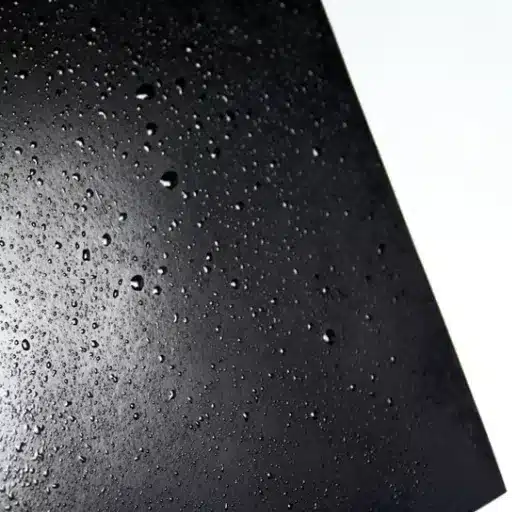
Hydraulic tests predict how water moves through the geotextile while soil particles are retained. These properties control filtration and drainage performance.
ASTM D4491 — Water Permeability (Permittivity)
ASTM D4491 measures permittivity, the flow rate of water perpendicular to the fabric plane under a defined hydraulic head. It is reported in sec^-1. Permittivity is a normalized value; it accounts for fabric thickness so that fabrics of different weights can be compared directly.
For drainage applications, higher permittivity means water can exit the soil faster. For filtration, permittivity must be balanced against AOS so that water passes, but soil stays behind.
ASTM D4751 — Apparent Opening Size (AOS)
ASTM D4751 measures AOS using dry glass bead sieving. The result, O90, is the bead size (in mm or U.S. sieve number) for which 90% are retained on or above the geotextile. A smaller O90 means a finer opening and better soil retention.
AOS selection depends on the soil gradation. A geotextile with openings too large will let fines pass and clog the drainage layer. A geotextile with openings too small may blind off and reduce flow.
Permittivity vs. Permeability: What Spec Sheets Really Show
Permeability (coefficient of permeability, k) is a property of the material alone. Permittivity is a property of the geotextile as a thin layer. Because geotextiles are thin, engineers usually specify permittivity rather than permeability.
| Term | Symbol | Units | What It Tells You |
|---|---|---|---|
| Permittivity | Ψ | sec^-1 | Flow capacity normalized by thickness; best for comparing fabrics |
| Permeability | k | cm/sec | Material property; less useful for thin fabrics |
When you read a geotextile specification sheet, look for permittivity per ASTM D4491. If the sheet only lists permeability, ask the supplier for the permittivity value or the thickness used in the calculation.
Durability and Physical Test Methods
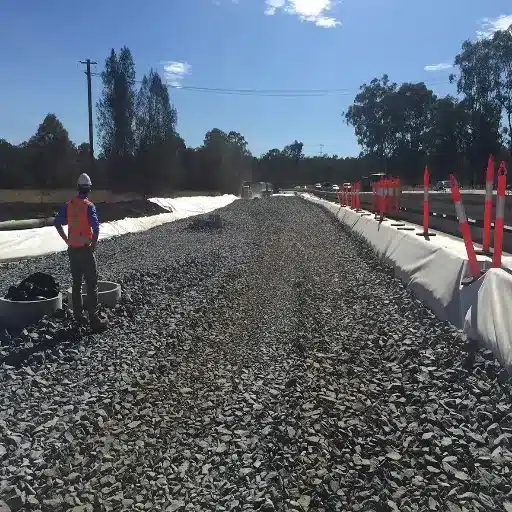
Durability tests predict how the geotextile performs after exposure to sunlight, chemicals, and handling. Physical tests verify basic construction properties.
ASTM D4355 — UV Degradation Resistance
ASTM D4355 exposes geotextile samples to ultraviolet light and water spray in a weathering chamber, then measures retained tensile strength. AASHTO M288 typically requires 500 hours of exposure with at least 50% strength retention.
UV resistance matters for any fabric that will be exposed during construction or in service. Even a few weeks of uncovered storage can weaken an unprotected polypropylene geotextile.
ASTM D5199 — Thickness
ASTM D5199 measures thickness under a specified pressure. Thickness affects protection capability, hydraulic transmissivity, and cushioning. It is not a strength property by itself, but it influences how the fabric interacts with adjacent soil and geomembrane layers.
ASTM D5261 — Mass per Unit Area (GSM)
ASTM D5261 measures mass per unit area, commonly called GSM (grams per square meter). GSM correlates with many other properties: heavier fabrics generally have higher strength, puncture resistance, and durability. However, GSM alone should never be used to select a geotextile because it says nothing about AOS, permittivity, or tensile behavior.
Chemical Resistance Notes
Chemical resistance depends on polymer type. Polypropylene resists most acids, alkalis, and biological growth but can be attacked by strong oxidizers and some hydrocarbons. Polyester resists alkalis and most organic chemicals but can hydrolyze in high-pH environments over long periods.
ASTM D543 and related protocols evaluate chemical resistance, but project-specific testing is often required for aggressive leachates or industrial effluent. When polymer selection matters, our polypropylene vs polyester geotextile comparison can help.
AASHTO M288: The Highway Specification Framework
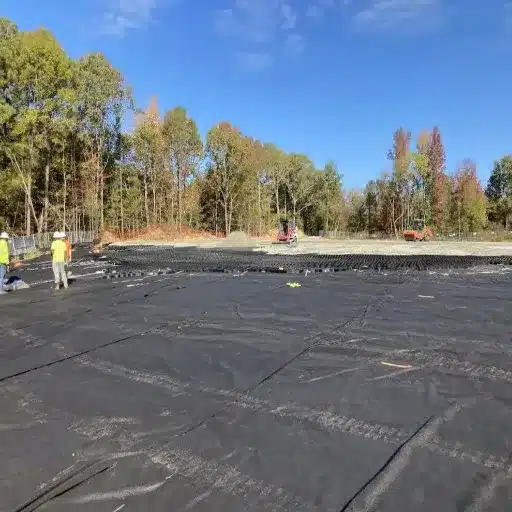
AASHTO M288 is the specification most often referenced by U.S. state DOTs for highway geotextile applications. It does not replace ASTM test methods; it uses them to define minimum performance classes.
What AASHTO M288 Covers
AASHTO M288 applies to geotextiles used in:
- Subsurface drainage
- geotextile separation and filtration
- Stabilization
- Erosion control
- Sediment control
- Paving fabrics
The current edition, AASHTO M288-24, updated survivability classes and test requirements. Always confirm which edition your project references because minimum values can change between editions.
Survivability Classes (Class 1, 2, 3, 4A/4B)
Survivability classes describe how aggressively the geotextile will be loaded during installation and service. Higher classes require stronger mechanical properties.
| Class | Typical Use | Installation Conditions |
|---|---|---|
| Class 1 | Severe: stabilization over very coarse aggregate, high loads | Maximum survival stress |
| Class 2 | Moderate: subsurface drainage, separation, erosion control | Normal construction handling |
| Class 3 | Mild: protected applications, low stress | Minimal handling and cover thickness |
| Class 4A/4B | Erosion control and sediment control | Specific to temporary or permanent installations |
Class 2 is the default for most drainage and separation projects. Class 1 is reserved for heavy stabilization or severe subgrades. Class 3 may be acceptable for well-graded, smooth subgrades with light cover.
How AASHTO M288 Uses ASTM Test Methods
AASHTO M288 creates a performance table by assigning minimum ASTM test values to each survivability class. For example, a Class 2 geotextile must meet minimum grab tensile strength, seam strength, tear strength, puncture strength, and UV resistance values measured by specific ASTM methods.
This is why the question “Does it meet ASTM?” is incomplete. The better question is: “Does it meet the ASTM test values required by the correct AASHTO M288 class for this application?”
AASHTO M288 Property Requirements Table
The table below summarizes typical mechanical requirements for woven and nonwoven geotextiles in AASHTO M288-24. Always verify exact values against the edition referenced by your project.
| Property | ASTM Method | Class 1 (min) | Class 2 (min) | Class 3 (min) |
|---|---|---|---|---|
| Grab tensile strength | D4632 | 1,400 N | 1,100 N | 800 N |
| Sewn seam strength | D4632 | 1,200 N | 990 N | 720 N |
| Tear strength | D4533 | 500 N | 400 N | 300 N |
| CBR puncture | D6241 | 3,500 N | 2,700 N | 1,900 N |
| UV resistance (% retained) | D4355 | 50% | 50% | 50% |
Values above are representative. Project specifications may add or modify requirements based on local conditions.
Hydraulic Requirements by Soil Fines Content
AASHTO M288 also sets hydraulic property requirements based on the percentage of soil passing the No. 200 sieve (fines content).
| Soil Fines Content | AOS Requirement (O90) | Permittivity Requirement |
|---|---|---|
| < 15% fines | ≤ 0.43 mm (max opening) | ≥ 0.5 sec^-1 |
| 15–50% fines | ≤ 0.25 mm | ≥ 0.5 sec^-1 |
| > 50% fines | ≤ 0.22 mm | ≥ 0.1 sec^-1 |
Mini-story: An engineer in Florida selected a Class 2 nonwoven geotextile for a roadside drainage trench. The specification met all mechanical requirements, but no one checked the soil gradation. The silty clay subgrade contained more than 50% fines, yet the chosen fabric had an O90 of 0.30 mm. Within two rainy seasons, fines migrated into the drainage stone and the trench began ponding. The fix required excavation and replacement.
This example shows why hydraulic requirements must be matched to soil conditions, not just to AASHTO class.
How to Read a Geotextile Specification Sheet
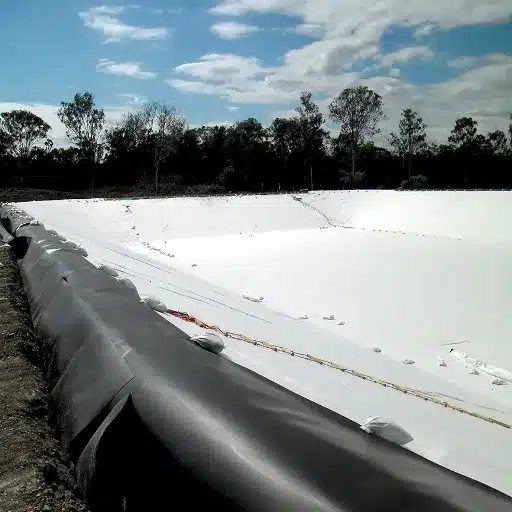
A geotextile specification sheet can look overwhelming. Reading it in a fixed order prevents mistakes.
Step 1: Identify the Application
Determine whether the fabric will be used for drainage, separation, stabilization, erosion control, or filtration. The application drives which properties matter most.
Step 2: Match the AASHTO M288 Class
Use the project specifications or a survivability table to select Class 1, 2, or 3. Most drainage and separation projects default to Class 2. Heavy stabilization or coarse aggregate placement may require Class 1.
Step 3: Check Mechanical Properties
Verify that grab tensile, tear, and puncture values meet or exceed the class minimums. Confirm whether the project requires CBR puncture (D6241) or allows index puncture (D4833).
Step 4: Verify Hydraulic Properties
Check AOS and permittivity against the soil gradation. If the soil is not yet tested, request a gradation analysis before finalizing AOS.
Step 5: Confirm Durability and Physical Properties
Look for UV resistance per ASTM D4355, mass per unit area per D5261, and thickness per D5199 if relevant. Confirm polymer type matches chemical exposure conditions.
Step 6: Look for MARV, Not Typical Values
Mini-story: A procurement buyer in Nigeria accepted a supplier’s “typical” CBR puncture value of 3,200 N for a Class 2 stabilization geotextile. The project accepted MARV values, but the datasheet did not state MARV. When third-party testing was performed on delivered rolls, several measured below 2,700 N. The rolls were rejected, and the contractor faced replacement costs and a schedule delay.
MARV is the value that protects you. A typical value is only an average. Always require MARV for mechanical properties and confirm the supplier’s quality control process. If you are unsure how to structure this in your purchase order, contact our engineering team for a specification review.
Geotextile Specification Checklist for Buyers
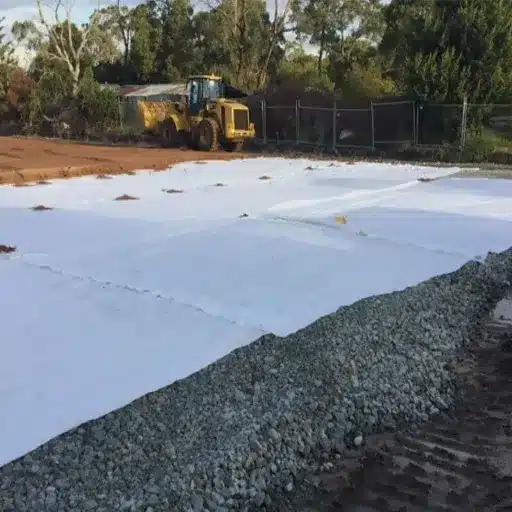
Use this procurement checklist to make sure every geotextile ASTM standard requirement is covered before you buy.
Define Application and Site Conditions
- Identify the primary function: drainage, separation, stabilization, erosion control, or filtration
- Confirm soil gradation and fines content
- Determine maximum aggregate size and cover thickness
- Assess installation stress: equipment traffic, drop height, stone angularity
Select Class and Woven/Nonwoven Type
- Choose AASHTO M288 survivability class (usually Class 2)
- Select woven or nonwoven based on strength and hydraulic needs
- Reference our woven geotextile applications guide for heavy-duty use cases
Supplier Qualification & Certifications
- Verify ISO 9001 quality management system
- Confirm third-party testing capability
- Request certified test reports (CTRs) for the specific product lot
- Check export documentation experience for international projects
Documentation Submittals
- ASTM test method designation for each reported property
- MARV values for mechanical properties
- AOS and permittivity values with the test method
- UV resistance data per ASTM D4355
- Mill certificate or certificate of conformance
Quality Inspection and Logistics
- Compare delivered roll labels to the submittal
- Inspect packaging and labeling for damage or misidentification
- Retain samples for possible retesting
- Confirm roll dimensions and quantity before unloading
Common Specification Mistakes
Even experienced teams make these errors. Avoiding them saves time and money.
- Using typical values instead of MARV: Typical values do not guarantee minimum field performance.
- Ignoring directional tensile differences: Some fabrics have higher strength in the machine direction (MD) than in the cross-machine direction (CD). Check both if the application is directional.
- Selecting AOS without soil gradation data: AOS must match the soil fines content, not just the AASHTO table default.
- Confusing D4833 with D6241 puncture values: Index puncture values look higher, but are not interchangeable with CBR puncture.
- Omitting UV exposure requirements: Unprotected storage or temporary exposure can degrade polypropylene geotextiles before installation.
For installation practices that protect these properties in the field, see our geotextile installation guide.
Frequently Asked Questions
What is the difference between ASTM and AASHTO geotextile standards?
ASTM publishes the geotextile ASTM standards that serve as test methods and terminology. AASHTO publishes specifications for highway applications, including M288, which references those ASTM test methods and assigns minimum values to survivability classes.
What does MARV mean on a geotextile spec sheet?
MARV stands for Minimum Average Roll Value. It is calculated as the mean test result minus two standard deviations, meaning about 97.5% of rolls should exceed the MARV. It is the compliance value you should specify, not the typical average.
Which AASHTO M288 class do I need for drainage?
Class 2 is the default for most subsurface drainage applications. Class 1 is used for severe installation conditions, and Class 3 may be acceptable for protected, low-stress drainage.
Can a geotextile meet ASTM standards but not AASHTO M288?
Yes. A fabric can be tested by ASTM methods, but still fail to meet the minimum values required by a specific AASHTO M288 class. Always compare test results to the class requirements in your project specifications.
How do I verify a supplier’s ASTM compliance?
Request certified test reports that list the ASTM method, test conditions, MARV values, and laboratory accreditation. For critical projects, arrange third-party testing of delivered rolls.
Conclusion: Putting Geotextile ASTM Standards to Work
Geotextile ASTM standards turn specification-sheet numbers into design decisions. ASTM D4439 gives you the language. ASTM D4632, D4595, D4533, D6241, D4833, D4491, D4751, D4355, D5199, and D5261 give you the measurements. AASHTO M288 organizes those measurements into classes that match real project risks.
The most important habit is to read spec sheets in order: application first, class second, mechanical and hydraulic properties third, and MARV last. Avoid the common mistake of accepting typical values or mixing index puncture with CBR puncture.
If you are specifying geotextile for a highway, drainage, or stabilization project, our team can review your specification, confirm the right AASHTO M288 class, and provide ASTM-compliant certified test reports. Request a quote or specification review today.