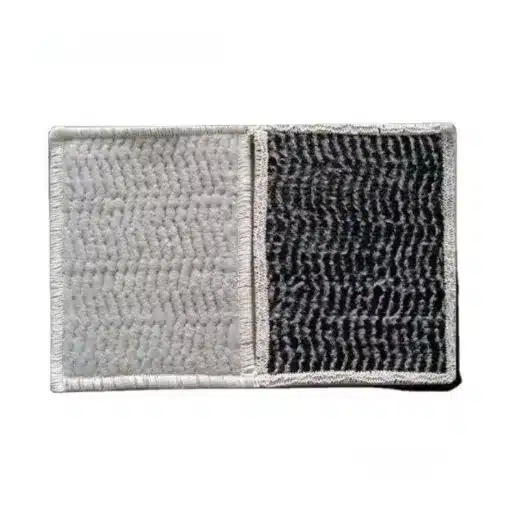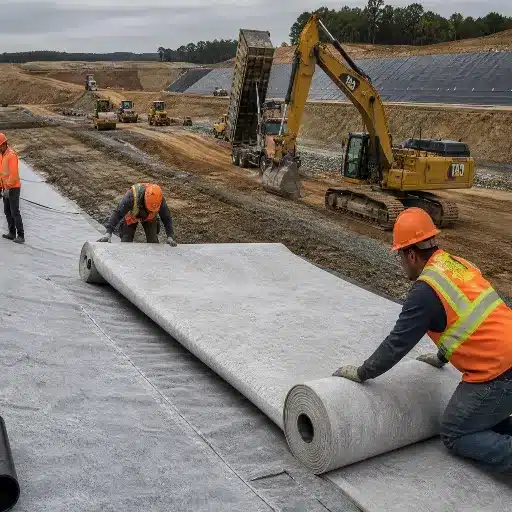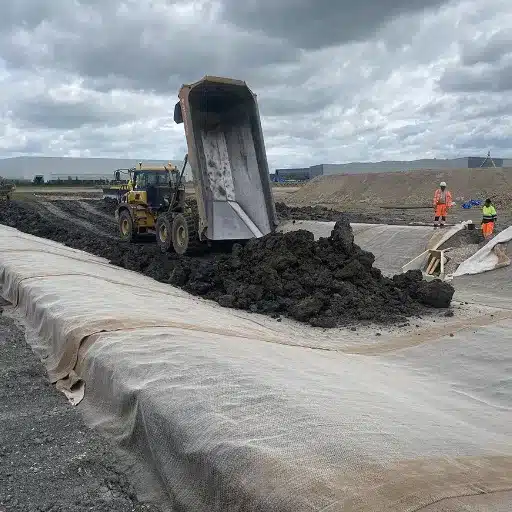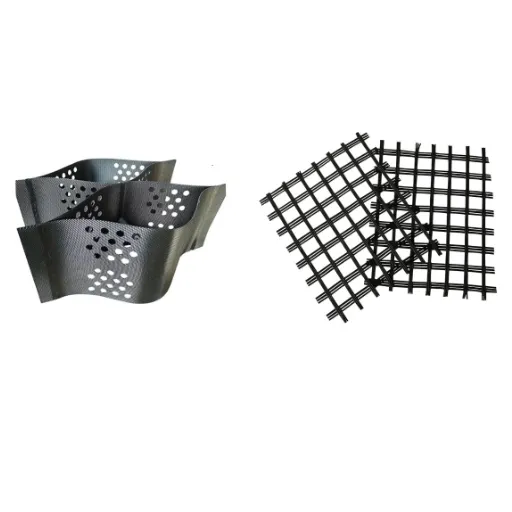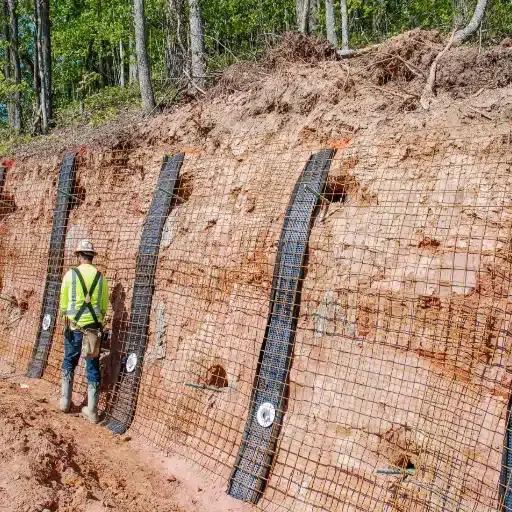
The main types of geosynthetic clay liner are defined by three independent choices: how the layers are bonded, what form the bentonite takes, and what is added for reinforcement, lamination, or chemical resistance. Getting those three choices right determines whether your liner survives a 3:1 slope, whether it hydrates from your subsoil, and whether it holds up against your leachate.
One number shows why this matters. Compare two GCLs sold as “a reinforced GCL” and their internal shear strength can differ enough to move a slope design from safe to failing. In published shear testing, needle-punched GCLs return a peak internal friction angle near 18°, but a residual value of only about 7.8°. Design on the peak and you have overestimated your liner by a factor of more than two.
Most manufacturer pages list their own product families without explaining the mechanics underneath. This guide works through the full taxonomy of geosynthetic clay liner types, with the shear strength, hydration, and chemical resistance data that actually decide the specification.
If you want the broader context on how these products fit into a containment design, our complete geosynthetic clay liner guide covers the fundamentals.
Key Takeaways
- A GCL type is defined by three independent axes: bonding method, bentonite form, and what is added (reinforcement, scrim, polymer, or geomembrane lamination).
- Needle-punched, stitch-bonded, and adhesive-bonded GCLs all fail at the woven geotextile/bentonite interface, and residual shear strength is nearly independent of bonding method. Bonding changes peak strength, not residual.
- Reinforced GCLs held 57.34% of 2025 GCL revenue. Non-reinforced grades suit slopes flatter than 10:1; reinforced grades are specified to 3H:1V and steeper.
- Powdered and granular bentonite have no universal winner. One granular and one powdered GCL reached identical saturated conductivity at 1.2 × 10⁻¹¹ m/s, yet granular grades hydrate poorly from lateritic subsoil.
- Polymer-enhanced grades are bounded, not unlimited. A dry-mixed bentonite polymer composite lost 92% of its polymer under aggressive leachate, and even advanced nanocomposites fail once calcium chloride reaches 10 to 20 mM.
What Determines the Types of Geosynthetic Clay Liner?
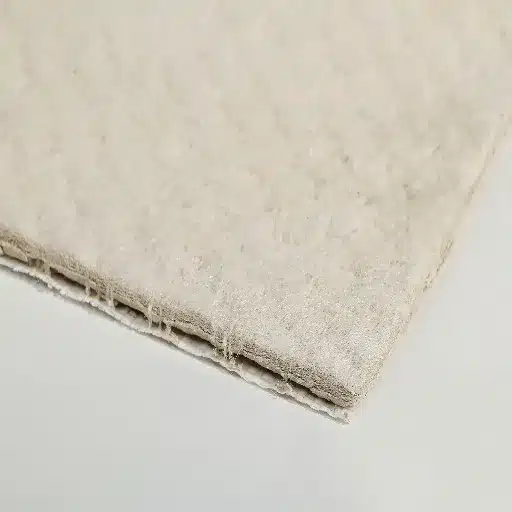
A GCL is a factory-made hydraulic barrier of sodium bentonite held between geosynthetic layers. What varies between products is how those layers hold the clay, what the clay looks like, and what else is built into the roll.
Three classification axes operate independently. Bonding method describes the mechanical connection between the carrier geotextiles. Bentonite form describes the particle size of the clay itself. The third axis covers everything added to the base product: internal reinforcement, scrim, a polymer additive, or a laminated geomembrane.
A single product is a combination of all three. A “needle-punched, granular, scrim-reinforced, geofilm-laminated GCL” is one specification, and each term in that description changes its behavior on site.
| Axis | Types | Property It Controls |
|---|---|---|
| Bonding method | Needle-punched, stitch-bonded, adhesive-bonded, combinations | Peak internal shear strength, bentonite migration resistance |
| Bentonite form | Powdered, granular | Hydration rate from subsoil, swell-shrink cycling |
| Added component | Unreinforced, reinforced (RNP/RNP2), scrim-reinforced | Internal shear strength, overlap retention |
| Construction | Geotextile-encapsulated, geomembrane-backed, composite laminate | Puncture resistance, defect sealing, chemical exposure |
| Chemistry | Standard sodium, coated, polymer-modified (BPC), nanocomposite (BPN) | Conductivity under aggressive leachate |
The most consequential of these is internal shear strength, because it governs whether a liner stays in place on a slope. That is where the bonding method and reinforcement axis do their work.
Whichever product type you land on, the decision to use a GCL at all is a separate question, covered in our GCL vs compacted clay liner comparison.
Types of Geosynthetic Clay Liner by Bonding Method
Bonding method is the first thing to specify, because it fixes the mechanical connection between the geotextiles and therefore the peak shear strength of the product. Manufacturers use needle punching, stitch bonding, adhesive, or a combination.
Needle punching draws barbed needles through the upper geotextile, the bentonite, and the lower geotextile, pulling fibres into a three-dimensional mechanical bond. NAUE developed the first needle-punched GCL in 1988, and the method now dominates the market. It is the default choice wherever there is meaningful shear demand.
Stitch bonding uses parallel rows of heavy yarn to stitch the layers together. It is also a reinforced construction, but with a different shear mechanism and a smaller share of the market today.
Adhesive bonding relies on a water-soluble adhesive mixed with the clay. It is unreinforced by construction and generally limited to flat or lightly loaded applications.
The critical finding comes from Fox et al. (1998), who tested all three types. Failure occurred at the woven geotextile/bentonite interface in every case, not in the bentonite itself.
More importantly, only the needle-punched product gained significant peak shear strength as normal stress increased, because its reinforcing fibres created a frictional connection. Adhesive-bonded and stitch-bonded products showed much smaller gains. Residual shear strength, in contrast, was essentially independent of product type. This is the single most useful thing to know about GCL types, and it appears on almost no supplier page.
Bonding method also affects bentonite migration. Under rapid loading with coarse cover soil, needle-punched products hold thickness and mass distribution better than adhesive-bonded grades, because the reinforcement adds confinement.
One caveat applies to bentonite behavior across all types, and our guide to the sodium bentonite liner covers the swelling chemistry in detail.
Powdered vs Granular Bentonite: Two Types, One Trade-Off
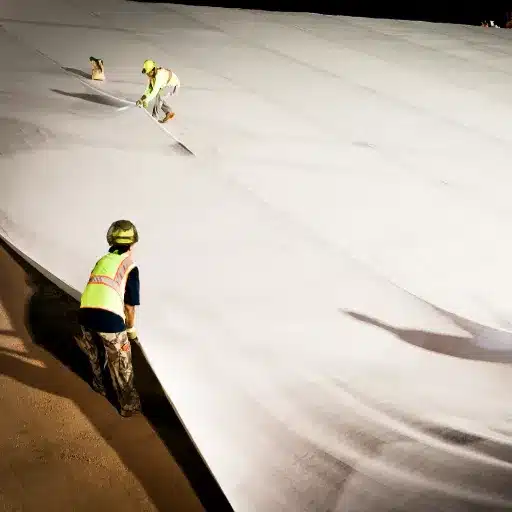
The second axis is bentonite form. Powdered bentonite has at least 80% of its particles passing the 75 µm sieve, while less than 1% of granulated bentonite passes that sieve. A swell index above 24 mL/2g is a common specification for both, measured under ASTM D5890.
The index and performance tests that define a GCL grade are collected in GRI-GCL3, the standard specification for geosynthetic clay liners. It references ASTM D5891 for bentonite fluid loss, ASTM D5993 for bentonite mass per unit area, ASTM D6496 for the bonding peel strength between the geotextile layers, and ASTM D6766 for hydraulic conductivity measured in a flexible-wall permeameter.
The choice is often presented as a straightforward performance ranking. The research does not support that framing.
Powdered bentonite hydrates more readily from low-moisture and fine-grained subsoils, including lateritic soils. It also retains more water at suctions below 1,000 kPa, which means more free swelling.
Granular bentonite swells less excessively and shrinks less, resists leaching during installation, distributes mass more evenly, and handles better in wind and light rain. It also holds lower permeability than powdered bentonite at comparable suction below 1,000 kPa, which matters in landfill barriers.
A 2024 study comparing three GCLs found the granular product struggled to hydrate from lateritic subsoil compared with the powdered grades. The granular GCL and one powdered GCL both had a swell index of 25 mL/2g, while the other powdered GCL measured 20 mL/2g. Reference gravimetric water contents reached 183% for the granular product against 214% and 268% for the powdered products (E3S Web of Conferences 2024).
Then the same study recorded something that undercuts any simple ranking. The granular GCL and one powdered GCL reached identical saturated hydraulic conductivity at 1.2 × 10⁻¹¹ m/s.
| Property | Powdered Bentonite | Granular Bentonite |
|---|---|---|
| Particle size | ≥80% passing 75 µm | <1% passing 75 µm |
| Hydration from dry subsoil | Faster, more reliable | Can be slow, especially lateritic soils |
| Water retention below 1,000 kPa suction | Higher | Lower |
| Swell-shrink cycling | Greater | Less |
| Handling during installation | More wind and rain sensitive | Better in wind and light rain |
| Bentonite migration | Somewhat higher | Lower, more even mass distribution |
| Saturated conductivity once hydrated | Equivalent | Equivalent |
The mechanism behind the differences is granule swelling. If swelling is suppressed, conductivity through a GCL rises toward that of non-plastic silt, around 10⁻⁸ m/s, for powdered bentonite, or toward sand, around 10⁻⁶ m/s, for granular bentonite (OSTI). Granule sizes range from 0.002 mm to 1.5 mm across the powdered-to-granular spectrum. Swelling closes the intergranular pores; without it, flow takes the easy path.
The practical rule: match the bentonite form to your subsoil moisture and site temperature, not to a product brochure. Subsoil characteristics often influence hydration more than particle form does.
Reinforced vs Non-Reinforced GCLs: The Slope Decision
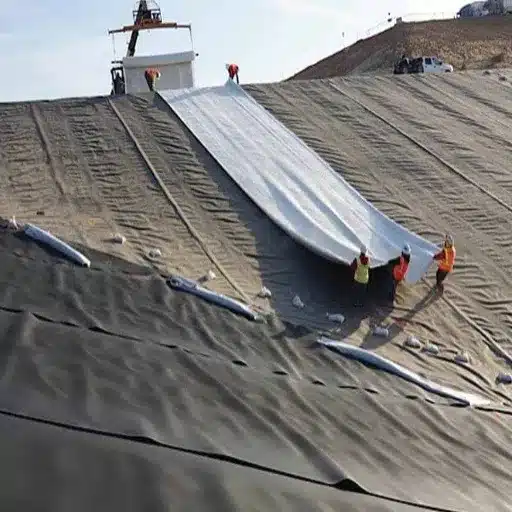
This is the axis that most often decides a specification. Non-reinforced GCLs have minimal needle-punch reinforcement and are recommended only for relatively flat work, conventionally flatter than 10:1 (AGRU America). Reinforced GCLs use a needle-punched nonwoven geotextile through the bentonite and the opposing geotextile, sometimes with an added scrim.
The market has already voted. Reinforced GCLs accounted for 57.34% of GCL revenue in 2025 (Mordor Intelligence), and grades such as RNP and RNP2 are standard designations.
Scrim reinforcement and overlap retention
Scrim reinforcement is often treated as a cost adder for high-stress projects. Field evidence suggests a second, more immediate benefit: it protects the overlap.
In documented field studies, double-nonwoven GCLs without scrim reinforcement shrank as much as 24 in (about 610 mm) over a two-year period with no cover soil. Scrim-reinforced double-nonwoven GCLs did not shrink at all and retained their original overlap width (GeoMontreal 2024).
That reframes scrim as an overlap-retention measure, not just a shear measure. An overlap that closes up is a direct flow path, regardless of how strong the GCL is internally.
GCL Internal Shear Strength Values
Here is the data that decides slope design, and here is where published supplier material goes quiet.
| Source | Product | Peak Friction Angle | Residual Friction Angle |
|---|---|---|---|
| Zornberg et al. database | Reinforced / needle-punched | ~18.0° | ~7.8° to 7.9° |
| New York DEC dataset | Reinforced / needle-punched | 16° | 6° |
| Fox et al. (1998) | Hydrated GCL, 200 mm displacement | Not reported | 4° to 5° |
| Fox & Ross (2011) | GCL internal | Not reported | 4.8° |
Adhesion values in the New York dataset were 39 kPa at peak and 7.8 kPa at residual (NY DEC, Zornberg et al.).
Two rules follow from those numbers. First, design on the residual, not the peak, because residual governs progressive failure. Second, read the test method before you trust a quoted value.
ASTM D6243, the standard for GCL internal and interface shear, prescribes no fixed shear rate but requires a minimum 2 in (about 50 mm) displacement when residual strength is reported. ASTM D5321, the soil-geosynthetic interface test, fixes the rate at 1.0 mm/min. Many supplier claims quietly quote peak values, and a peak number taken at small displacement tells you very little about how the liner behaves after it starts to move (GeoAsia 8).
There is also a governing-plane point that surprises people. Smooth geomembrane/GCL interfaces show large-displacement friction of at least 7°, and up to 9° in some databases. That can exceed the GCL’s own internal residual of 4° to 5°. The critical failure surface is frequently the interface, not the liner interior, so buying more internal shear strength does not automatically solve a slope problem.
GCL Maximum Slope by Type
| GCL Type | Typical Maximum Slope | Anchoring Notes |
|---|---|---|
| Non-reinforced | Flatter than 10:1 | Standard anchorage |
| Standard reinforced (needle-punched) | 3H:1V, commonly applied to 4H:1V | Standard anchorage, cover soil |
| Reinforced with scrim | 2.5H:1V to 2H:1V | Detailed stability analysis required |
| Reinforced, canyon/steep grades | Steeper than 3H:1V, to about 1.5H:1V | Project-specific design |
| Vertical applications | Vertical | Mechanical restraint such as shotcrete |
Design practice requires a factor of safety of at least 1.5 under static conditions, calculated against the lowest strength along any potential failure plane, whether internal or at an interface (IGS slope design).
Priya, a landfill design engineer working on a canyon cell, ran into exactly this. Her first specification called out a standard reinforced GCL for a sidewall drawn at 2.5H:1V. The direct shear results came back with a residual interface friction lower than the internal value she had based her factor of safety on. Re-running the stability analysis against the interface moved her to a scrim-reinforced grade with a thicker cover soil. The fix cost more per square meter, but it kept the design above 1.5 without re-grading the cell.
Overlap width and anchoring detail are specified during installation design, and they must be checked against the shrinkage behavior of the grade you select.
Composite, Laminated, and Geomembrane-Backed GCL Types
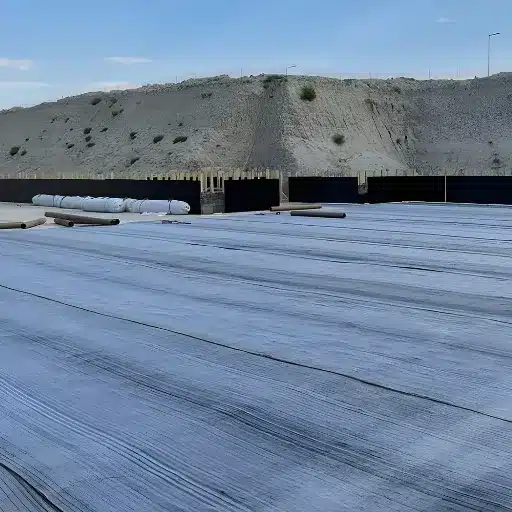
A fourth group changes the construction rather than the bonding or the clay. These products bring a polymer component into the roll itself.
Geomembrane-backed GCLs bond bentonite directly to a geomembrane during manufacture, using an adhesive or thermal process. Gundseal is a long-established example, with adhesive-mixed bentonite bonded to a geomembrane.
Composite laminate GCLs place bentonite between geotextiles and laminate that assembly to a textured HDPE geomembrane or a polyethylene geofilm. Common commercial grades include CLT, CL, and 600CL.
The design logic is a factory-made two-in-one barrier. The polymer film blocks liquid and the clay component seals around defects in the film, which is a meaningful advantage because a defect in a film alone is a direct leak path.
The performance gap is not marginal. In one landfill final cover study, a conventional GCL degraded within 4 to 15 months, while a polyethylene-geofilm-laminated composite GCL performed well beyond five years.
One distinction causes constant confusion and is worth stating plainly. A composite laminated GCL is a product type: clay and film bonded together in the factory. A composite liner system is a design configuration: a geomembrane placed over a separate GCL as two distinct layers during installation.
They perform related functions and are specified differently. Our guide to the composite liner system covers the design configuration in detail.
Polymer-Enhanced GCLs: Type Selection for Aggressive Chemistry
The final axis addresses chemistry. Standard sodium bentonite loses its low permeability when divalent cations such as calcium and magnesium displace the sodium in the clay structure. Polymer additives exist to resist that.
The categories run from simple to sophisticated, and the performance data separates them sharply.
Dry-mixed bentonite polymer composites (BPC) blend polymer granules with the bentonite. Their weakness is the interface bond, and with no covalent bonding between polymer and clay, aggressive leachate flushes the polymer out.
In testing, 92% of the polymer eluted under coal-combustion-product leachate with an ionic strength of 975 mmol/L, raising conductivity from 2.4 × 10⁻¹² m/s to 2.2 × 10⁻⁸ m/s, a rise of four orders of magnitude. Under 500 mM calcium chloride, 35.3% eluted; under 2,000 mM sodium chloride, 15.8% eluted. Wet-mixing the polymer reduced elution to 34.4% against up to 90.6% for dry-mixing (University of Wisconsin).
Bentonite polymer nanocomposites (BPN) perform better. A polyacrylate-modified bentonite showed membrane efficiency coefficients between 109% and 433% of conventional sodium bentonite. It sustained membrane behavior at 5 mM calcium chloride with an efficiency of 0.95, against 0.13 for an anionic polymer-modified bentonite and 0 for a plain GCL. Conductivity under 500 mM calcium chloride was more than five orders of magnitude lower than sodium bentonite, and it stayed independent of pH from 0.3 to 13.1 .
Then the same research found the ceiling. Membrane behavior was ultimately destroyed at 10 mM calcium chloride in a rigid-wall cell and 20 mM in a flexible-wall cell. The benefit is real, and it is bounded.
Interface-crosslinked nanocomposites represent the current research frontier. A salt-resistant polymer grafted onto calcium bentonite via silane crosslinking cut polymer elution to 22% of the dry-mixed control, with conductivity as low as 2.8 × 10⁻¹² m/s, or 5.6% of the required GCL limit. Bound water content ran 3.9 times higher than natural calcium bentonite with 37.5% lower effective porosity (JRMGE). A related intercalated copolymer reached 1.6 × 10⁻¹² m/s against coal-combustion-product leachate, about 3.3% of the US standard, with elution at only 1.9% of dry-mixed samples (ScienceDirect).
Treat the last category as emerging capability rather than commodity supply, and specify it with test data from the actual production batch.
Conductivity across all these types depends on hydration and confinement as much as chemistry, and our reference on GCL hydraulic conductivity covers the test methods.
Matching GCL Types to Your Application
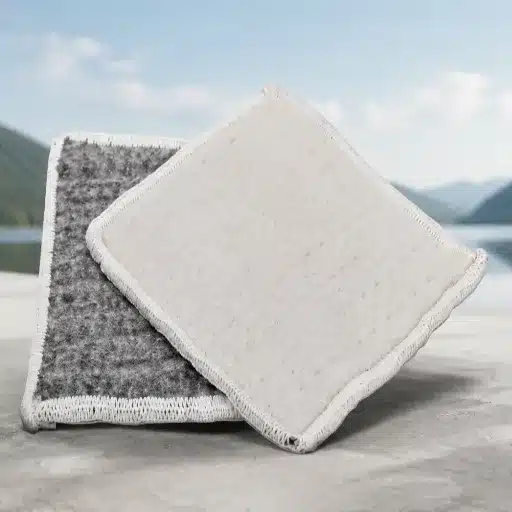
Work the axes in order, because each decision constrains the next.
- Establish the slope angle and the governing failure plane. Determine whether the critical surface is internal to the GCL or at an interface. This sets the reinforcement requirement before anything else.
- Determine the confining stress and cover thickness. Lower confinement reduces the internal shear strength you can rely on and increases desiccation risk.
- Characterise the contained liquid. Note the divalent cation concentration, the ionic strength, and the pH. This decides whether a standard grade is adequate or a polymer grade is required.
- Set the design life and the wet-dry exposure. Cyclic drying drives desiccation cracking and, over time, cation concentration in the clay.
- Fix the bentonite form from subsoil moisture and temperature. Powdered for drier, fine-grained subsoils; granular where handling and shrink-swell control matter more.
- Choose the bonding method and reinforcement grade from steps 1 and 2, adding scrim where overlap retention is critical.
- Decide whether lamination or a polymer grade is needed from step 3, and confirm it with chemical compatibility testing.
- Specify bentonite mass per unit area and index flux against the applicable standard, and require batch test reports.
| Application | Typical Slope | Chemistry | Recommended Type |
|---|---|---|---|
| Landfill base liner | Flat to 4H:1V | Moderate leachate | Needle-punched, powdered, reinforced |
| Landfill sidewall or canyon cell | 3H:1V to 1.5H:1V | Moderate to aggressive | Scrim-reinforced or steep-grade reinforced |
| Landfill final cover | Flat to 4H:1V | Low | Unreinforced or laminate composite |
| Pond and reservoir lining | Flat to 4H:1V | Benign water | Standard needle-punched |
| Mining heap leach or tailings | Flat to 3H:1V | High ionic strength, low pH | Polymer-modified, chemically tested |
| High-sulfate or high-calcium containment | Varies | Aggressive | Nanocomposite or geomembrane-primary |
A specification team in a mining project learned the chemistry axis the hard way. They specified a dry-mixed polymer GCL for a heap leach pad on the strength of a vendor datasheet, then ran compatibility testing only after the material was ordered. The leachate ionic strength was far above the range the polymer could survive, and the elution numbers predicted a conductivity rise of several orders of magnitude. Reworking the specification to a tested nanocomposite grade delayed the order, but avoided a liner that would have lost its barrier function in the first operating season.
Full cost implications across these types, including the premium for polymer and laminate grades, are covered in our breakdown of GCL cost per square meter. When you are ready to compare grades against your actual conditions, request a technical quotation and our engineers will match the specification to your slope, chemistry, and subsoil data.
Frequently Asked Questions
How many types of geosynthetic clay liner are there?
There is no single fixed count, because GCLs are defined by three independent axes. Bonding method gives three main categories plus combinations, bentonite form gives two, and the added-component axis gives at least four product families. A GCL type is a combination, so the practical taxonomy runs to a dozen or more meaningful specifications.
What is the difference between reinforced and non-reinforced GCL?
Non-reinforced GCLs have minimal needle-punch reinforcement and suit slopes flatter than 10:1. Reinforced GCLs use a needle-punched nonwoven geotextile, sometimes with an added scrim, to raise internal shear strength and resist bentonite migration. Reinforced types held 57.34% of 2025 GCL revenue and are required for steeper slopes and higher overburden loads.
Is needle-punched better than stitch-bonded GCL?
Needle-punched GCLs gain significantly more peak shear strength as normal stress increases, because the punched fibres create a frictional connection through the bentonite. Stitch-bonded products show smaller gains. However, residual shear strength is nearly independent of bonding method, so the advantage is concentrated in peak performance rather than long-displacement behavior.
Is powdered or granular bentonite better in a GCL?
Neither wins universally. Powdered bentonite hydrates faster from dry and lateritic subsoils and holds more water below 1,000 kPa suction. Granular bentonite shrinks less, handles better in wind and rain, and distributes mass more evenly. One granular and one powdered GCL reached identical saturated conductivity at 1.2 × 10⁻¹¹ m/s, so subsoil moisture and temperature often matter more than particle form.
What slope can a GCL be installed on?
Non-reinforced GCLs are limited to slopes flatter than 10:1. Standard reinforced grades are commonly applied to 3H:1V to 4H:1V, and scrim-reinforced or steep-grade products reach about 1.5H:1V with project-specific design. Vertical applications are feasible with mechanical restraint. Design against the lowest strength along any failure plane with a factor of safety of at least 1.5.
Which GCL type is best for a landfill?
For a base liner on flat to moderate slopes with moderate leachate, a needle-punched reinforced GCL in powdered bentonite is the common specification. Sidewalls and canyon cells call for scrim-reinforced or steep-grade products. Where leachate carries high divalent cation concentrations or low pH, a polymer-modified or nanocomposite grade with chemical compatibility testing is the safer choice.
Conclusion
The types of geosynthetic clay liner available today are not variations on one product. They are distinct engineering solutions, defined by three choices that a specifier makes in sequence.
Five points carry most of the decision:
- Bonding method governs peak shear strength, not residual, and residual is what design depends on.
- Reinforcement is what makes steep slopes possible, and scrim does double duty by protecting overlaps from shrinkage.
- Bentonite form has no universal winner, so the subsoil decides.
- Friction at interfaces, not just internal strength, frequently governs slope stability.
- Polymer enhancement extends chemical tolerance to a defined ceiling rather than indefinitely.
Get those right and the specification follows. Get them wrong and no amount of material strength compensates.
Send us your slope angle, confining stress, leachate chemistry, and subsoil moisture data, and our engineering team will recommend the GCL type that fits. Request a technical quotation to start the specification review.
For the wider picture on how GCL types fit into a full containment design, begin with our complete geosynthetic clay liner guide, then use our framework on how to choose the right GCL when you are ready to qualify suppliers.