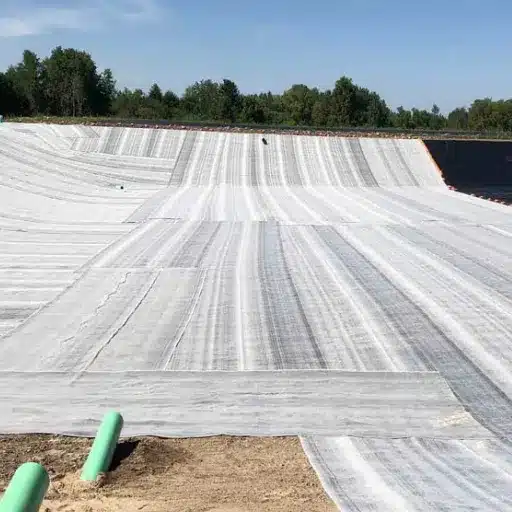
A GCL for mining is a geosynthetic clay liner used as a low-permeability barrier in heap leach pads, tailings storage facilities, process ponds, and mine closure covers, most often as the secondary layer beneath a geomembrane in a composite liner system. It replaces roughly a metre of compacted clay with a 7–15 mm sheet of sodium bentonite held between geotextiles, so it can be shipped to a remote site instead of quarried and hauled on-site.
That is the short answer. The longer answer decides whether your containment works.
In a heap leach pad, everyone argues about the geomembrane. The thin bentonite sheet beneath it is what keeps a leak from becoming an aquifer problem, and it is the layer most often specified from a datasheet instead of from project test data. You already know a GCL replaces clay and seals well. What you may not have been told is that its chemistry, its shear strength, and the schedule for testing both can rule it out of your project entirely.
This guide covers where a GCL belongs in a mine, where chemistry and slope stability rule it out, and how to specify, install, and source one. Every claim below ties to a standard, a test result, or a documented failure, so you can put the numbers straight into a design review.
Key Takeaways
- A GCL works in mining as the secondary barrier beneath a primary geomembrane; composite GM-over-GCL systems cut leakage to roughly 0–4 L/ha/day versus ~860 L/ha/day for a GCL alone.
- Mining is the fastest-growing GCL application, forecast at about 7.01% CAGR through 2031, driven by heap leach and tailings containment.
- The single biggest restraint is chemical compatibility: aggressive, low-pH, divalent-cation leachates can raise GCL hydraulic conductivity by orders of magnitude unless a bentonite-polymer composite (BPC) or PE-coated GCL is specified.
- Shear strength is a design input, not a datasheet number. Heap heights above 200 m push normal stresses toward 4 MPa, well beyond standard direct-shear testing.
- Two catastrophic 2024 heap leach failures, Çöpler and Eagle Gold, both involved GCL-bearing liner systems, so interface shear and prompt covering are now central design concerns.
What Is a GCL and Why Mining Uses It
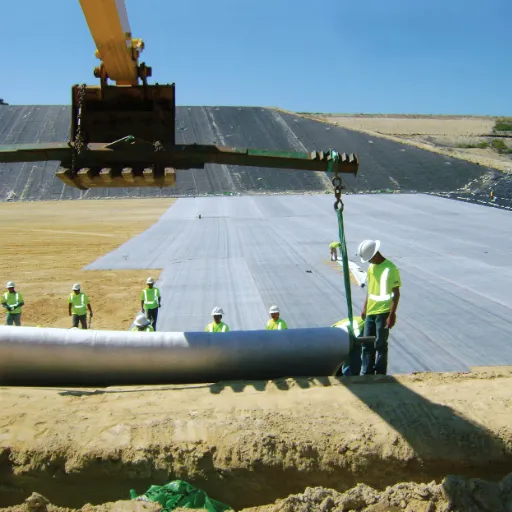
A geosynthetic clay liner is a factory-manufactured sheet of sodium bentonite, typically 4,000–6,000 g/m², encapsulated between two geotextiles and needle-punched, stitch-bonded, or thermally bonded into a flexible roll. When the bentonite hydrates, it swells into a low-permeability, self-sealing barrier. Typical hydraulic conductivity sits around 1×10⁻¹¹ to 5×10⁻¹¹ m/s, and lab tests show bentonite sealing holes up to about 75 mm in diameter.
Mining values that barrier function for one reason above all others: logistics. A GCL replaces roughly a metre of compacted clay with a layer only 7–15 mm thick. On a site above 3,000 m with no local source of low-permeability clay, that difference is the project. You ship rolls in containers instead of quarrying, hauling, and compacting a metre of clay across a pad measured in hectares. Because the resource is where the ore is, that is not a convenience. It is the only practical way to line some facilities.
The market agrees. GCL demand is growing globally, and mining is the fastest-growing application segment, forecast at about 7.01% CAGR through 2031, according to Mordor Intelligence. For a deeper look at the material itself, our complete guide to geosynthetic clay liners covers manufacture, grades, and test methods.
Where GCLs Are Used in Mining Containment
A GCL earns its place wherever a mine needs a mineral seal that can ship to site and self-heal if it is nicked. That covers most of the containment a mine builds.
Heap Leach Pads
Heap leaching stacks crushed ore on a lined pad and irrigates it with lixiviants that dissolve target metals. The GCL’s job is to sit beneath the primary geomembrane as a secondary barrier, so that a puncture in the membrane still meets a swelling clay seal rather than the subgrade. On structures that can exceed 200 m of stacked ore, the GCL also cushions the geomembrane, which reduces the number of installation defects.
Tailings Storage Facilities (TSF)
Tailings impoundments use GCLs in base liners and in closure covers. The base liner limits seepage under a permanent head of process water. The cover, added at closure, limits infiltration into the tailings and cuts the flux that drives acid generation. This is where the regulatory pressure is sharpest: the Global Industry Standard on Tailings Management has pushed operators toward more demanding liner practice, and downstream-raised and centerline facilities now routinely specify composite barriers.
Process, PLS and Evaporation Ponds
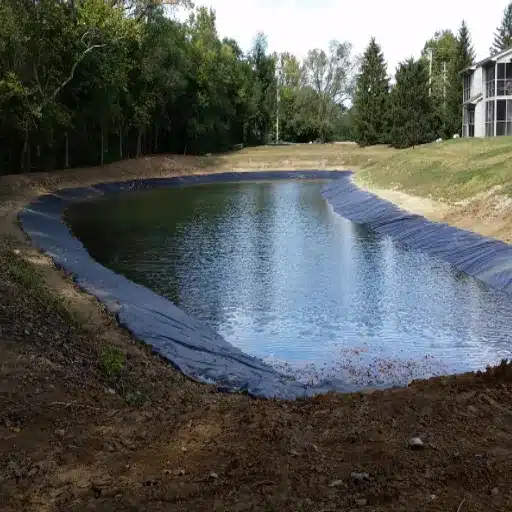
Pregnant leach solution (PLS), barren solution, raffinate, and evaporation ponds all hold concentrated process liquors. GCLs appear here as the secondary layer under the membrane, particularly where high ionic strength makes a mineral backup barrier attractive. Lithium brine evaporation ponds are a growing case, though the very high salinity requires careful compatibility screening.
Waste Rock, AMD and Mine Closure
Waste rock encapsulation and mine closure use GCLs to control acid mine drainage (AMD) and acid rock drainage (ARD). Cover systems that combine a GCL with a geomembrane and a drainage layer limit oxygen ingress and infiltration, which reduces sulfide oxidation. In geochemically sensitive rock, that is the difference between a passive cover and decades of active water treatment.
Read about the geomembrane side of these systems in our guide to geomembrane for mining, which covers materials and thickness selection.
GCL in Composite Liner Systems
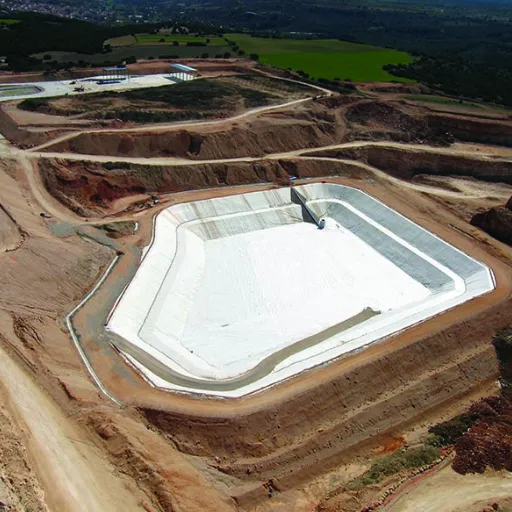
The GCL rarely works alone in mining. It works as half of a composite liner system, the paired barrier that has become the default for high-consequence containment. The standard build-up, bottom to top, is subgrade, then GCL, then geomembrane, then a protection geotextile or overliner, then the drainage and solution-collection layer.
The pairing is not marketing. The geomembrane is the primary, low-permeability polymer barrier. The GCL underneath provides two things the membrane cannot. First, it cushions the membrane against subgrade puncture, so fewer installation defects occur. Second, where the membrane is damaged, water passing the defect hydrates the bentonite and it seals the leak, exuding into the interface to form a hydraulic seal.
The performance gap is large enough to plan around. A composite GM-over-GCL system can hold leakage to roughly 0–4 L/ha/day, against about 860 L/ha/day for a GCL acting alone. That is the argument that turns a “nice to have” backup barrier into a design requirement on any pad where a leak would reach groundwater.
Consider how this plays out on a real pad. Elena, a geotechnical engineer specifying a copper heap leach facility in northern Chile, initially drew a single 1.5 mm textured HDPE liner across 90,000 m². A groundwater model during review showed the shallow aquifer below the pad would be exposed to acid leachate within two wet seasons if even a handful of membrane defects leaked undetected. She re-specified a composite: 2.0 mm textured HDPE over a 5,000 g/m² needle-punched GCL. The GCL added a bentonite seal at every future defect and cushioned the stiff membrane during installation. The change added material cost and moved no part of the schedule, because the liner crew placed the GCL in the same mobilization.
Chemical Compatibility: The Make-or-Break Factor for Mining GCLs
Here is the honest part that most product pages skip. A standard sodium-bentonite GCL is engineered for water and benign leachate. Mining rarely offers either.
Why Aggressive Leachates Attack Sodium Bentonite
Bentonite swells because sodium ions hold water between the clay layers. When the pore fluid is rich in calcium, magnesium, or other multivalent cations, those ions displace the sodium in a process called cation exchange. The clay shrinks and its permeability climbs. In one gold tailings study, the exchangeable sodium percentage in a bentonite-sand layer dropped from 59% to 2% on contact with high-ionic-strength porewater, and hydraulic conductivity rose from 4×10⁻¹¹ to 6.9×10⁻⁹ m/s, an increase of more than two orders of magnitude. A 0.15 m foundation layer reduced that degradation, but the mechanism is real and fast.
When You Need BPC or PE-Coated GCLs
Research on copper heap leach solutions, which are often low-pH and dominated by divalent cations, shows conventional Na-bentonite GCLs can develop hydraulic conductivity that is too high for containment. Two engineered options solve this:
- Bentonite-polymer composite (BPC) GCLs add a polymer that forms a gel, clogging the intergranular pores and holding conductivity low even under aggressive chemistry.
- PE-coated GCLs bond a polyethylene film to the GCL, protecting the bentonite core from ion exchange. These suit divalent-cation-rich or strongly corrosive media.
The practical rule: match the GCL to the leachate, not to the price list. Plain Na-bentonite glass for neutral water. BPC or PE-coated chemistry for acid leach, high-salinity brine, or leachate with a high multivalent-cation load.
Schedule the Compatibility Test Early
Compatibility testing on site-specific leachate can take 8 to 12 weeks. That timeline is a project risk, not a formality. If the compatibility work starts after the liner is ordered, a failed result becomes a redesign under construction pressure.
Priya, a process engineer at a gold operation in Ghana, learned this the useful way. Her team pulled a synthetic leachate sample and ran GCL compatibility testing nine months before pad construction, expecting the standard grade to pass. It did not; conductivity spiked under the alkaline cyanide chemistry. Because the result arrived early, procurement switched to a polymer-enhanced GCL in the same tender round. The only cost was a revised datasheet. Had the test run on the original schedule, it would have landed after the liner was committed, and the fix would have been a change order.
Our article on GCL hydraulic conductivity explains how these values are measured and why a datasheet number rarely survives contact with site chemistry.
Shear Strength, Slope Stability & the 2024 Heap Leach Failures
This is the section a supplier’s brochure will not write, and it is the one a heap leach designer needs most.
Hydrated bentonite is a low-strength planar material. Where a GCL sits in a composite under a heap, the interface between the geomembrane and the GCL, and the GCL itself, become among the weakest planes in the system. Reported peak friction angles for reinforced GCLs run from about 33.5° for needle-punched down to 6.6° for unreinforced, and residual values fall lower still. Under saturated conditions and large deformation, internal GCL strength can drop to 6° or less.
Load makes it worse, and mining loads are extreme. Heap leach facilities can exceed 200 m in height, imposing normal stresses approaching 4 MPa. Standard direct-shear equipment is typically limited to about 690 kPa, so a datasheet test does not represent conditions under a tall heap. Where testing has been pushed to mining loads, textured geomembrane against a needle-punched GCL showed peak friction angles falling from roughly 30° at 517 kPa (about 27 m of ore) to 20° at 2,758 kPa (about 146 m). Higher loads and higher temperatures, tested to 80 °C, reduce strength further.
What Çöpler and Eagle Gold Taught the Industry
Two failures in 2024 made this concrete. At the Çöpler mine in Türkiye (February 2024), an independent review concluded that the design had overestimated the shear strength of the liner system at the base of the heap leach pad, inflating the calculated factor of safety. The liner system contained a GCL. At the Eagle Gold mine in Yukon (June 2024), investigators pointed to the side-slope lining system, with undrained shear and static liquefaction as probable mechanisms, and identified freezing and prolonged exposure of the GCL as contributing factors that reduced peak and residual shear strength.
The lessons are not that GCLs fail. They are that a GCL’s interface shear strength must be measured at project stresses with project materials, and that a GCL must be covered and protected on schedule. Both are design and construction disciplines, not product defects.
Design rule: Never carry a datasheet friction angle into a slope stability model for a heap leach pad or tailings dam. Require project-specific interface shear testing at representative normal stresses, and confirm hydration and coverage requirements in the specifications.
How to Specify, Install and Source a GCL for Mining
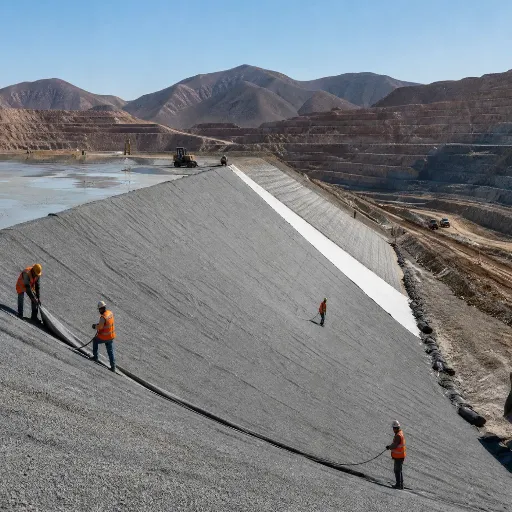
Getting the specification right protects the design. Getting the installation right protects the specification.
Specifications to Lock Down
Start with the three numbers that set performance. Bentonite mass (typically 4,000–6,000 g/m²) sets the reserve of clay available to seal. Swell index (commonly ≥24 mL/2g) confirms the bentonite is sodium-grade and will hydrate. Peel strength confirms the reinforcement holds the sheet together under handling and hydration. For code-referenced values, the Geosynthetic Institute’s GRI-GCL3 standard and the relevant ASTM methods (D5890, D5891, D6496) are the accepted references.
Overlaps, Anchoring and the Bentonite Bead
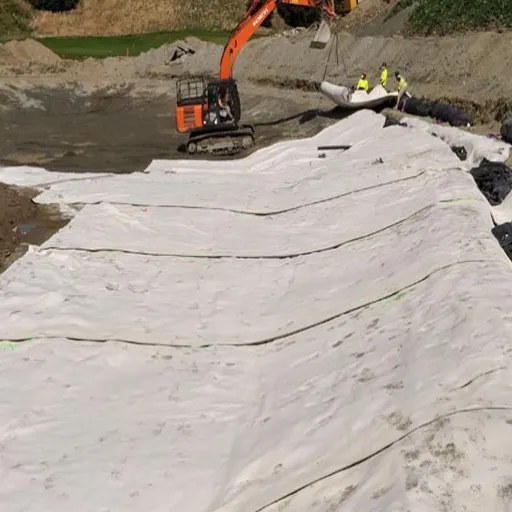
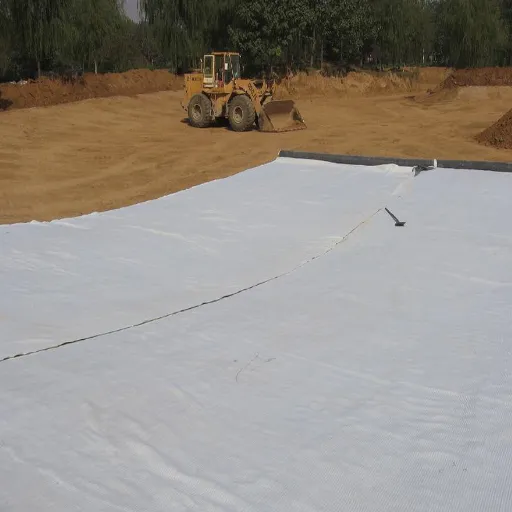
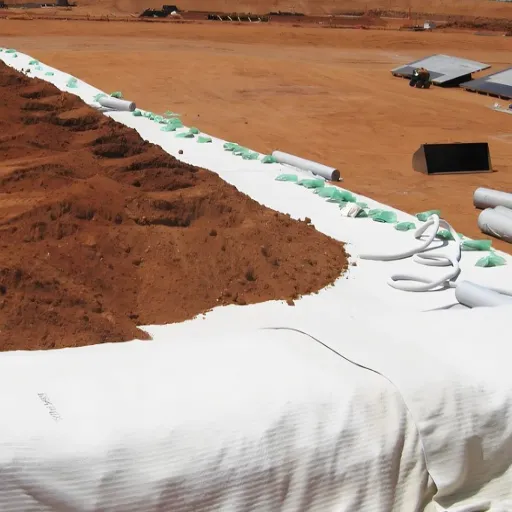
Seams are where GCLs leak. Adjacent rolls overlap 300 mm in shingle fashion; end-of-roll seams overlap 600 mm. A continuous bead of granular bentonite at not less than 0.4 kg per lineal metre fills every overlap zone. Panels are anchored in perimeter trenches and, on steep slopes, in intermediate anchor trenches. GCLs are deployed down-slope with a spreader bar, never dragged, and never laid in standing water or rain. Full step-by-step guidance is in our GCL installation guide.
Construction Quality Assurance
Mining GCLs need a formal CQA program. Representative samples are taken for every 10,000 m² produced and tested for bentonite mass per unit area and index flux. Roll certificates are collected and reviewed, and a sample of at least 300 mm square is archived from each roll. The inspector verifies subgrade approval, spreader operation, overlap dimensions, and bentonite application. And because exposure degrades the material, the specification must fix a covering window, commonly 24 to 72 hours.
Sourcing for a Remote Site
Procurement for a mine site is a spec decision as much as a price decision. Verify certified manufacturing and batch test data for the exact grade you specified. Confirm the grade against the leachate chemistry, not against the cheapest quote. Remember that GCL is heavy: freight is driven by container weight limits as much as by roll volume, so roll width and loading efficiency change the delivered cost per square metre. For international projects, choose a supplier who can ship export-ready packaging, provide batch test documentation, and retain samples for traceability.
GCL vs Geomembrane vs Compacted Clay in Mining
No single liner wins every role. Mining containment usually uses two barriers, and the question is which material does which job.
| Material | Primary role | Permeability | Best mining application | Key limitation |
|---|---|---|---|---|
| GCL | Secondary mineral barrier | ≈1×10⁻¹¹ – 5×10⁻¹¹ m/s | Backup seal under geomembrane; closure covers | Chemistry-sensitive; low shear strength |
| HDPE geomembrane | Primary polymer barrier | ≤1×10⁻¹³ cm/s | Heap leach pads, TSF base liners, PLS ponds | Stiff; needs cushioning and good subgrade |
| LLDPE geomembrane | Primary polymer barrier | ≤1×10⁻¹³ cm/s | Uneven subgrade, settling heaps, steep slopes | Slightly lower chemical resistance than HDPE |
| Compacted clay liner | Single mineral barrier | ~1×10⁻⁹ m/s or better | Sites with local, high-quality clay | Clay often unavailable at remote mines; haul cost |
The pattern that emerges: clay loses on logistics, the geomembrane carries the primary barrier duty, and the GCL earns its place as the self-healing backup. For the head-to-head on mineral barriers, see GCL vs compacted clay liner.
Choosing a GCL That Performs for the Mine Life Cycle
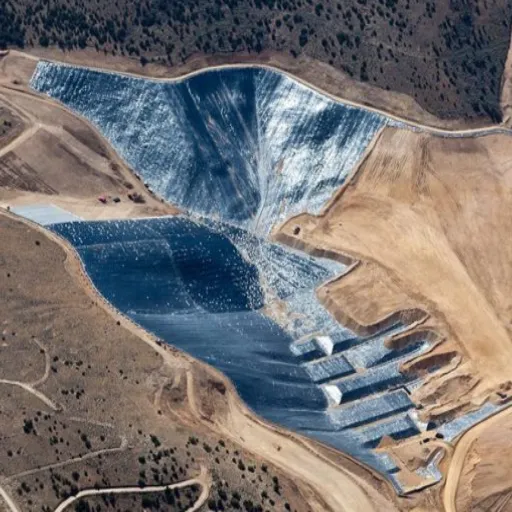
Pulling the threads together, a mining GCL decision comes down to three questions in order. First, what is the chemistry? If the leachate is acidic, saline, or multivalent-cation-rich, plain Na-bentonite is the wrong grade; specify a BPC or PE-coated GCL and start compatibility testing early. Second, what is the stress and slope on the interface? If the heap or dam is tall or steep, require project-specific interface shear testing at representative loads rather than accepting a datasheet number. Third, how will it be installed and covered? A GCL that stays exposed for months, or freezes while hydrated, loses strength, as the Eagle Gold investigation showed.
Answer those three questions with test data, and a GCL becomes what it is meant to be: a durable, self-sealing secondary barrier that ships to the site and backs up a geomembrane for the life of the facility.
Conclusion
A GCL for mining is a mineral barrier that replaces a metre of compacted clay with a thin, shippable, self-healing sheet. It is at its best as the secondary layer in a composite system, where it cushions the geomembrane and seals around damage. But it is not a universal fix. Its performance depends on leachate chemistry, its stability depends on interface shear strength measured at real heap loads, and its durability depends on disciplined installation and prompt covering.
To specify with confidence:
- Match the grade to the chemistry. Acid, saline, or divalent-cation leachates need BPC or PE-coated GCLs, not plain sodium bentonite.
- Test compatibility early. Budget 8–12 weeks for site-specific leachate testing and start it before the liner is ordered.
- Treat shear strength as a design input. Require project-specific interface testing at representative normal stresses.
- Follow the overlap and CQA rules. 300 mm shingle overlaps, 600 mm end-of-roll, ≥0.4 kg/m bentonite bead, one sample per 10,000 m².
- Cover on schedule. Keep the exposure window to 24–72 hours.
Handled this way, a GCL protects groundwater, supports tailings management compliance, and keeps a remote containment project on schedule.
Ready to specify a GCL for your mining project? Contact our engineering team for a technical quote, grade selection against your leachate chemistry, and export-ready supply documentation.
Frequently Asked Questions
Can a GCL be used for a heap leach pad?
Yes. A GCL is widely used as the secondary liner beneath the primary geomembrane in heap leach pad composite systems. It provides a self-sealing bentonite backup and cushions the geomembrane. For aggressive leach solutions, specify a bentonite-polymer composite or PE-coated GCL rather than a standard sodium-bentonite grade.
Is a GCL better than a geomembrane for mining?
They do different jobs. The geomembrane is the primary, low-permeability polymer barrier. The GCL is the secondary mineral barrier that self-heals and cushions the membrane. In mining, the strongest results come from using both together in a composite liner system rather than choosing one over the other.
What bentonite loading is used in mining GCLs?
Mining GCLs typically use 4,000–6,000 g/m² of sodium bentonite, with heavier loadings specified for tailings and other high-consequence containment. Heavier loading provides a larger reserve of clay to seal damage, but it also adds weight and cost.
Does a GCL work with acid mine drainage?
A conventional sodium-bentonite GCL can lose hydraulic performance under acidic, divalent-cation-rich leachate because of cation exchange. For AMD and ARD containment, use a bentonite-polymer composite (BPC) or PE-coated GCL and confirm performance with site-specific compatibility testing.
Why did GCL-bearing liners fail at Çöpler and Eagle Gold?
At Çöpler, the design overestimated the liner system’s shear strength at the heap base, reducing the factor of safety. At Eagle Gold, the side-slope lining system failed after undrained shear and static liquefaction, with freezing and prolonged GCL exposure reducing shear strength. Both are design and construction issues, not inherent product failures.
How long does a GCL last in a mining application?
A properly installed and covered GCL has a long design life, but durability depends on chemistry, hydration, and covering. Mining containment design assumes geosynthetics have a finite service life, so specifications include prompt covering, CQA, and, where needed, a redundant composite barrier.