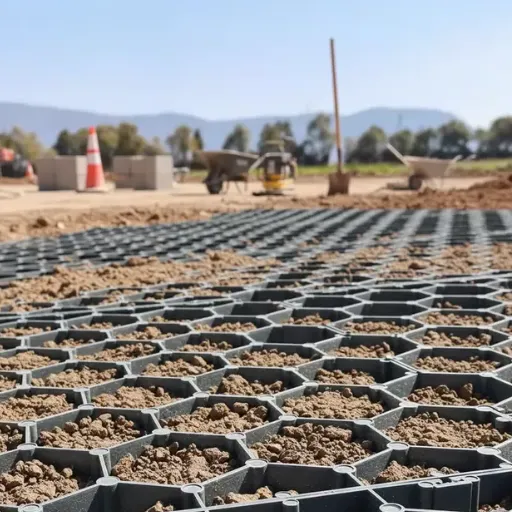
The right aggregate for geogrid base course is angular, crushed, well-graded stone whose particle sizes suit the grid apertures, with limited plastic fines. For most road bases and driveways that means 19 mm (¾ in) minus crushed stone with under 10% passing the No. 200 sieve.
That is the short answer. The hard part is proving it at the quarry gate.
Buyers spend weeks choosing between a 20 kN/m and a 30 kN/m grid, then accept whatever aggregate for a geogrid base course the quarry sends that week. On a soft site the second decision matters more, because stone that can’t interlock turns a correctly specified grid into an expensive separator.
This guide covers the stone, not the grid: two published gradation envelopes side by side, the quality limits that get enforced, the one ratio that confuses everybody, and five checks to run at the stockpile. The geogrid for road base and gravel driveways guide carries the thickness charts behind it.
Key Takeaways
- Two published gradation envelopes exist for a geogrid base course. They disagree at three of six sieves, and neither is a code requirement.
- Gradation is the only aggregate property that can negate the grid entirely. No tensile strength compensates for stone that bridges the apertures instead of seating in them.
- The optimum aperture-to-stone ratio is quoted between 1.1 and 5.4 because studies normalise to different particle sizes. On well-graded stone, A/Dmax 1.3 and A/D50 5.1 describe the same pair.
- The “maximum stone is one-third of lift thickness” rule is not in AASHTO M 147. It comes from pavement design guidance and agency practice.
- Plastic fines cause the failures that get blamed on gradation. Above a plasticity index of 6, the stone is the problem.
What Aggregate for Geogrid Base Course Must Do
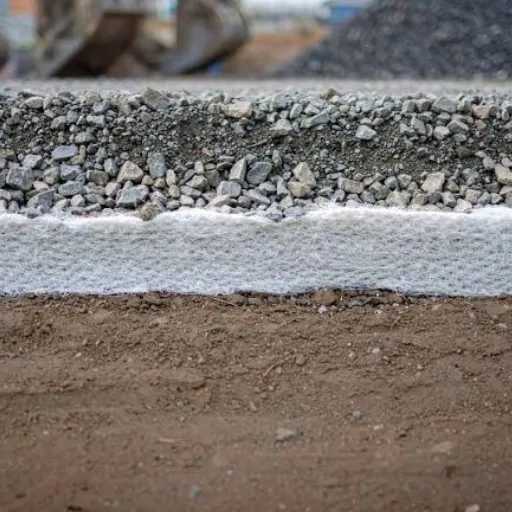
Four properties decide it, and they are not equally important. Gradation decides whether stone can seat into the apertures at all. Fines and plasticity decide whether the layer stays free-draining when wet. Angularity decides whether particles grip the ribs or slide past them. Durability decides whether stone survives the roller and the traffic after it.
For aggregate for a geogrid base course, gradation ranks first because it’s the only property that can cancel the grid outright. During compaction, mid-sized particles drop into the openings and wedge against the rib faces. As traffic loads the surface, the ribs go into tension against that wedged stone and restrain it from spreading sideways.
Stone that is too fine bridges across the opening; stone that’s too coarse sits on top of it. Either way the load path through the grid is broken.
The pairing rule comes from FHWA design guidance, reproduced in this state-of-practice presentation: the aperture must exceed the D50 of the fill and stay below twice its D85. For the derivation and the four competing sizing rules, see our geogrid aperture size guide. This article takes the grid as given and works on the stone.
Aggregate for Geogrid Base Course: Two Gradation Envelopes
There’s no single mandated gradation for aggregate for a geogrid base course. Two are widely cited, and they aren’t the same stone.
| Sieve | ND DOT optimum (% passing) | Tensar TriAx preferred fill (% passing) |
|---|---|---|
| 37.5 mm (1½ in) | 100 | 100 |
| 19 mm (¾ in) | 90–100 | 50–100 |
| 4.75 mm (No. 4) | 23–50 | 25–50 |
| 2.0 mm (No. 10) | 15–36 | not specified |
| 0.425 mm (No. 40) | 8–22 | 10–20 |
| 0.15 mm (No. 100) | not specified | 5–15 |
| 0.075 mm (No. 200) | 0–8 | under 10 |
The as the optimum gradation for use with geogrid. Tensar labels its version a preferred fill gradation in its TriAx installation manual and states plainly that it is not a requirement.
Look at where they part. At 19 mm the agency envelope permits only 0 to 10% passing while the manufacturer envelope permits up to 50%. At the fine end the positions reverse. ND DOT allows 0 to 8% passing the No. 200, while Tensar accepts up to 10% and demands a fuller distribution between the No. 40 and No. 100 sieves.
Both are defensible. ND DOT was specifying a subcut repair on a state highway, where a coarse, free-draining skeleton serves the section. Tensar was describing the fill that best mobilises its own product. A project specification overrides both.
What gives the table teeth is the failure that came with it. The pit run on that North Dakota job ran far finer than the envelope. Every test section where less than 610 mm (24 in) of it was placed over the grid failed, and the report’s explanation is blunt: in those areas, “the geogrid could not confine the pit run material.”
Salvaged bituminous material on the same job, whose gradation sat close to the envelope, produced the best-performing sections. One grid type, one subgrade, one season. The variable separating success from failure was the gradation of the stone.
The report is candid about its limits. Its summary states there was “no appreciable difference in the average rut data between the test and control sections.” The thickness finding still stands: 250 mm (10 in) of reinforced base equalled 410 mm (16 in) of unreinforced base. A reader deserves both sentences, not just the flattering one.
Why Interlock Fails When the Stone Is Wrong
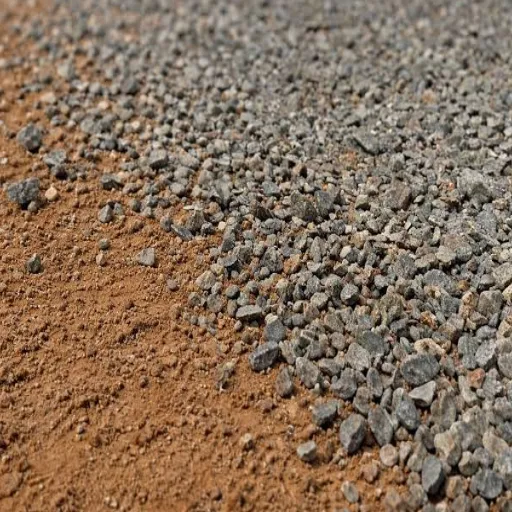
Too fine. Particles bridge across the aperture instead of penetrating it, so load transfer falls back to skin friction. On a wet subgrade, fines pump upward and progressively block the openings. Ruts return within weeks on a section where the grid was placed correctly and compaction was signed off.
Too coarse or uniformly graded. Stone sits on top, the ribs never receive passive bearing from adjacent particles, and the layer will not close under the roller. Tensar warns that uniformly sized coarse fill “does not compact well and may rut under repeated wheel loading” despite the stability the grid adds. A single-sized stone is really a drainage layer wearing a base course label.
Between those failures sits the number everyone argues about. Published optima for the aperture-to-particle ratio span a wide range.
One laboratory study reported effective interlock at A/D of 1.30 to 1.71 for biaxial grids and 1.08 to 1.43 for triaxial grids. Ballast research puts the optimum at A/D50 of about 1.20. A 2026 triaxial study on crushed rock found peak performance at A/Dmax 1.32, A/D90 1.89 and A/D50 5.15. Sarsby gives aperture at roughly 3.5 times d50.
A supplier quoting 1.3 and a supplier quoting 5.1 aren’t lying to each other. They’re normalising to different particles.
Work through the 2026 study’s material and it becomes obvious. The crushed rock had a maximum particle size of 19.0 mm, a D90 of 13.2 mm, a D50 of 4.85 mm and a coefficient of uniformity of 16.04. An aperture of about 25 mm gives A/Dmax near 1.3 and A/D50 near 5.2 from the same pair of objects. Both numbers are correct. They answer different questions.
The lesson for anyone specifying aggregate for a geogrid base course is short. On well-graded crushed stone, normalise to D90 or Dmax. Use D50 only for single-sized material. That’s why a datasheet comparison can look like a contradiction and be nothing of the kind.
Interlock itself is a contact count, not a strength value. A discrete element study held the grid fixed at 39 × 39 mm apertures and varied only the gradation. The better-graded specimen mobilised a higher peak deviator stress, 734 kPa against 552 kPa, and developed more grid-particle contacts.
Comparing two geogrid quotations? Send both datasheets and the gradation of the stone you intend to use. We’ll tell you which grid suits your stone, and which supplier is quoting a ratio to a particle size you do not have. Request a technical quote.
What Size Stone Goes Over Geogrid?
For most road bases and driveways, the aggregate for a geogrid base course should be 19 mm (¾ in) minus, angular, crushed, well-graded stone with under 10% passing the No. 200 sieve. The top size must suit the grid aperture, and particles must show freshly fractured faces on at least two sides.
Both reference envelopes cap top size at 37.5 mm (1½ in). In practice, 19 mm minus is the stone a small contractor can actually place and compact, because larger stone needs heavier equipment and thicker lifts to seat properly.
That leads to a rule everyone repeats and nobody codifies. Maximum particle size is commonly held to one-third of the compacted lift thickness. It’s nowhere in AASHTO M 147.
It appears in pavement design guidance such as ACI 330.2R-17, and agencies enforce their own versions: one half, two thirds or three quarters of the lift. A 150 mm lift with 37.5 mm stone is comfortable. A 100 mm lift with the same stone is not.
Local names for aggregate for a geogrid base course vary more than the engineering does. What matters is the percent-passing curve, not the label on the ticket.
| Name you will hear | What it usually is | Fine for a geogrid base course? |
|---|---|---|
| ¾-inch minus, 0 to 32 mm crushed | Dense-graded crushed stone, 19 to 32 mm top size | Yes, if it meets the project envelope |
| Class II base, Class V aggregate, granular A | Regional agency base gradings | Yes, if the specified envelope matches |
| No. 57, No. 67 | Open-graded drainage stone, single size | No. It drains, but it won’t confine a grid |
Recycled crushed concrete and reclaimed asphalt can meet an envelope, and some agencies accept them. They vary more between loads and need the same sieve analysis and plasticity testing as quarried stone.
Cover depth over the grid is a separate calculation, set out in how much gravel goes over geogrid.
Fines, Plasticity and Durability in a Geogrid Base Course
Gradation gets the attention. Fines and plasticity cause most of the failures.
| Property | Typical requirement | Test method |
|---|---|---|
| Fines passing No. 200 | Under 10% for a free-draining base; ND DOT envelope 0 to 8%; AASHTO M 147 base gradings span 2 to 25% | ASTM C 136 |
| Liquid limit, fraction passing No. 40 | 25 or less | AASHTO T 89 |
| Plasticity index | 6 or less; No. 200 fraction treated as non-plastic | AASHTO T 90 |
| Los Angeles abrasion loss | 50% or less | AASHTO T 96 |
| Fractured faces | At least 50% by weight retained on the 9.5 mm sieve with one or more fractured faces; some agencies require 90% or more | ASTM D 5821 |
| Clay lumps and friable particles | No clay balls or soft lumps | ASTM C 142 |
AASHTO M 147 also limits fines as a proportion of the No. 40 fraction: material passing 75 µm must not exceed two thirds of the material passing 425 µm. That clause suppresses dust, the case where stone passes its No. 200 limit by weight while the fine matrix is effectively all dust.
Plasticity is the limit most often skipped and most often responsible. Plastic fines swell when wetted, lose strength when saturated, and migrate. A non-plastic rock dust at 8% and a plastic clay at 8% are not the same material in service, and only one will pump through a grid.
Angularity is the requirement a buyer can verify with their eyes. One Wisconsin municipal standard requires at least 90% fractured faces while barring rounded river gravel by name, and Tensar concedes the same point, allowing that fill meeting the gradation but rounded will not interlock. If the stockpile looks like a beach, stop.
Where the problem is fines migrating up from a soft subgrade rather than fines in the stone, the fix is a separator, not a finer base. Tensar’s advice is a sand filter layer of at least 150 mm directly on the grid. The geotextile alternative is covered in our guide to separation and filtration geotextile.
Five Checks Before the Stone Goes Down
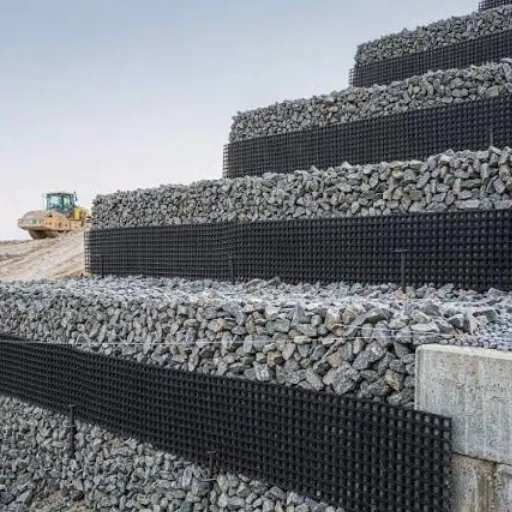
None of it matters if the load that arrives isn’t the stone you specified.
- Sample the stockpile, not the truck. Segregation means the face of the pile and its core are different materials. Sample across the full height.
- Wash-sieve the sample. Dry sieving overstates fines in a damp stockpile. Compare against the envelope at every sieve, not just the No. 200.
- Roll a handful of fines in your palm. Fines that ribbon and hold together when wet are plastic. Dusty, non-plastic fines crumble. Ten seconds catches what the percent-passing figure hides.
- Break a few particles open. Freshly fractured, angular faces interlock. Smooth, water-worn surfaces will not, whatever the certificate says.
- Place a trial lift and proof-roll it. If the lift pumps, ruts or will not close, stop. The grid will not rescue it, and the stone is the cheaper variable to change.
Then re-test the placed aggregate after compaction. Gradation measured at the stockpile shifts once stone is placed and rolled, because particles break down under the drum. Testing the placed fill, including its fines content, is the step most often skipped and the one that explains most post-construction surprises. Our review of geogrid failure modes puts this check alongside the seven other ways a reinforced section loses its benefit.
Three hold points sit alongside the stone checks: a first lift of 100 to 150 mm lightly compacted so the grid has a supported bed, no trafficking on exposed grid, and sufficient cover before tracked plant is allowed on. The placement sequence around those hold points is set out in how to install geogrid for gravel driveway.
Frequently Asked Questions
What size aggregate goes over geogrid?
19 mm (¾ in) minus, angular, crushed, well-graded stone for most bases, with a maximum particle size of 37.5 mm (1½ in) and under 10% passing the No. 200 sieve. It must sit inside the project envelope and suit the grid aperture.
Can you use pea gravel over geogrid?
No. Rounded particles slide past each other and past the ribs, so no confinement develops. A perfect gradation curve does not compensate for rounded shape. Pea gravel under a grid is a drainage layer, not a base.
Does the aggregate have to be crushed?
Yes for anything carrying traffic. Fractured faces are the mechanism that lets particles lock together and bear against the ribs. Some specifications demand 90% or more and exclude river gravel explicitly.
How much fines is too much in a geogrid base?
Under 10% passing the No. 200 sieve for a free-draining base, and none of it plastic. Keep the plasticity index at 6 or below and the liquid limit at 25 or below.
Can I use recycled concrete or RAP over geogrid?
Sometimes. They can work where gradation, fines and plasticity meet the envelope and are tested load by load. They break down more under compaction and vary more between deliveries.
What if my stone does not match the envelope?
Change the stone, or change the grid aperture to suit it. Do not place a mismatch and hope. The aperture size guide walks through the second option.
Aggregate for Geogrid Base Course: The Bottom Line
Gradation decides whether the grid works at all. Every other property here is a refinement on that, and no tensile rating recovers a base that will not seat.
Four conclusions are worth carrying to the next quotation. The two published envelopes disagree and neither is code, so your project specification wins. Fines and plasticity cause the failures gradation gets blamed for.
Angularity is the one requirement you can verify by eye at the gate. And the ratio a supplier quotes depends on which particle size it was normalised to, so ask.
For buyers sourcing both materials together, the useful enquiry isn’t “what stone do you sell” but “here is my gradation and my subgrade, quote the grid against it.” Constc Mart supplies biaxial geogrid for road base and driveway applications and works out gradation-specific recommendations at the enquiry stage rather than after the order.
Export documentation is prepared to ASTM and ISO test methods; domestic supply in China typically references GB/T 17689. If you’re still choosing between grid grades, which geogrid for a driveway sets out the selection logic before you settle on aggregate for geogrid base course.
Send us your gradation and subgrade condition, and we’ll recommend the aggregate for geogrid base course alongside the right grid. Our biaxial geogrid range covers standard road base grades, and the technical team will tell you when a grid does not belong in the section at all.