A geogrid does not prevent frost heave. Heave happens because water freezes inside frost-susceptible soil, and no grid removes water or stops an ice lens from growing. What a geogrid does under frost conditions is narrower, and still worth paying for. It reduces the differential movement that cracks and ruts a surface, and it lets a thinner base carry the same load.
Anyone on a gravel driveway in a cold climate knows the cycle. A hump rises in December, flattens by May, and in March the stone that carried a loaded truck in August turns to mush under a barrow.
Those are two problems with two fixes. This guide covers the cause, the evidence, why spring thaw does more damage, and the drainage detail that changes the outcome. The geogrid for road base design guide carries the thickness method.
Key Takeaways
- Geogrid does not stop ice-lens growth. Drainage, a non-frost-susceptible base, and depth do that. The grid reduces differential movement and base thickness.
- Laboratory models report 18% to 34% reductions in heave and thaw settlement for geosynthetics, most of them for geocells.
- Geogrid field results range from “no to minor” alone to a halving of differential heave when a separator is included.
- Spring thaw does more structural damage than winter heave. Subgrade modulus can fall from about 138 MPa to about 17 MPa, roughly 88%.
- Three conditions produce heave: susceptible soil, subfreezing temperature, and available water. Only the water condition is fully under the owner’s control.
Does Geogrid Prevent Frost Heave?
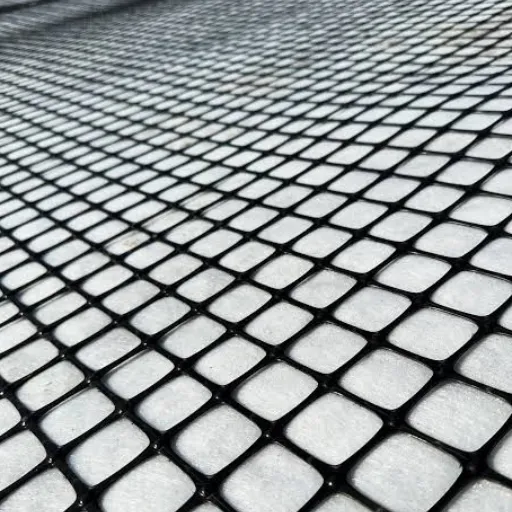
No. Heave is water freezing in frost-susceptible soil, and a grid changes neither the water nor the soil.
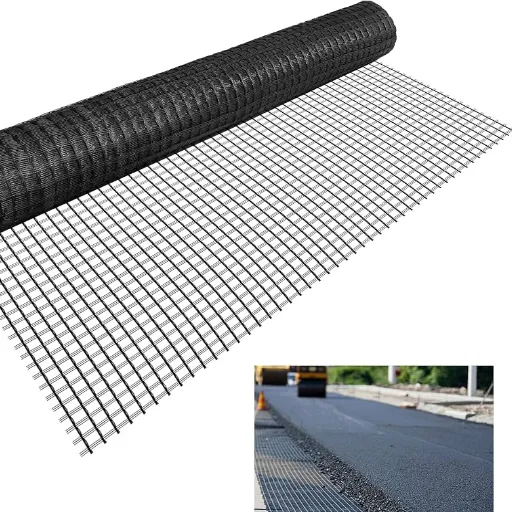
A geogrid contributes three things. It restrains the granular layer from spreading sideways. It acts in tension across a soft patch, spreading a wheel load wider. And it allows a thinner base, which in a cold region also means less material to store water.
None of that is a frost fix. It is a section fix that happens to help in frost conditions.
The boundary matters. A driveway that lifts and settles uniformly does not need a grid. Humps in one place, ruts at the entrance, or a step at the culvert are differential movement, and that is where a grid earns its place. See geogrid for gravel driveway for base depth and grade.
Not sure which problem you have? Describe the pattern in your enquiry, and we’ll tell you whether a grid is the right purchase or whether the budget belongs in the ditch. Talk to our technical team.
What Causes Frost Heave in a Gravel Driveway
Frost heave needs three conditions at once, and Pavement Interactive sets them out clearly: a frost-susceptible soil, subfreezing temperatures penetrating it, and a supply of water. Remove any one and the ice lenses do not form.
Temperature you cannot control. Soil you can replace. Water you can drain. That hierarchy is the whole design logic of a cold-climate driveway.
The Soil Has to Be Frost-Susceptible
Clean crushed rock is not susceptible. Silt is. The difference is the fines, and their size, not their amount alone.
Agency practice draws the line in two places. A frost-susceptible soil is one where 10% or more passes the 0.075 mm (No. 200) sieve, or where 3% or more passes the 0.02 mm (No. 635) sieve.
The second threshold is stricter and needs a hydrometer test rather than a wash sieve. The Casagrande criterion (1932) refines it.
Non-uniform soils with more than 3% finer than 0.02 mm may show considerable ice segregation. Uniform soils need more than 10%. Below 1%, no segregation was observed even with a high water table.
| Criterion | Threshold | What it means on site |
|---|---|---|
| Fines passing 0.075 mm (No. 200) | 10% or more | Treat as frost-susceptible |
| Fines passing 0.02 mm (No. 635) | 3% or more | Susceptible; needs a hydrometer test |
| Casagrande, non-uniform soil | More than 3% finer than 0.02 mm | Considerable ice segregation possible |
| Casagrande, uniform soil | More than 10% finer than 0.02 mm | Same |
| Casagrande, clean case | Under 1% finer than 0.02 mm | No segregation observed |
| Plasticity index | 6 or above | Plastic fines hold water and heave |
Pit run with 15% fines has a heave mechanism built into it. It is a poor base in a cold region and a fine one in a mild region. Put a grid under it, over it, or both, and it will still heave.
A homeowner we’ll call Marion learned that the expensive way. They graded the hump out every April for four years, then bought a geogrid because a neighbour’s drive with one had stopped rutting. The heave came back the first winter. The base was pit run with visible silt, and the uphill side had no ditch.
Replacing 200 mm of base with clean crushed stone and cutting a ditch changed the outcome. In a cold region, the stone under the grid matters more than the grid.
Water Has to Be Available
Most frost heave on a private driveway is a water management failure in a soil costume. The soil looks guilty. The water is.
Water arrives three ways: it falls on the surface and soaks through, it rises by capillary action from a water table below, or it moves sideways from higher ground. The second path is the one people miss, because it operates under a driveway that looks dry.
Capillary rise is why Canadian practice still raises grades 4 to 5 ft above the water table. Armstrong and Csathy reported it in 1963. A 2026 review of geosynthetics in cold-region roads still cites it. Get the base out of the capillary zone and the ice lens loses its supply.
Frost Depth and the Frost Line
How deep the freezing front reaches decides how much of your section is exposed. It varies with air temperature, snow cover, soil type and moisture, so there is no universal number.
Use a frost depth map as a starting point, then check local practice. Northern state highway agencies publish design frost depths and build them into their thickness rules. The 1993 AASHTO Guide handles frost through a reduced subgrade support treatment, not a fixed depth. A driveway is not a highway, but the local depth is the local depth.
Geogrid Frost Heave: How Much Difference Does It Make?
Less than a supplier page implies, more than a skeptic allows. The gap comes down to test type, and to whether a separator was used.
| Study | Setup | Material | Measured effect |
|---|---|---|---|
| Huang et al., 2021 | Laboratory model and element tests, 5 freeze-thaw cycles | Geocell in sand | Heave reduced 18%, thaw settlement 34% |
| Zhao et al., 2020 | Laboratory, silty clay | Multilayer biaxial geogrid | Significant reduction in heave and settlement, no percentage reported |
| Alfaro and Pathak, 2012 | Bench-scale, freezing and thawing | Geogrid in silty soil | Lateral displacement 2.5 mm to 1.2 mm, about 50% |
| Li et al., 2017 | Full-scale field sections, Iowa | Geogrid alone, then with a nonwoven separator | “No to minor” alone; small to moderate with separator |
| Poyhonen, 1995 | Field sections, Finland, built 1991 to 1992 | Geogrid 35/20-20 and strengthening fabric | Differential heave within a 5 m span reduced to about half |
Read the table in order of evidence strength, not headline number. The biggest percentages come from laboratory models, and a geocell is a three-dimensional confinement system, not a grid. That leaves the two field studies as the ones to weigh.
The Finnish trial, run by the Finnish National Road Administration, tested reinforced and control sections on gravel roads, most on weak soil. Control sections heaved as much as 40 cm, at frost depths around 2 m.
Heave did not disappear. The differences in heave within a 5 m span dropped to half, which is exactly the differential movement that cracks a surface and opens a rut.
The Iowa result is the honest counterweight. A single geogrid layer between base and subgrade gave “no to minor” improvement alone, with modulus degrading after thaw. Add a nonwoven geotextile separator and the benefit moved to small to moderate.
Read together, the two studies agree. A grid alone under a frost-susceptible subgrade is weak. A grid with separation and drainage is real.
Why Spring Thaw Does More Damage Than the Heave
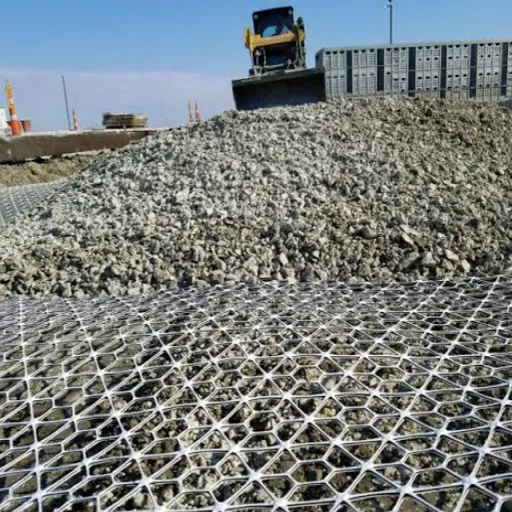
The hump is visible in winter. The damage happens in March.
When ice lenses melt, the water has nowhere to go. The subgrade saturates, effective stress drops, and the base loses the support it was designed around. FHWA figures reported in that same 2026 review put subgrade resilient modulus at roughly 138 MPa (20,000 psi) in winter. By the March thaw it can fall to 17.2 MPa (2,500 psi), a drop of about 88%.
A section sized on summer strength is under-designed for several weeks a year. No grid solves that.
The visible symptom is a frost boil: a patch that turns to slurry under load and pumps fines upward. It appears where water concentrates, at the low point, the culvert, or a cut-to-fill transition.
Frost heave prevention at network scale uses the same principle: drain the subgrade and lighten weak-season traffic. Geogrid for gravel road covers the unpaved-road case. Agencies impose seasonal load limits when spring deflection exceeds 45% to 50% of the summer value. A driveway owner makes the same call in miniature: keep heavy deliveries off for a few weeks, or repair the ruts.
A small contractor we’ll call Priya priced a repair in a cold-winter county. The grid was not the problem. The driveway heaved only at the culvert, the backfill was silty, and the ditch outlet was blocked.
Their fix re-excavated the backfill with granular material, re-cut the outlet, and left the existing grid in place. Two winters later it had not moved. Transitions fail first, and a grid laid across one carries the step rather than fixing it.
Gravel Driveway Drainage Is the Frost Heave Fix
Frost heave driveway repair is a drainage job before it is a materials job. Order the work correctly and the budget goes further: drainage first, then material, then reinforcement. A geogrid spreads load; it does not drain water.
Shape the Section and Cut a Ditch
A gravel surface needs more fall than asphalt, because a rough surface drains less efficiently. Paved roads are built at about 2%. Unpaved roads are normally designed at 4% to 6%, with 6% to 7% the upper limit before the crown starts to erode.
On a driveway with a single crossfall, shed water away from the house and any structure.
The side ditch is the part most often missing on private drives. It must sit below subgrade level, so water in the base can drain out, and fall continuously to an outlet that works in a thaw. A ditch that ends in a low spot is a pond.
Where the driveway crosses a slope, a cut-off ditch on the uphill side intercepts water before it reaches the section. That detail alone resolves many differential-heave cases.
Cut the Capillary Supply
A capillary break stops water rising into the base from below. It is an open-graded layer with enough thickness to keep the freezing front out of the saturated zone. USACE practice pairs non-frost-susceptible granular with filter layers, drainage, and insulation.
Three options, in order of cost:
- Raise the grade. More cover above the water table means less capillary reach into the base.
- Add a nonwoven separator. It stops fines pumping into the clean base, which would otherwise restore the frost-susceptible material you just paid to remove. This is the detail the Iowa field study rewarded.
- Add an underdrain where the water has nowhere else to go, at the low corner or against a cut slope.
The separator is not optional on a silt subgrade, and matters much less on clean granular subgrade. The nonwoven geotextile range covers the grades, and the base stone has its own requirements in aggregate for a geogrid base course.
Specifying a separator and a grid together? Send the subgrade classification and the base gradation. We’ll quote the separator weight and the grid grade as one package, matched to the same drainage detail. Request a technical quote.
Base Thickness and Cold-Climate Allowances
Adding depth for frost is a real allowance. It is not a substitute for drainage.
As a working figure, add 50 to 100 mm to a base section on frost-susceptible soil. That is the allowance used on the pillar design guide, and it sits alongside the CBR-based thickness charts rather than replacing them.
Several agencies write the rule into their manuals. Alaska, Maine, Oregon, and Washington require the pavement structure to exceed 50% of the freeze depth. Hokkaido uses 70%. The US Army Corps takes three routes: complete protection, limited subgrade frost penetration, or design for reduced strength.
For a geogrid-reinforced driveway, the practical sequence is:
- Classify the subgrade and find the local design frost depth.
- Fix drainage first, including the ditch and any capillary break.
- Choose a clean, non-frost-susceptible base, then size it for the drained, thaw-weakened condition rather than the summer one.
- Place the grid as in how to install geogrid for gravel driveway, then check cover depth against how much gravel goes over geogrid.
Do not add stone without fixing drainage. A thicker susceptible layer stores more water, and the heave gets worse.
Geogrid Frost Heave Specification for Cold Regions
Cold does not call for a stronger grade. It calls for a drained section, a durable polymer, and a specification that states the conditions.
On the polymer, the evidence is reassuring but specific. Low temperature raises stiffness and strength while reducing ductility, and freezing water inside the material accelerates both. The 2026 review concludes that cold-induced embrittlement, not loss of peak strength, is the concern. Design still works from long-term strength reduced for creep, installation damage, and durability.
What to put in a cold-region enquiry:
- Subgrade classification and fines content, including the fraction passing 0.02 mm
- Local design frost depth and the drainage detail proposed
- Base gradation and fines, matched to the grid aperture
- Separator specification, if a silt or clay subgrade is present
- Grid grade, cover depth, and the intended traffic
- Test reports for the exact roll grade quoted
Two warnings for a quotation. A 30-30 grade is not a frost measure, and paying for one does not reduce heave. A grid without a separator on silt is half a solution, as the Iowa sections showed.
The geogrid specification guide explains how to read tensile values and reduction factors on a data sheet. Where the subgrade is soft clay rather than silt, geogrid for driveway clay soil covers the bearing capacity side.
Frequently Asked Questions
Will geogrid stop frost heave?
No. Geogrid does not remove water or stop ice-lens growth, which are the causes of heave. It reduces differential movement and restrains the base from spreading. Fix the drainage and the base material first, then use the grid to hold the section together.
Does gravel prevent frost heave?
Clean gravel does not heave, because it lacks the fines that feed ice-lens growth. Gravel containing silt does heave. A base is frost-susceptible when 10% or more passes the 0.075 mm sieve, or 3% or more passes 0.02 mm.
What is the difference between frost heaving and frost wedging?
Heaving lifts a surface as ice lenses grow and draw in more water. Wedging splits rock or concrete when water freezes inside a crack. One moves a surface, the other breaks it.
How deep does frost go under a driveway?
It depends on climate, soil, snow cover, and moisture, so there is no single figure. Check a frost depth map, then confirm design depth with local highway agency practice. Several states require pavement structure deeper than 50% of the freeze depth.
Does a geotextile help with frost heave?
A nonwoven separator helps indirectly, and sometimes significantly. It stops fines pumping into the clean base, preserving the non-frost-susceptible material and the drainage path. In Iowa field sections, geogrid alone gave little benefit and geogrid with a separator gave moderate benefit.
Why does only one part of my driveway heave?
Differential heave usually means a change in material, drainage, or fill depth. Culverts, cut-to-fill transitions, and the low corner concentrate water. A uniform lift over the whole driveway is a soil problem; a hump in one place is a water problem at that place.
Geogrid Frost Heave: The Bottom Line
A geogrid does not prevent frost heave, and any page that says otherwise is selling rather than explaining. Heave is water freezing in susceptible soil. Drainage and clean base material are the fix.
What a grid does is measurable and modest. It halves differential heave in a field trial, restrains lateral movement by about 50% in a bench test, and allows a thinner section. It works considerably better with a separator.
Spring thaw is the bigger structural threat. An 88% drop in subgrade modulus is why a driveway that carried all summer fails for three weeks in March. Cold does not require a stronger grid. It requires a drained section, and a specification that states the subgrade, the frost depth, and the separator.
Constc Mart supplies biaxial geogrid for road base and driveway applications, with technical consultation at the enquiry stage. Send your subgrade classification and local frost depth. We’ll recommend a grade and a separator, or tell you the money is better spent on drainage. The biaxial geogrid range covers the standard road base grades, and the technical team will review installation sequencing.
Winter will still lift the ground. The difference is whether it breaks your driveway on the way.