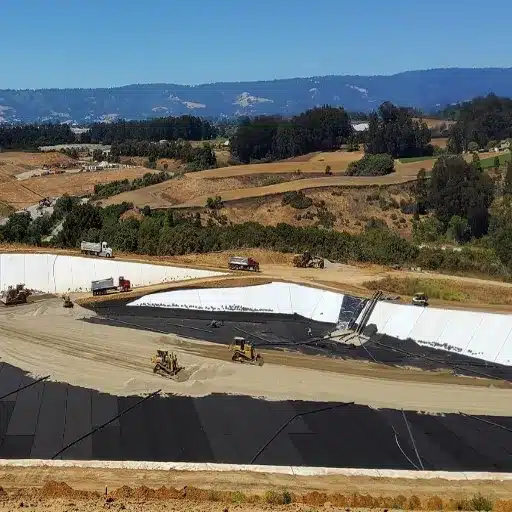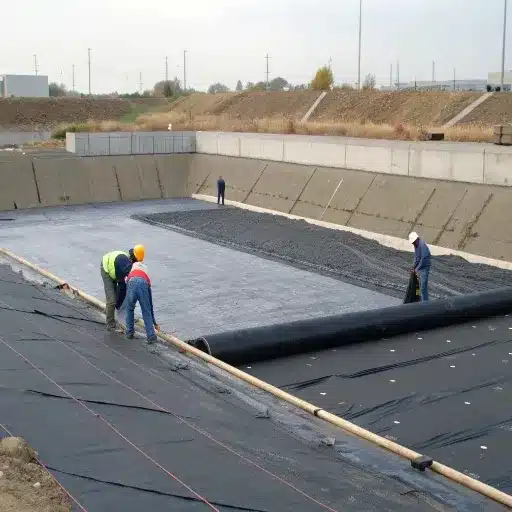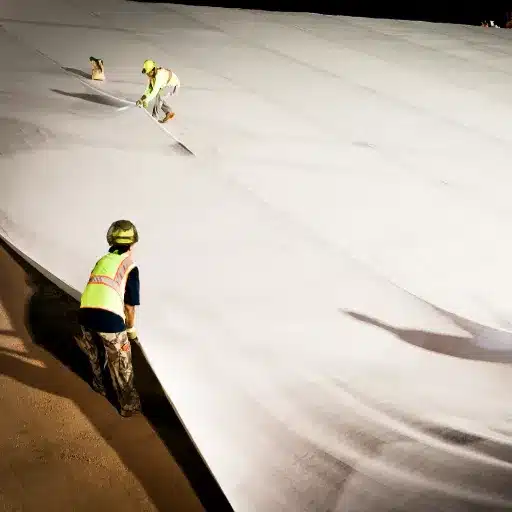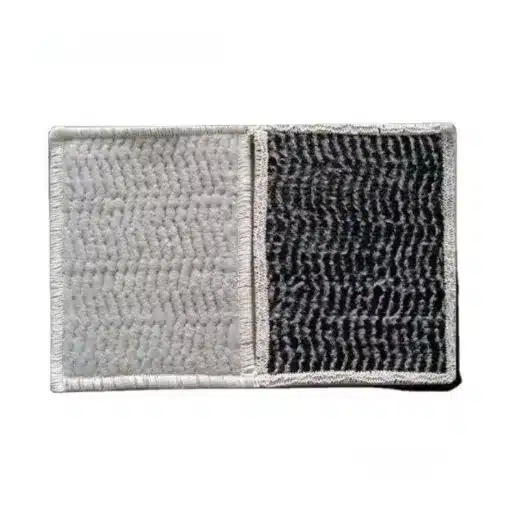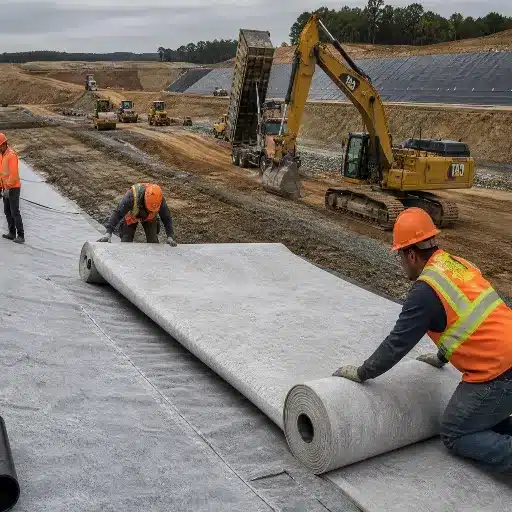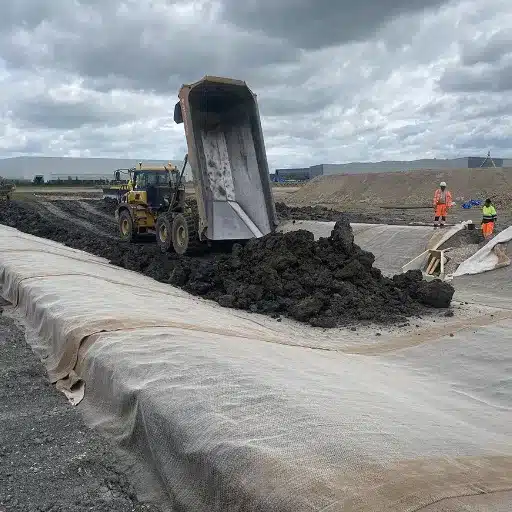
Ground protection mats for construction sites are load-distribution panels placed between heavy equipment and the ground surface to prevent soil compaction, rutting, and turf damage. HDPE and composite mats are deployed across six primary zones on every active construction site: temporary access roads, laydown yards, work platforms, pedestrian walkways, crane pads, and track-out control areas.
A site manager named Marcus deployed 200 HDPE mats across a 12-acre commercial development in Houston. He spent $16,000 on matting. He saved $47,000 in soil restoration costs, avoided a $15,000 OSHA-related shutdown, and handed over the site with zero rutting liability. The general contractor on the next phase called him before breaking ground.
Most site managers treat ground protection mats for construction sites as an afterthought. They order mats after the first heavy rain turns the access road into a mud pit, or after a crane outrigger sinks into soft clay and forces a three-day shutdown. This guide treats ground protection mats for construction sites as what they actually are: a site logistics and liability management system. You will learn exactly where mats go on a construction site, what regulations govern their use, how much soil damage really costs, and how to deploy them with a checklist any site manager can execute in one afternoon.
For the complete technical overview of mat types, materials, and selection criteria, see our complete ground protection mats buyer’s guide. For equipment-specific load calculations, see our guide on ground protection mats for heavy equipment.
Key Takeaways
- Ground protection mats for construction sites prevent soil damage across six zones: access roads, laydown yards, work platforms, walkways, crane pads, and track-out areas.
- OSHA 1926.1402 legally requires firm, graded ground conditions or supporting materials, including mats, under hoisting equipment.
- Soil remediation costs $0.50-$18.00 per square foot depending on severity, while mat investment typically runs $1.50-$3.00 per square foot protected.
- HDPE mats handle standard construction traffic at 80-120 ton ratings; composite mats support heavy equipment at 150-300+ ton ratings.
- A site-manager deployment checklist covers pre-installation site prep, interlocking placement, daily inspection, and demobilization documentation.
Where to Use Ground Protection Mats for Construction Sites
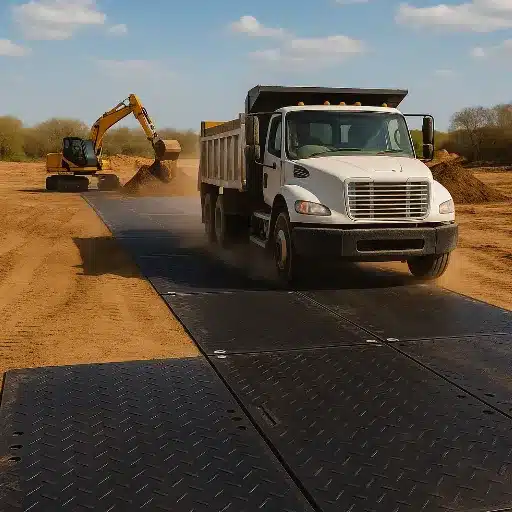
Ground protection mats for construction sites are not a single-application product. Different zones demand different mat specifications, connection systems, and layout patterns. The sections below map each construction site zone to the correct mat type and configuration.
Temporary Access Roads
Temporary access roads are the highest-traffic corridors on any construction site. Concrete trucks, dump trucks, and equipment haulers make repeated passes over the same route. Without protection, these roads rut within days on soft ground.
Use medium- to heavy-duty HDPE or composite mats rated for 80-150 tons. Lay mats perpendicular to the direction of traffic for maximum stability. Stagger joints in a brick-lay pattern to prevent continuous seams. Interlock or bolt panels together to prevent separation under braking and turning loads.
A contractor in Arizona learned this the hard way. He skipped mats on a 400-foot gravel access road because “gravel is already a road surface.” After two weeks of 40-ton concrete truck traffic, the gravel had punched 8 inches into the underlying clay subgrade. Remediation required removing 12 inches of saturated material, importing structural fill, and re-compacting. The bill was $28,000. Matting the road from day one would have cost $4,200.
For detailed roadway layout and soft-ground access strategies, see our guide on temporary roadway mats for site access roads.
Laydown Yards and Staging Areas
Laydown yards are where materials sit before installation. Forklifts, telehandlers, and loader traffic create concentrated point loads. The ground beneath a steel beam stack or palletized pipe can compact soil to the depth of several feet.
Use medium-duty composite or HDPE mats configured in modular interlocking patterns. Because laydown areas have irregular dimensions, modular mats adapt to the exact shape needed. A continuous mat surface prevents forklifts from getting stuck in soft spots and reduces material handling delays.
Space planning matters. Divide the yard into clearly marked zones: bulk material storage, palletized components, equipment parking, loading/unloading areas, and waste collection. One-way traffic routes reduce congestion. Primary access lanes should be 12-15 feet wide with turning radii suitable for delivery trucks.
Work Platforms and Equipment Pads
Excavators, drilling rigs, and pump stations need stable work surfaces. An excavator working on marginal soil can sink its tracks into saturated ground within hours, creating ruts that channel water and worsen the problem.
Specify 20-30 mm HDPE or composite mats for work platforms. The thicker panels bridge minor surface irregularities without cracking. On soft or wet ground, add a geotextile fabric for site separation under mats beneath the mats to prevent subgrade contamination and improve load distribution.
Pedestrian Walkways
Construction sites are dangerous enough without crews slogging through mud between the parking area and the work zone. Pedestrian walkways separate foot traffic from vehicle routes and keep crews out of the mud.
Use light- to medium-duty HDPE mats with treaded or diamond-plate surfaces for slip resistance. High-visibility mats in safety green or yellow help delineate pedestrian routes from vehicle corridors.
Crane Pads and Outrigger Zones
Crawler cranes and mobile cranes exert the highest point loads of any equipment on a construction site. A 100-ton crawler crane can generate 40-50 tons of reaction force on a single outrigger pad. Standard access mats are not sufficient for crane lifting operations.
For crane work, use heavy-duty composite mats rated at 400-600 PSI or timber crane mats. Calculate the required pad area by dividing the outrigger reaction force (in pounds) by the ground bearing capacity (in PSI).
Track-Out Control Mats
Track-out mats sit at site entrances and exits. Their job is simple: remove mud and debris from tires before vehicles reach public roads. Most jurisdictions require track-out control as a condition of construction permits.
Medium-duty HDPE mats with aggressive tread patterns work best. Position them at the transition from unpaved site surface to paved road. Clean mats daily during wet weather to maintain effectiveness.
Regulatory Compliance for Ground Protection Mats on Construction Sites
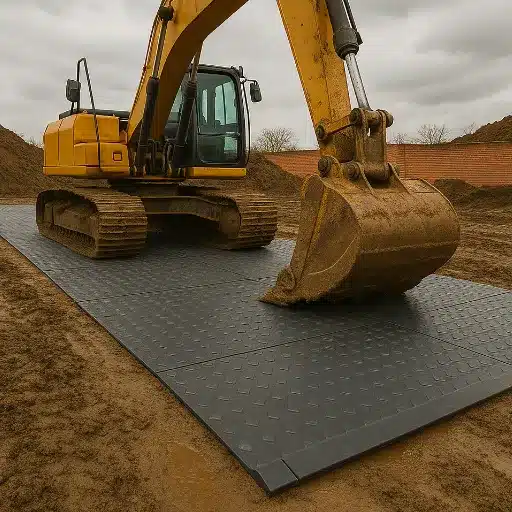
Construction site ground protection mats are not optional in many jurisdictions. Federal, state, and local regulations either mandate their use or treat their absence as a violation.
OSHA 1926.1402, Ground Conditions
The Occupational Safety and Health Administration’s standard for cranes and derricks is clear. Equipment must not be assembled or used unless ground conditions are “firm, drained, and graded” to support the equipment. If ground conditions are inadequate, the standard explicitly requires “supporting materials, including blocking, mats, cribbing, marsh buggies, or similar supporting materials or devices.”
This is not guidance. It is a legal requirement. The controlling entity, typically the general contractor or construction manager, is responsible for ensuring ground preparations are adequate and informing operators of buried hazards. Failure to stabilize soft ground is a direct route to OSHA citations, project shutdowns, and worker injury liability.
A site engineer named Viktor deployed a 90-ton crawler crane on standard 20 mm HDPE mats in Poland. The mats were rated for 120 tons. He assumed a safety margin.
He did not calculate the outrigger reaction force: 42 tons on the front-left pad due to boom position. The mat itself did not break. But the wet clay beneath it had a bearing capacity of only 25 PSI. The mat punched through the subgrade, tilting the crane and forcing a three-day shutdown while geotechnical crews reinforced the pad area. OSHA’s equivalent European authority cited the contractor for inadequate ground preparation. The direct and delay costs exceeded $18,000.
EPA and NPDES, Stormwater and Erosion Control
The Environmental Protection Agency’s National Pollutant Discharge Elimination System requires construction sites to develop a Stormwater Pollution Prevention Plan and implement Best Management Practices. Ground protection mats function as structural BMPs by minimizing soil compaction, reducing sediment-laden runoff, and preventing track-out of mud onto public roadways.
Some state specifications prohibit mats that introduce harmful chemical residues. Pressure-treated timber mats may leach chemicals into soil and are banned on certain environmental remediation sites. HDPE mats carry no such restriction.
State DOT and Municipal Specifications
New York State DOT Specification 209.23 for temporary ground protection mats sets a clear engineering benchmark. Mats must have “sufficient and known mechanical properties, stiffness, and strength” to support intended loads without failure. As installed, mats must not separate or migrate under load, and must effectively distribute concentrated loads to minimize soil and ecological disturbance.
Pre-installation requirements often include clearing debris, mowing turf to 3-5 inches where present, and laying geotextile fabric underneath to prevent soil contamination while allowing drainage.
For installation best practices that satisfy these specifications, see our guide on ground protection mat installation best practices.
The Hidden Cost of Skipping Mats: Soil Damage Liability
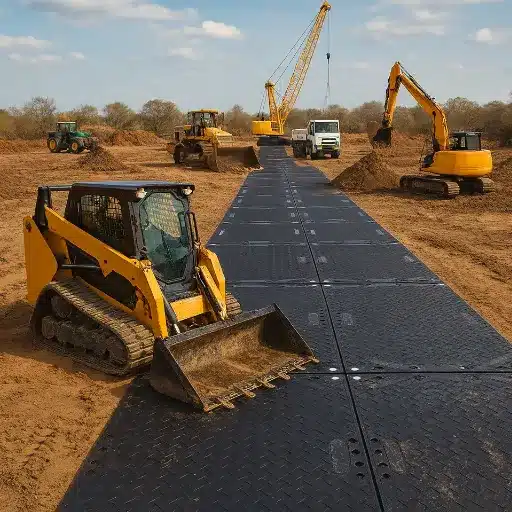
The purchase price of construction site ground protection mats is easy to quantify. The cost of not using them is harder to see. Until the invoice arrives.
Soil Restoration Costs
Soil damage from heavy equipment falls into three cost tiers. Light compaction remediation through aeration and ripping costs $0.50-$1.50 per square foot. Moderate remediation requiring over-excavation of 12-18 inches plus backfill with structural fill runs $5.00-$12.00 per square foot. Full-depth pavement repair, including base stabilization, reaches $8.00-$18.00 per square foot.
A 500-foot access road, 12 feet wide, covers 6,000 square feet. Moderate rutting remediation at $5 per square foot costs $30,000. HDPE matting for the same area at $70 per 4×8 panel requires roughly 188 panels, or $13,160 at import pricing. The mats are reusable for 10-15 years across multiple projects.
Turf and Landscape Replacement
Landscaped areas, grassed verges, and existing turf require replacement at 1−1−3 per square foot when damaged by construction traffic. Municipal contracts often include restoration clauses that hold the contractor financially responsible for restoring disturbed areas to pre-construction condition.
Project Delay Costs
When soil failure halts work, the costs accumulate fast. Equipment standby rates run $500-$5,000 per day, depending on machine class. Crew standby adds labor costs. Weather windows close. Delivery schedules slip.
A commercial developer in Phoenix skipped mats on a 3-acre site because “it’s desert, the ground is rock.” It was not a rock. It was caliche over compressible soil.
Two weeks of excavator traffic created ruts 10 inches deep across 8,000 square feet. The remediation required removing 18 inches of failed soil, importing 450 cubic yards of structural fill, and re-compacting in lifts. The bill was $42,000. The three-week delay pushed the project past the tenant move-in deadline. Liquidated damages added $1,500 per day.
Ground Protection Mat Deployment Checklist for Site Managers
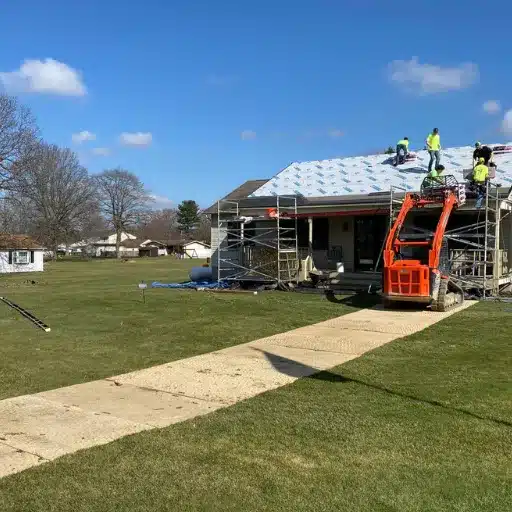
Use this checklist to plan, install, and maintain construction site ground protection mats from mobilization through demobilization.
Pre-Deployment
- Conduct site assessment: document terrain, soil type, moisture conditions, and slope
- Audit equipment list: identify the heaviest axle loads, point loads, and traffic frequency
- Review regulatory requirements: OSHA 1926.1402, EPA SWPPP, state DOT specs, contract documents
- Select mat type and thickness by zone using the application table in the next section
- Order 10-15% surplus mats to cover damage, loss, and layout inefficiency
- Plan delivery timing: Mats should arrive before heavy equipment mobilization
Installation
- Clear and level subgrade: remove debris, rocks, vegetation, and sharp objects
- Install geotextile underlayment where specified or where soil is marginal
- Lay mats perpendicular to traffic flow on access roads
- Stagger joints in brick-lay pattern; avoid continuous seams
- Interlock or bolt panels to prevent separation under load
- Anchor mats on slopes greater than 5% using stakes or pins
- Verify load distribution: no panel should carry a concentrated load at its edge
During Operations
- Inspect mat placement daily for displacement, cracking, or subsidence
- Check connections after heavy equipment passes or after rain events
- Clean track-out mats daily during wet weather
- Maintain drainage paths around and beneath mat systems
- Photograph the subgrade condition before mat removal for documentation
Demobilization
- Clean mats thoroughly before removal to prevent cross-site contamination
- Inspect subgrade and photograph final condition
- Report any soil damage to the project manager and document remediation needs
- Stack mats dry; store flat in a cool location away from direct UV exposure
- Update inventory and condition assessment for reuse on the next project
Material Selection by Construction Site Zone
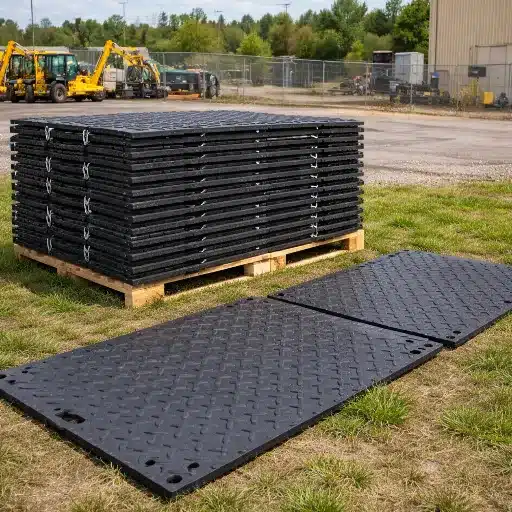
The table below matches construction site zones to the appropriate mat type, thickness, and load rating.
| Site Zone | Mat Type | Thickness | Load Rating | Connection System |
|---|---|---|---|---|
| Temporary access roads | HDPE or composite | 18-25 mm | 80-150 tons | Interlocking or bolted |
| Laydown yards | HDPE or composite | 18-25 mm | 80-120 tons | Interlocking modular |
| Work platforms | HDPE or composite | 20-30 mm | 100-200 tons | Interlocking with flanges |
| Pedestrian walkways | HDPE | 10-15 mm | 10-40 tons | Plain edge or interlocking |
| Crane pads/outriggers | Composite or timber | 25-40 mm / 6-12 in | 200-750 PSI | Bolted or pinned |
| Track-out control | HDPE | 15-20 mm | 40-80 tons | Plain edge |
Load ratings assume firm, dry ground. Reduce effective capacity by 30-50% on soft or saturated soils.
HDPE mats dominate standard construction applications because they balance load capacity, weight, and cost. A single 4×8 HDPE panel weighs roughly 36-45 kg, meaning two workers can handle installation without heavy equipment. UV-stabilized HDPE resists chemical exposure and handles repeated loading cycles. For standard construction equipment, HDPE is the default choice.
Composite mats with cross-ribbed interiors distribute weight more evenly than solid panels. Rated at 400-600 PSI, they handle heavy point loads from crane outriggers and drilling jack feet. They also provide better bridging over minor surface irregularities.
Timber mats remain essential for extreme loads and bridging applications. No engineered plastic matches the spanning capability of a 12-inch hardwood mat over a trench or soft spot. Timber is heavier, absorbs moisture, and has limited reuse compared to HDPE, but it solves problems engineered plastics cannot.
Frequently Asked Questions About Ground Protection Mats for Construction Sites
Where should ground protection mats be placed on a construction site?
Ground protection mats for construction sites should be placed in six primary zones: temporary access roads for haul traffic, laydown yards for material storage, work platforms for excavators and drilling rigs, pedestrian walkways for crew safety, crane pads for outrigger load distribution, and track-out control areas at site entrances. Each zone requires a different mat thickness and connection system based on traffic type and load.
Are ground protection mats required by OSHA?
OSHA 1926.1402 requires that ground conditions be “firm, drained, and graded” to support equipment. If ground conditions are inadequate, the standard mandates “supporting materials, including blocking, mats, cribbing, marsh buggies, or similar supporting materials or devices.” While OSHA does not explicitly mandate mats for every application, using mats is the most common and defensible method to achieve compliance on soft or unimproved ground.
How much do ground protection mats save in soil restoration costs?
The savings depend on site conditions and traffic intensity. A typical scenario: protecting a 6,000 square foot access road with HDPE mats costs $8,000-$15,000. Remediating rutting and compaction damage in the same area costs $30,000-$72,000. The mats are reusable for 10-15 years, so the same inventory protects multiple projects at zero marginal material cost after the first use.
Can HDPE mats handle construction equipment traffic?
Standard 18-20 mm HDPE mats are rated for 80-120 tons, which covers most excavators, dump trucks, and rubber-tired equipment on firm ground. For cranes, drilling rigs, and extreme loads, step up to 25-40 mm composite mats or timber crane mats. Always apply a 15-20% safety margin above calculated maximum loads and reduce ratings by 30-50% on soft soils.
What is the best mat type for a construction laydown yard?
Medium-duty HDPE or composite mats with interlocking connections work best for laydown yards. The interlocking system prevents panel separation under forklift traffic and allows flexible layout configurations. Choose 18-25 mm thickness for standard material storage, or 25-30 mm if the yard will see frequent heavy loader traffic.
Conclusion
Ground protection mats for construction sites are not a material purchase. They are a site logistics and liability management system. Deployed correctly across access roads, laydown yards, work platforms, walkways, crane pads, and track-out zones, construction site ground protection mats prevent soil damage, satisfy regulatory requirements, and eliminate the hidden costs that destroy project margins.
The five numbers to remember about ground protection mats for construction sites: $0.50-$18.00 per square foot for soil remediation versus $1.50-$3.00 per square foot for mat protection. 80-120 ton load ratings for standard HDPE. OSHA 1926.1402 requires firm ground or supporting materials. 400-500 mats per 40HQ container for international buyers. And 10-15 years of reusable service life from a single HDPE fleet.
At Shanxi Shengxing, we manufacture HDPE ground protection mats under ISO9001 quality systems, with load testing to ASTM D4020 standards. We retain production samples for five years and provide container-optimized loading plans with every technical quote.
Need a site-specific deployment plan? Browse our HDPE ground protection mats for detailed specifications by thickness and load rating, or request a technical quote with your site dimensions, equipment list, and ground conditions. Our engineering team provides zone-by-zone mat sizing, container loading calculations, and export-optimized pricing for construction and infrastructure projects worldwide.