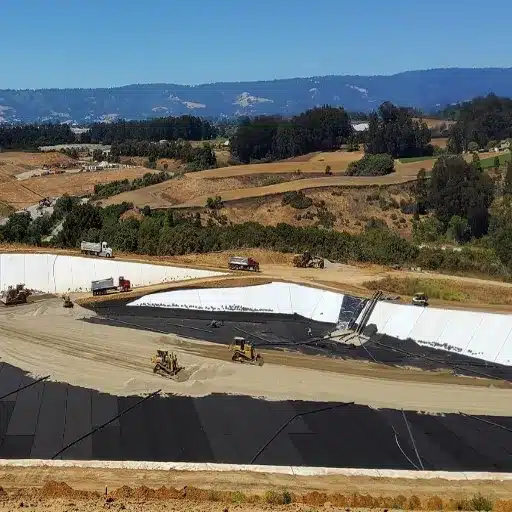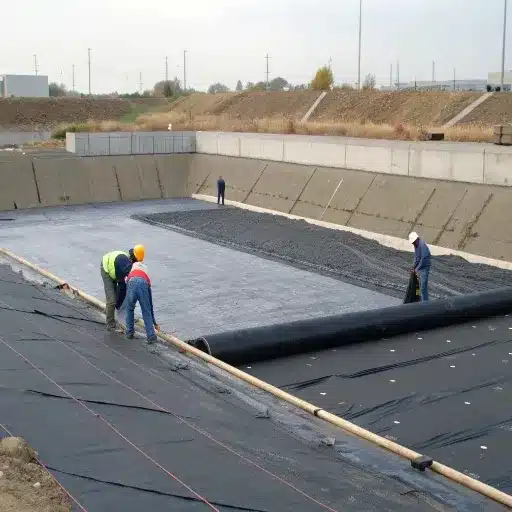
Temporary roadway mats range from 10 mm (3/8″) light-duty HDPE panels rated for 30 tons to 100 mm (4″) extreme-duty composite systems rated for 600+ tons. The right temporary roadway mat thickness depends on equipment weight, ground conditions, project duration, and freight constraints.
This guide gives you exact mm-to-inch conversions, load ratings by thickness, ground-condition adjustments, and cost/weight trade-offs for temporary roadway projects. For a complete overview of temporary roadway mats, see our complete temporary roadway mats guide.
What Is Temporary Roadway Mat Thickness?
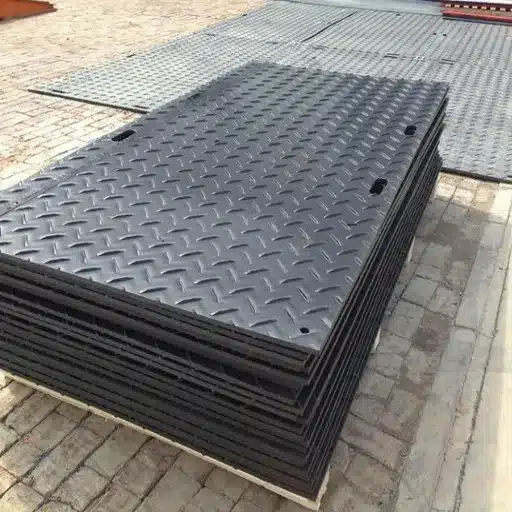
Temporary roadway mat thickness is the base plate depth of a ground protection panel, usually measured in millimeters. It ranges from 10 mm for light-duty HDPE pedestrian mats to 100 mm or more for extreme-duty composite systems. The right thickness depends on equipment load, ground bearing capacity, and project duration.
Common Temporary Roadway Mat Thicknesses
- 10–12 mm HDPE: light trucks and utility access
- 15–20 mm HDPE: standard construction haul roads
- 25 mm+ HDPE: crawler cranes and soft ground
- 25–100 mm+ composite: heavy cranes and extreme loads
Key Takeaways
- 20 mm HDPE is the market-leading thickness for heavy trucks and continuous haul roads.
- 15 mm HDPE suits standard construction traffic up to 100 tons.
- 25 mm+ HDPE is needed for crawler cranes, tracked equipment, and soft ground.
- Composite mats start at 25 mm and reach 100 mm+ for loads above 250 tons.
- Soft ground reduces effective capacity by 30–50%; upsize thickness or improve the subgrade.
Temporary roadway mat thickness ranges from 10 mm light-duty HDPE to 100 mm+ extreme-duty composite.
How Thick Are Temporary Roadway Mats?
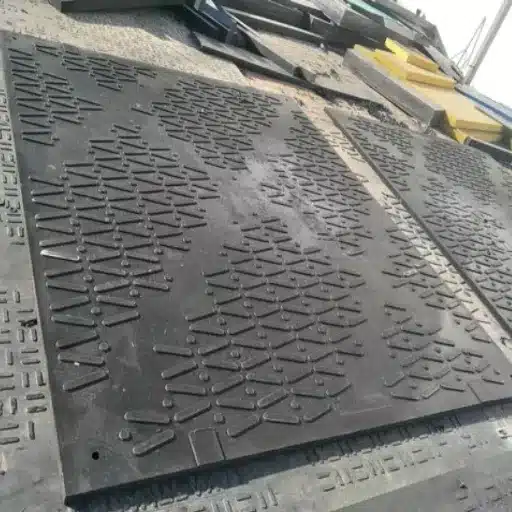
Base Thickness vs. Overall Thickness
Manufacturers report thickness in two ways. Understanding the difference prevents ordering errors.
- Base thickness: The raw panel plate before surface molding. A 12.7 mm base plate is a 12.7 mm structural panel.
- Overall thickness: Includes raised cleats, diamond tread, or overlapping flanges. A 12.7 mm base plate with 5 mm cleats on each side measures roughly 22.7 mm overall.
For structural performance, connection compatibility, and container loading, base thickness is the number that matters. A buyer who orders by overall height may receive a thinner panel than expected and lose load capacity.
For example, a procurement team ordering “22 mm mats” based on overall height might receive a 12.7 mm base plate. Under a 40-ton concrete truck, those panels could flex beyond their rating and rut. Always confirm base thickness in millimeters before purchase.
A clear specification callout helps avoid this mistake: “HDPE temporary roadway mat, 20 mm base thickness, 12.7 mm × 2,400 mm × 1,200 mm, load rating 80 tons on firm ground.”
Standard Thickness Range
| Material | Standard Base Thickness | Typical Load Capacity |
|---|---|---|
| HDPE | 10–12 mm | 30–60 tons |
| HDPE | 15 mm | 60–100 tons |
| HDPE | 20 mm | 80–120 tons |
| HDPE | 25 mm+ | 100–150+ tons |
| Composite | 25–38 mm | 100–250 tons |
| Composite | 40–100 mm+ | 250–600+ tons |
Temporary Roadway Mat Thickness Chart
The table below is a temporary roadway mat thickness chart that matches base thickness to equipment loads and common roadway uses. Use it as a starting point, then adjust for ground conditions.
| Base Thickness | Overall Thickness | Imperial | Load Capacity | Best For |
|---|---|---|---|---|
| 10–12 mm | ~15–20 mm | 3/8″–1/2″ | 30–60 tons | Light trucks, utility access, service roads |
| 15 mm | ~23–26 mm | ~5/8″ | 60–100 tons | Dump trucks, excavators, medium haul roads |
| 20 mm | ~28–32 mm | 3/4″ | 80–120 tons | Heavy trucks, cranes, continuous haul roads |
| 25 mm | ~33–38 mm | 1″ | 100–150 tons | Crawler cranes, soft ground, extreme roads |
| 30 mm+ | ~40–50 mm | 1 3/16″+ | 120–200+ tons | Tracked equipment, semi-permanent roads |
| 25–38 mm composite | ~35–50 mm | 1″–1.5″ | 100–250 tons | Heavy cranes, long-term roads |
| 40–100 mm composite | ~50–120 mm | 1.5″–4″ | 250–600+ tons | Oil rigs, tower cranes, extreme loads |
The 20 mm HDPE segment holds approximately 36.8% of the global ground protection mat market share because it balances capacity, weight, and cost for commercial roadway projects. ReAnIn
HDPE Temporary Roadway Mat Thickness by Application
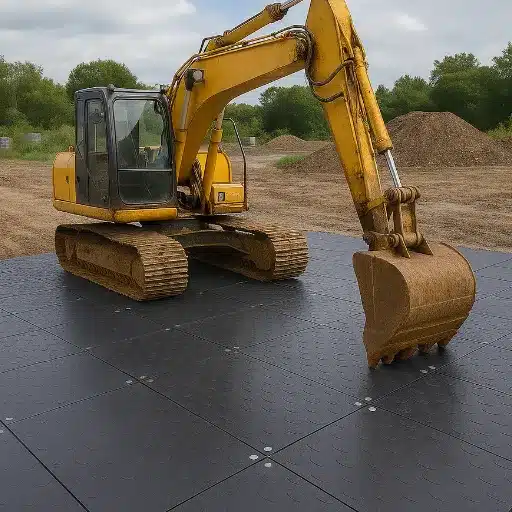
Light-Duty Roadways (10–12 mm)
10–12 mm HDPE mats suit service vehicles, pedestrian walkways, and light utility access. They weigh roughly 25–35 kg per 4′ x 8′ panel and install quickly by hand. These panels are not suitable for heavy haul trucks or repeated traffic.
Standard Construction Haul Roads (15 mm)
15 mm HDPE handles excavators, dump trucks, and concrete mixers up to roughly 100 tons on firm ground. A 4′ x 8′ panel weighs 35–45 kg. This thickness is common for medium-duty construction access roads lasting several months.
Heavy-Duty Haul Roads (20 mm)
20 mm HDPE is the market-leading thickness for commercial and industrial roadway projects. It supports heavy trucks, crane access, and continuous traffic up to 120 tons. Panel weight is 40–55 kg, still manageable by two workers. For detailed HDPE specifications, see our HDPE temporary roadway mats specifications guide.
Extreme-Duty & Soft Ground (25 mm+)
25 mm+ HDPE is used for crawler cranes, tracked equipment, and muddy or saturated conditions. The extra thickness reduces deflection and improves load distribution. Panel weight rises to 55–70 kg or more, so equipment may be needed for placement. For timber alternatives used with extreme steel-track loads, see our timber bog mats vs temporary roadway mats comparison.
Composite Temporary Roadway Mat Thickness by Application
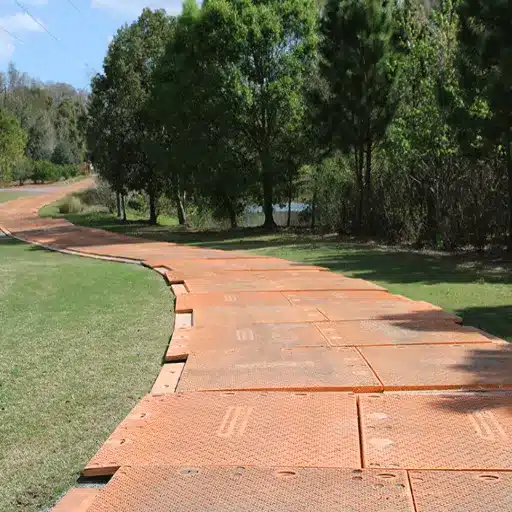
Composite mats use fiberglass or proprietary reinforcement to achieve higher stiffness than HDPE at a given thickness. They are typically larger and heavier than HDPE panels.
25–38 mm Composite Mats
These handle 100–250 tons and suit heavy crawler cranes and long-term installations. They replace HDPE when deflection or joint instability becomes unacceptable.
40–60 mm Composite Mats
These support 250–450 tons for large cranes, piling rigs, and tower-crane bases. The added thickness resists high point loads and repeated heavy trafficking.
75–100 mm+ Composite Mats
These extreme-duty systems support 450–600+ tons for oil rigs, heavy-haul trackways, and semi-permanent roads. For a full material comparison, see our composite vs HDPE temporary roadway mats analysis.
How Ground Conditions Affect Thickness Selection
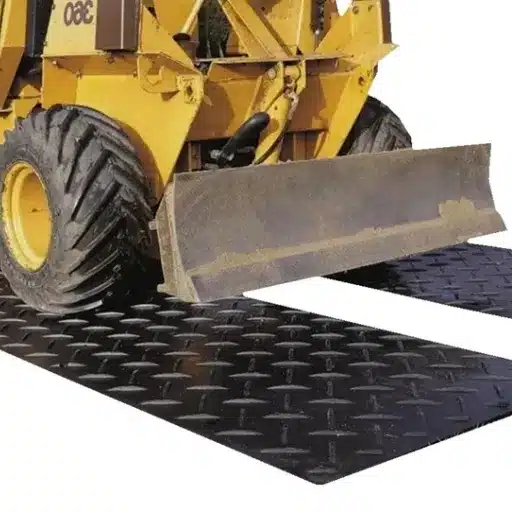
Firm, Compacted Ground
On firm subgrades, manufacturer load ratings apply with little adjustment. A 20 mm HDPE mat rated for 100 tons performs close to that rating on compacted gravel or clay. For specific equipment-load matching, see our guide to temporary roadway mats for heavy equipment.
Soft Ground, Mud, and Wet Clay
Soft or saturated soils reduce effective mat capacity by 30–50%. A 20 mm mat rated for 100 tons on firm ground may only support 50–70 tons on saturated clay. Solutions include upsizing to the next thickness, adding a geotextile separation layer and aggregate lift, or switching from HDPE to composite for better load distribution.
A Southeast Asia highway contractor used 20 mm HDPE over soft clay for a 200-meter haul road. The road stayed level through monsoon season and avoided a six-figure soil remediation bill.
Peat and organic soils are even more challenging than clay. They have low bearing capacity and can shift during wet-dry cycles. In these conditions, 25 mm+ HDPE or 25 mm+ composite mats over a geotextile and aggregate layer are usually the minimum specification.
Uneven Terrain
Thicker mats bridge gaps and handle differential loading better than thin mats. On uneven ground, 25 mm+ HDPE or 25 mm+ composite reduces the risk of panel rocking or joint separation.
Thickness, Weight, and Transport Economics
Weight by Thickness (HDPE 4′ x 8′)
| Base Thickness | Weight Per Panel |
|---|---|
| 10–12 mm | 25–35 kg |
| 15 mm | 35–45 kg |
| 20 mm | 40–55 kg |
| 25 mm | 55–70 kg |
| 30 mm+ | 65–100+ kg |
Container Loading by Thickness
A 40-foot high-cube container holds approximately:
| Base Thickness | Panels Per 40′ HC |
|---|---|
| 10–12 mm | 400–500 |
| 15 mm | 350–400 |
| 20 mm | 300–350 |
| 25 mm+ | 200–280 |
| Composite 75–100 mm | 40–60 large panels |
Thicker mats reduce capacity per container and increase freight cost per square meter. The same logic applies to temporary access mat thickness when sizing mats for site entry roads. For export buyers, this trade-off can be significant.
Common Mistakes in Thickness Selection
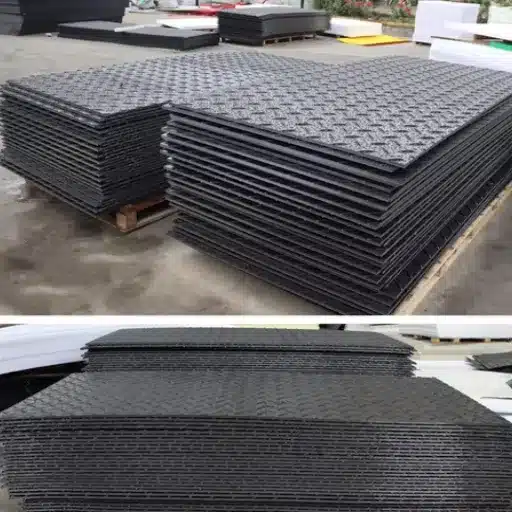
Under-Specification
Choosing 10–12 mm mats for 40-ton haul trucks, or ignoring ground-condition reductions, leads to mat failure, rutting, project delays, and equipment damage. When in doubt, add a 25% safety margin above the maximum expected load.
Over-Specification
Specifying 25 mm mats for light utility access wastes budget and increases handling weight. It also ships fewer mats per container, raising freight cost per square meter.
Confusing Base vs. Overall Thickness
Ordering by overall height can result in receiving a thinner base plate than expected. Always confirm base thickness in the specification sheet and purchase order.
Ignoring Project Duration
Short projects often tolerate thinner mats because deflection and wear are limited. Long-term roads benefit from thicker mats that reduce maintenance and replacement.
Temporary Roadway Mat Thickness Selection Checklist
- Determine the maximum equipment axle or point load.
- Assess ground bearing capacity: firm, soft, or saturated.
- Apply a 30–50% reduction for soft ground.
- Add a 25% safety margin above the maximum expected load.
- Match the adjusted load to the HDPE or composite thickness chart.
- Consider project duration and reuse plans.
- Verify freight/container capacity and handling constraints.
- Confirm base thickness, not just overall height, with the supplier.
Frequently Asked Questions
What is the minimum temporary roadway mat thickness for pedestrian use?
For pedestrian walkways and light landscaping, 10 mm HDPE is usually the minimum temporary roadway mat thickness. It is lightweight, easy to handle, and sufficient for foot traffic and occasional light vehicles.
Is temporary access mat thickness the same as temporary roadway mat thickness?
The terms are often used interchangeably. Temporary access mat thickness generally follows the same selection logic as temporary roadway mat thickness, but access mats may include lighter-duty panels for site entry roads where heavy haul trucks do not pass.
How thick should temporary roadway mats be?
For light trucks and utility access, 10–12 mm HDPE is sufficient. For standard construction haul roads with dump trucks and excavators, use 15–20 mm HDPE. For crawler cranes, tracked equipment, or soft ground, use 25 mm+ HDPE or 25 mm+ composite mats.
What is the standard thickness of temporary roadway mats?
The most common standard thickness for commercial temporary roadway mats is 20 mm HDPE. It supports 80–120 tons on firm ground and balances capacity, weight, and cost.
Does thicker always mean stronger?
Thickness increases stiffness and load distribution, but material matters too. A 25 mm HDPE mat is stiffer than 15 mm HDPE, but a 25 mm composite mat is typically much stiffer than 25 mm HDPE because of fiberglass reinforcement.
What thickness do I need for a 50-ton excavator?
A 50-ton excavator on rubber tracks or pads typically requires 15–20 mm HDPE on firm ground. On soft or muddy ground, upgrade to 20–25 mm HDPE or add subgrade improvement.
Can I use two thin mats instead of one thick mat?
Stacking two thin mats is generally not recommended. Without a structural bond, the layers can slide, and load transfer is poor. A single thicker panel provides better performance and simpler installation.
What thickness HDPE mat do I need for a crawler crane?
Crawler cranes require 25 mm+ HDPE or 25 mm+ composite mats on firm ground. On soft ground, use composite mats or add geotextile and aggregate reinforcement underneath.
How does soft ground affect mat thickness selection?
Soft ground reduces effective capacity by 30–50%. Either choose a thicker mat or improve the subgrade with geotextile and aggregate to restore capacity.
How does thickness affect temporary roadway mat cost?
Thicker mats use more material and weigh more, increasing both purchase price and freight cost. However, the cost of under-specification (failure, delays, repairs) usually exceeds the cost of choosing the right thickness.
Conclusion
Temporary roadway mat thickness depends on equipment load, ground conditions, project duration, and freight constraints. For most commercial haul roads, 20 mm HDPE is the standard choice. For heavy crawler cranes, tracked equipment, or soft ground, upgrade to 25 mm+ HDPE or composite. Always specify base thickness, not just overall height, and apply a safety margin for soft ground.
For road design decisions that influence how many panels and what thickness you need, see our temporary roadway design guide. If you need project-specific thickness recommendations, contact Shanxi Shengxing engineering support.
Request a technical quote or browse our HDPE temporary roadway mats catalog to get started.