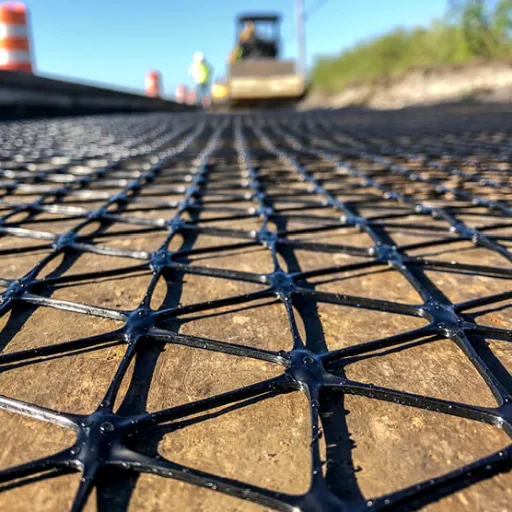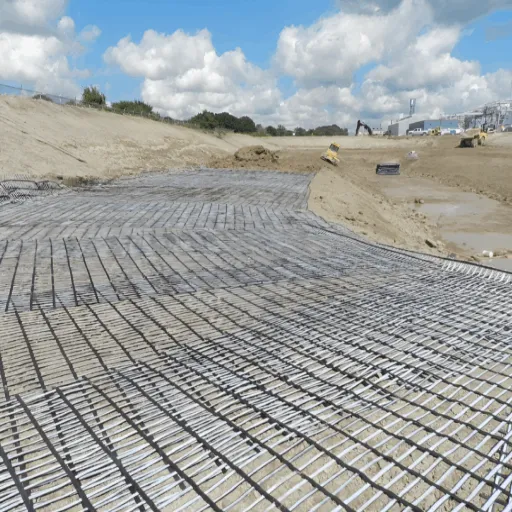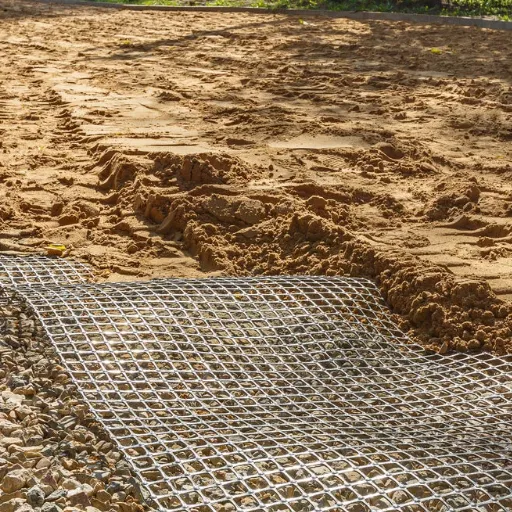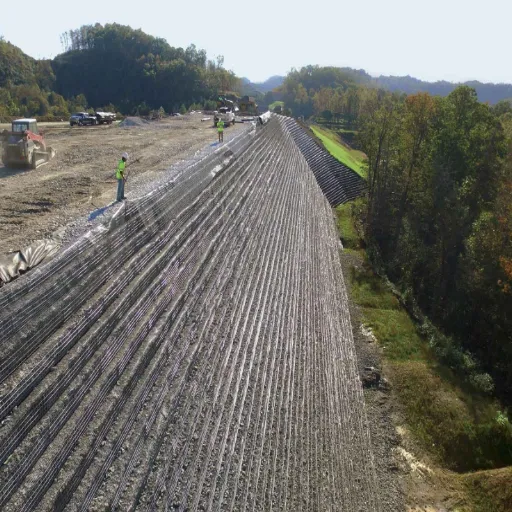
Timber bog mats are massive hardwood beams built for steel-tracked cranes and single-use wetland crossings. HDPE and composite temporary roadway mats are lighter, interlocking, reusable panels that win on freight, lifespan, and total cost for most haul-road projects. The right choice in the timber bog mats vs temporary roadway mats decision comes down to three questions: Are you running steel tracks, will you reuse the mats, and are you shipping them long distances?
For a full overview of every mat type before you compare, see our complete temporary roadway mats guide.
Quick verdict: The timber bog mats vs temporary roadway mats choice comes down to steel tracks and reuse. Pick timber for steel-tracked cranes, extreme point loads, and single-use wetland crossings. Pick HDPE or composite temporary roadway mats for reusable haul roads, export freight, and a 10-15+ year service life.
Key Takeaways
- Timber bog mats suit steel-tracked cranes, extreme point loads, and wetland crossings where mats may be left in place.
- HDPE and composite temporary roadway mats win on freight, lifespan, handling speed, and biosecurity for reusable haul roads.
- A single timber mat can weigh 2,000–5,000+ lb, while a 20 mm HDPE panel weighs 40–55 kg and moves in the hundreds per container.
- Timber typically lasts 1–5 years; quality HDPE and composite mats last 10–15+ years across many projects.
- Decide on total delivered cost and reuse, not the sticker price per mat.
This is a decision between mass and modularity: heavy hardwood beams versus light, reusable engineered panels.
What Are Timber Bog Mats and Temporary Roadway Mats?
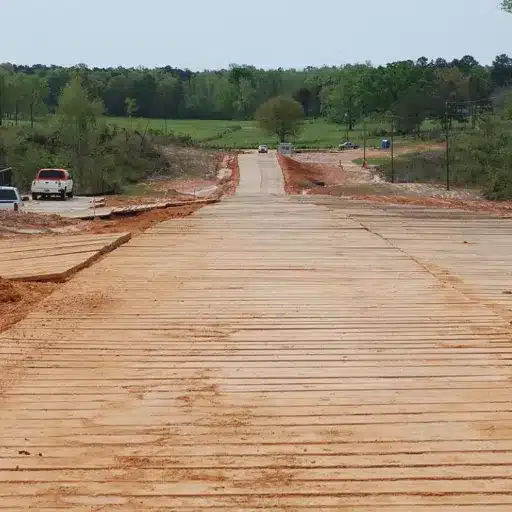
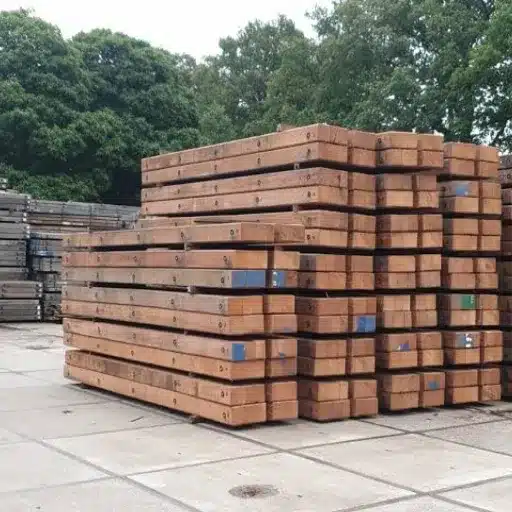
Timber bog mats are solid hardwood beams, usually oak or mixed hardwood, 8–12 inches thick and 16–40 feet long. A single mat can weigh 2,000–5,000+ lb, and more when saturated. They are placed by crane or large excavator and have been the default for pipeline right-of-way, transmission lines, swamp access, and crane support for decades.
Temporary roadway mats are engineered modular panels. HDPE panels are typically 12–25 mm thick and weigh 25–70 kg each, light enough for two workers to carry by hand. Composite panels run 25–100 mm and handle the heaviest tracked loads. Both interlock to form continuous haul roads. For HDPE material specifications, see our guide to HDPE temporary roadway mats.
The core difference is philosophy. Timber uses mass to bridge and absorb load. Engineered mats use stiffness, interlock, and load distribution across many panels.
Timber Bog Mats vs Temporary Roadway Mats: Side-by-Side
| Factor | Timber Bog Mats | HDPE Temporary Roadway Mats | Composite Temporary Roadway Mats |
|---|---|---|---|
| Weight per unit | 2,000–5,000+ lb | 25–70 kg | 100–400+ kg |
| Load capacity | Very high point loads | 30–150 tons | 100–600+ tons |
| Steel-track tolerance | Excellent | Limited on thin HDPE | High on heavy composite |
| Typical lifespan | 1–5 years | 10–15 years | 10–20+ years |
| Placement | Crane or large excavator | Two workers by hand | Forklift or grapple |
| Units per 40ft container | Not containerized; few per flatbed | 300–500 panels | 40–200 panels |
| Water and rot | Absorbs water, rots, harbors pests | Inert, UV-stable | Inert, UV-stable |
| End of life | Landfill or burn | Reusable and recyclable | Reusable and recyclable |
| Best fit | Steel tracks, single-use wetland, extreme point loads | Reusable haul roads, export, fast deployment | Heavy tracked loads, long-term roads |
The global ground protection mats market is projected to grow from USD 1.45 billion in 2025 to USD 2.75 billion by 2034, with engineered HDPE and composite systems taking share from timber as reuse and freight economics matter more. (FNF Research)
Where Timber Bog Mats Still Win
Steel-Tracked Equipment
Steel track lugs can gouge thin plastic. Solid hardwood tolerates the abrasion and point pressure of crawler tracks, which is the historic reason timber dominated pipeline and transmission access. A crane mat or dragline mat made from oak remains a defensible choice when steel tracks are non-negotiable and no composite option is on site. For equipment-specific load guidance, see our temporary roadway mats for heavy equipment guide.
Extreme Point Loads and Crane Support
A 12-inch oak section has enormous bending resistance. Laminated timber crane mats still carry outrigger and crawler loads that would deflect a 20 mm HDPE panel. Where the load is concentrated rather than distributed, timber’s mass is an asset. This is the heart of the crane mats vs composite mats question: heavy composite now matches much of that capacity, but oak still leads on raw section depth.
Single-Use or Abandoned Wetland Crossings
On some wetland and restoration projects, mats are left in place to decompose. Timber is biodegradable and acceptable in that narrow scenario. For engineered alternatives in sensitive ground, see our guide to temporary access mats for soft ground.
A transmission contractor in the southeastern United States ran laminated timber crane mats along a wetland right-of-way because a steel-tracked crawler was the only machine that could reach the towers and several mats were expected to remain after restoration. In that specific context, timber was the practical call.
Where HDPE and Composite Temporary Roadway Mats Win
Freight Efficiency and Export
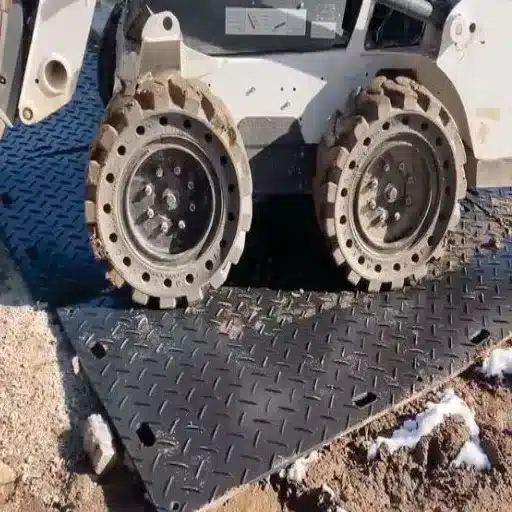
Freight is where the math flips. A flatbed moves a handful of timber mats. A 40ft high-cube container moves 300–500 HDPE panels. For export buyers, the delivered cost per square meter of HDPE is often a fraction of timber once ocean freight and port handling are counted.
Lifespan and Reuse
Timber typically lasts 1–5 years depending on species, moisture, and handling. Quality HDPE and composite mats deliver 10–15+ years and move from project to project. Reuse is the single biggest driver of lower total cost, and it is why the timber bog mats vs composite mats debate usually ends in favor of engineered panels for multi-project work. For the HDPE-versus-composite breakdown, see our composite vs HDPE temporary roadway mats comparison.
Handling Speed and Labor
Two workers place HDPE panels by hand with lever bars. No crane is standing by, no rigging, and no swing radius to manage. Composite panels need a forklift or grapple, but still deploy faster than positioning 3,000 lb timbers.
Environmental and Biosecurity Compliance
HDPE and composite panels are inert, washable, and recyclable. They do not absorb water, rot, or carry invasive insects and plant pathogens between regions, which matters for cross-border and agricultural projects. Timber can transfer pests and is frequently landfilled or burned at the end of its life.
An export wind-farm project in East Africa specified HDPE roadway mats and shipped hundreds of panels in a few containers. The equivalent access in timber would have required dozens of flatbeds and on-site cranes at every mobilization, and the freight alone would have exceeded the mat budget.
Cost: Upfront Price vs 10-Year Total Cost
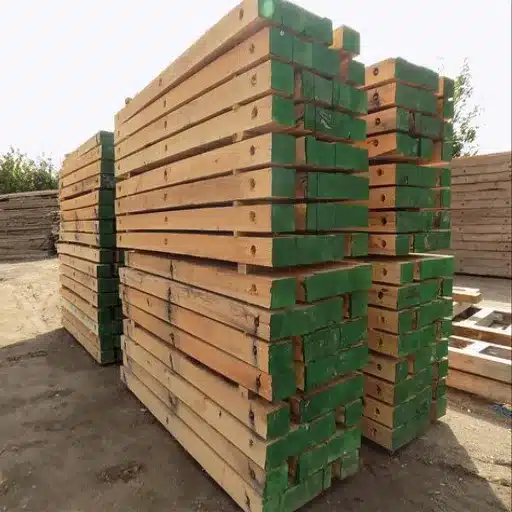
Timber can look cheaper per unit until you add freight, crane time, and replacement. Total cost of ownership has six parts: purchase price, freight, handling equipment, cleaning, replacement frequency, and disposal or residual value.
Timber scores poorly on freight (heavy, bulky), handling (crane required), replacement (short lifespan), and disposal (landfill or burn). Its only line-item win can be a low purchase price in regions with cheap hardwood. HDPE and composite cost more upfront but win on every other line, and they retain reuse value across projects.
A useful rule: if you will use the mats on more than one project, engineered mats almost always cost less over time. If the mats will be consumed on a single wetland crossing and steel tracks are mandatory, timber can be the lower-cost choice. Mat performance and price also depend heavily on thickness; see our temporary roadway mat thickness guide for sizing.
Need a delivered-cost comparison for your project? Shanxi Shengxing can model container loading, freight, and per-project cost for HDPE and composite options. Request a technical quote.
How to Choose the Right Mat
Use this decision framework:
- Choose timber bog mats if you run steel-tracked cranes or draglines, the crossing is single-use and biodegradable mats are acceptable, a crane is already on site, and you have no reuse plan.
- Choose HDPE temporary roadway mats if traffic is wheeled or medium-tracked, you will reuse mats across projects, freight or export matters, and you want fast hand-deployment.
- Choose composite temporary roadway mats if you need heavy tracked-load capacity plus a long-term reusable road, or where HDPE deflection is unacceptable.
Most global haul-road projects fall into the HDPE or composite column once freight, lifespan, and reuse are counted honestly. On saturated soils, the effective capacity of any mat drops 30-50%, so material choice cannot fix a weak subgrade.
Frequently Asked Questions
Are timber bog mats better than temporary roadway mats?
Neither is universally better. Timber is better for steel-tracked cranes, extreme point loads, and single-use wetland crossings. HDPE and composite temporary roadway mats are better for reusable haul roads, export, fast deployment, and lower 10-year cost.
How long do timber mats vs HDPE mats last?
Timber bog mats typically last 1–5 years depending on species, moisture, and handling. Quality HDPE and composite mats last 10–15+ years and can be reused across many projects, which is the main reason their total cost is lower.
Do steel tracks damage HDPE temporary roadway mats?
Thin HDPE panels can be gouged by steel track lugs under heavy crawlers. For steel-tracked equipment, heavy composite mats or timber are the safer choice, while HDPE suits wheeled and medium-tracked traffic.
Are timber bog mats cheaper than composite mats?
Timber can be cheaper per unit at purchase, but it is usually more expensive once freight, crane handling, short lifespan, and disposal are included. Composite mats cost more upfront but are reusable and far cheaper to ship per square meter.
How many timber mats fit on a truck vs HDPE in a container?
A flatbed carries only a handful of timber mats because each weighs 2,000–5,000+ lb. A 40ft high-cube container holds roughly 300–500 HDPE panels, which is why engineered mats dominate export projects.
Can composite mats replace timber crane mats?
In many cases, yes. Heavy composite mats rated to 250–600+ tons can match or exceed timber for crawler and outrigger loads while adding reuse and easier handling. Verify the load rating and subgrade before substituting.
Are HDPE temporary roadway mats recyclable?
Yes. HDPE panels are recyclable and reusable, and they do not rot or harbor pests. Timber is biodegradable but is often landfilled or burned at end of life and can carry invasive species between sites.
When should I use timber bog mats instead of temporary roadway mats?
Use timber when steel tracks are mandatory, the load is an extreme point load, the crossing is single-use and biodegradable mats are acceptable, and you have a crane on site with no plan to reuse the mats.
Conclusion
The timber bog mats vs temporary roadway mats decision is not about heavy-duty versus light-duty. It is about matching the material to the load, the reuse plan, and the freight reality. Timber still earns its place under steel-tracked cranes and on single-use wetland crossings. For most reusable haul roads, especially export projects, HDPE and composite temporary roadway mats deliver lower total cost, faster deployment, and a 10–15+ year service life.
Start with the three questions: steel tracks, reuse, and shipping distance. Then price the total delivered cost, not the sticker.
For project-specific recommendations, contact Shanxi Shengxing engineering support. We provide material selection, container-loading plans, and volume quotes for global delivery.
Request a technical quote or browse our HDPE temporary roadway mats catalog to get started.