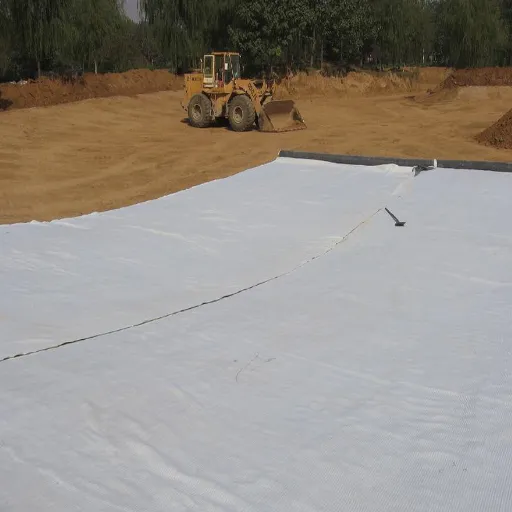
A geogrid service life of 75 to 120 years is realistic for a buried, covered, well-specified grid, and that range is backed by decades of field evidence, not just lab extrapolation. But the “120-year design life” on a datasheet doesn’t mean the polymer stays physically intact for 120 years. It means the grid’s long-term design strength has been calculated for a 120-year horizon using creep, installation-damage, and durability reduction factors. That distinction is the single most misunderstood idea in geogrid durability, and it’s what separates a structure that performs from one that fails.
If you have tried to get a straight answer to “how long does a geogrid last?”, you already know the problem. Search results split into vendor notes that quietly promote one product and academic PDFs written for researchers, not buyers. Almost none separate design life from service life, or give you the numbers behind the claim.
This guide fixes that. It walks through the four mechanisms that actually limit geogrid durability, decodes the reduction-factor math behind long-term design strength, compares polymers side by side, presents exhumation evidence from 25 to 36-year-old structures, and shows you how to specify and install for maximum service life. For the broader picture of how grids reinforce soil across different applications, see our guide to geogrid soil reinforcement.
Key Takeaways
- Design life and service life are not the same thing. Design life is the test horizon for long-term design strength (LTDS); service life is the actual in-ground functional life.
- Creep governs long-term performance for polypropylene (PP) and HDPE geogrids. Polyester (PET) resists creep far better, retaining roughly 55 to 57% of ultimate strength versus about 35% for PP.
- Long-term design strength follows LTDS = T_ult / (RF_CR × RF_ID × RF_D), where the reduction factors cover creep, installation damage, and chemical/oxidative durability.
- Installation damage is permanent and happens during construction. Product-specific RF_ID values range from about 1.01 to 2.01 depending on backfill and grid.
- Exhumation studies of 25, 28, and 36-year-old structures show properly installed, covered geogrids retain their strength with no meaningful loss.
What Is Geogrid Service Life?
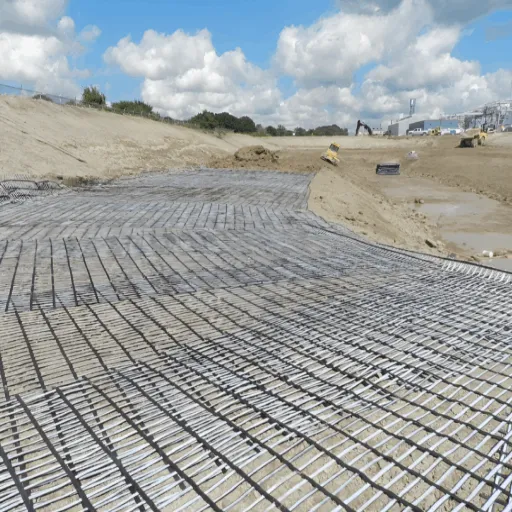
Geogrid service life is the period during which a geogrid continues to perform its reinforcement function within design limits in its installed environment. It is governed by creep, installation damage, chemical and oxidative degradation, and, if the grid is left exposed, UV weathering. For permanent buried structures, service life is typically taken as 75 to 120 years.
The confusion starts with terminology, so let’s draw a hard line between the two terms you will see on every specification.
Design life is the test and analysis horizon for which long-term design strength (LTDS) is calculated. Engineers commonly specify 100 or 120 years. When a supplier claims a “120-year design life,” they are saying their grid’s LTDS has been extrapolated to a 120-year point using accelerated creep and durability testing.
Service life is the actual in-ground functional life. It’s a function of the polymer, the backfill chemistry, the ground temperature, the sustained load, and how carefully the grid was installed. It isn’t a number you can read off a datasheet, because it depends on your site.
Here is why the distinction matters. Two geogrids can both carry a “120-year design life” label and have very different durability: one a PET grid retaining roughly 57% of its strength at 120 years, the other a PP grid retaining about 35%. The label is a prediction from extrapolated testing, not a physical warranty, and treating the two as equivalent is a design error that shows up decades later.
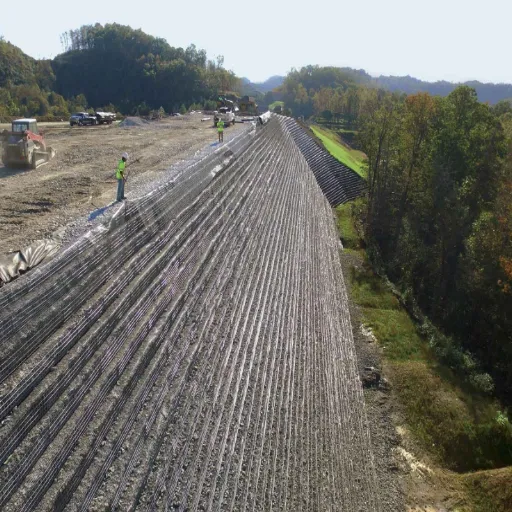
The good news is that a properly installed geogrid barely works at service loads. Independent exhumation studies find strains of 0.2 to 0.8% in grids from walls that have stood for 25 years. That enormous reserve margin is why predictions of 75 to 120 years hold up in the field.
The 4 Factors That Determine Geogrid Service Life
Every factor that shortens a geogrid’s life falls into one of four categories. Understanding them as a set is the fastest route to specifying intelligently.
- Creep and creep rupture – time-dependent deformation under sustained load. This is the dominant mechanism for PP and HDPE grids.
- Installation damage – rib and junction damage during fill placement and compaction. It happens once, during construction, and the strength lost is never recovered.
- Chemical and oxidative durability – oxidation for polyolefins, hydrolysis for PET, plus acid, alkali, and biological attack.
- Weathering and UV – relevant only while the grid sits exposed before it is buried.
These four combine into a single equation that governs how much strength you can actually count on:
LTDS = T_ult / (RF_CR × RF_ID × RF_D)
Where T_ult is the ultimate tensile strength, RF_CR is the creep reduction factor, RF_ID is the installation damage reduction factor, and RF_D is the durability reduction factor. For permanent mechanically stabilized earth (MSE) walls, the minimum overall factor of safety is about 1.5; for reinforced soil slopes it is about 1.0.
One thing that is largely a non-issue: corrosion. Geogrids are polymers, so they don’t rust. That removes an entire failure mode that governs steel reinforcement, and we’ll return to that comparison later. For a deeper look at reading UTS versus LTDS on a datasheet, see our guide to geogrid specifications & tensile strength.
Creep and Creep Rupture: The Dominant Long-Term Mechanism
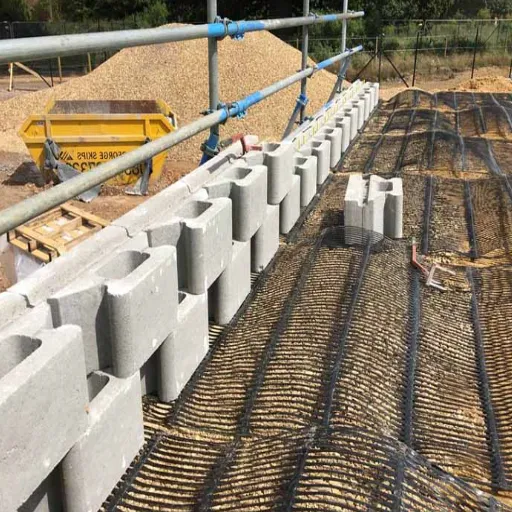
Geogrids are viscoelastic, which is the root cause of geogrid creep. Their strength and stiffness depend on how long a load is applied and at what temperature. Under a sustained load, a grid slowly strains, and if the load is high enough and the duration long enough, it can creep-rupture. This is the mechanism that most often governs how long a geogrid lasts.
Geogrids are tested for this in two main ways. Constant-load creep testing per ASTM D5262 is extrapolated over time using the time-temperature superposition (TTS) principle. The accelerated stepped isothermal method (SIM), ASTM D6992, simulates roughly 100 years of behavior in two to three weeks. The governing frameworks are ISO/TS 20432:2022 and AASHTO R69. The failure criterion is commonly 10% strain, and the 120-year strength is defined to a lower confidence limit.
The payoff of all this testing is a creep reduction factor for each polymer. The table below shows RF_CR values for a design life of about 114 years (from Lothspeich & Thornton) alongside widely used default ranges.
| Polymer | RF_CR (strain limit) | RF_CR (rupture) | FHWA default range | Creep resistance |
|---|---|---|---|---|
| PVA (50 kN/m) | ~1.57 | ~1.63 | – | Excellent |
| Aramid (175 kN/m) | ~1.49 | ~1.49 | – | Excellent |
| PET (40 kN/m) | ~1.61 | ~1.62 | 1.6-2.5 | Very good |
| HDPE (70 kN/m) | ~2.69 | ~3.04 | 2.6-5.0 | Moderate |
| PP (35 kN/m) | ~3.27 | ~4.63 | 4.0-5.0 | Lowest |
The message is unmistakable. PET retains far more of its long-term strength than PP or HDPE. A PET grid loses roughly 38% of its ultimate strength to creep over the design life, while a PP grid can lose 70% or more. This is why PET is the default choice for high-consequence wall and slope reinforcement, and why a PP grid needs careful justification in the same role. Real “120-year” numbers look like this: Tensar’s UX1800HS carries an RF_CR of 2.7 at 120 years with a design strength of 74.1 kN/m, not a slogan.
One nuance matters here. Field monitoring of seven reinforced soil walls suggests real structures experience stress relaxation, so actual safety margins may increase over time rather than decrease. Research by Allen & Bathurst and by Greenwood concluded that multiplying RF_CR by RF_ID is conservative; the design method already builds in a cushion.
For where creep governs design most directly, see our article on the uniaxial geogrid for MSE walls and design life.
Installation Damage (RF_ID): The Service-Life Risk You Control
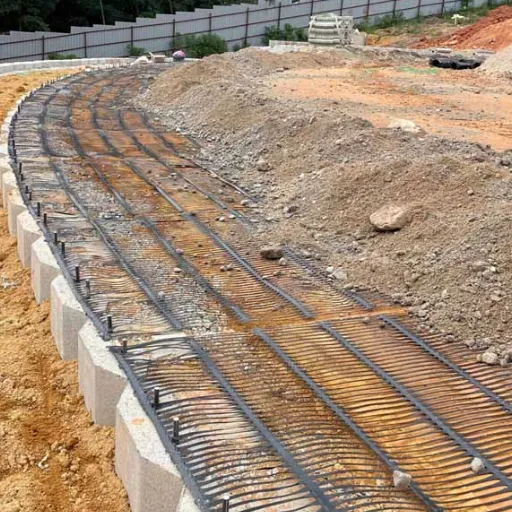
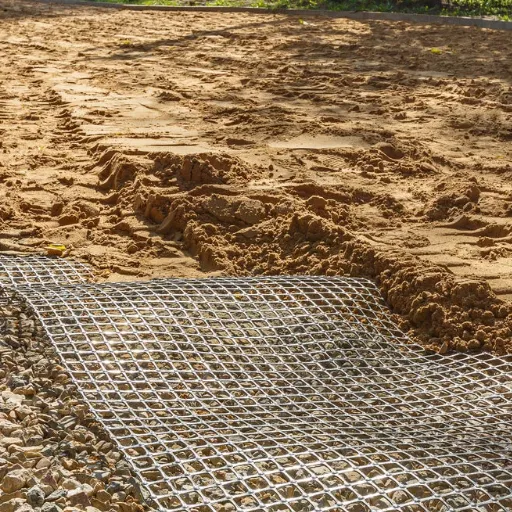
Geogrid installation damage is strength loss from fill placement, compaction, and equipment traffic during construction. It is an immediate, permanent reduction, and unlike creep it happens in a matter of days. The grid that leaves the truck at full strength can be measurably weaker by the time the first lifts are compacted over it.
Installation damage is tested per ASTM D5818 and qualified through the NTPEP program under AASHTO R69. The reduction factor typically ranges from a minimum of about 1.1 up to 2.0 or more, depending on the backfill and the product.
The spread is wider than most buyers expect. NTPEP data for TenCate Miragrid XT geogrids gave RF_ID values from 1.01 to 2.01 across the product range: 1.01 for the strongest product in sandy gravel, and 2.01 for the lightest product in coarse gravel. In other words, the same family of grids can lose anywhere from almost nothing to half its strength to installation, purely because of backfill gradation and product weight.
Typical values used in design reflect this. HDPE uniaxial and PP biaxial grids commonly run 1.20 to 1.45 in coarse Type 1 backfill and 1.10 to 1.20 in fine Type 2 backfill. PVC-coated PET ranges from 1.30 to 1.85 in coarse fill and 1.10 to 1.30 in fine fill.
The practical controls are straightforward, and getting them right is one of the most valuable things you can do for service life:
- Maintain a minimum first-lift cover, typically around 150 mm, before compaction equipment passes over the grid.
- Do not allow tracked equipment directly on the grid.
- Control backfill gradation, and know that angular, coarse fill damages grids more than rounded, fine fill.
- Insist on the product-specific RF_ID from NTPEP data rather than a generic default.
Mike, a contractor on a highway widening project, learned this the expensive way. His team used the default RF_ID of 1.1 with a coarse angular crushed-stone backfill. The product-specific NTPEP value for that grid in that fill was closer to 1.5. The design was under-strength on paper, and the fix required re-running the reinforcement calculations with the correct factor. The lesson: installation damage is permanent, so it must be designed for, not hoped away. For installation practice that controls this risk, see our guide to geogrid installation to avoid installation damage.
Chemical and Oxidative Durability: Oxidation, Hydrolysis, and pH
The durability reduction factor RF_D, sometimes written RF_CH, covers chemical and biological degradation over the design life. It typically ranges from about 1.1 to 2.0. Get it wrong and a grid that resists creep perfectly can still fail in service.
The behavior is polymer-specific.
| Polymer | Vulnerability | Practical service range |
|---|---|---|
| PP | Thermal oxidation, which depends on the antioxidant package | Unstabilized PP: half-life under 50 years. With ASTM D4355 at 90% or more retained at 500 hr, RF ~1.1 at 20°C/100 yr |
| HDPE | Oxidation and antioxidant depletion | Very inert, no degradation up to pH 12; RF ~1.1 at 20°C/100 yr |
| PET | Hydrolysis | Roughly pH 3 to 9; avoid high pH combined with high temperature |
| PVA | Low vulnerability | Best chemical resistance for aggressive and high-pH landfill |
| Basalt | Low vulnerability | Excellent acid and alkali resistance |
| ABS | Poor solvent resistance | Not recommended for landfill |
The oxidation screening test is ISO 13438, an oven-aging test at 110°C requiring at least 50% strength retention. PP is not inherently short-lived; PP without a good stabilizer package is.
Backfill chemistry is where site-specific assessment pays off. pH, chlorides, sulfates, organic content, acid sulfate and calcareous soils, hydrocarbons, and active slag can all shorten service life. In aggressive environments, test the site rather than assuming a default. On the microbiological side, properly formulated geogrids retain essentially full strength against biological attack in normal soils, so this is rarely the deciding factor.
One cautionary example ties it together. A project specified a PET grid behind lime-stabilized backfill, driving the pore-water pH above 9. That is squarely in the hydrolysis risk zone for polyester. Switching to an HDPE or PVA grid resolved the durability concern at little cost, but catching it after construction would have meant a permanent liability.
Geogrid UV Resistance: Only a Problem While Exposed
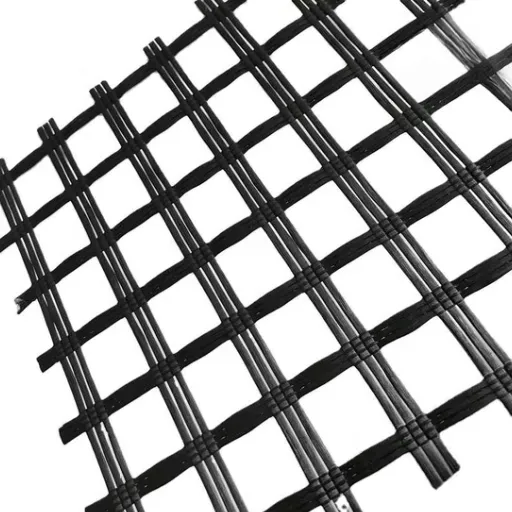
UV degradation is not a buried problem. Once a geogrid is covered with soil or vegetation, UV exposure effectively stops. That is why buried service-life predictions of 75 to 120 years are far longer than any exposed estimate. The entire question of UV comes down to how long the grid sits uncovered.
The evidence for prompt covering is unambiguous. Flexible PET geogrids left outdoors retained about 88% of tensile strength at one month, 71% at 12 months, and 66% at 18 months, with a tensile half-life just over 18 months. HDPE geogrid strength held steady or even increased for the first nine months as UV-driven crosslinking occurred, then declined. Even the best exposed performer, such as TenCate Miramesh GR with a declared 75-year exposed life, relies on a strong stabilization package.
Protection comes from two additions: carbon black at 2% or more and an antioxidant at roughly 1%. The screening test is ASTM D4355 at 500 hours, supported by accelerated weathering tests such as ASTM D7238. The practical rule is simple enough to put in a construction specification: install and cover the grid within days, specify a maximum exposure time, and never leave grids uncovered through a full construction season.
How Long Do Geogrids Actually Last? The Evidence
Independent exhumation of geogrids from decades-old structures shows that properly formulated, properly installed, and properly covered geogrids retain their strength far beyond typical service expectations. This is the strongest single answer to “how long does a geogrid last?”, because it is measured, not modeled.
The field record is impressive:
- A 25-year reinforced sloped soil wall near Oslo, Norway, built in 1987 with Tensar SR55 geogrid and exhumed around 2012, showed little to no installation damage and strains of only 0.2 to 0.8%, with maximum measured loads of 1.4 to 3.0 kN/m (Thiel, 2019).
- A 28-year PET reinforcement showed no measurable strength reduction.
- A 35 to 36-year-old HDPE MSE wall at Devil’s Punchbowl in Oregon, built with Tensar SR2 geogrid in the 1970s, was still serviceable when samples were re-tested.
- Geogrid after more than 10 years of continuous load showed no reduction in tensile resistance.
On the certification side, what “rated” lifetimes mean is well documented. Tensar RE500 holds HAPAS approval for a 120-year design life, Tensar SR55 has held a BBA certificate since 1988 for 120 years, and Tenax TT is rated 120 years across pH 1.6 to 13.
The realistic bottom line: buried, covered, well-specified geogrids are both predicted and empirically observed to last 75 to 120 years or more. Exposed grids degrade in months to a few years. The difference is almost entirely a matter of cover, polymer choice, backfill chemistry, and the antioxidant package.
Geogrid vs Steel Reinforcement: Service Life Compared
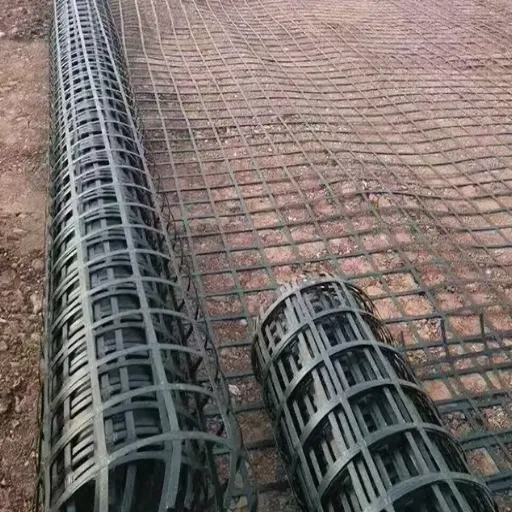
Both geogrid and steel reinforcement can be designed for 75 to 100-year service lives, but each has a different failure mode. Steel life is governed by corrosion; it relies on galvanizing, coatings, select fill, and waterproofing, and carbon steel can lose 1.42 to 2.02 mm of section over 75 to 100 years, with deicing salts accelerating attack in the upper two and a half meters. Geogrid has no metallic corrosion; its concerns are creep, installation damage, and polymer durability instead.
There is a counterintuitive twist: geosynthetic selection is often described as more complex than steel, because tensile properties vary with creep, temperature, installation damage, and backfill chemistry, and even between products of the same polymer. That is exactly why product-specific test data matters. The takeaway: no material is universally longer-lasting. Geogrid tends to win where corrosion risk is high, such as saline, acidic, or wet conditions, and where its light weight and ease of handling simplify construction.
Ready to compare geogrid options for your project? Our engineering team can walk you through polymer selection and design-life specification. Talk to an engineering specialist →
How to Maximize Geogrid Service Life
Everything above condenses into a practical checklist. Work through these eight points before you finalize a specification. If you are still deciding between stabilization systems, our geogrid vs geocell comparison explains how the two behave differently under sustained load.
- Match the polymer to the environment. PET for high-consequence reinforcement where creep matters most. PP or HDPE where cost matters and creep is managed. PVA or basalt for aggressive or high-pH conditions.
- Verify the antioxidant and carbon-black package. Request ASTM D4355 evidence of at least 90% retention at 500 hours, plus carbon black content of 2% or more. This governs buried oxidation life.
- Control installation damage. Use the correct RF_ID for your specific backfill, maintain minimum first-lift cover, and keep tracked equipment off the grid.
- Select compatible backfill. Keep PET within pH 3 to 9, and avoid high pH combined with high temperature. Backfill gradation and geogrid aperture size together determine how well the grid interlocks with the soil, so check both against your site material.
- Design with LTDS, not UTS. Specify long-term design strength for your design life, not ultimate tensile strength.
- Ensure drainage. Water chemistry and temperature drive degradation. Avoid ponding around the reinforcement.
- Cover promptly. Eliminate UV exposure and specify a maximum exposure time in the construction sequence.
- Buy to a qualified standard. Request product-specific creep, installation-damage, and durability test data rather than relying on generic defaults.
For a structured way to move from application to specification, see our how to choose a geogrid selection framework.
How Geogrid Service Life Is Specified and Verified
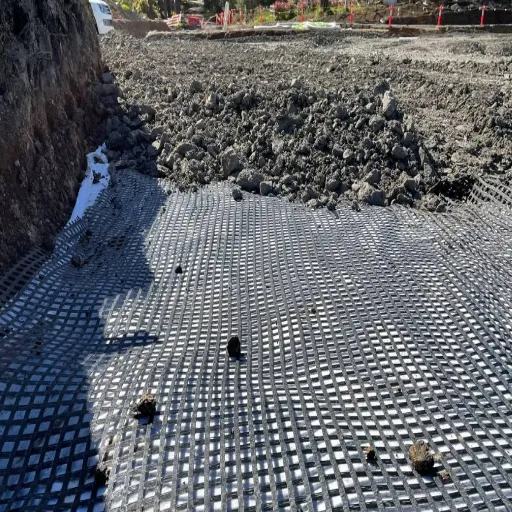
State the design life (100 or 120 years) and the required LTDS, then require product-specific creep, installation-damage, and durability reduction factors supported by test reports, plus durability testing tied to your site chemistry in aggressive soils. The governing standards are ISO/TS 20432:2022 for long-term strength, AASHTO R69 for qualification, ASTM D5262/D6992 for creep, ASTM D5818 for installation damage, ASTM D4355 for UV, and ISO 13438 for oxidation.
When buying internationally, verify rather than accept. Request MARV reports, carbon black and antioxidant content, pH range coverage, third-party creep data, and ISO 9001 certification. A bare “120-year” claim means nothing until you can see the RF_CR, RF_ID, and RF_D values behind it and confirm they match your backfill and environment.
Need durability test data before you specify? Request datasheets, MARV reports, and reduction-factor documentation for our PP and PET geogrid qualified to ASTM and ISO. We answer technical inquiries within one hour.
Frequently Asked Questions
How long does a geogrid last?
Buried, covered, well-specified geogrids last 75 to 120 years or more, corroborated by 25 to 36-year exhumation studies. Exposed grids degrade in months to a few years, so prompt covering is essential.
What is the difference between geogrid design life and service life?
Design life is the test horizon for which long-term design strength is calculated, commonly 100 or 120 years. Service life is the actual in-ground functional life, which depends on polymer, backfill chemistry, temperature, load, and installation quality.
Is a 120-year geogrid design life realistic?
It is a prediction from extrapolated creep and durability testing, validated by field exhumations of 25 to 36-year-old structures. It is a design basis, not a physical guarantee, so it must be paired with correct polymer choice and installation.
Does geogrid degrade over time?
Yes, through creep, oxidation or hydrolysis, chemical attack, and UV exposure. The rate depends on the polymer, the backfill, the temperature, and whether the grid is covered. Properly specified grids degrade very slowly.
Does UV light damage geogrid?
Only while the grid is exposed. Once covered with soil or vegetation, UV exposure stops. Specify carbon black at 2% or more and cover grids promptly to eliminate UV risk.
Which lasts longer, polyester or polypropylene geogrid?
Polyester resists creep far better, with an RF_CR of about 1.6 versus 3.3 to 4.6 for polypropylene at roughly 114 years. Polypropylene can still perform well, but it depends on a strong, verified antioxidant package.
Does geogrid corrode?
No. Geogrid is a polymer, not steel, so it does not rust. Its long-term concerns are creep, installation damage, and chemical or oxidative degradation instead.
Can geogrid last 100 years?
Yes, for buried, covered, well-specified products. This is supported by 120-year design-life approvals and by long-term exhumation studies of structures built decades ago that retain their strength.
Conclusion
Geogrid service life comes down to a handful of facts that are easy to get wrong and valuable to get right. Design life is a test horizon for long-term design strength, not a physical warranty. Creep governs the long-term performance of PP and HDPE, while PET retains the most strength. Installation damage is permanent and must be designed for with a product-specific factor. Oxidation depends on a verified antioxidant package. UV only matters while the grid is exposed, so cover it promptly. Backfill chemistry and coverage drive real-world longevity, and you should always design with LTDS rather than ultimate strength.
Put those together and the answer to “how long does a geogrid last?” stops being a mystery. A properly selected, properly installed, properly covered grid is a genuinely 75 to 120-year material, and the field evidence backs it up.
If you are specifying geogrid and want the durability numbers behind the headline, we can help. Shanxi Shengxing supplies export-ready geogrids qualified to ASTM and ISO, with MARV test reports, carbon-black and antioxidant verification, product-specific reduction factors, and engineering consultation on design life and durability. Flexible minimum order quantities and responsive support make it straightforward to qualify a supplier before you commit.