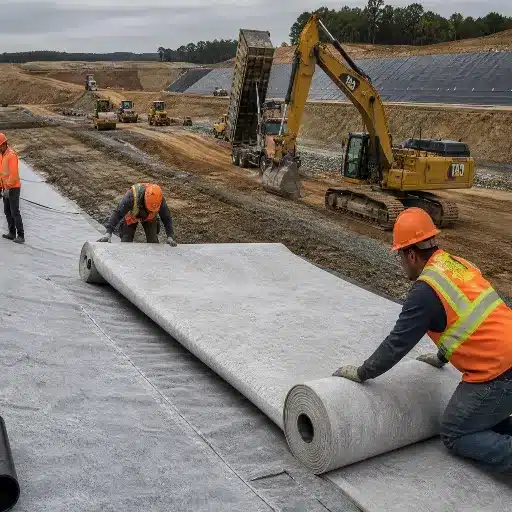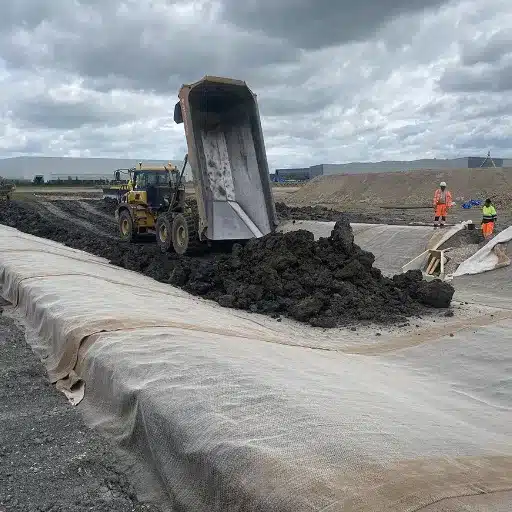
Geomembrane thickness typically ranges from 0.5 mm (20 mil) for light ponds to 3.0 mm (120 mil) for mining and hazardous waste containment. The right thickness depends on your application, subgrade conditions, mechanical loads, chemical exposure, and design life. Thicker is not automatically better—over-specifying raises cost and complicates installation without adding proportional value.
What if the liner you specify today fails because it is 0.5 mm too thin for the rock layer beneath it?
It happens more often than project teams expect. A 0.75 mm pond liner punctured by a buried stone. A 1.5 mm landfill liner placed on a steep slope without enough friction. A 2.0 mm mining liner chosen for peace of mind but welded poorly because the crew lacked experience with thick sheets. When the wrong geomembrane thickness fails, the cost goes far beyond the material. It includes cleanup, regulatory penalties, project delays, and lost credibility.
You already know that thickness matters. The challenge is choosing the right value among options that look similar on a datasheet but behave very differently in the field. This guide explains how to select geomembrane thickness for ponds, landfills, mining, and industrial containment. You will learn how thickness relates to puncture resistance, tensile strength, and standards, and how to balance performance with budget.
Key Takeaways
- Geomembrane thickness ranges from 0.5 mm (20 mil) for ponds to 3.0 mm (120 mil) for heavy mining and hazardous waste.
- Thicker liners increase puncture resistance, tensile strength, and service life, but also raise cost, weight, and welding difficulty.
- GRI-GM13 defines HDPE geomembrane properties from 0.75 mm to 3.0 mm, with mechanical values that scale directly with thickness.
- Landfill base liners usually require 1.5–2.0 mm HDPE; ponds and reservoirs typically use 0.5–1.5 mm; mining uses 1.5–3.0 mm.
- Final thickness selection must be approved by the project engineer and comply with local regulations and project specifications.
Why Geomembrane Thickness Matters
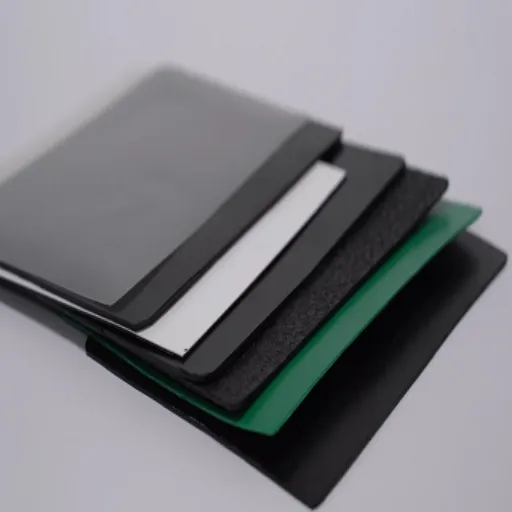
Thickness is one of the most visible and influential properties of a geomembrane liner. It affects mechanical strength, durability, installation, and cost. Specifying the right thickness means matching the liner to the risks it will face over its design life.
Thickness vs. Puncture Resistance
A thicker geomembrane resists puncture from stones, roots, and construction debris better than a thinner one. Under GRI-GM13, puncture resistance scales almost proportionally with thickness. A 1.5 mm HDPE liner typically offers around 480 N of puncture resistance, while a 2.0 mm liner reaches approximately 640 N.
This does not mean you should always choose the thickest option. A well-prepared subgrade with a geotextile cushion can allow a thinner liner to perform safely. A rough subgrade with no protection can force you to upgrade thickness or add a protection layer.
Thickness vs. Tensile and Tear Strength
Tensile yield strength, tear resistance, and elongation at break all improve as thickness increases. GRI-GM13 sets minimum tensile yield values that rise with each thickness step. For smooth HDPE, the tensile yield strength increases from 84 lb/in width at 1.0 mm to 126 lb/in at 1.5 mm and 168 lb/in at 2.0 mm.
Higher tensile strength matters in applications with high hydrostatic pressure, deep waste cells, or steep slopes. Higher tear resistance helps the liner survive installation stresses, wind uplift, and localized loading.
Thickness vs. Durability and Design Life
Thicker liners generally last longer. They contain more polymer and stabilizer mass, which improves resistance to UV oxidation, thermal cycling, and chemical attack. Buried HDPE geomembranes can achieve service lives of 50–100 years, with thicker sections typically performing better in exposed or aggressive environments.
However, design life depends on more than thickness. Resin quality, carbon black content, installation quality, and seam integrity all play major roles. A thick liner with poor welds is less reliable than a thinner liner with excellent seams.
Thickness vs. Installation and Welding
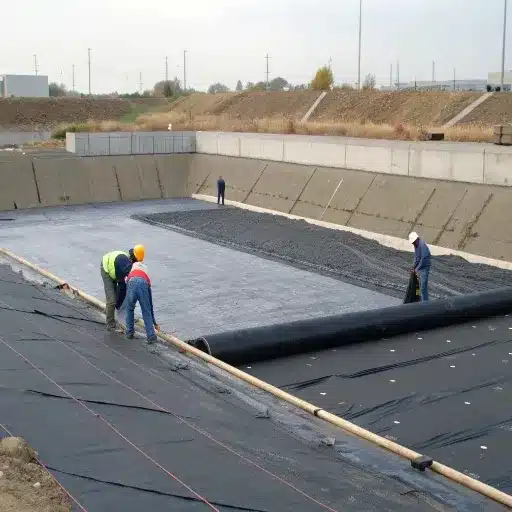
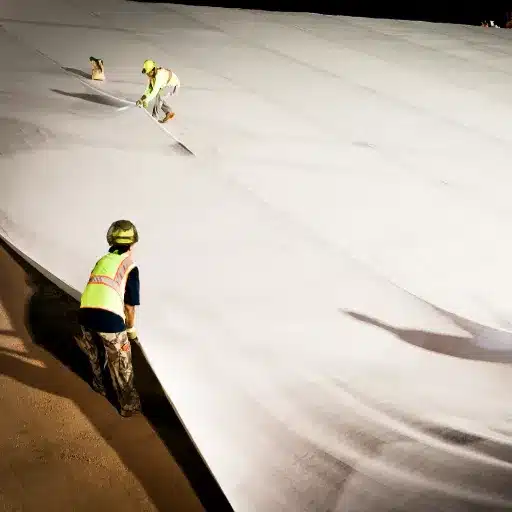
Thicker geomembranes are heavier, stiffer, and harder to position. They require more powerful welding equipment, higher temperatures, and more experienced crews. For HDPE, effective wedge welding becomes more demanding above 2.0 mm, and thermal expansion during installation increases stress on seams.
LLDPE is more flexible than HDPE at the same thickness, which can offset some handling difficulty. Factory-fabricated panels can also reduce field welding length for complex sites.
Common Geomembrane Thickness Options
Manufacturers produce geomembranes in standard thickness increments. Understanding the mm-to-mil conversion is essential because datasheets and regulations may use either unit.
Mil-to-mm Conversion Table
| Millimeters (mm) | Mils (mil) | Inches (in) |
|---|---|---|
| 0.5 mm | 20 mil | 0.020″ |
| 0.75 mm | 30 mil | 0.030″ |
| 1.0 mm | 40 mil | 0.040″ |
| 1.5 mm | 60 mil | 0.060″ |
| 2.0 mm | 80 mil | 0.080″ |
| 2.5 mm | 100 mil | 0.100″ |
| 3.0 mm | 120 mil | 0.120″ |
One mil equals 0.001 inch, or 0.0254 mm. The geomembrane industry typically rounds these values to the nearest 10 mil increment.
Standard Thickness Ranges for HDPE and LLDPE
HDPE geomembranes are commonly available from 0.5 mm to 3.0 mm. LLDPE geomembranes are often supplied from 0.3 mm to 2.0 mm, with 0.5–1.5 mm being the most common range for ponds and caps. PVC geomembranes can be supplied in thinner gauges, typically 0.5–1.5 mm, but this guide focuses on polyethylene liners.
Smooth vs. Textured: Nominal Thickness vs. Core Thickness
Smooth geomembrane thickness is measured directly with ASTM D5199. Textured geomembranes have raised surface asperities that add height but do not contribute to structural strength. For textured liners, engineers distinguish between nominal thickness and core thickness. Core thickness is the minimum thickness of the liner between the asperities and is the value that matters for tensile and puncture calculations.
ASTM D5994 is used to measure core thickness for textured geomembranes. When you specify a 1.5 mm textured HDPE liner for a slope, confirm whether the 1.5 mm refers to nominal or core thickness. This distinction can affect both performance and compliance.
How GRI-GM13 Properties Scale with Thickness
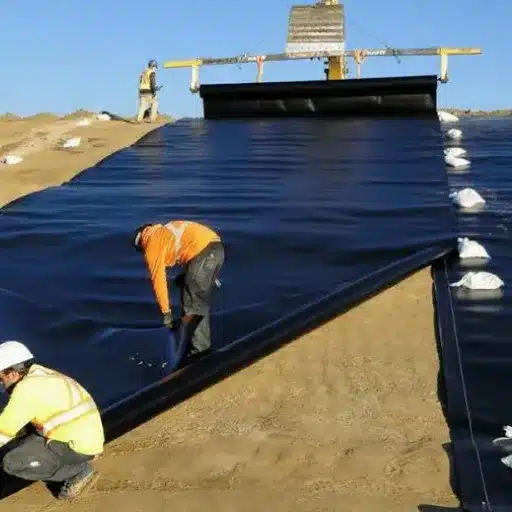
GRI-GM13 is the most widely referenced manufacturing quality specification for HDPE geomembranes. It defines minimum properties for each nominal thickness and applies to both smooth and textured products.
GRI-GM13 Thickness Range
GRI-GM13 covers HDPE geomembranes from 0.75 mm to 3.0 mm. Separate tables exist for smooth and textured geomembranes because texture affects surface measurements and some mechanical requirements. The specification does not set the design thickness for a project—that is determined by the engineer, regulator, or owner—but it ensures that the material meets minimum quality thresholds once a thickness is chosen.
Tensile, Tear, and Puncture Values by Thickness
The table below shows how selected GRI-GM13 minimum values scale for smooth HDPE.
| Nominal Thickness | Tensile Yield (lb/in width) | Tear Resistance (lb) | Puncture Resistance (lb) |
|---|---|---|---|
| 1.0 mm (40 mil) | 84 | 28 | 72 |
| 1.5 mm (60 mil) | 126 | 42 | 108 |
| 2.0 mm (80 mil) | 168 | 56 | 144 |
| 2.5 mm (100 mil) | 210 | 70 | 180 |
These values show that doubling the thickness from 1.0 mm to 2.0 mm approximately doubles the mechanical resistance. This scaling is useful when comparing upgrade options.
ASTM D5199 Thickness Measurement and Tolerance
ASTM D5199 measures the nominal thickness of smooth geomembranes using a calibrated micrometer. The minimum average thickness must equal the nominal value, and individual readings are generally not allowed to fall more than 10% below nominal. For textured geomembranes, ASTM D5994 measures core thickness because the surface texture would distort a simple micrometer reading.
When you receive a mill test report, verify that thickness was measured with the correct ASTM method and that all readings meet the tolerance limits. This is especially important for international shipments where factory QC practices may vary.
Geomembrane Thickness by Application
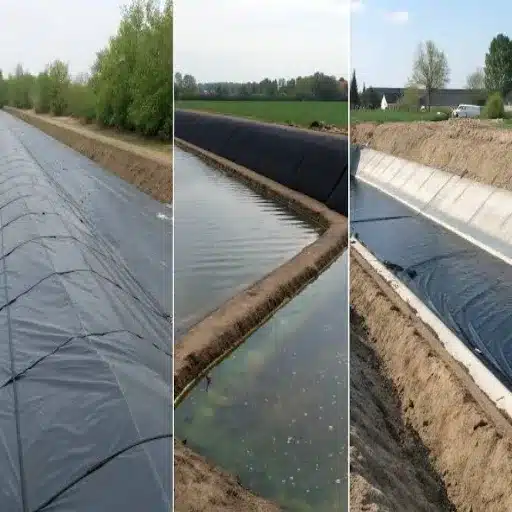
The fastest way to narrow down thickness is to start with the application. Each use case has typical ranges based on load, risk, and regulatory requirements.
Ponds, Reservoirs, and Aquaculture
For fish ponds, decorative ponds, and small reservoirs, HDPE or LLDPE thickness typically ranges from 0.5 mm to 1.0 mm. LLDPE is often preferred for uneven terrain because it conforms better and reduces field seams.
- Small decorative ponds: 0.5 mm
- Fish ponds and aquaculture: 0.5–0.75 mm
- Irrigation reservoirs and canals: 0.75–1.0 mm
- Larger reservoirs with higher water depth: 1.0–1.5 mm
If the pond bottom is rocky or stony, add a geotextile cushion rather than simply increasing thickness. This often costs less and improves protection. For more pond-specific guidance, see our geomembrane pond liner guide.
Wastewater Lagoons and Industrial Containment
Wastewater lagoons, industrial effluent ponds, and secondary containment typically use 1.0 mm to 1.5 mm HDPE. Chemical exposure and moderate mechanical loads justify the thicker section compared to simple water ponds.
- Wastewater treatment ponds: 1.0–1.5 mm
- Industrial effluent ponds: 1.0–1.5 mm
- Secondary containment: 1.0–1.5 mm
In these applications, chemical resistance and seam quality are as important as thickness. A 1.5 mm liner with poor welds can leak more than a 1.0 mm liner with excellent seams.
Landfill Liners and Caps
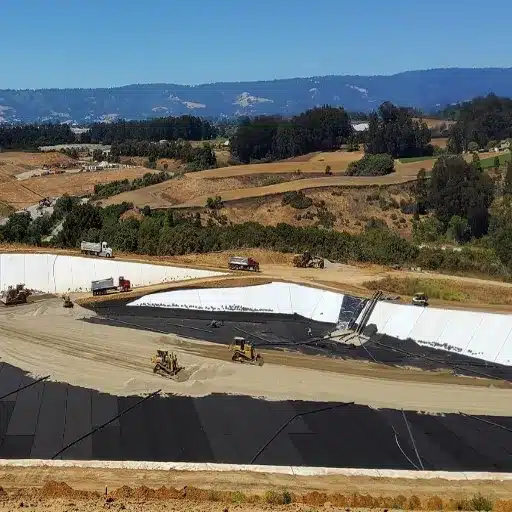
Municipal solid waste landfill base liners are the most thickness-regulated geomembrane application. The U.S. EPA commonly requires a minimum of 1.5 mm (60 mil) HDPE for primary bottom liners. Steep slopes, hazardous waste, or coarse subgrades may require 2.0 mm or more.
| Landfill Application | Typical Thickness |
|---|---|
| Municipal solid waste base liner | 1.5–2.0 mm |
| Hazardous waste landfill liner | 2.0–2.5 mm |
| Leachate collection pond | 1.5–2.0 mm |
| Final cover/cap | 1.0–1.5 mm |
| Secondary liner | 1.0–1.5 mm |
Textured HDPE is usually specified on side slopes to improve friction and prevent liner sliding. For more detail, see our guide to geomembrane landfill liner systems and textured vs smooth geomembrane.
Mining Heap Leach Pads and Tailings
Mining applications impose some of the highest mechanical and chemical stresses on geomembranes. Heap leach pads, tailings storage facilities, and solution ponds typically use 1.5 mm to 3.0 mm HDPE.
- Heap leach pads: 1.5–2.0 mm
- Tailings impoundments: 1.5–2.5 mm
- Process solution ponds: 1.5–2.0 mm
- Aggressive chemical zones: 2.0–3.0 mm
In these projects, the design engineer often performs puncture analysis under expected loads and selects thickness based on factor of safety. Long design lives of 20–50 years also favor thicker sections. Learn more in our guide to geomembrane for mining.
Key Factors in Thickness Selection
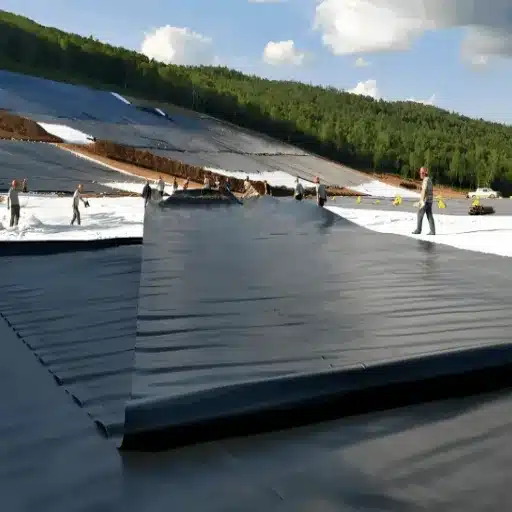
Application gives you a starting range. The final thickness depends on several project-specific factors.
Subgrade Conditions and Protection Layers
A smooth, well-compacted subgrade with a fine-grained soil layer allows a thinner liner. A rocky, angular, or poorly prepared subgrade increases puncture risk and may require either a thicker liner or a geotextile protection layer.
In many cases, adding a 200–300 g/m² nonwoven geotextile cushion is more cost-effective than upgrading from 1.0 mm to 1.5 mm. The geotextile distributes point loads and prevents sharp objects from contacting the liner directly.
Hydrostatic Pressure and Liquid Depth
Deeper ponds and lagoons create higher hydrostatic pressure on the liner. A simplified tension check uses the relationship T = p × R, where T is liner tension, p is pressure, and R is the radius of curvature of any subgrade deformation. Higher tension favors greater thickness and higher tensile strength.
For most practical purposes, water depths below 3 meters rarely drive thickness above 1.0–1.5 mm if the subgrade is reasonable. Depths above 5 meters, or steep side slopes, may justify 1.5–2.0 mm.
Mechanical Loads and Traffic
Traffic during installation, waste placement, or cover soil placement can puncture or tear the liner. Areas with heavy equipment traffic, sharp waste fragments, or high overburden loads require thicker sections or protective layers.
Mining heap leach pads are a classic example. Ore stacking, solution loading, and long-term settlement create repeated mechanical stress that justifies 2.0 mm or thicker HDPE.
Chemical Exposure and Design Life
Aggressive leachate, acidic mining solutions, and industrial effluents can stress the polymer. Thicker liners provide more material to resist chemical diffusion and oxidative degradation. Long design lives also favor thicker sections because they include more stabilizer mass and polymer reserve.
For mild water containment, chemical exposure is not a major thickness driver. For landfills, mining, and chemical containment, it is.
Slope Stability and Surface Texture
Steep slopes increase the risk of liner sliding. Textured HDPE improves interface friction and is often required on landfill side slopes steeper than 1V:3H. However, texture height does not add tensile strength, so the core thickness must still meet structural requirements.
Smooth HDPE is acceptable on flat base liners where sliding forces are low. A hybrid design—textured on slopes, smooth on the base—is common in landfills.
Climate and UV Exposure
Exposed liners face UV radiation, thermal expansion, and wind uplift. Thicker liners generally perform better under UV exposure because they contain more carbon black and antioxidant stabilizer. In tropical or high-altitude climates with intense sun, consider upgrading thickness or ensuring a prompt cover soil placement schedule.
Cold climates introduce different concerns. HDPE becomes stiffer at low temperatures, making installation and welding more challenging. LLDPE retains flexibility better in cold conditions and may be easier to install in winter.
Cost Comparison by Thickness
Material price is only part of the cost equation. Installation, freight, supervision, and lifecycle performance all affect the final project cost.
Indicative Material Cost per m²
Factory-ex-works price ranges for HDPE geomembrane by thickness are approximately:
| Thickness | HDPE (USD/m²) | LLDPE (USD/m²) |
|---|---|---|
| 1.0 mm | $1.10–$2.00 | $1.10–$1.80 |
| 1.5 mm | $1.50–$2.80 | $1.60–$2.60 |
| 2.0 mm | $2.30–$3.80 | $2.30–$3.60 |
Actual prices depend on order volume, surface finish, resin quality, certification, and freight distance. Treat these figures as reference ranges, not fixed quotes.
Installation and Welding Cost Differences
Thicker liners cost more to install. They are heavier, require more crew handling, and may need higher-capacity welding equipment. Seaming 2.0 mm HDPE takes longer than seaming 1.0 mm HDPE, and QA destructive testing frequency may increase.
On large flat sites, the extra handling cost may be modest relative to the material cost. On complex sites with many corners, pipes, and seams, the installation cost difference can be significant. For step-by-step installation guidance, read our geomembrane installation guide.
Lifecycle Cost: When Thicker Pays Off
A thicker liner can reduce lifecycle cost in high-risk applications by reducing the probability of puncture, seam failure, or premature replacement. In low-risk applications, the extra cost may not provide proportional benefit.
For example, upgrading a landfill base liner from 1.5 mm to 2.0 mm adds material cost but may reduce long-term repair risk in a coarse subgrade. Upgrading a decorative pond from 0.5 mm to 1.5 mm rarely provides the same return.
For a broader cost discussion, see our geomembrane price guide.
Common Thickness Selection Mistakes
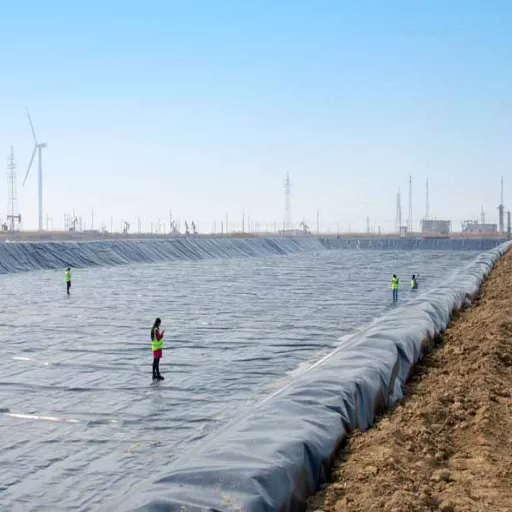
Even experienced engineers can make errors when selecting geomembrane thickness. Here are the most common pitfalls.
Under-Specifying to Save Budget
Choosing the minimum thickness to reduce upfront cost is tempting, especially on large projects. If the subgrade is rough or the loads are high, a thin liner may puncture during installation or early service. The cost of locating and repairing a leak usually exceeds the savings from the thinner material.
Over-Specifying Without Engineering Benefit
Thicker is not always better. A 2.0 mm liner in a small, well-protected pond adds cost and welding difficulty without meaningful performance improvement. Over-specification can also increase thermal expansion stress and make field seaming less reliable.
Ignoring Core Thickness for Textured Liners
Specifying a 1.5 mm textured liner without clarifying core thickness can lead to disputes. If the 1.5 mm includes texture height, the structural section may be significantly less. Always state core thickness requirements in the project specification and verify with mill test reports.
Neglecting Subgrade Preparation
A thicker liner cannot compensate for a poorly prepared subgrade. Sharp stones, hard clods, and debris will puncture even 2.0 mm HDPE if they are large enough and loaded heavily enough. Subgrade preparation and geotextile protection are often more cost-effective than simply increasing thickness.
Step-by-Step Thickness Selection Checklist
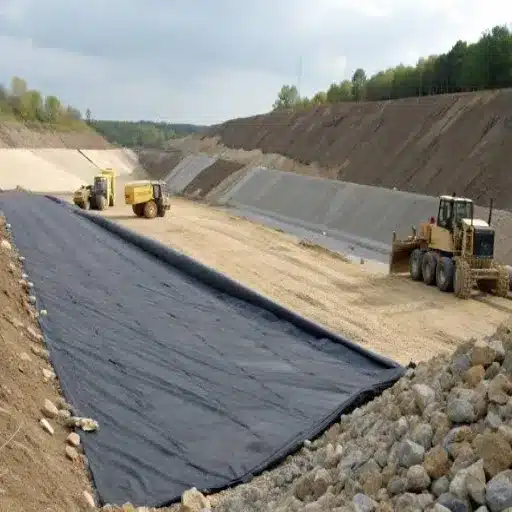
Use this framework to move from an initial guess to a defensible specification.
Step 1: Define Containment Chemistry
Identify the liquids or gases the liner will contain. Water and mild effluent allow thinner sections. Acids, alkalis, hydrocarbons, and aggressive leachate favor thicker HDPE.
Step 2: Evaluate Subgrade and Loads
Assess the subgrade condition, expected traffic, overburden height, and settlement potential. Rough or loaded conditions require either thicker liners or protective geotextile layers.
Step 3: Confirm Regulatory and Project Specifications
Check local regulations, owner requirements, and project specifications for minimum thickness mandates. For municipal landfills, 1.5 mm HDPE is often the regulatory floor.
Step 4: Compare HDPE vs. LLDPE Options
HDPE offers higher strength and chemical resistance. LLDPE offers better flexibility and conformance. The right material affects the thickness choice because the two polymers perform differently at the same gauge.
Step 5: Calculate Total Cost of Ownership
Include material, freight, installation, supervision, testing, and expected service life. The lowest material price does not always produce the lowest project cost.
Real-World Thickness Scenarios
Municipal Landfill in Southeast Asia
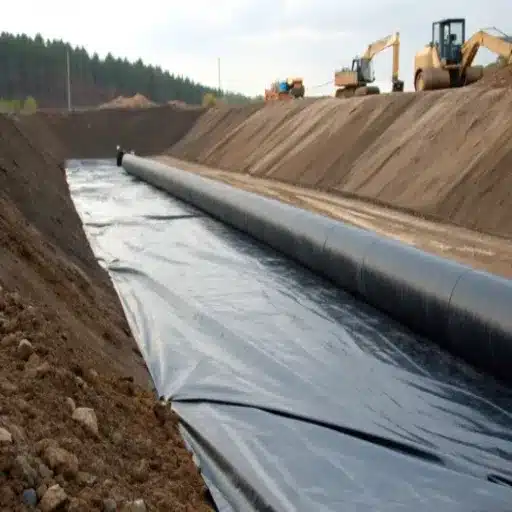
In 2021, an environmental contractor specified 1.5 mm smooth HDPE for the base liner and 2.0 mm textured HDPE for the side slopes of a municipal landfill. The base was well compacted, so 1.5 mm met regulatory requirements. The slopes were steep, so the textured liner provided the friction angle needed for stability. Third-party destructive testing confirmed seam quality, and the liner has recorded zero leaks after five years.
Aquaculture Pond in Uneven Terrain
In 2022, a fish farm in East Africa considered 1.0 mm HDPE for a series of ponds. The natural terrain was uneven and stony. The supplier recommended 0.75 mm LLDPE with a 300 g/m² nonwoven geotextile cushion. The thinner, more flexible liner conformed to the terrain, and the geotextile protected against puncture. The combined cost was lower than 1.0 mm HDPE alone, and installation finished ahead of schedule.
Mining Heap Leach Pad in South America
In 2023, a mining engineer selected 2.0 mm HDPE for a heap leach pad after rejecting 1.5 mm. The subgrade was coarse, the ore load was high, and the design life was 30 years. Puncture analysis showed that 1.5 mm provided insufficient factor of safety under the expected loading. The 2.0 mm liner added material cost but eliminated the risk of puncture-related solution loss.
Sourcing Geomembrane by Thickness Globally
For international buyers, thickness selection affects logistics as well as performance.
Roll Dimensions and Weight by Thickness
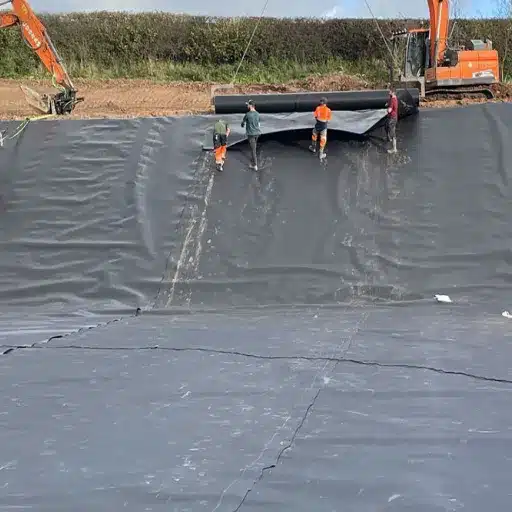
HDPE and LLDPE geomembrane are typically supplied in rolls 4–10 meters wide and 50–200 meters long. Roll weight increases directly with thickness. A 7 m × 100 m roll of 1.5 mm HDPE weighs roughly 1,575 kg, while the same roll in 2.0 mm weighs roughly 2,100 kg. Confirm roll weights and diameters before shipment to ensure handling equipment is adequate.
Order Volume and Freight Considerations
Large orders can reduce unit material costs by 10–20% or more. However, thicker liners reduce the number of square meters per container, which can raise freight cost per m². Balance order volume, thickness, and shipping logistics when preparing a budget.
Factory Certification and QA Testing
Look for suppliers with ISO9001 quality management certification. Confirm that the geomembrane is produced from virgin resin with 2–3% carbon black. Request mill test reports that include thickness measurements per ASTM D5199 or D5994, tensile properties per ASTM D6693, and puncture resistance per ASTM D4833.
When to Request Technical Consultation
If you are unsure about the right thickness, request technical consultation early. A qualified supplier can review your subgrade conditions, chemical exposure, design life, and regulatory requirements to recommend the appropriate material and thickness.
Ready to specify the right thickness? Contact our engineering support team for a technical quote or product recommendation.
Frequently Asked Questions
What is the standard thickness of HDPE geomembrane?
HDPE geomembrane is commonly supplied in thicknesses from 0.5 mm to 3.0 mm. For municipal solid waste landfill liners, 1.5 mm is the most widely specified minimum. Mining and hazardous waste applications often use 2.0 mm or more.
How thick should a pond liner geomembrane be?
Pond liners typically range from 0.5 mm to 1.5 mm. Small decorative ponds may use 0.5 mm, fish ponds 0.5–0.75 mm, and larger reservoirs 1.0–1.5 mm. A geotextile cushion can reduce the required thickness on rough ground.
What is 60 mil HDPE geomembrane in mm?
60 mil HDPE geomembrane equals approximately 1.5 mm. This is the most common thickness specified for municipal landfill liners.
Is thicker geomembrane always better?
No. Thicker geomembranes offer higher puncture resistance and durability, but they also cost more, weigh more, and can be harder to weld. The right thickness matches the application, subgrade, loads, and design life.
What thickness HDPE geomembrane for landfill liner?
Municipal solid waste landfill base liners typically require 1.5–2.0 mm HDPE. Hazardous waste landfills may require 2.0–2.5 mm. Side slopes often use textured HDPE to improve friction.
How does textured geomembrane thickness work?
Textured geomembranes have a nominal thickness that includes surface asperities and a core thickness that measures the structural section between asperities. Core thickness is the value that matters for strength calculations and should be specified in project documents.
Conclusion
Geomembrane thickness is an engineering decision, not a guess. The right thickness balances puncture resistance, tensile strength, chemical exposure, installation practicality, and total cost of ownership. Ponds and reservoirs often perform well with 0.5–1.5 mm. Landfill liners typically need 1.5–2.0 mm. Mining and hazardous waste applications may require 2.0–3.0 mm.
The best specification starts with the application, then adds site-specific factors: subgrade quality, loads, chemistry, slope stability, climate, and design life. A thicker liner is not always better, and a thinner liner is not always cheaper when lifecycle risk is included.
Shanxi Shengxing manufactures and supplies HDPE and LLDPE geomembranes in thicknesses from 0.5 mm to 3.0 mm, with options for smooth, textured, and factory-fabricated panels. We support global infrastructure and environmental projects with technical consultation, certified quality control, and export logistics.
Need help selecting geomembrane thickness? Request a technical quote or explore our geomembrane selection guide to get started.