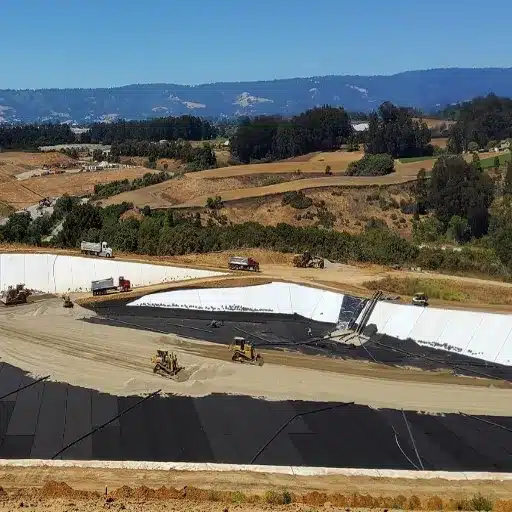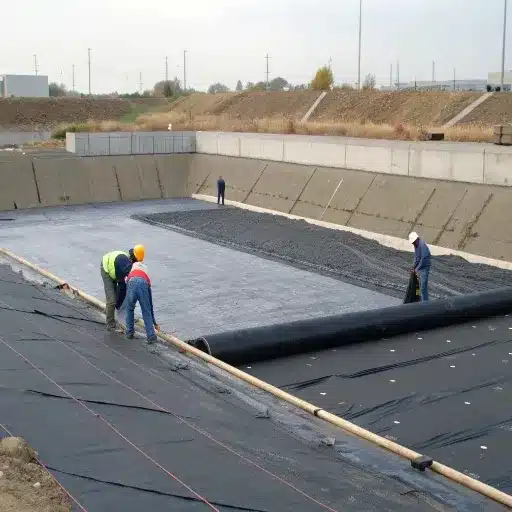
Yes, you can use woven and nonwoven geotextiles together, and engineers do it on real projects every day. The two fabrics solve opposite problems: woven geotextile carries load, while nonwoven geotextile filters and drains water. When a structure needs both jobs done at once, contractors either lay the two fabrics as separate layers in one structure, or they specify a needle-punched composite that bonds both fabrics into a single product.
Most buying guides force a one-or-the-other choice. That misses how the geotextile industry actually works. On soft subgrades, retaining walls, riprap slopes, and embankments, the two fabric families are regularly combined because neither alone can do everything the structure demands.
By the end of this guide you’ll know the three ways to use woven and nonwoven geotextiles together, which fabric goes on top and why, and when a single fabric is the smarter call. You’ll also see real project examples where combining both saved money or prevented failure.
Key Takeaways
- Yes, they work together. Woven geotextile carries load; nonwoven geotextile filters and drains. Combining them covers both functions in one structure.
- There are 3 ways to combine: separate layered rolls, needle-punched composite fabrics, and sandwich assemblies that add a geogrid or geonet.
- Layer by function, not by a fixed rule. Put the strength layer at the load interface and the filter layer at the soil-water interface.
- The combination solves real failure modes: woven fabric can blind with fines, and nonwoven fabric can have oversized openings called light spots. Together they fix both.
- Don’t over-engineer. French drains and most driveways need one fabric. Add a second layer only when the structure needs reinforcement plus filtration.
The Short Answer: Can You Use Woven and Nonwoven Geotextile Together?
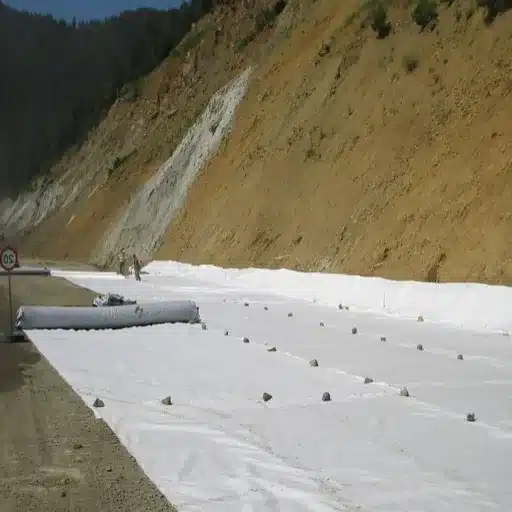
Yes. Woven and nonwoven geotextiles are routinely used together in layered systems. The woven layer provides tensile strength, separation, and reinforcement. The nonwoven layer provides filtration, drainage, and puncture protection. Engineers combine them as separate rolls or as a needle-punched composite fabric when a project needs load support and water management in the same cross-section.
The division of labor is straightforward:
- Woven geotextile is made from yarns interlaced on a loom. It has high tensile strength, low elongation (5-25%), and a tight, grid-like structure. Its job is reinforcement and separation.
- Nonwoven geotextile is made from randomly oriented fibers needle-punched into a felt-like mat. It has high permeability and elongation above 50%. Its job is filtration, drainage, and cushioning.
| Property | Woven Geotextile | Nonwoven Geotextile |
|---|---|---|
| Primary job | Reinforcement, separation | Filtration, drainage, cushioning |
| Tensile strength | High | Lower |
| Elongation at break | 5-25% | 50%+ |
| Permeability | Low | High |
| Best for | Load-bearing, stabilization | Water management, erosion control |
When you stack them, the woven layer spreads the load while the nonwoven layer manages water. That’s the whole argument for using both. For a full side-by-side comparison of the two fabric families, our woven vs nonwoven geotextile guide covers the properties, standards, and decision framework in detail. Not sure which combination fits your soil and loads? Send us your project details and our engineering team will recommend the right fabric pairing.
3 Ways to Use Woven and Nonwoven Geotextile Together
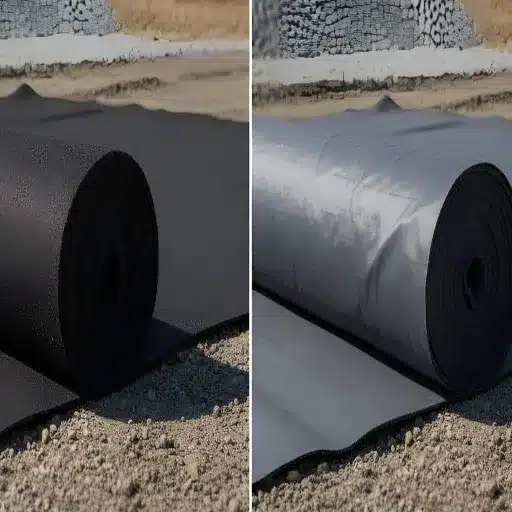
Engineers combine the two fabrics in three distinct ways. Each has its own installation and cost profile.
1. Separate Layered Rolls
This is the most common method. You place two different fabrics at different points in one structure, each doing its own job.
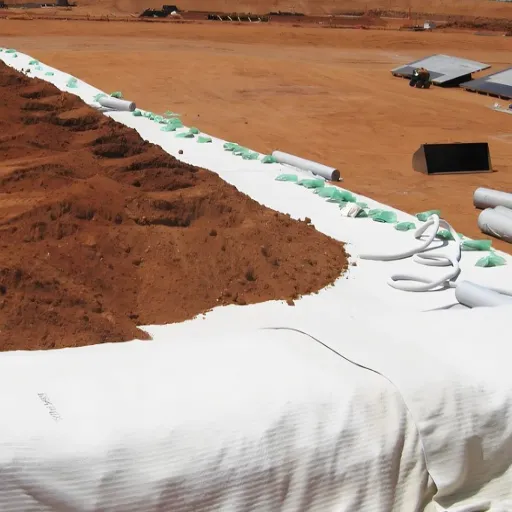
A typical road base on soft ground uses this approach: a nonwoven needle-punched geotextile goes directly on the subgrade to filter and separate, and a woven reinforcement layer goes above it to carry the aggregate and spread the load. No bonding is needed. You simply overlap, seam, and backfill according to each fabric’s installation rules.
2. Needle-Punched Composite Fabrics
Manufacturers also bond the two fabrics into one product. A nonwoven layer is needle-punched through a woven layer so that nonwoven fibers project through the woven fabric and form a fuzzy surface on the other side. The result is an integral two-layer filter that you install in a single pass.
This hybrid design fixes a specific engineering problem. Nonwoven manufacture can leave small oversized openings, called light spots, that control how well the fabric filters. The woven layer’s tighter, more uniform openings compensate for them. At the same time, the nonwoven’s three-dimensional fiber structure prevents the woven layer from blinding with fines.
3. Sandwich and Geocomposite Assemblies
The third approach builds a multi-layer assembly. A common design is nonwoven, then woven (or geogrid), then nonwoven again. The woven or geogrid core adds tensile strength and low deformation, while the two nonwoven faces provide filtration and separation on both sides.
Manufacturers sell ready-made versions of this, such as a geogrid reinforced nonwoven geotextile or a nonwoven plus geonet drainage composite. These products install in one operation and replace two or three separate layers.
Why Combining Works: The Engineering Rationale
The combination is not about convenience. It solves two real failure modes that occur when you use either fabric alone in a demanding application.
Woven Fabric Can Blind With Fines
A woven filter has only a limited number of openings per unit area. Fine soil particles can accumulate at any single opening and block the flow of water. This is called surface blinding. Once the woven layer blinds, drainage stops and the system fails.
The nonwoven layer prevents this. Its random, three-dimensional fiber structure has 80-90% porosity. Fines are retained within the fiber mesh, and water always finds a path between fibers. An impermeable mud cake cannot easily form on its surface.
Nonwoven Fabric Can Have Light Spots
Nonwoven manufacture occasionally produces small areas with larger openings than the rest of the sheet. These light spots control the ultimate filtration performance because the largest openings determine which particle sizes pass through.
The woven layer’s consistent, uniform openings compensate for those light spots. Laboratory work on composite filtration and drainage systems documents this pairing: the woven substrate provides mechanical support and stable pore structure, while the nonwoven provides high retention and resistance to clogging.
The Two Layers Protect Each Other
There is also a mechanical benefit. The nonwoven layer cushions the woven fabric against puncture during construction, especially when angular aggregate is placed by machinery. And the woven layer’s high tensile modulus keeps the structure stable, which prevents tensile strain from enlarging the nonwoven’s pores over time.
Performance tests on hybrid geotextiles for fly-ash dewatering show the results. A needle-punched nonwoven and woven composite cut piping to roughly 1,444 g/m² versus 2,651 g/m² for a plain woven fabric, and it improved dewatering efficiency while keeping filtration retention above 99%. The two layers genuinely outperform either one alone.
Which Fabric Goes on Top? Layering Order Rules
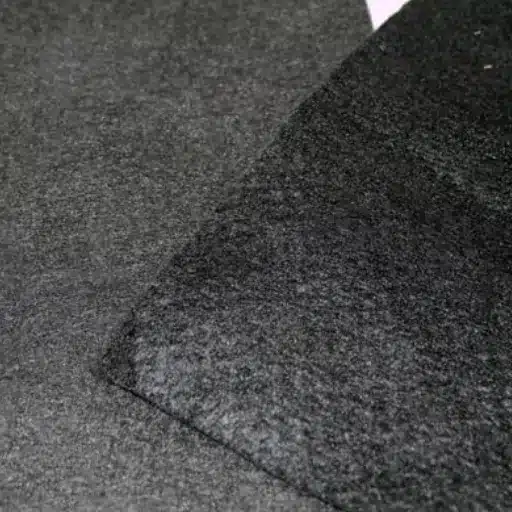
No fixed rule says woven always goes on the bottom. The correct order depends on the function each layer serves. Use this guiding principle: put the strength layer at the load interface, and put the filter layer at the soil-water interface.
Road Base: Nonwoven on Subgrade, Woven Above
On soft subgrade, lay the nonwoven geotextile directly on the soil first. It filters and separates, keeping subgrade fines out of the aggregate base. Place the woven reinforcement layer above it to carry the load and spread wheel loads over the soft ground. Woven geotextile over soft subgrade can reduce aggregate base thickness by 25-40%, which is why the pair is so common in road construction.
Retaining Wall: Woven in the Backfill, Nonwoven at the Drain
A reinforced retaining wall uses both fabrics at different points. Woven geotextile goes in as horizontal reinforcement layers embedded in the backfill, giving the wall tensile strength to resist lateral earth pressure. Nonwoven geotextile goes at the drainage stone and wraps the perforated drain pipe, filtering water and preventing hydrostatic pressure buildup. More than a third of highway retaining wall failures worldwide trace back to missing or inadequate drainage, so the nonwoven filter layer is not optional. Our woven vs nonwoven geotextile for retaining walls guide walks through the full layering setup.
Riprap and Slopes: Nonwoven Filter Under the Rock
For riprap erosion control, the nonwoven geotextile is the standard filter layer placed directly beneath the rock. It retains soil fines while letting water pass, and it drapes over irregular subgrade without leaving voids. Woven fabric is added only when the subgrade is too soft to carry the weight of the stone, in which case a high-strength woven layer goes below the nonwoven filter. Our woven vs nonwoven geotextile for erosion control guide covers the hydraulic-gradient selection in more depth.
Real Projects That Use Both Fabrics Together
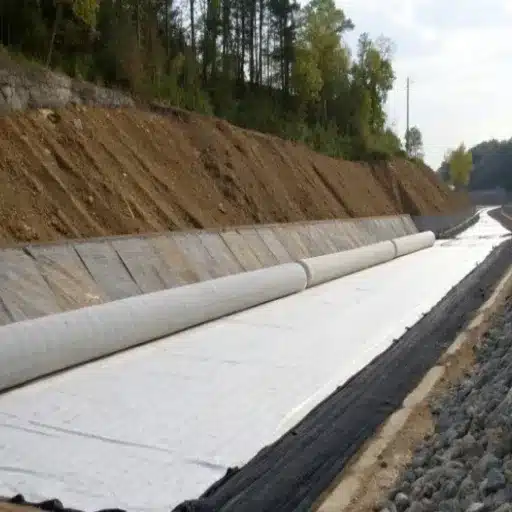
Here are three examples that show how the combined system performs in the field.
Soft-Ground Road Base in Southeast Asia
A road contractor in Southeast Asia was building a haul road over a saturated clay subgrade with a California Bearing Ratio below 1. The initial plan called for a single fabric, and the team debated which one. They settled on both: a nonwoven needle-punched geotextile on the subgrade for filtration and separation, and a woven reinforcement layer above it to carry the load. The result was roughly a 30% reduction in aggregate base thickness, and the road stayed serviceable through three monsoon seasons. The nonwoven stopped the fines from pumping up into the base, and the woven stopped the base from sinking into the clay.
Highway Retaining Wall
A geosynthetic-reinforced soil wall on a highway project used woven geotextile as internal reinforcement layers every 18 inches of backfill, and nonwoven geotextile wrapped the drainage pipe at the wall base and lined the drainage stone. The wall carried the traffic load through the woven layers, while the nonwoven kept the backfill fines out of the drainage system. The contractor avoided the single most common cause of wall failure, which is a clogged or missing drainage layer. The wall remained dry and stable through a full freeze-thaw winter.
Riprap on Peat at a Coastal Site
A coastal slope armoring project was placing riprap over deep, organic peat. A nonwoven filter under the rock was the correct start, but the geotechnical report flagged a risk of rotational slip because the peat could not carry the stone. The design added a high-strength woven geotextile below the nonwoven filter to reinforce the soft subgrade and span weak pockets. The nonwoven filtered, the woven reinforced, and the combined system held the slope through a storm season without failure.
Composite Products: When to Buy One Fabric That Does Both
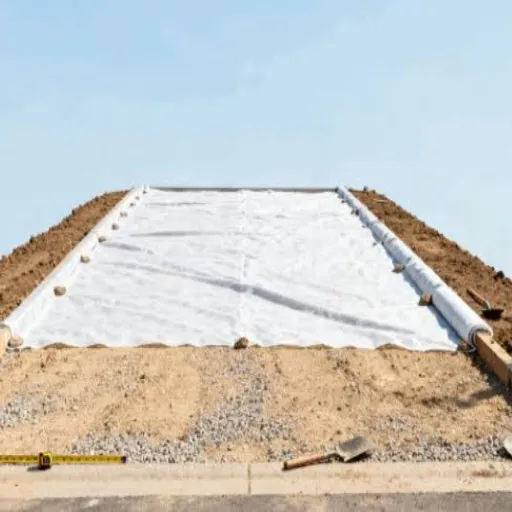
You don’t always need two separate rolls. Pre-bonded composite products combine the functions into one layer and cut installation time.
A needle-punched nonwoven and woven composite gives you reinforcement, separation, and filtration in a single fabric. A geogrid-reinforced nonwoven geotextile adds even higher tensile capacity, with biaxial strengths up to 75 kN/m in products like Huesker’s Basetrac Duo. A nonwoven plus geonet composite adds a drainage core for landfill and leachate applications.
Choose a composite when installation speed matters, when you want to minimize seams and overlap points, and when the layer thickness can stay thin. Choose separate layers when the two fabrics need different service lives, when you may need to replace one layer independently, or when a spec requires distinct certification for each function.
If you are comparing materials for a combined spec, our woven geotextile products and nonwoven geotextile products pages give the specification ranges for each fabric family. Need a bonded composite instead? Tell us the loads and drainage requirements, and we’ll match you to the right needle-punched fabric for a single-pass install.
When NOT to Use Both Together
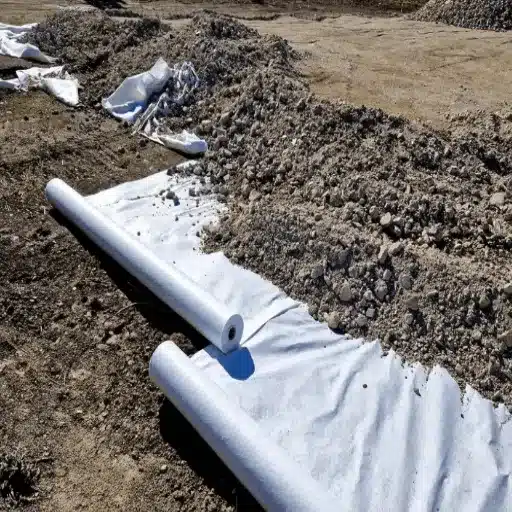
Combining fabrics is not always the right answer. A second layer adds cost, more seams, and more potential failure points. Use both only when the structure needs reinforcement plus filtration in the same cross-section.
Single-function jobs call for a single fabric:
- French drains need nonwoven geotextile alone in the 4-6 oz range. Woven fabric, especially landscape weed barrier, is a leading cause of drain clogging.
- Driveways and patios on decent subgrade usually need woven geotextile alone for separation and load distribution. The nonwoven filter layer adds nothing if there is no drainage concern.
- Simple erosion blankets on stable slopes may need only a nonwoven filter with no reinforcement layer at all.
More layers isn’t automatically better. Every additional layer introduces another seam to lap and another surface to protect from UV before backfill. Price the full installed system, not just the fabric, before you add a second product.
Frequently Asked Questions
Can you layer two different types of geotextile?
Yes. You can lay a nonwoven geotextile and a woven geotextile as separate layers in one structure, and each layer serves a different function.
Which geotextile goes on the bottom, woven or nonwoven?
It depends on the function. In a road base, the nonwoven goes on the subgrade for filtration and the woven goes above for reinforcement. In riprap, the nonwoven filter goes directly under the rock and the woven is added below only if the subgrade is too soft.
Do I need both woven and nonwoven geotextile for a retaining wall?
Most reinforced retaining walls use both. Woven geotextile goes in as internal reinforcement layers, and nonwoven geotextile filters the drainage stone and wraps the drain pipe.
What is a composite geotextile?
A composite geotextile bonds two or more geosynthetic layers into one product, such as a nonwoven filter layer needle-punched to a woven reinforcement layer, or a geogrid reinforced nonwoven.
Can I use geotextile and geogrid together?
Yes. Geogrid and geotextile are regularly combined, either as separate layers or as a bonded geocomposite, when a project needs high tensile reinforcement plus filtration and separation.
Conclusion
Woven and nonwoven geotextiles can absolutely be used together, and doing so is a standard engineering practice. The woven layer carries the load, and the nonwoven layer filters and drains. Together, they cover both functions that many structures need in the same cross-section.
The key takeaways: use woven for strength and separation, nonwoven for filtration and drainage, and combine them when the structure demands both. Layer by function, not by a fixed rule. Consider a needle-punched composite when installation speed matters, and skip the second fabric entirely for single-function jobs like French drains.
If you are specifying a layered system and need help matching the fabric grades, weights, and overlap details to your soil and loads, talk to our engineering support. We can provide technical consultation, product datasheets, and a tailored recommendation for combining woven and nonwoven geotextiles on your project. Request a technical quote today and we will help you build the right layered spec.