A biaxial geogrid carries balanced tensile strength in two directions and is the economical standard for roads, driveways, and parking areas. A triaxial geogrid uses triangular apertures to spread load uniformly through 360 degrees and earns its higher price on weak subgrades and heavy, multidirectional traffic. Choose biaxial for predictable, straight-line loads on moderate ground; choose triaxial when the load is heavy or the soil is soft and variable. This guide explains the geometry, the stiffness, the independent test data, and the cost math behind that decision.
Ask Tom, a site manager who priced a 2,000-square-meter access road over silty clay in 2025. The biaxial quote came in 18 percent cheaper per square meter than the triaxial alternative, and the material savings looked like the whole story. Then he ran the numbers both ways. On the biaxial design he needed a 450 mm aggregate section; on the triaxial design, the engineer allowed 300 mm based on repeated-load data. The aggregate he saved, plus the freight to move it, covered the grid premium twice over. He ordered triaxial, and the road carried loaded trucks through a wet spring without a rut.
Most buyers never run that comparison. Almost every article they find is written by a supplier who sells one type. The manufacturer that invented the triangular grid says triangular is always better. Independent sellers who stock only square-aperture grids say the shape is a marketing gimmick. This article takes neither side, because a neutral position is the only honest one when you sell both. You’ll finish knowing what the two grids actually are, how the geometry changes load behavior, what independent tests show, where each type wins, and how to compare total installed cost instead of roll price.
Key Takeaways
- Biaxial geogrid has square apertures and two-direction strength; triaxial geogrid has triangular apertures and near-uniform radial stiffness through a full 360 degrees.
- Triaxial tends to outperform biaxial under heavy, multidirectional traffic and weak subgrade, but the gap shrinks on light, straight-line loads where biaxial is usually the economical choice.
- In a full-scale study, a 406 mm aggregate base was reduced by 26 percent with biaxial geogrid and 45 percent with triaxial geogrid at equivalent rutting.
- Triaxial typically costs about 10 to 40 percent more per square meter, so the decision should rest on total installed cost including aggregate savings, not grid price alone.
- Neither biaxial nor triaxial is the right grid for a retaining wall, which needs uniaxial geogrid; and neither replaces a separator geotextile on soft clay.
What Is a Biaxial Geogrid?

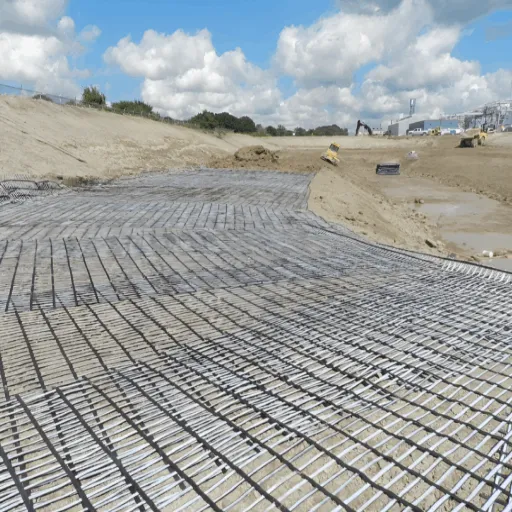
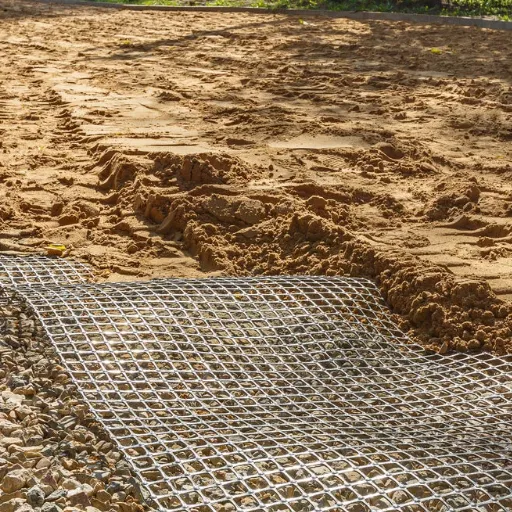
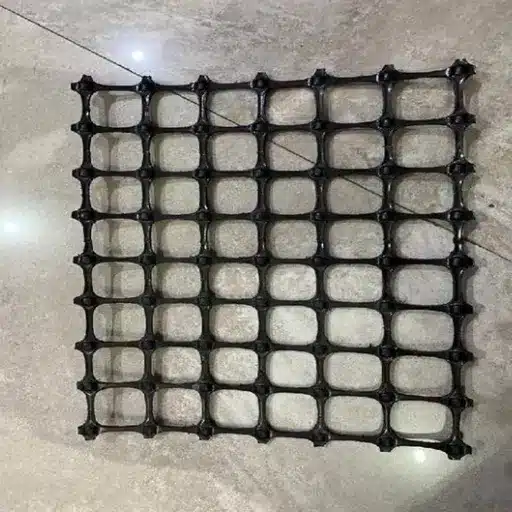
A biaxial geogrid is a polymer grid with square or rectangular apertures, oriented in two perpendicular directions so it carries roughly balanced tensile strength in both the machine and cross directions. It’s the workhorse reinforcement for horizontal stabilization and has been the standard since the late 1970s.
Biaxial grids are usually punched and drawn from polypropylene sheet, which aligns the polymer molecules along both rib directions and forms the junctions in one piece. Those integral junctions are what let the grid transfer load from soil into the ribs without tearing. A typical biaxial grade is specified as a pair of strength values, one for each direction, such as 20-20, 30-30, or 40-40 kN/m.
Representative biaxial grades help you calibrate a datasheet. A light 20 kN/m class grid commonly shows a 39 x 39 mm aperture and about 7 kN/m strength at 2 percent strain and 14 kN/m at 5 percent strain. A 40 kN/m grade tightens to a 33 x 33 mm aperture with roughly 14 kN/m at 2 percent strain. Carbon black content should be at least 2 percent so the grid survives UV exposure before it is covered, per ASTM D4218.
Because its strength sits in two axes, a biaxial grid is orthotropic: it is stiffest when load runs parallel to a rib and weakest when load comes at about 45 degrees to the roll. That matters at installation, which we cover later. If you are new to the material family, our complete geogrid guide to types and applications explains the full picture, including uniaxial and composite grids.
What Is a Triaxial Geogrid?

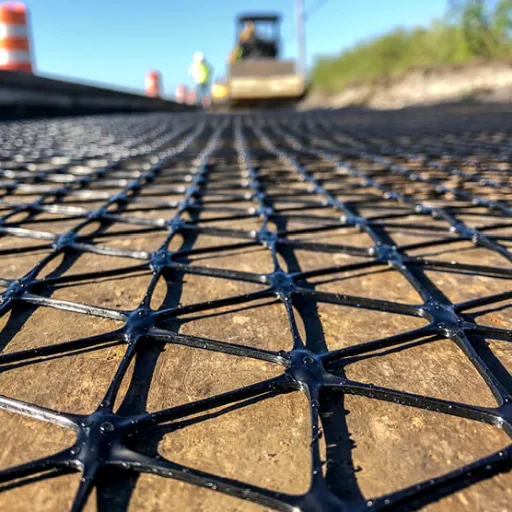
A triaxial geogrid is a polymer grid with triangular apertures, its ribs laid at 60 degrees so it provides near-uniform stiffness in all directions rather than two perpendicular axes. It’s a second-generation product, introduced commercially around 2007, and its stiffness is reported differently from a biaxial grid.
The key number for a triaxial grid is not ultimate tensile strength in two directions. It is the radial secant stiffness measured at low strain, because the grid must resist deformation as aggregate interlocks and loads spread. Published values for export PP triaxial grids typically run 200 to 540 kN/m at 0.5 percent strain, with junction efficiency between 93 and 100 percent. Rib pitch commonly lands between 35 and 40 mm, carbon black at 2 percent or more, and elongation around 13 percent.
The triangular structure is the point. A triangle is one of the most stable shapes in construction, and a field of triangles forms a hexagonal pattern that confines aggregate in every horizontal direction. Because the grid is drawn in three directions, its stiffness is close to isotropic, which is why manufacturers describe it as delivering strength through the full 360 degrees rather than along two ribs.
Triangular geometry alone is not the whole story. Stiffness, rib profile, and junction efficiency do as much of the work as the shape of the opening. That distinction matters when you compare two grids, and we look at the research behind it shortly. For the full reference on test methods and how to read a datasheet, our geogrid specifications and ASTM standards guide walks through every value.
Biaxial vs Triaxial Geogrid: Key Differences
The table below summarizes how the two grids compare. It is also a good template for checking a supplier’s datasheet side by side.
| Feature | Biaxial geogrid | Triaxial geogrid |
|---|---|---|
| Aperture shape | Square / rectangular | Triangular (60°) / hexagonal |
| Strength direction | Two (machine + cross) | Three axes, near-uniform 360° |
| Load distribution | Orthotropic (directional) | Near-isotropic |
| Key spec metric | Tensile strength MD + CD (kN/m) | Radial secant stiffness at 0.5% strain (kN/m) |
| Typical strength class | 20-20 to 50-50 kN/m (up to ~100) | Radial stiffness ~200 to 540 kN/m at 0.5% |
| Common aperture | 25 to 46 mm | Rib pitch ~35 to 40 mm |
| Junction efficiency | High (integral) | 93 to 100% |
| Orientation at install | Align with traffic direction | Orientation-insensitive |
| Typical applications | Roads, driveways, parking, subgrade | Heavy or multidirectional traffic, weak subgrade |
| Relative cost | Lower (baseline) | Roughly 10 to 40%+ premium per m² |
Two rows deserve emphasis. First, the two grids measure performance with different metrics, so you can’t compare an ultimate tensile strength against a radial stiffness number directly. Second, orientation: a biaxial grid must be laid so the load runs along its ribs, while a triaxial grid works the same regardless of how it is rolled out. That makes triaxial more forgiving on site, a real advantage under construction variability.
How the Geometry Changes Performance

To understand why a triangular grid behaves differently, you need the load path, not just the drawing.
Aggregate Interlock and Confinement
A geogrid does not reinforce by friction alone. Aggregate particles push into and are caught by the apertures, and the ribs confine them so the whole layer behaves like a stiffer composite. Interlock works best when the aperture is large enough for the aggregate to bite in, roughly 1.5 to 3 times the nominal aggregate size, and when the rib edges are deep and square so particles cannot slide over them. Both grid families rely on this mechanism; the difference is how completely the pattern confines movement in every direction.
The Load Spreads in a Cone, Not a Square
A wheel or axle load spreads downward through the aggregate as an inverted cone, so the stress that reaches the grid level is roughly circular, not square. A square aperture has ribs in two perpendicular directions, and it is weakest where the load acts between those axes. A triangular field of ribs responds to radial stress more evenly, which is why triaxial grids lock aggregate in place under loads arriving from any angle.
This is the physical basis for the marketing phrase you will read everywhere: the “snowshoe effect.” A high-stiffness grid keeps aggregate locked under the wheel, spreads the contact area over a wider footprint of soft subgrade, and reduces the vertical stress the soil must carry.
The 45-Degree Weak Spot
Because a biaxial grid is stiffest along its two rib axes, its weakest direction sits at about 45 degrees between them. On a straight road, traffic conveniently runs parallel to the roll, so that weak angle rarely matters. At an intersection, a roundabout, or a turning area, wheels load the grid from constantly changing angles, and the two-direction grid is caught off-axis more often. Triaxial geometry removes that weak spot entirely, which is why heavy-turning applications favor it.
Stiffness Matters as Much as Shape
Here’s the nuance most marketing skips. A 2025 three-dimensional discrete element study in the journal Geotechnique found that when geogrid stiffness and effective rib area were held constant, the shape and size of the openings had only a secondary influence on reinforced soil behavior. The practical conclusion: a high-stiffness biaxial grid can outperform a cheap, low-stiffness triaxial grid, and vice versa. Geometry tilts the field, but grade quality and correct specification decide most of the game.
Biaxial vs Triaxial Geogrid: What Independent Research Shows
The strongest case for triaxial shows up under real wheel loads. The strongest case for biaxial shows up in the cost column and in a few honest field trials. Both deserve airtime.
Where Triaxial Leads
Repeated-load and full-scale pavement studies consistently report larger gains with triaxial grids under trafficked aggregate layers.
- In repeated-load triaxial tests, a triaxial grid placed at one-third base depth reached a traffic benefit ratio (TBR) near 4.97, versus 2.45 for a biaxial grid of similar class. With two reinforcement layers, triaxial reached about 8.73 against 3.19 for biaxial.
- In a full-scale accelerated pavement test at the University of Nevada, Las Vegas, a 406 mm unreinforced base was reduced by 26 percent with biaxial geogrid and 45 percent with triaxial geogrid at the same rutting limit. On a 305 mm base the reductions were 29 and 36 percent. Traffic benefit ratios at a 6 mm rut depth reached 3 for biaxial and 7.5 for triaxial on the thicker section.
- Model bearing-capacity tests report roughly 31 percent improvement with triaxial against 22 percent with biaxial over an unreinforced structure. The two also failed differently: the biaxial-reinforced model slipped between the ballast and clay layers, while the triaxial-reinforced model failed only when the material itself gave way.
On soft subgrade and under heavy or turning traffic, that evidence is hard to argue with. Triaxial generally provides greater aggregate confinement and lower vertical stress on the subgrade.
Where Biaxial Holds Its Ground
The honest counterweight comes from trials and economics.
- Full-scale sections tested by Montana State University for the US Department of Transportation, and by the Technical University of Clausthal, found biaxial grids performing comparably to or better than triangular grids in some test sections. The widely used Giroud and Han design method was later recalibrated to use geogrid junction stiffness in the cross-machine direction as the governing property, rather than a geometry-based aperture stability value.
- The Minnesota Department of Transportation concluded that light-duty biaxial geogrids are among the most economical options for typical thin base sections and recommended placing them at the base of the aggregate layer.
- On light, predictable traffic with a moderate subgrade, the aggregate savings from a triaxial grid shrink, and the cheaper biaxial grade often wins on total cost.
The honest summary: triaxial tends to win on weak soils and heavy or multidirectional traffic, and the gap narrows or reverses on light, straight-line, well-supported sections.
Which Applications Favor Biaxial vs Triaxial Geogrid
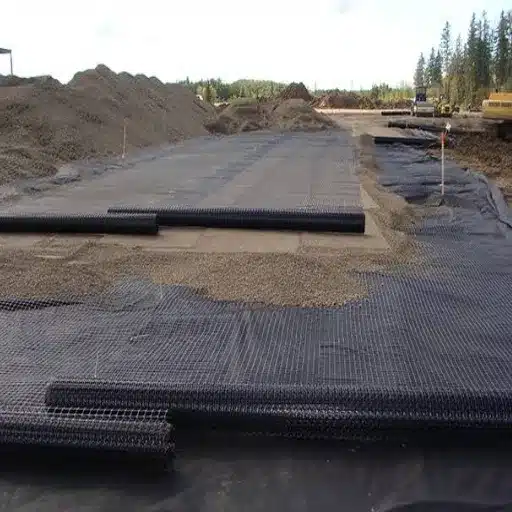
A simple rule of thumb captures most decisions: driveways, parking, and standard road bases lean biaxial; weak soils, frequent turning, and heavy vehicles lean triaxial. Here’s the application split in more detail.
Choose biaxial when:
- Traffic is light to moderate and runs in a dominant straight-line direction.
- The subgrade is stable to moderate, not saturated or variable.
- The project is a gravel driveway, low-volume road, parking lot, or large-area subgrade stabilization.
- The budget is tight and aggregate savings are modest.
- The section is thin, where light-duty biaxial is the documented economical option.
Choose triaxial when:
- The subgrade is soft, saturated, or variable in strength.
- Traffic is heavy, frequent, or multidirectional: intersections, roundabouts, turning areas, industrial yards, haul roads, and container terminals.
- The section is a permanent paved road carrying high equivalent single-axle loads.
- Maximizing aggregate reduction matters more than grid price.
- Construction variability is high, because triaxial needs no orientation control.
Placement matters as much as choice. Repeated-load studies found a grid at roughly one-third base depth outperformed one at half depth, and both types can sit between the subgrade and the base or within the base layer itself. Where the grid is installed and how much aggregate covers it changes the result more than most people expect.
Cost Comparison: Is the Triaxial Premium Worth It?
Material prices are only half the story, so start with the range and then add the aggregate math.
Factory-direct biaxial geogrid typically runs USD 0.10 to 1.50 per square meter depending on grade and volume. Triaxial runs roughly USD 0.12 to 2.00 per square meter. At comparable light grades the premium is often 10 to 20 percent; at the low end of the market the gap can approach double, and in a documented retail comparison a biaxial grade cost about 39 percent less than a triaxial grade of similar class.
A higher grid price can still produce a cheaper road. Because the grid lets you cut aggregate thickness, the saving is often far larger than the grid itself. In the UNLV full-scale test, a 406 mm base dropped to equivalent performance at a 26 percent reduction with biaxial and a 45 percent reduction with triaxial. Manufacturer-reported case studies show the pattern in dollar terms: a heavy-vehicle access road over 9.5 miles saved an estimated USD 1.2 million in aggregate and installation cost, and a UK housing access road saved about GBP 64,000 while using a third less imported fill. One published example put the trade at a 12 percent higher initial grid cost against a 37 percent lower life-cycle cost for the reinforced section.
Work the comparison as total installed cost, not roll price:
- Estimate the required aggregate thickness with no reinforcement, with biaxial, and with triaxial for your subgrade strength and traffic.
- Price the aggregate, delivery, and placement for each scenario.
- Add the grid cost for each option.
- Compare the totals, then add a maintenance allowance for the design life.
When the aggregate savings are small, on firm ground with light traffic, the triaxial premium buys little and biaxial is the right call. When the soil is soft and the loads are heavy, the aggregate saving usually swamps the grid premium. The challenge is that most buyers are quoted a grid price without an aggregate thickness comparison. Our team can run that comparison for your site and supply both grid families, which is why the advice here is not tied to a single product.
Biaxial vs Triaxial Geogrid Installation: What’s Different?
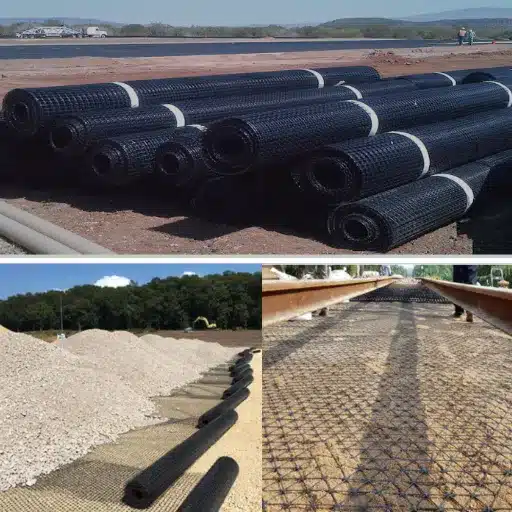
The two grids install the same way, with one critical difference in orientation.
Orientation. Roll a biaxial grid so the machine direction runs parallel to the traffic, which lets wheel loads engage both rib directions. If you install it at an angle, you cut the effective reinforcement and may need a heavier grade to compensate. A triaxial grid has no weak axis, so you can’t orient it wrong, a genuine advantage on a busy site where crews lay grid fast.
Common sequence. Both types follow the same field protocol: prepare and lightly grade the subgrade, roll the grid taut and remove wrinkles, lap adjacent sheets by the designed overlap (typically 300 to 500 mm, or wider on soft subgrade), pin or stake the edges, and place a minimum aggregate cover, usually 150 mm, before any equipment crosses the grid. Compact in thin lifts and keep the grid covered quickly to limit UV exposure.
QC on delivery. Verify the Minimum Average Roll Value test report matches the grade you specified, confirm the junction efficiency value, and check carbon black at 2 percent or more. A grid that looks identical can perform very differently if the polymer or junction quality differs.
When Biaxial or Triaxial Is the Wrong Choice
The most useful advice in this article is also the least promotional: know when not to use either grid.
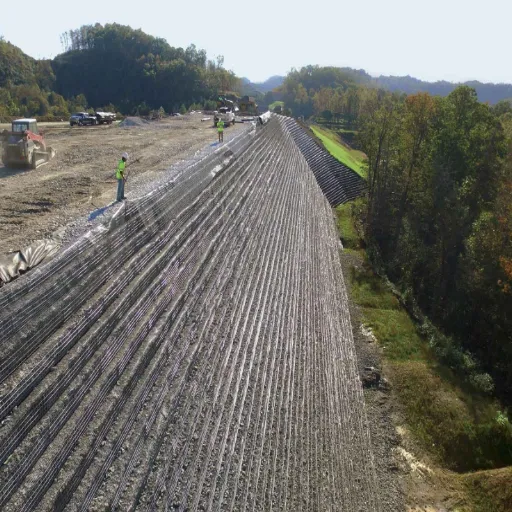
Do not use triaxial or biaxial for a retaining wall. A wall loads reinforcement in one direction, along the plane pulling the face away from the backfill. That’s uniaxial work, and a triangular or two-direction stabilization grid spends polymer on directions the wall never loads. Specify uniaxial geogrid for retaining and MSE walls, where creep resistance and one-direction strength are the governing properties.
Do not expect a geogrid to separate or filter. On soft clay, a geogrid confines aggregate but does not stop fine soil from pumping up into it. That needs a woven geotextile separator beneath or between layers, a distinction our geogrid vs geotextile coverage explains in full.
Do not buy triaxial for a light driveway on firm ground. The aggregate saving will not exist, so the premium is wasted. A standard biaxial grade is the economical call, and on very firm ground with light traffic you may not need a grid at all.
Do not buy a light biaxial grid for a heavy highway or a heavily turning yard. That is the classic under-specification, and it shows up as rutting within the first traffic season. If the load is heavy and multidirectional, the design belongs on a triaxial or higher-grade system.
Frequently Asked Questions
What is the difference between biaxial and triaxial geogrid?
A biaxial geogrid has square apertures and balanced strength in two perpendicular directions. A triaxial geogrid has triangular apertures laid at 60 degrees and provides near-uniform stiffness in all directions, reported as radial secant stiffness at low strain.
Is triaxial geogrid better than biaxial?
Under heavy, multidirectional traffic and on soft subgrade, triaxial generally outperforms biaxial in confinement and aggregate savings. On light, straight-line traffic with moderate subgrade, the difference narrows and biaxial is usually the economical choice.
When should I use triaxial geogrid instead of biaxial?
Choose triaxial for soft or variable subgrade, heavy traffic, and areas with frequent turning or braking such as intersections, industrial yards, haul roads, and container terminals. Choose biaxial for driveways, parking, and standard road bases.
Can I use triaxial geogrid for a retaining wall?
No. Retaining and MSE walls need uniaxial geogrid, which has high one-direction strength and creep resistance under sustained load. A triaxial stabilization grid is not an efficient wall reinforcement.
Does triaxial geogrid reduce aggregate thickness?
Yes. In full-scale testing a 406 mm base was reduced by 45 percent with triaxial geogrid versus 26 percent with biaxial at equivalent rutting. The saving shrinks on firm ground and light traffic.
Is a triaxial geogrid worth the extra cost?
It is when the aggregate saved covers the roughly 10 to 40 percent grid premium, which happens on soft subgrade and heavy loads. On light, predictable traffic, biaxial is usually the better value. Compare total installed cost, not grid price.
Conclusion
The biaxial vs triaxial geogrid decision is an engineering trade, not a loyalty test. Biaxial geogrid offers two-direction strength at the lowest cost and is the right default for driveways, parking, and standard road bases with predictable traffic. Triaxial geogrid spreads load uniformly in all directions, needs no orientation control, and earns its premium on weak subgrade and heavy or turning loads, where the aggregate it saves usually outweighs the extra grid cost.
Get the specification right and the rest follows: confirm the radial stiffness or two-direction strength you actually need, check junction efficiency and carbon black on the test report, install at the right depth with the right cover, and compare total installed cost instead of price per roll.
If you are weighing a biaxial or triaxial geogrid for a specific site, our engineering team at Shanxi Shengxing supplies both export-ready PP families and will help you run the aggregate-thickness comparison before you commit. Tell us your subgrade conditions, traffic, and section design, and we will recommend the grade that fits. Request a technical quote, or work through our how to choose a geogrid selection framework first.