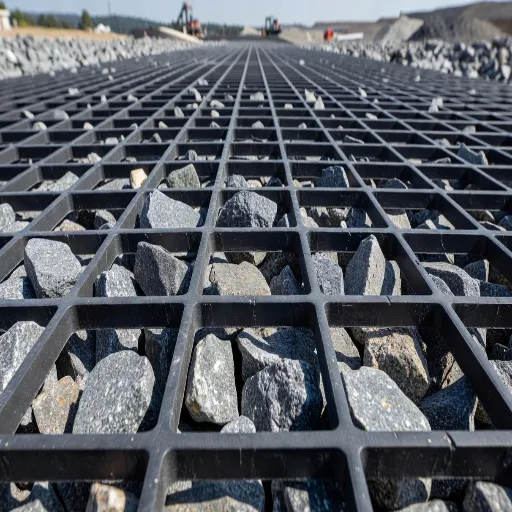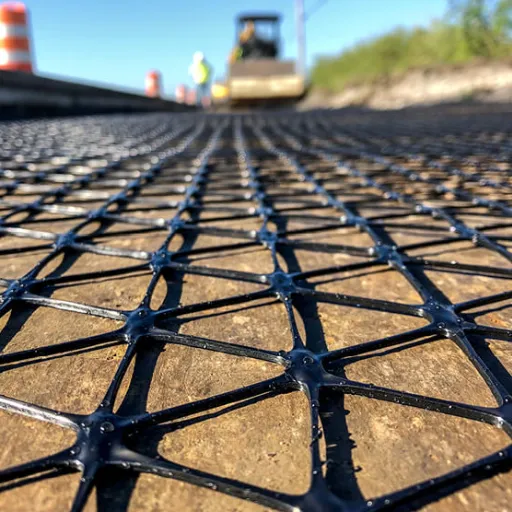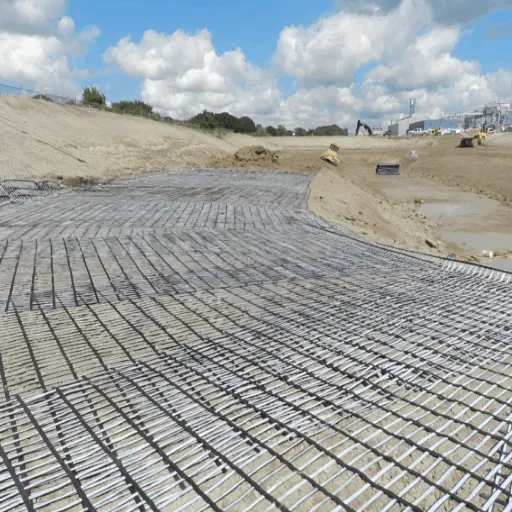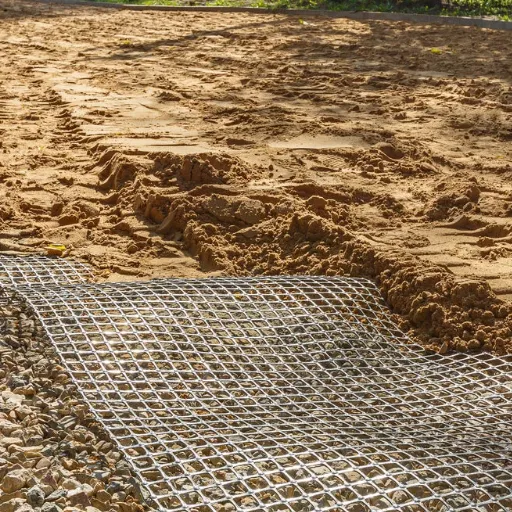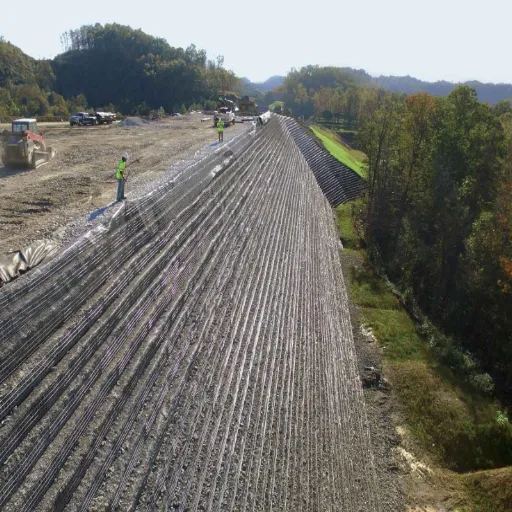
Geogrid aperture size is the clear opening between adjacent ribs. Match it to your aggregate gradation so the fill falls between D50 and 2 times D85 of the stone. For a typical graded base course, the working band narrows to roughly 12 to 24 mm. A standard 25 by 33 mm biaxial grid sits just above it and is usually the practical choice, because few products are manufactured smaller.
Two grids can carry the same 30 kN/m label and still behave nothing alike in the ground. One has 33 mm openings. The other has 38 mm. That 5 mm difference decides whether your stone locks into the ribs or slides past them.
Most buyers never check it. They compare tensile strength, pick the cheaper quote, and find out months later when the base starts rutting.
This guide gives you the actual numbers: the four published sizing rules and when each applies, the typical aperture for every grid type, real datasheet values, and a five-step procedure that turns a sieve analysis into a specification. If you’re new to the material, start with our geogrid soil reinforcement guide and come back here for the sizing detail.
Key Takeaways
- Aperture is definitional, not incidental. ASTM D4439 defines a geogrid as having apertures greater than 6.4 mm specifically to allow interlocking.
- The Holtz criterion is the pass/fail gate most agencies use: fill gradation should fall between D50 and 2 times D85.
- Too small and too large are both failures. Aggregate bridges over an undersized opening and falls through an oversized one.
- Aperture alone doesn’t define a grid. SKAPS BX1100 and BX1200 share the same 25 by 33 mm opening but differ by 100% in aperture stability modulus.
- Within one product family, aperture shrinks as tensile grade rises, because heavier ribs take up more of the sheet.
Already have a grid and a gradation? Send both to our engineers and we’ll tell you whether the pair matches before you place an order.
What Is Geogrid Aperture Size?
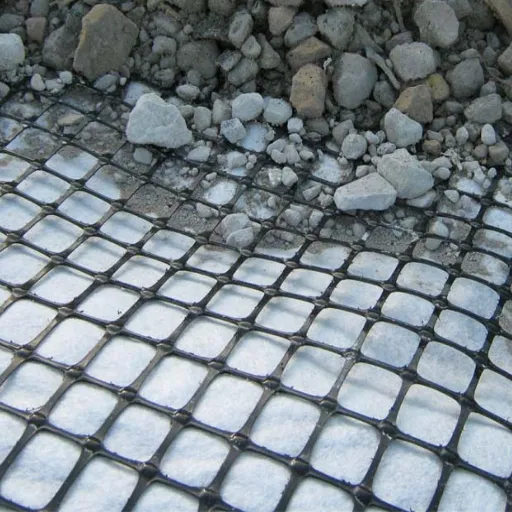
Geogrid aperture size is the clear opening between adjacent ribs, measured across the shortest dimension of the opening in millimetres. Biaxial grids typically run 25 to 40 mm, triaxial grids 66 to 120 mm, and uniaxial grids 12 to 50 mm.
Aperture is part of the definition. ASTM D4439 describes a geogrid as a regular network of connected elements with apertures greater than 6.4 mm, sized to let soil, rock, and aggregate interlock through them. Below that threshold you’re looking at a geotextile, not a grid.
Three different numbers get confused on datasheets, so keep them separate:
- Aperture is the clear opening, the gap the aggregate actually passes through.
- Rib pitch is the centre-to-centre distance between ribs, which equals the aperture plus one rib width.
- Geogrid mesh size is a marketplace term, usually a rounded square dimension like 25.4 by 25.4 mm or 40 by 40 mm, sometimes measured to rib centres instead of clear opening.
The Tenax 3D-LT shows why the distinction matters. It has a rib pitch of 33 mm and a mid-rib width of 3.3 mm in the machine direction, so the clear opening is meaningfully smaller than the pitch. A datasheet quoting “33 mm” could mean either number.
Rectangular apertures need measuring in both directions. SKAPS BX1200 lists 25 mm in the machine direction and 33 mm across it, and the tighter dimension governs interlock in that direction.
Not sure which number on your datasheet is the aperture? Send it to our engineers and we’ll read it with you.
Why Aperture Decides Whether a Geogrid Works At All
Aggregate particles drop into the apertures during placement and compaction. Under load they bear against the rib faces, and the grid restrains them from spreading. As a result, the layer stops behaving like loose stone and starts behaving like a stiff composite.
Aperture is the gate on that mechanism. Ribs carry tensile load, but they only receive load if aggregate is locked into the openings. Get the aperture wrong and the strongest grid in the catalogue acts like a flat sheet.
Three load-transfer paths exist, and aperture governs each differently. Interlock through the opening is the strongest. Passive bearing on the transverse ribs comes next and depends on rib depth as well as aperture. Skin friction is weakest, and it’s the only path left when the aperture is mismatched.
That’s why rib geometry belongs next to aperture on your comparison sheet. Tensar’s technical resources concede that rib height, width, aspect ratio, and material all influence interlock alongside opening size. The literature also suggests interlocking becomes significant when the rib-thickness-to-mean-grain-size ratio is small, roughly below 3.
For the full mechanism, our guide to how does geogrid work walks through it from particle scale to layer scale.
The Four Aperture-Sizing Rules, and When Each Applies
Four published rules govern geogrid aperture size, and they don’t agree. Most guides stop short of saying so. They aren’t competing answers to one question. They answer four different questions.
| Rule | Criterion | Basis | Applies to |
|---|---|---|---|
| Holtz et al. (2008) | Fill gradation between D50 and 2 times D85 | Pavement base retention | Aggregate base under roads, the criterion most agencies apply |
| A/D50 optimum | A/D50 of about 1.2 | Large-scale direct shear on ballast | Railway ballast and coarse single-sized fill |
| Industry working rule | Aperture 1.5 to 3 times D50 | Field practice | General stabilization, fastest sanity check |
| Mean-particle rule | Aperture about 2 times mean particle size | Secondary guidance | Rough estimate when only D50 is known |
The disagreement comes from three sources. First, the rules use different descriptors, some D50, some D85, some Dmax. Second, they were derived for different fills, well-graded base versus single-sized ballast. Third, they use different failure criteria.
The ballast research is the clearest evidence that an optimum exists rather than just a minimum. Large-scale direct shear tests at the University of Wollongong divided the A/D50 ratio, aperture divided by D50, into three zones: feeble interlock, optimum interlock, and diminishing interlock. The best aperture for interface shear strength came out at 1.20 times D50, as reported in Geotechnical News. Oversizing is a real failure mode.
Where the rules agree
Take a typical graded aggregate base with D50 of 8 mm and D85 of 20 mm. Holtz gives a band of 8 to 40 mm, the industry rule gives 12 to 24 mm, and the mean-particle rule suggests about 16 mm.
The overlap is roughly 12 to 24 mm. A standard 25 by 33 mm biaxial grid sits just above that band. That is why the Georgia Department of Transportation checked gradation against aperture before selecting BX1200, applying the Holtz criterion directly in their research report.
Use Holtz as the pass/fail gate. It’s the most permissive rule and the one agencies cite. Then use the industry rule to choose within the passing band. If the two don’t overlap, your gradation and your grid are mismatched.
These are screening criteria, not design. On high-consequence work, confirm the grid and fill pair with interface shear testing to ASTM D5321 or pullout testing to ASTM D6706.
What Happens When Geogrid Aperture Size Is Wrong

Geogrid aperture size fails in two directions, and both are expensive.
Too small. The opening is narrower than the aggregate, so particles bridge across it instead of penetrating. Interlock becomes friction-dominated, and friction is the weakest load-transfer path a grid has. You paid for reinforcement and got separation. On fine-grained or saturated subgrades, fines can also pump and clog the openings.
Too large. The opening is much wider than the aggregate, so stone passes through or sits on top rather than seating against the ribs. Passive bearing is lost, the grid acts as a smooth plane inside the layer, and the predicted aggregate savings never appear.
Tomas found this the expensive way. He was running a 4,000 square metre hardstand project outside Antofagasta in early 2025, and he specified a 40 kN/m biaxial grid because the tensile number looked stronger than the alternative.
The local stone was a 20 mm crushed material with a D50 near 9 mm, so the 40 mm openings were more than four times the mean particle size. Stone dropped through during spreading, and the platform rutted within six weeks of first plant traffic.
Replacing the layer with a 25 by 33 mm grid and the same stone fixed it. The second grid cost less per square metre than the first.
Typical Geogrid Aperture Sizes by Grid Type
| Grid type | Polymer | Typical aperture | Rib pitch | Notes |
|---|---|---|---|---|
| Biaxial, punched and drawn | PP | 25 to 40 mm | 33 to 39 mm | Square or rectangular, machine direction often tighter |
| Biaxial, extruded or welded | PP, HDPE | 30 to 65 mm | Varies | Export catalogues commonly list 12.7, 25.4, 40, and 65 mm |
| Triaxial | PP | 66 to 120 mm | Hexagon pitch 35 to 120 mm | Triangular openings, near-isotropic stiffness |
| Multiaxial | PP | Mixed geometries | 80 mm on some products | Several aperture shapes in one sheet |
| Uniaxial | PP, HDPE, PET | 12 to 50 mm | Elongated rectangular | Strength concentrated in one direction |
| Warp-knitted PET | PET, PVC coated | 12 to 50 mm | Varies | Higher creep resistance, apertures vary widely |
One pattern nobody publishes is worth knowing. Within a single product family, aperture shrinks as strength rises, because heavier ribs occupy more of the sheet. The Lin Yuan PBX biaxial series runs 38 mm at 15 and 20 kN/m, then tightens to 36, 35, and finally 33 mm at 50 kN/m.
That matters when you compare products. Put a 50 kN/m grid next to a 15 kN/m grid and the different apertures reflect rib mass, not a design decision by the supplier.
Triaxial grids take a different route. Tensar offers its TriAx range in 66, 80, and 120 mm so one product family covers several gradations, and the multi-aperture approach mixes hexagonal, trapezoidal, and triangular openings in one sheet so a graded fill finds a compatible opening somewhere in the pattern.
Aperture Stability Modulus: The Number That Measures Opening Rigidity
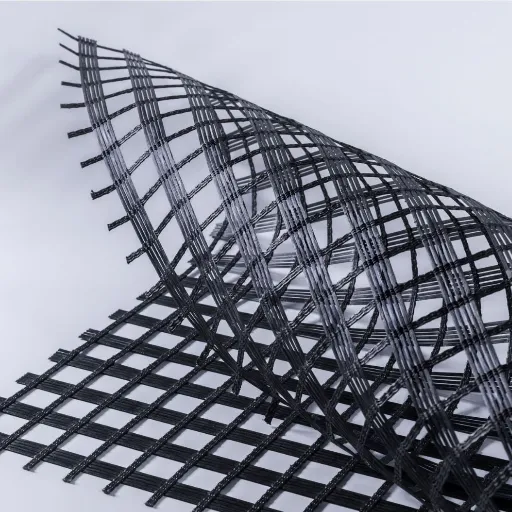
Aperture stability modulus measures a geogrid’s resistance to in-plane rotational movement of its junctions. The test applies a 5 kg-cm moment to the central junction of a 9 inch square specimen held at its perimeter, then divides the moment by the resulting rotation angle. Results are reported in m-N/deg, and higher is stiffer.
An opening that rotates under load stops gripping the aggregate. Aperture stability is a proxy for how well the opening holds its shape while the layer is compacted and trafficked, which is when interlock is established or lost. The method is ASTM D7864, also referenced as GRI-GG9. Here are real datasheet values:
| Product | Type | Aperture | Aperture stability (m-N/deg) | Flexural rigidity (mg-cm) |
|---|---|---|---|---|
| Lin Yuan PBX1515 | Biaxial PP | 38 mm | 0.32 | 250,000 |
| Lin Yuan PBX3030 | Biaxial PP | 36 mm | 0.75 | 2,000,000 |
| Lin Yuan PBX5050 | Biaxial PP | 33 mm | 1.10 | 8,000,000 |
| SKAPS BX1100 | Biaxial PP | 25 by 33 mm | 0.32 | 250,000 |
| SKAPS BX1200 | Biaxial PP | 25 by 33 mm | 0.65 | Not published |
| Tenax 3D-LT | Triplanar PP | 33 mm pitch | 0.30 | 1,200,000 |
Look at the two SKAPS grades. BX1100 and BX1200 share the identical 25 by 33 mm aperture. BX1200 has double the aperture stability at 0.65 versus 0.32, and roughly 50% more ultimate tensile strength at 19.2 and 28.8 kN/m versus 12.4 and 19.0 kN/m.
A buyer comparing those two datasheets on aperture alone would conclude they are the same product. They aren’t.
Priya hit exactly that on a port expansion tender in 2024. Two suppliers quoted “25 by 33 mm biaxial, 93% junction efficiency” at prices 18% apart. She asked both for aperture stability alongside the tensile report. One supplier had the numbers ready and one did not, so she paid the premium and got a grid that held its openings under a 90 tonne reach stacker.
Aperture stability is an index property, not a design input. It doesn’t appear in pavement design equations. Read it as a discriminator between products of similar tensile strength, alongside junction efficiency, which is the percentage of rib strength retained through the junction rather than lost at the crossing. Our geogrid specification and test methods guide explains how the rest of the datasheet fits together.
Does Geogrid Aperture Shape Matter?
Square and rectangular apertures give two orthogonal strength directions, which suits roads and working platforms where load direction is predictable. Triangular and hexagonal apertures put ribs at 60 degrees for near-isotropic stiffness, which suits heavy multidirectional traffic.
The research is more cautious than the marketing. Dong et al. (2011) reported that triangular apertures distribute stress more uniformly than rectangular ones, though the improvement depends on other factors. However, three-dimensional discrete element modelling found that when stiffness and effective area are held constant, aperture shape has only secondary impact.
Aperture size and rib stiffness dominate. Shape is a refinement, not a substitute. Our biaxial vs triaxial geogrid comparison covers the geometry trade-off in full.
How to Match Aperture to Aggregate: 5 Steps
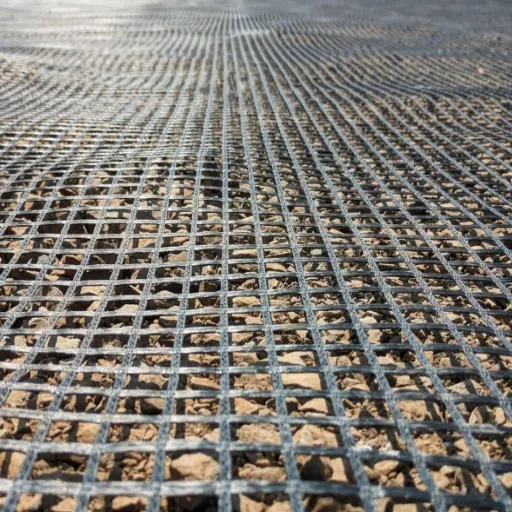
- Get the actual gradation. Not “20 mm stone,” but the sieve analysis with D50, D85, and Dmax. Without it you’re guessing, and guessing is what produces the rutting story above.
- Apply the Holtz gate. Confirm the aperture falls between D50 and 2 times D85. If it doesn’t, the pair is mismatched before you go any further.
- Refine with the working rule. Within the passing band, target an aperture of 1.5 to 3 times D50, meaning D50 should be about half the aperture.
- Check the fill, not just the size. Angular crushed stone interlocks reliably. Rounded river gravel doesn’t, at any aperture. Confirm the specification calls for crushed angular material.
- Test the pair on critical work. Interface shear to ASTM D5321 or pullout to ASTM D6706 on the actual grid and fill combination. Screening gets you a shortlist. Testing gets you a specification.
Worked example
A warehouse platform needs a biaxial grid over a graded crushed base with D50 of 8 mm and D85 of 20 mm.
Holtz requires an aperture between 8 and 40 mm, which passes easily. The working rule narrows it to 12 to 24 mm. A 25 by 33 mm grid sits marginally above that band; it and a 33 by 33 mm are both defensible and worth testing.
If the same site used 20 mm single-sized stone, D50 would be near 20 mm and D85 near 25 mm. Holtz would then require 20 to 50 mm, pushing you toward a 33 to 40 mm opening. Same grid family, different answer, because the fill changed. Once you have the number, our how to choose a geogrid selection framework carries it through strength class, polymer, and supplier qualification.
Frequently Asked Questions
What is geogrid aperture size?
The clear opening between ribs, measured across its shortest dimension in millimetres. Biaxial grids usually run 25 to 40 mm, triaxial 66 to 120 mm, uniaxial 12 to 50 mm.
What aperture size geogrid do I need for aggregate?
Geogrid aperture size for aggregate should match the gradation. The opening needs to fall between D50 and 2 times D85 of the fill, refined toward 1.5 to 3 times D50. For a typical graded base course that narrows to roughly 12 to 24 mm. A 25 by 33 mm biaxial grid sits just above that band and is the usual starting point.
What happens if the geogrid aperture is too small?
Aggregate bridges across the opening instead of penetrating it. Interlock becomes friction-dominated, passive bearing is never mobilised, and the grid confines nothing.
What happens if the aperture is too large?
Stone passes through or sits on top rather than seating against the ribs. Passive bearing is lost, and the layer behaves as though it were unreinforced.
How do I check a supplier’s aperture claim?
Ask for nominal aperture in both directions, rib thickness and depth, junction efficiency, and aperture stability modulus, all on a minimum average roll value basis with the test method named.
Does aperture affect how long a geogrid lasts?
Not directly. Durability is governed by polymer, UV exposure, chemical environment, and installation damage. Aperture affects whether the grid performs its function while it lasts. Our guide to geogrid service life covers the durability side.
The Bottom Line on Aperture
Aperture is the most checkable number on a geogrid datasheet. You can measure it with a ruler, and it decides whether interlock happens at all. It is also the cheapest quality check you have.
Measure it in both directions. Gate your gradation with Holtz, using D50 to 2 times D85. Refine within that band using 1.5 to 3 times D50, then confirm the pair by testing on critical work.
Then look past the opening to rib depth, junction efficiency, and aperture stability modulus. Two grids with identical apertures can differ by 100% on rigidity.
Yusuf applied that sequence to a rail ballast project in 2023. The specification called for a 65 mm aperture, but the ballast had a D50 near 35 mm, putting A/D50 at 1.86 well past the 1.2 optimum and into the diminishing interlock zone. Dropping to a 45 mm opening brought the ratio back toward 1.2, and settlement readings over the first year came in well below the previous section.
That’s the point of specifying geogrid aperture size properly. It’s a five minute check that prevents a five figure repair.
Ready to specify? Request a technical quote with your gradation, or browse our PP and PET geogrid qualified to ASTM and ISO. We quote aperture in both directions, on a MARV basis, with the test method named.