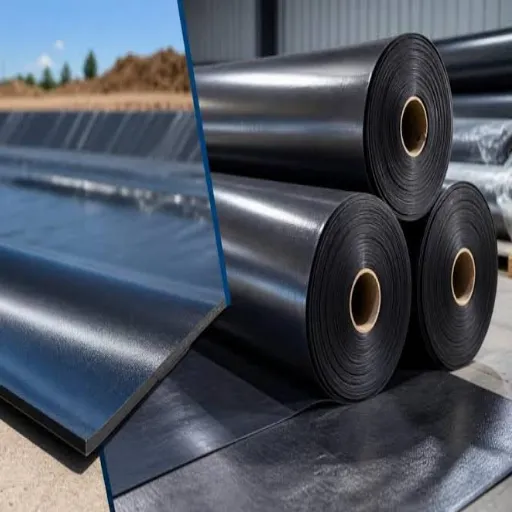
Yes. An LLDPE pond liner is a sound choice for aquaculture when it is specified at 0.75 mm to 1.5 mm (30 to 60 mil), laid over a prepared subgrade with a geotextile underlay, and welded and tested to GRI-GM17. Its flexibility suits ponds that settle. Its lower tear and puncture resistance than HDPE at the same gauge means thickness and underlay carry more of the load.
A farm manager we will call Lina bought a 20 mil liner for a 0.6 ha tilapia pond because the supplier called it “fish grade.” Two seasons later, the sheet around the aerator looked like a colander. The material was not the problem. The specification was.
This guide covers the decisions that matter: thickness, underlay, seam acceptance, and food-contact documentation. Send the pond dimensions with the stocking plan and we will check the layout against GRI-GM17. Request a specification review.
Key Takeaways
- GRI-GM17 Revision 17 defines LLDPE as a sheet with density at or below 0.939 g/ml, a 60,000 psi maximum 2% modulus, no yield requirement, and 800% break elongation.
- At 1.5 mm, LLDPE has 33 lb tear and 84 lb puncture resistance, against 42 lb and 108 lb for HDPE. Flexibility costs puncture margin.
- SRAC Publication 105 recommends 30 to 40 mil for permanent aquaculture and calls 20 mil or less temporary.
- GRI-GM17 sets 394 N/25 mm shear and 328 N/25 mm peel for a 1.5 mm hot-wedge seam; HDPE under GM13 needs 525 and 398.
- “Fish safe” is not a regulated certification. Ask for the resin grade and a lot-specific food-contact declaration.
LLDPE Pond Liner for Aquaculture: The Short Answer
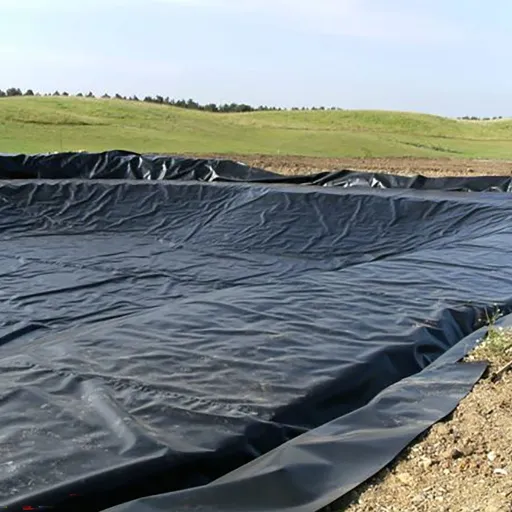
The right LLDPE pond liner for aquaculture is thick enough to survive the pond’s operation, not just its water depth. A seasonal pond and an intensively aerated shrimp pond are different specifications at the same depth.
| Pond situation | Starting thickness | Underlay | Driver |
|---|---|---|---|
| Seasonal pond, low stock density | 0.75 mm (30 mil) | Nonwoven geotextile | Above SRAC’s temporary-use floor |
| Permanent earthen pond, 1 to 2.5 m | 1.0 mm (40 mil) | Nonwoven geotextile | SRAC’s 30 to 40 mil range |
| Intensive aeration, mechanical cleaning, rocky ground | 1.5 mm (60 mil) | Geotextile plus walkways | Puncture and abrasion |
| Waste or effluent storage | State NRCS standard | Per design | Unreinforced LLDPE may not be listed |
These are starting points, not a design. The engineer of record sets final thickness after reviewing subgrade, slope stability, groundwater, cleaning, and leak consequences.
For a backyard ornamental pond with a 20 mil sheet, the consumer guide to the LLDPE pond liner is the better fit. This page covers farm aquaculture, where stock density and harvest traffic change the specification.
Why Aquaculture Ponds Need an Engineered Liner
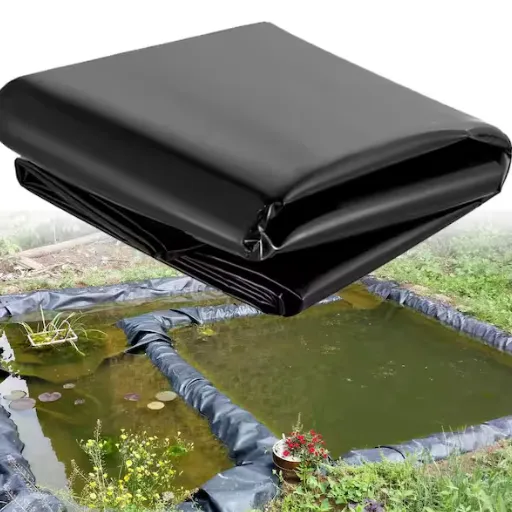
A liner stops seepage and separates the culture water from the soil beneath. SRAC Publication 105 states that a properly installed liner is 100 percent effective in stopping seepage. The qualifier matters: seepage control is most critical where the soil is sandy, gravelly, or fractured, or above a sensitive aquifer.
Soil separation matters for water quality. A clay pond can stay turbid, buffer pH in ways the farm did not plan, and release nutrients. A liner gives the farm a cleanable surface that collects sludge where it can be removed. It does not make the pond self-cleaning or replace aeration, water exchange, or biosecurity, and a low-intensity pond on good clay may be adequately sealed by compacted clay. The geomembrane pond liner guide covers that comparison.
Is LLDPE Safe for Fish and Food Contact?
Most supplier pages answer this badly. The answer has three parts:
No regulator certifies a pond liner as “fish safe.” There is no international certificate with that name. The phrase is commercial shorthand: it can mean the sheet uses a food-contact resin, passed a migration test, or simply that the supplier has sold it to farms before. Those are not equivalent claims.
The relevant frameworks are separate. Each answers a different question:
| Framework | Covers | Does not cover |
|---|---|---|
| FDA 21 CFR 177.1520 | Olefin polymers for food-contact use, with formulation and extractables limits | Pond water, fish health, or performance |
| EU Regulation 10/2011 | Plastic food-contact materials, with a 10 mg/dm² or 60 mg/kg migration limit and a Declaration of Compliance | A pond certified safe for fish |
| NSF/ANSI/CAN 61 | Materials in contact with drinking water | Fish health or aquaculture performance |
| Supplier “fish grade” | A commercial designation defined by the supplier | A harmonised test unless one is named |
NSF/ANSI/CAN 61 is the most misused standard in aquaculture marketing: it covers drinking-water components, not fish toxicity.
The polymer family is not the formulation. LLDPE is a non-plasticized polyolefin. It does not rely on the plasticizers used in flexible PVC, and NRCS CPS 521 does not recommend PVC for aquatic production because stabilizers may leach and harm aquatic species.
A finished geomembrane still contains antioxidants, carbon black, and other additives, and those plus the resin grade decide whether a food-contact statement applies. LLDPE is a family, not a single product: comonomer type, density, melt index, and additive package vary.
Documentation matters more than adjectives. Ask for the resin grade and density with the GM17 report for the lot, plus the additive package. Compliance is a separate document: FDA 21 CFR 177.1520, or an EU Declaration of Compliance with the migration test. Ask which product any NSF/ANSI/CAN 61 listing covers.
A procurement officer we will call Ahmed once accepted a one-page “food grade certificate” that named a resin supplier. It did not name the finished sheet, the additives, or a migration test. His auditor asked for the missing link. The liner was probably fine. The paperwork was not.
Request the LLDPE datasheet and lot documents before you approve the order.
LLDPE vs HDPE for Aquaculture Ponds
Both polymers can line a fish pond; the choice turns on ground movement, puncture risk, chemical exposure, and installer competence.
At the same 1.5 mm thickness, GRI-GM17 and GRI-GM13 define different sheets:
| Property at 1.5 mm | LLDPE, GM17 Rev 17 | HDPE, GM13 Rev 19 |
|---|---|---|
| Formulated density | 0.939 g/ml maximum | 0.940 g/ml minimum |
| 2% secant modulus | 60,000 psi maximum | Not required |
| Yield strength | No requirement | 126 lb/in |
| Break strength | 228 lb/in | 228 lb/in |
| Yield elongation | Not applicable | 12% |
| Break elongation | 800% minimum | 700% minimum |
| Tear resistance | 33 lb (147 N) | 42 lb (187 N) |
| Puncture resistance | 84 lb (374 N) | 108 lb (480 N) |
| Hot-wedge seam shear | 394 N/25 mm | 525 N/25 mm |
| Hot-wedge seam peel | 328 N/25 mm | 398 N/25 mm |
The first rows explain the field behavior. LLDPE has a capped modulus and no yield point, so it stretches and drapes instead of resisting. That is why it performs over settlement and odd geometry, and why it needs less thermal slack than HDPE in a hot climate. The LLDPE installation guide covers the slack setting.
The tear and puncture rows explain the trade-off. At the same gauge, LLDPE has less reserve against a stone, a root, or a dropped tool. In a pond, that reserve is bought back with underlay, thickness at traffic areas, and protection around aerators and pumps.
A practical decision rule: choose LLDPE where the subgrade may settle, the pond shape is irregular, or the site has a history of movement. Choose HDPE where chemical exposure is aggressive, the design depends on high seam strength, or the installer will not qualify new weld settings. Do not choose either on price alone; compare thickness, fabricated area, seam testing, and documentation as one package. A separate LLDPE vs PVC geomembrane comparison covers PVC.
SRAC 105 describes low-density polyethylene as the flexible option and HDPE as more chemical-resistant, a trade-off rather than a ranking. The HDPE geomembrane pond liner page covers the HDPE side, and the GRI-GM17 specification breakdown carries the full tables.
Choosing LLDPE Thickness for a Fish or Shrimp Pond
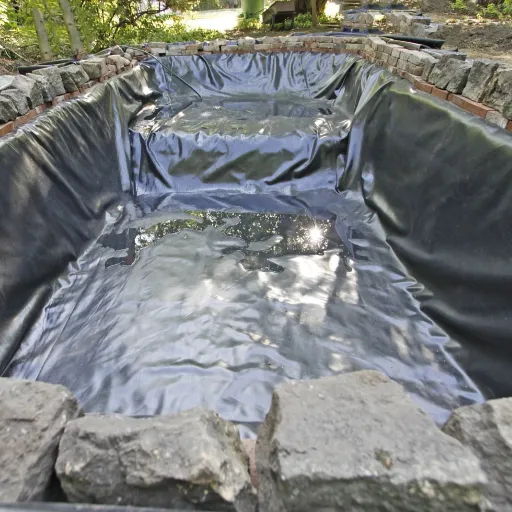
For an LLDPE pond liner for aquaculture, thickness is where most failures are designed in. The LLDPE geomembrane thickness guide covers the method.
SRAC Publication 105 recommends 30 to 40 mil (0.75 to 1.0 mm) for permanent aquaculture facilities. It calls 20 mil or less suitable for temporary use, and it notes that thin liners can be punctured by plant sprouts along the pond edge. Rocky soils need more thickness and a geotextile mat.
NRCS CPS 521 sets minimum criteria by waste stream: 24 to 30 mil unreinforced LLDPE for clean water, and 60 mil reinforced LLDPE for manure and wastewater. The unreinforced cell for manure and wastewater reads “Not Applicable,” which is a regulatory floor rather than an aquaculture design rule. Check the current state standard for effluent.
GRI-GM17 sets the manufacturing range at 0.50 mm to 3.00 mm (20 to 120 mil). A sheet can meet GM17 at 20 mil, which does not make it adequate for a permanent farm pond.
A seasonal nursery can start at 0.75 mm, but a permanent pond with hand harvest belongs at 1.0 to 1.5 mm, and mechanical harvest pushes that upward. On rocky or variable subgrade, no thickness replaces a geotextile.
Three factors push the choice upward. Subgrade: rock, roots, debris, and clods concentrate stress, so remove them, proof-roll, and use a nonwoven geotextile, the cheapest puncture protection available. Traffic: aerators, feeders, pumps, nets, and boots concentrate load, and a 1.5 mm sheet with a wear pad at the aerator outperforms a 1.0 mm sheet without one. Exposure: the band above the waterline sees UV, thermal cycling, and wet-dry movement. GM17 requires 35% high-pressure OIT retention after 1,600 hours of UV exposure, a laboratory test rather than a service-life guarantee, so specify UV-stabilized sheet with carbon black on the datasheet.
A shrimp farm that chose 0.75 mm found the sheet at the harvest ramp and aerator pads abraded through by the second cycle. It replaced those areas with 1.5 mm patches and added geotextile under the walkways. The cheaper sheet moved the cost to a mid-season repair.
SRAC also warns that liners become slippery on steep banks. Textured LLDPE, or a properly anchored cover, gives the crew something to stand on.
Designing the Pond Around the Liner
A liner is only as good as the shape it is asked to hold. Five details decide whether the sheet survives.
Subgrade. The surface should be smooth, firm, and free of sharp objects. Remove stones, roots, and debris, proof-roll, compact to specification, and keep it dry. The geotextile goes over the prepared surface, not a rough one.
Slopes. Flatter slopes are easier to line and less likely to shed the sheet. Steep slopes need textured sheet, secure anchorage, and a stability check with the cover in place.
Anchor trench. The edge is carried into a perimeter trench and backfilled. Size, setback, and backfill are design decisions. Keep production seams out of the trench and compact the backfill.
Uplift and venting. Groundwater or gas beneath the liner can lift it when the pond is drawn down. NRCS CPS 521 requires underliner drainage and venting where conditions call for it, with at least a 1% bottom slope where drainage is used, and the outlets must be inspectable. A liner that balloons during an empty-pond inspection is a design failure.
Penetrations and access. Every pipe, drain, aerator stand, and harvest ramp interrupts the membrane. Minimise them, use purpose-made boots or flanges, reinforce the area, and keep the detail accessible. Concrete pads are easier to maintain than a buried field patch.
The liner must also extend above the maximum water level and be anchored above the wave and splash zone. A sheet that stops at the normal waterline will be UV-aged and pulled at every fill. The LLDPE geomembrane reservoir guide covers larger storage.
Installation and Handover Checks
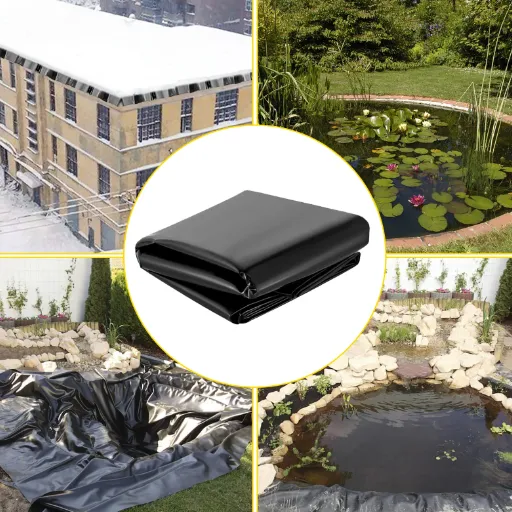
LLDPE installs with standard polyethylene equipment, but settings and acceptance values are material-specific.
- Survey and set out. Confirm dimensions, depths, slopes, anchor trench, and penetrations against the fabrication drawing.
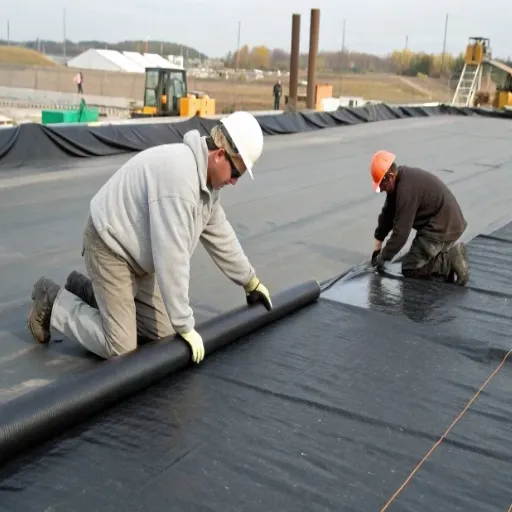
- Prepare the subgrade and place the geotextile. Inspect and photograph the surface before it is covered.
- Deploy the panels. Do not drag the sheet over rough ground; allow the designed slack and ballast against wind.
- Qualify the weld. Trial-weld the actual sheet and finish. Adjust heat, pressure, and speed to the sheet, not the last HDPE job.
- Weld and test every seam. Hot wedge for long seams, extrusion for details and boots. At 1.5 mm, a hot-wedge seam needs 394 N/25 mm shear and 328 N/25 mm peel. Air-channel test dual-track seams, vacuum-box test details, and cut destructive coupons at the specified frequency. A visual check is not a test.
- Complete penetrations, anchors, and repairs. Boots, flanges, pads, and trench backfill. Repair any defect and retest it.
- Fill under control. Fill slowly, watch the venting system, and keep equipment off the sheet. Record the as-built condition before stocking.
The handover package should include the fabrication drawing, certificates, trial-weld records, seam test results, repair log, and photographs. Without those, the pond is not ready for water, let alone fish. The LLDPE geomembrane installation guide covers the rest.
Operating and Maintaining an LLDPE-Lined Pond
A lined pond still needs maintenance, but it is a pond with a known, repairable surface.
Keep the water level stable where the design allows. Rapid drawdown changes the load on the liner and exposes the UV-sensitive band. If the pond must be emptied, check uplift and venting first.
Test cleaning agents before use. LLDPE resists many chemicals, but oxidizers, concentrated chlorine, lime, and some disinfectants can attack the sheet or seams. Ask for a compatibility statement and soak a coupon of the actual sheet before the first full-pond treatment.
Inspect the waterline, seams, edges, and penetrations. Damage shows up there first: abrasion, cracking, lifting, fish digs, and equipment contact.
Control roots and burrowers. Trees on levees are a common cause of damage. Keep vegetation off the liner and anchor trench, and manage crawfish and muskrats.
Keep traffic off the exposed sheet. Use walkways, pads, or ramps at aerators, feeders, and harvest points. A sheet that survives the water may still fail under a wheelbarrow.
Specifying an LLDPE Pond Liner for Aquaculture
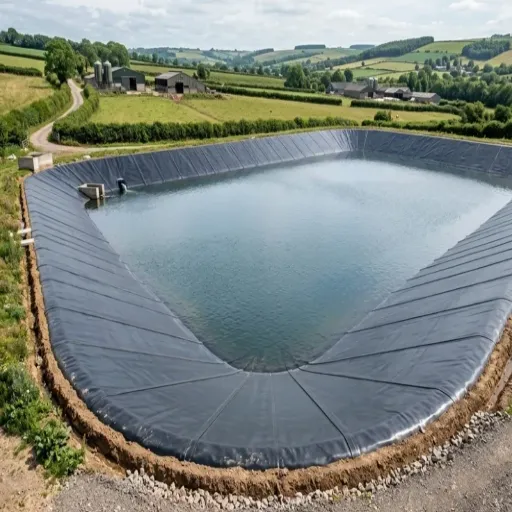
A quotation for an LLDPE pond liner for aquaculture should be a specification, not a price per square meter. The LLDPE geomembrane price guide explains how thickness and fabrication change the number. Send the supplier:
- Pond dimensions, depths, side slopes, and freeboard.
- Subgrade, groundwater, and any rock or debris.
- Species, stocking density, aeration, feeding, and harvest method.
- Cleaning chemicals, with concentration and contact time.
- Required standard, thickness, seam standard, and test frequency.
Ask for the resin grade, GM17 conformance for the lot, the product covered by the food-contact statement, and roll identification.
Common mistakes:
- Specifying 20 mil because it is cheap, then calling the pond permanent.
- Omitting the geotextile on a rocky or rooty site.
- Applying HDPE weld settings and seam values to LLDPE.
- Burying seams in the anchor trench without testing.
- Accepting a “food grade” letter that does not name the finished product.
- Ignoring uplift because the pond is normally full.
Send the pond drawing, stocking plan, and cleaning chemicals, and we will confirm the thickness and seam standard against GRI-GM17. Request a quotation.
FAQ
Is LLDPE safe for fish?
LLDPE is a non-plasticized polyolefin and is widely used in aquaculture, but “safe for fish” is not a certificate a supplier can hold. Safety depends on the resin grade, additives, and lot documentation: ask for the food-contact statement, the migration test if claimed, and the exact product it covers.
What thickness of fish pond liner do I need for a 1 acre pond?
For a permanent LLDPE pond, start at 1.0 mm (40 mil), inside SRAC’s 30 to 40 mil recommendation. Increase to 1.5 mm (60 mil) for intensive aeration, mechanical harvest, rocky ground, or heavy traffic. A 20 mil sheet is a temporary product.
Is LLDPE better than HDPE for aquaculture?
For an LLDPE pond liner for aquaculture, it depends on the site. LLDPE conforms better to settlement and uneven ground; HDPE has higher tear and puncture resistance at the same thickness and resists more chemicals. Specification, seam quality, and installation matter more than the polymer name.
Can LLDPE pond liner be welded?
Yes, with hot wedge, hot air, ultrasonic, or extrusion methods, against GRI-GM17 Revision 17 acceptance values. At 1.5 mm, a hot-wedge seam needs 394 N/25 mm shear and 328 N/25 mm peel. Do not use the HDPE table from GRI-GM13.
How long does an LLDPE pond liner last?
SRAC Publication 105 notes 20 to 25 years with care. That is an operating expectation, not a warranty. UV, cleaning chemicals, traffic, subgrade, and seam work all affect service life.
Conclusion
An LLDPE pond liner for aquaculture works when four things are right: thickness matches the operation, subgrade and underlay protect the sheet, seams are welded and tested to GM17, and food-contact documentation matches the lot.
LLDPE earns its place on moving ground, uneven subgrade, and irregular pond shapes, not by being called flexible. At the same gauge it has less tear and puncture reserve than HDPE, so the design has to supply what the material does not.
Start with the pond, not the roll. Send the dimensions, stocking plan, cleaning chemicals, and subgrade report, and ask for a specification that states the resin grade, thickness, seam values, and documentation. That is the difference between a liner that lasts and one that becomes next season’s repair.
Constc Mart supplies LLDPE geomembrane in smooth and textured finishes from 0.5 mm to 2.5 mm. Send your pond details for a specification review and we will confirm the material and seam standard against GRI-GM17.