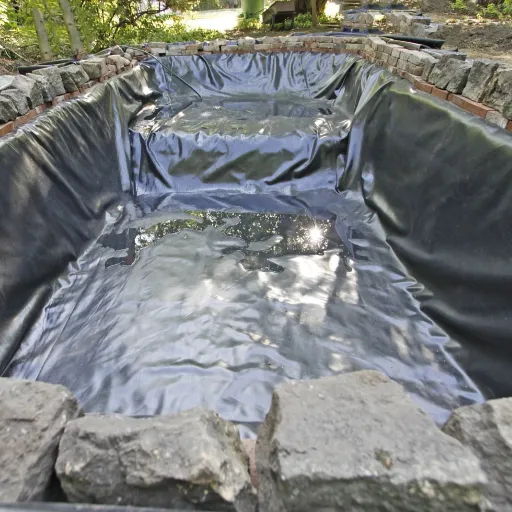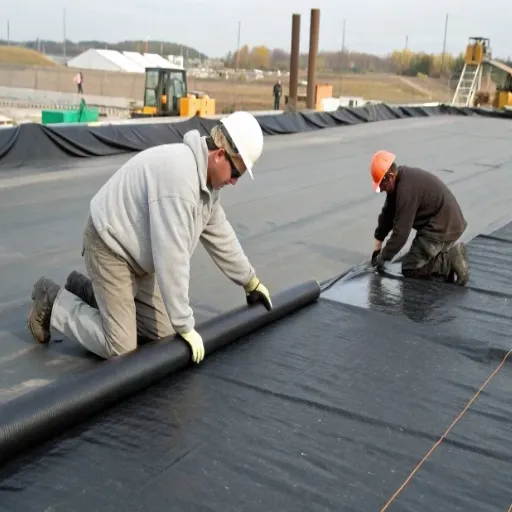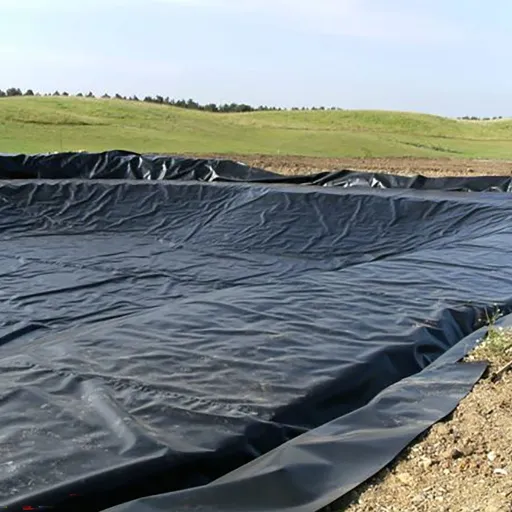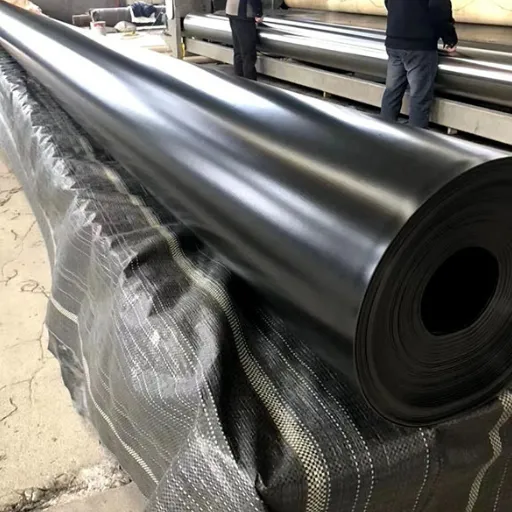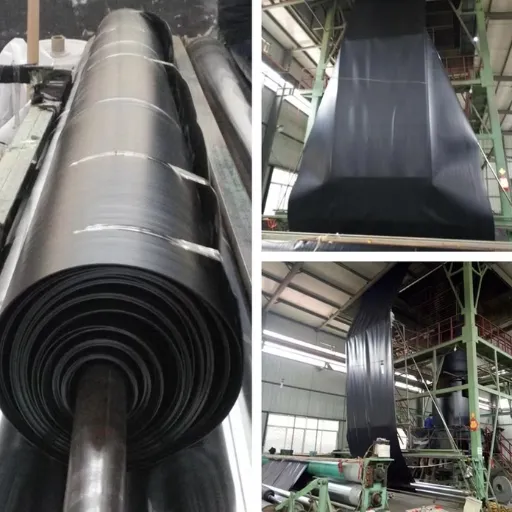
The short answer to LLDPE vs LDPE geomembrane is that LLDPE is the linear ethylene/α-olefin copolymer specified by GRI-GM17, while LDPE is a long-chain-branched polyethylene with no GRI geomembrane specification. At similar density, LLDPE has higher tensile, impact, and puncture resistance, while LDPE is softer, easier to process, and generally more susceptible to environmental stress cracking.
The names look interchangeable on a quotation. Search for an LDPE geomembrane datasheet and you will find pages that call the sheet LDPE, describe linear low-density polyethylene in the next sentence, and cite GRI-GM17 in the same paragraph. That is a label problem.
This guide covers the molecular difference, the GM17 requirements, the seam gap, where the cheaper sheet is legitimate, and the checks that expose a hiding datasheet. Send the datasheet you have been quoted and we will tell you which polymer it describes. Request a technical review.
Key Takeaways
- LLDPE is linear; LDPE is long-chain branched. Their density ranges overlap, so density alone cannot identify either.
- GRI-GM17 Rev 17 covers LLDPE only. The GSI catalogue lists no LDPE geomembrane specification.
- GM17 requires 800% break elongation for smooth sheet and caps 2% modulus at 60,000 psi (414 MPa). Generic LDPE data sit near 400%.
- GRI-GM19a sets seam values for HDPE, LLDPE, and fPP, not LDPE. A welded LDPE sheet has no GRI seam acceptance table.
- LDPE can be the right sheet for a temporary cover or a non-critical pond. It is the wrong sheet for a GM17 project.
Quick Answer: LLDPE vs LDPE Geomembrane at a Glance
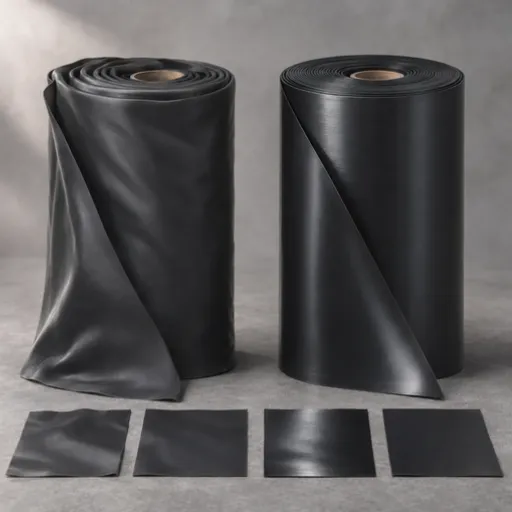
For a quick comparison, the LLDPE vs LDPE geomembrane choice comes down to this: LLDPE is a linear, short-chain-branched copolymer made to GRI-GM17. LDPE is a long-chain-branched resin with no GRI specification. LLDPE is tougher at equal density; LDPE is softer and usually cheaper. For engineered containment, specify GM17 LLDPE or GM13 HDPE, not an unqualified “LDPE” sheet.
| Property | LDPE (typical) | LLDPE (GRI-GM17) |
|---|---|---|
| Molecular structure | Long-chain branched, high-pressure radical polymerisation | Linear backbone with short-chain branches, low-pressure copolymerisation |
| Typical density | 0.915 to 0.935 g/cm³ | 0.915 to 0.925 g/cm³ natural resin |
| GRI specification | None | GM17 Rev 17 |
| Break elongation | About 400% in generic materials data | 800% smooth; 250% textured |
| 2% secant modulus | No GRI requirement | 60,000 psi (414 MPa) maximum |
| UV and aging | Poor UV resistance unless stabilized | Carbon black, OIT, oven aging, and UV retention required |
| Seam acceptance values | No GRI values | GM19a values for LLDPE |
| Typical use | Temporary covers, secondary containment, non-critical ponds | Engineered ponds, reservoirs, caps, containment |
The Difference Is Molecular, Not Just Density
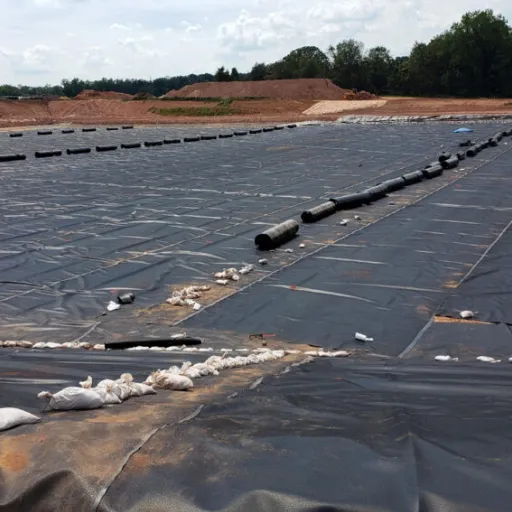
The difference between LDPE and LLDPE is structural, and density hides it. Buyers compare density first, and it is the least useful number here. PlasticsEurope’s polyolefin data put the LDPE family at 0.910 to 0.940 g/cm³. Its PE eco-profile narrows typical LDPE to 0.915 to 0.935 g/cm³ and LLDPE to 0.915 to 0.925 g/cm³. The ranges overlap almost completely, so a sheet at 0.920 g/cm³ could be either polymer.
LDPE: High Pressure, Long Branches
LDPE is produced by high-pressure radical polymerisation. PlasticsEurope’s PE eco-profile reports 20 to 40 methyl side groups plus 0.5 to 5 long-chain branches per 1,000 carbon atoms. Those long branches keep the chains from packing closely, which lowers crystallinity and produces a soft, flexible resin.
The branches also cause the weaknesses. LDPE has lower strength and stiffness than LLDPE, poorer UV resistance, and a greater tendency toward environmental stress cracking. A materials database entry for a generic LDPE grade lists 10 MPa tensile strength and 400% elongation at break. Those are generic moulding values, not geomembrane values, but they show the direction of the difference.
LLDPE: Low Pressure, Short Branches
LLDPE is a copolymer of ethylene with a C4 to C8 α-olefin, usually 1-butene, 1-hexene, 1-octene, or 4-methyl-1-pentene, at about 2.5% to 3.5% by weight. The backbone stays linear, and the comonomer adds short branches that control crystallinity without the long-chain entanglements of LDPE.
PlasticsEurope states that LLDPE has higher tensile strength and higher impact and puncture resistance than LDPE. It is flexible, elongates under stress, and is harder to process, which is why the two are not drop-in substitutes on an extrusion line.
Why 0.92 g/cm³ Tells You Nothing
GRI-GM17 does not rely on density to define LLDPE. Section 3.3 defines it as an ethylene/α-olefin copolymer with a linear molecular structure and a natural resin density of 0.915 to 0.926 g/ml. The 0.939 g/ml formulated cap in Section 1.1 is a scope limit, not an identity test.
A buyer we will call Marco compared two 0.75 mm sheets on density alone. Both read 0.92 g/cm³.
One datasheet listed 400% elongation; the other listed 800% and a GM17 report. The density column had told him nothing. Marco is an illustrative composite.
Only the resin description, the comonomer, and the full property set tell you which polymer you are buying. The LLDPE geomembrane guide covers the rest of the GM17 property set.
What the Standards Cover, and What They Do Not
The GSI specifications index lists GM13 for HDPE, GM17 for LLDPE, GM25 for reinforced LLDPE, and GM18 for flexible polypropylene. It does not list an LDPE geomembrane specification.
That absence is the central fact in this comparison. It does not mean LDPE sheet is illegal or useless. It means there is no published GRI minimum property set, test frequency, or seam table for a sheet sold as LDPE.
GRI-GM17: The LLDPE Standard
GM17 Rev 17, dated 11 June 2025, covers smooth and textured LLDPE from 0.50 to 3.00 mm. The resin must be virgin material with no more than 10% rework and no post-consumer resin. Natural resin density is generally 0.926 g/ml or lower, and melt index must be 1.0 g/10 min or less.
At 30 mil (0.75 mm), the smooth-sheet requirements are:
| Property | GM17 requirement |
|---|---|
| Break strength | 114 lb/in (20 N/mm) |
| Break elongation | 800% minimum |
| 2% secant modulus | 60,000 psi (414 MPa) maximum |
| Tear resistance | 16 lb (70 N) |
| Puncture resistance | 42 lb (190 N) |
| Carbon black content | 2.0% to 3.0% |
| Standard OIT / HP-OIT | 100 min / 400 min |
| Oven aging, 85 °C for 90 days | Retain 35% Std-OIT or 60% HP-OIT |
| UV resistance, 1,600 hours | Retain 35% HP-OIT |
| Formulated density | 0.939 g/ml maximum |
Textured LLDPE is a separate table. Its minimum break elongation is 250%, not 800%. A datasheet that quotes 800% for a textured sheet is using the smooth-sheet value.
The full requirements are in GRI-GM17 Rev 17. The LLDPE geomembrane specifications page turns them into a buyer’s checklist.
The Missing LDPE Specification
If a supplier claims an LDPE sheet is “GRI-certified,” ask which specification. There is no GM number for LDPE. The sheet is probably LLDPE, the claim refers to another standard, or the certificate covers another product.
The seam gap is worse. GRI-GM19a covers thermally bonded homogeneous HDPE, LLDPE, and flexible polypropylene. Its scope does not include LDPE, and it publishes no LDPE shear or peel values.
A welded LDPE liner can be tested, but there is no GRI acceptance table to test it against. That is a real problem where the engineer expects five-of-five seam acceptance.
The Regulatory Floor
The US federal landfill rule, 40 CFR 258.40(b), requires a composite liner with an upper flexible membrane liner of at least 30 mil and a lower compacted soil layer. It raises the floor to 60 mil for HDPE components. The rule does not create an LDPE specification.
Read it as a floor, not a design guide. A state permit or project specification can require GM17 LLDPE or GM13 HDPE at greater thickness. Substituting an unqualified LDPE sheet does not satisfy either document.
LLDPE vs LDPE Geomembrane Properties That Matter on Site
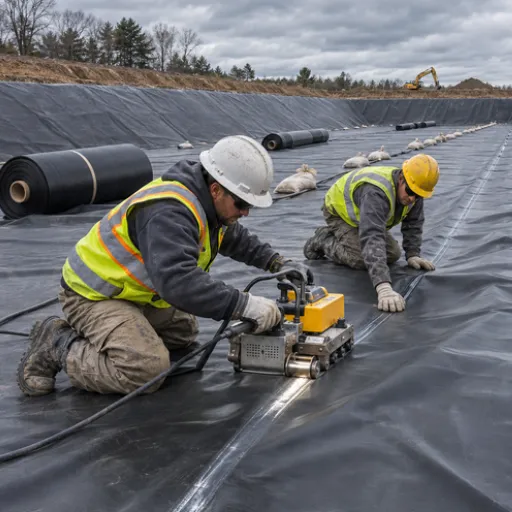
The differences show up in tension, puncture and tear, aging, and seams. Each has a different consequence for the design.
Tensile Strength and Elongation
LLDPE has higher tensile strength than LDPE at similar density, and GM17 sets a minimum break strength of 20 N/mm at 30 mil. The more useful number is elongation. GM17 requires 800% for smooth LLDPE. Generic LDPE data list about 400%.
That does not mean every LDPE sheet fails at 400%. Film grades vary, and a supplier can formulate for higher elongation. It means the datasheet is the only reliable evidence.
A sheet described as LDPE with 400% elongation is not a GM17 smooth-sheet product. A sheet described as LLDPE with 800% elongation has a description and a test result that agree.
Puncture, Tear, and Stress Cracking
LLDPE’s short-chain structure gives it higher impact and puncture resistance than LDPE. GM17 sets 42 lb (190 N) puncture and 16 lb (70 N) tear at 30 mil. Those are minimums, not typical values, and they are lower than HDPE at the same thickness. The HDPE geomembrane range is the better starting point when puncture resistance governs, and the HDPE vs LLDPE geomembrane comparison covers the trade-off.
Stress cracking is the quieter difference. LDPE is generally more susceptible to slow crack growth under sustained stress in the presence of a surfactant or chemical. LLDPE’s shorter, more uniform branches generally perform better.
GM17 does not test stress crack resistance at all; ESCR is on its list of deliberately omitted methods. A GM17 certificate proves the properties in the table, not stress-crack performance.
UV, Carbon Black, and Aging
LDPE has poor UV resistance unless it is stabilized. A thin LDPE cover left exposed can chalk, crack, and lose strength faster than expected. LLDPE is not immune, but GM17 requires 2.0% to 3.0% carbon black, 35% HP-OIT retention after 1,600 hours of UV exposure, and 35% or 60% OIT retention after oven aging.
Those requirements are a screening tool. An LDPE datasheet that lists density and elongation but says nothing about carbon black, OIT, or UV exposure is not a comparable document. It may suit a six-month cover. It is not evidence for a long-term exposed installation.
Welding and Seam Testing
Both polymers can be thermally bonded. The difference is acceptance. GM19a gives LLDPE hot-wedge values of 45 lb/in shear and 38 lb/in peel at 30 mil, and extrusion fillet values of 45 lb/in shear and 34 lb/in peel. It gives no LDPE values.
That does not make LDPE unweldable. It makes the seam a project-specific test. The installer has to run a trial weld on the actual sheet, test it to ASTM D6392, and have the engineer accept the result.
On a GM17 project, the acceptance criteria are already defined. The geomembrane welding guide covers the test methods and sampling intervals.
Where LDPE Still Makes Sense
The LLDPE vs LDPE geomembrane choice is not about good and bad materials. LDPE is a material with a different job, and the mistake is specifying it for a job that asks for GM17.
LDPE sheet is commonly sold for temporary covers, secondary containment, vapor barriers, and small or non-critical ponds. Those applications share three conditions: short exposure, low mechanical demand, and a failure that is inconvenient rather than catastrophic.
A contractor we will call Priya used an LDPE cover over a stockpile for a six-month project. It was light, easy to deploy, and cheap enough to replace if a loader caught an edge. Specifying GM17 LLDPE would have added cost without adding value, because the design life was one season. Priya is an illustrative composite.
The same logic does not transfer to a landfill liner, a long-term reservoir, or a project where the engineer has written GM17 into the specification. In those cases the LDPE sheet is the wrong purchase. That holds even if it is flexible, cheaper, and labelled “LLDPE/LDPE” by the supplier. If you are holding two datasheets, send both and we will review them side by side.
This page stays with LDPE. LLDPE vs PVC geomembrane and fMLDPE geomembrane are separate comparisons.
For pond-specific guidance, including the consumer 20-mil case, the HDPE, LDPE, and LLDPE pond liner comparison covers the application in more detail.
How to Read an “LDPE/LLDPE” Datasheet
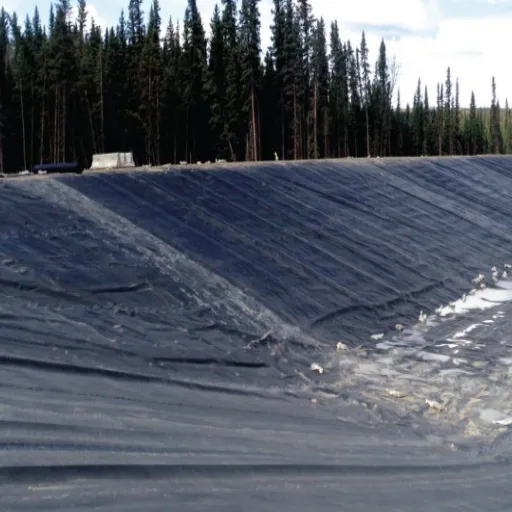
A datasheet is a short document with a lot of work to do. In any LLDPE vs LDPE geomembrane review, these seven checks tell you whether it describes a geomembrane or a film.
- Resin description. Look for “linear low-density polyethylene” or “LLDPE” and the comonomer, not just “polyethylene.”
- Formulated density. GM17 requires 0.939 g/ml or less. Density alone does not prove the polymer.
- Melt index. GM17 requires 1.0 g/10 min or less for the natural resin.
- Break elongation. Smooth GM17 sheet needs 800% minimum. Textured sheet needs 250%.
- 2% secant modulus. GM17 caps it at 60,000 psi (414 MPa). This is the specification’s real flexibility metric.
- Carbon black, OIT, and UV. GM17 requires 2.0% to 3.0% carbon black, 100 min Std-OIT or 400 min HP-OIT, and retention after oven and UV aging.
- Seam standard. GM19a gives LLDPE seam values by thickness. A datasheet with no seam table is not a complete submittal.
| Red flag | Why it matters |
|---|---|
| “LDPE/LLDPE” written as one material | The two have different structures, properties, and standards. One line cannot describe both. |
| Density quoted as the only identifier | LDPE and LLDPE density ranges overlap. Density does not identify the polymer. |
| 400% elongation on a smooth sheet | Below the GM17 800% minimum. It may be a valid LDPE sheet, but it is not GM17 LLDPE. |
| “GRI certified” with no GM number | Ask which specification. There is no LDPE GM specification. |
| A PVC standard cited for a polyethylene sheet | ASTM D7176 is the non-reinforced PVC geomembrane standard. A PE sheet cannot meet it. |
| No carbon black, OIT, or UV data | The sheet may be unstabilized, or the datasheet may be incomplete. |
| No seam values | GM19a covers LLDPE, not LDPE. Without values, seam acceptance is undefined. |
Two market examples show why the checklist matters. One distributor page headed “LDPE Geomembranes” describes “Linear Low Density Polyethylene” and says the sheet complies with GM17 in the same paragraph. Another LDPE product page states that its liner meets ASTM D7176, the PVC geomembrane standard. Neither is a reliable specification document.
A project team we will call the Delta team wrote “LDPE/LLDPE” into a specification. Phase one delivered a GM17 sheet. Phase two delivered an LDPE sheet with 400% elongation.
The seams had no acceptance table, so the engineer wrote one after the panels were welded. The Delta team is an illustrative composite.
When you request a quotation, state the application, required standard, thickness, surface, seam method, exposure, and chemical environment. Ask for the resin description, the GM17 or GM13 report for the lot, and the seam values. The geomembrane selection guide explains how the material choice fits the rest of the lining system.
Frequently Asked Questions
What is the difference between LLDPE and LDPE geomembrane?
LLDPE is a linear ethylene/α-olefin copolymer with short-chain branches. LDPE is a long-chain-branched polyethylene made by high-pressure polymerisation. LLDPE has higher tensile, impact, and puncture resistance at similar density. Only LLDPE has a GRI geomembrane specification.
Is LDPE the same as LLDPE?
No. In an LDPE vs LLDPE comparison, the names are related and their density ranges overlap, but they are different polymers with different molecular structures and property sets. A datasheet that uses the names interchangeably is not specific enough to specify.
Does LDPE meet GRI-GM17?
GRI-GM17 is written for LLDPE. It defines LLDPE as a linear ethylene/α-olefin copolymer, and its property table is built around that material. An LDPE sheet might meet some individual values, but it is not a GM17 LLDPE product.
Can LDPE be used as a pond liner?
Yes, for a small or non-critical pond where exposure is short and mechanical demand is low. For a long-term pond, an exposed installation, or a project specified to GM17, LLDPE is the appropriate material.
Is LDPE stronger than LLDPE?
No. At similar density, LLDPE has higher tensile strength and higher impact and puncture resistance. LDPE’s advantage is softness and ease of processing, not strength.
Can LDPE geomembrane be welded?
Yes, it can be thermally bonded. The limitation is acceptance: GRI-GM19a publishes seam values for HDPE, LLDPE, and fPP, not LDPE. A project using LDPE needs a trial weld, a project-specific test plan, and an engineer’s acceptance criteria.
Is LLDPE better for the environment than LDPE?
Both are polyolefins. The more important question is the specification and the service life, not the label. A liner that lasts the design life with tested seams avoids the resource cost of premature replacement. Ask for the resin source, rework content, and end-of-life plan.
Conclusion
The choice between LLDPE and LDPE geomembrane is not about which name sounds more flexible. It is about which material the standard covers and which properties the project needs.
LLDPE is the linear copolymer defined by GRI-GM17, with an 800% smooth-sheet elongation minimum, a 60,000 psi modulus cap, and a seam table in GM19a. LDPE is a long-chain-branched resin with no GRI geomembrane specification, no GRI seam values, and a softer, less tough property set. The density ranges overlap, so the datasheet has to settle it.
Use LDPE where its limitations do not matter: a temporary cover, a secondary liner, a non-critical pond. Use GM17 LLDPE or GM13 HDPE where the liner is engineered, exposed, welded to an acceptance standard, or expected to last. If a quotation says “LDPE/LLDPE,” ask for the resin description and the GM17 report before you compare price.
Constc Mart supplies LLDPE geomembrane in smooth and textured finishes. Send the datasheet, the application, and the exposure conditions, and we will confirm whether the sheet is GM17 LLDPE or something else. Request a technical review.