The hydraulic conductivity of a geosynthetic clay liner (GCL) usually falls below 1 × 10⁻⁹ cm/s (1 × 10⁻¹¹ m/s) once the bentonite is hydrated and confined. That same product can measure above 1 × 10⁻⁷ cm/s when it sits dry, lightly loaded, or against an aggressive leachate. The spread across those conditions is roughly five orders of magnitude, and it is the most important thing to understand about GCL hydraulic conductivity. It is also why a specification that says only “permeability ≤ 5 × 10⁻⁹ cm/s” tells you very little.
If you have written or reviewed that clause, you are in good company. Most tender documents carry it, and most supplier datasheets answer it. The problem is that neither usually states the test conditions that produced the number.
Here is a quick illustration of how that gap plays out. Priya, a CQA engineer on a 12-hectare landfill cell in Queensland, received an index flux report that passed comfortably. The permeant was deionised water, tested at the manufacturer’s standard stress. Her design case was a leachate with elevated calcium at the base of a deep cell. The report was valid and the criteria were met. It simply did not describe her site.
This guide closes that gap. You will get the conductivity values to expect by hydration state, product type and confining stress, every ASTM and GRI method that generates those values, the acceptance criteria projects actually use, and a specification clause you can adapt for your own tender.
Key Takeaways
- GCL hydraulic conductivity is a function of test conditions, not a fixed material property. The same liner measures below 1 × 10⁻⁹ cm/s when hydrated and confined, and above 1 × 10⁻⁷ cm/s when dry or lightly loaded.
- k-value alone is a weak specification because it depends on total thickness, and GCL thickness is set by the geotextiles rather than the bentonite. Specify index flux or permittivity, and pair it with a minimum bentonite mass per unit area.
- GRI-GCL-3 sets the acceptance values the market uses: index flux ≤ 1 × 10⁻⁸ m³/m²/s, hydraulic conductivity ≤ 5 × 10⁻⁹ cm/s, swell index ≥ 24 mL/2g, fluid loss ≤ 18 mL, bentonite mass around 3.6 kg/m².
- Chemistry and confining stress have to be specified together. Mine leachate at 24 kPa raised k to about 1.52 × 10⁻⁸ m/s and failed a limit of 1 × 10⁻⁹ m/s (1 × 10⁻⁷ cm/s, the criterion set for that project). At 93 to 438 kPa, the same leachate raised k by only 10 to 26 times, and every specimen passed.
- A passing test report proves the specimen met the criteria under the test’s conditions. It does not prove performance under your site’s conditions.
What Is GCL Hydraulic Conductivity?
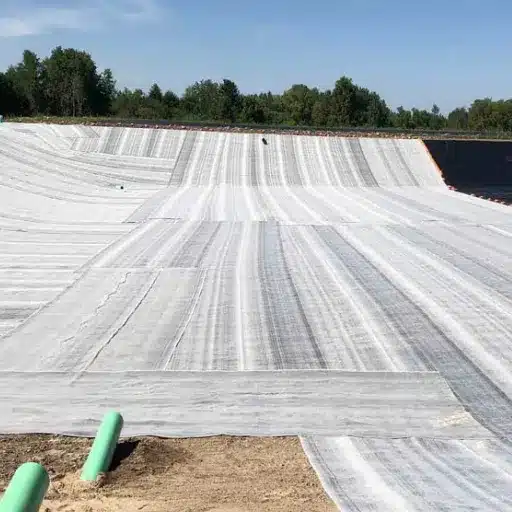
GCL hydraulic conductivity is the rate at which water or another liquid passes through the hydrated bentonite layer of a geosynthetic clay liner under a hydraulic gradient. It is expressed as a velocity, normally in centimetres per second (cm/s) or metres per second (m/s). A lower value means a better barrier. Geosynthetic clay liner permeability and GCL permeability are the same quantity under different names, so do not treat them as separate specifications.
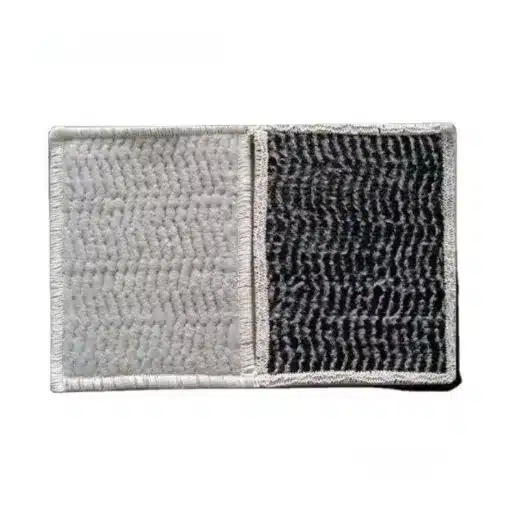
A geosynthetic clay liner sandwich sodium bentonite between two geotextiles. When the clay hydrates, it swells and forms a low-permeability gel. The liner does not block water the way a polymer sheet does. It slows water down by roughly ten orders of magnitude compared with clean sand, and it keeps doing that as long as the bentonite stays hydrated and confined.
That qualification, “as long as”, is where most projects get into trouble.
Three Numbers People Confuse: k, Permittivity and Index Flux
The industry uses three related quantities, and datasheets often mix them.
- Hydraulic conductivity (k) is the familiar value in cm/s or m/s. It depends on both the material and the thickness of the layer the water crosses.
- Permittivity is k divided by thickness. Because thickness cancels out, permittivity is independent of how thick the GCL happens to be.
- Index flux is the volume of water crossing a unit area per unit time, in m³/m²/s. It is a direct flow measurement rather than a calculated velocity.
The units are not interchangeable, and a specification that swaps one for another without saying so is a specification you cannot check.
The Range You Should Expect
A dry GCL isn’t a barrier. Dry bentonite measures around 10⁻⁶ cm/s, close to a silty soil. Once saturated and confined, quality sodium bentonite products sit below 1 × 10⁻⁹ cm/s, and high-performance grades reach 10⁻¹¹ to 10⁻¹² cm/s. A 2022 hydration study measured GCL conductivity between 5.2 × 10⁻¹² and 2.6 × 10⁻¹¹ m/s. It stayed low at 9.2 × 10⁻¹² m/s even when bentonite mass per unit area dropped to 1.8 kg/m².
Multi-component or coated GCLs, which add a thin polymer barrier, are cited as low as 5 × 10⁻¹² m/s. That places them closer to a geomembrane, though not equivalent to one.
Where a GCL Sits Next to a Geomembrane
Position matters when you compare barriers. An HDPE geomembrane has a permeability coefficient near 10⁻¹³ cm/s, several orders of magnitude below a hydrated GCL. Neither replaces the other in a well-designed containment cell. That’s why the composite liner system pairs a geomembrane with a GCL so each barrier covers the other’s failure mode. A geomembrane resists chemistry and holds gas but punctures. The GCL self-seals small punctures but is sensitive to pore-fluid chemistry. Knowing the conductivity of each layer is what lets you design the pair deliberately.
Why the k-Value Alone Is the Wrong Specification
Here is the counterintuitive part. The number most tenders insist on, hydraulic conductivity, is the least reliable of the three quantities for comparing GCL products. A conference paper presented at GeoAsia8 makes the case in detail, and it is worth understanding.
k Depends on Thickness, and the Geotextiles Set the Thickness
Hydraulic conductivity is calculated by dividing a measured flux by a hydraulic gradient and the specimen thickness. For a GCL, that thickness is dominated by the surrounding geotextile structure, which carries no water and does nothing for the seal. A GCL built on a thicker textile structure therefore calculates a higher, worse-looking k even when its permittivity and flux are identical to a thinner competitor.
The liner did not get worse. The arithmetic did.
What More Than 1,000 Tests Showed About Bentonite Mass
The same paper reports an evaluation of over 1,000 GCL tests. Increasing bentonite mass from roughly 3,000 g/m² to 6,000 g/m² cut index flux by about half, from 3.3 × 10⁻⁹ to 1.7 × 10⁻⁹ m³/m²/s. Over that same range, the k-value barely moved at all.
Read that again, because it changes how you buy. Doubling the bentonite measurably reduced the water getting through the liner, and the k-value reported no change. A specification that tracks k alone treats the most important performance variable as if it were irrelevant, and it rewards products that are thin rather than products that seal well.
What to Specify Instead
The practical fix is straightforward, and it takes one extra line in the tender:
- Make index flux or permittivity the primary acceptance value.
- Add a minimum bentonite mass per unit area, commonly around 4,000 g/m² at 0 percent moisture.
- Require k-value for reference, with the thickness basis and test conditions stated.
- State the permeant, effective stress and hydraulic gradient for every test.
- Require the raw test report, not a summary table.
Need the wider picture before you rewrite a spec? Our engineering team reviews GCL test documentation and project conditions for buyers worldwide. Request a technical quote and we will tell you which tests your design actually needs.
GCL Hydraulic Conductivity Values by Stress and State
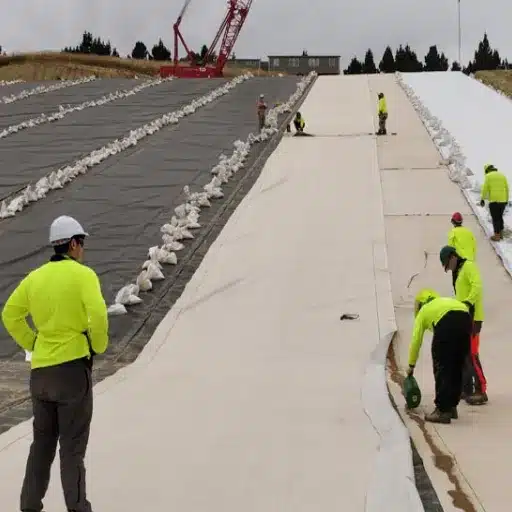
Once you accept that conductivity moves with conditions, the next question is how far. The published data give clear answers.
By Hydration State
- Dry bentonite: around 10⁻⁶ cm/s, comparable to a silt.
- Hydrated but lightly loaded: 10⁻⁸ to 10⁻⁷ cm/s.
- Hydrated and confined: below 10⁻⁹ cm/s for most products, down to 10⁻¹² cm/s for high-performance grades.
The jump between the first and third rows is the entire reason hydration control matters during installation, and why a cover that never gets wet enough is a liability rather than a barrier.
By Confining Stress
This is the table no supplier datasheet publishes, even though it explains most field results. Values below are reported for conventional sodium bentonite GCLs.
| Effective confining stress | Typical GCL hydraulic conductivity | Equivalent |
|---|---|---|
| 100 to 1,000 kPa | 3 × 10⁻¹⁰ to 1 × 10⁻⁹ cm/s | 3 × 10⁻¹² to 1 × 10⁻¹¹ m/s |
| 10 to 100 kPa | 6 × 10⁻¹⁰ to 6 × 10⁻⁹ cm/s | 6 × 10⁻¹² to 6 × 10⁻¹¹ m/s |
| Around 7 kPa | approximately 2 × 10⁻⁹ cm/s | approximately 2 × 10⁻¹¹ m/s |
| Around 1 kPa | 6 × 10⁻⁹ to about 1 × 10⁻⁷ cm/s | 6 × 10⁻¹¹ to about 1 × 10⁻⁹ m/s |
At the bottom of that table, a conventional GCL behaves more like a very poor clay than a hydraulic barrier. A deep landfill base liner under tens of metres of waste sits comfortably at the top. An exposed cover with 300 mm of soil over it does not.
Field Values for Calibration
Laboratory numbers make more sense next to exhumed samples.
A study of GCLs in an Antarctic environment found exhumed specimens measuring 0.4 to 12 × 10⁻¹¹ m/s against tap water, compared with 5 × 10⁻¹¹ m/s for virgin material. A GCL cover over arsenic-rich tailings held at or below 5 × 10⁻¹¹ m/s where cover soil was at least 0.7 m deep, while a polymer-enhanced bentonite GCL held at or below 3 × 10⁻¹¹ m/s. And an exhumed exposed composite liner showed the stress story plainly: about 10⁻¹¹ m/s at the top of the slope, typically above 10⁻⁷ m/s at mid-slope, and 10⁻⁸ m/s or higher at the toe.
Same product. Same project. Five orders of magnitude apart, because position on the slope changed the stress and the exposure.
Test Methods and Acceptance Criteria
Six standards do most of the work. Knowing what each one measures is the difference between accepting a report and understanding it.
ASTM D5887: Index Flux Through a Saturated Specimen
ASTM D5887 measures index flux through a saturated GCL in a flexible-wall permeameter. It is the routine quality control test, run during production at a stated frequency. In the index configuration it is often run at a confining stress of about 35 kPa with a 2 psi head; in project configurations, conditions such as 80 psi cell pressure and 75 psi backpressure with at least 48 hours of hydration are common. Because it is run on a prepared, saturated specimen, it is a product-acceptance test rather than a design-prediction test.
ASTM D5084: Saturated Hydraulic Conductivity
ASTM D5084 covers saturated hydraulic conductivity and supplies the falling-head and increasing-tailwater procedures and the termination criteria. It was written for fine-grained soils, and D5084 caps the hydraulic gradient at 30 for materials below 10⁻⁷ cm/s. GCLs are far thinner than the soils the method was designed for, so gradients of 50 to 600 are widely used instead, with a gradient of 200 appearing in published work. Practitioners justify this on the basis that the same effective stress is induced. Test stresses in practice run from about 20 kPa up to 240 kPa; dedicated studies cover 150 to 500 kPa.
ASTM D6766: Hydraulic Properties With Incompatible Liquids
ASTM D6766 is the compatibility test. It evaluates the flux and hydraulic conductivity of a GCL permeated with a potentially incompatible aqueous solution, typically a site-specific leachate or process liquid. Two limits matter:
- It does not apply to GCLs with a geomembrane, geofilm or polymer coating behind them.
- Its specimens are continuously hydrated, so results must not be applied where repeated wetting and drying will occur.
That second point is where a lot of cover designs go wrong. D6766 can return a passing number for a condition the field will never reproduce.
The Bentonite Index Tests: D5890, D5891, D5993
Three fast, inexpensive tests describe the clay itself rather than the finished composite.
- ASTM D5890 measures the swell index of the clay mineral component.
- ASTM D5891 measures fluid loss of the clay component.
- ASTM D5993 measures bentonite mass per unit area and moisture content.
These run at roughly one test per 50 tonnes and every truck or railcar, which makes them the first warning that a clay will not hold low conductivity against a given chemistry. A falling swell index or a rising fluid loss is a chemistry problem arriving before the permeability test can confirm it.
GRI-GCL-3: The Acceptance Criteria
GRI-GCL-3 supplies the acceptance values the market actually specifies. Most United States permit documents trace their GCL requirements back to it.
| Property | Test method | Acceptance value | Typical frequency |
|---|---|---|---|
| Index flux | ASTM D5887 | ≤ 1 × 10⁻⁸ m³/m²/s | Per production lot |
| Hydraulic conductivity | ASTM D5887 / D5084 | ≤ 5 × 10⁻⁹ cm/s | Weekly or per lot |
| Swell index | ASTM D5890 | ≥ 24 mL/2g | 1 per 50 t |
| Fluid loss | ASTM D5891 | ≤ 18 mL | 1 per 50 t |
| Bentonite mass per unit area | ASTM D5993 | 0.75 psf (about 3.6 kg/m²) at 0% moisture | 1 per 50 t |
| Internal and interface shear | ASTM D6243 | Project-specific | Project-specific |
For calibration, a permitted facility in Arkansas reported as-built index flux of 2.9 × 10⁻⁹ m³/m²/s and hydraulic conductivity of 1.8 × 10⁻⁹ cm/s, both comfortably inside those limits.
EN 16416 and Permittivity for European Tenders
European projects often specify the water flux index determined in a flexible-wall permeameter at constant head, under EN 16416, with values normalised to 10 °C. If you are bidding into Europe or importing a liner for a European specification, permittivity and flux index are the currencies, not cm/s. Asking for a k-value in that context is asking for the wrong document.
What Raises a GCL’s Hydraulic Conductivity

Everything above describes a liner behaving well. Now for the conditions that move the number, in order of how much damage they do.
Pore-Fluid Chemistry
Sodium bentonite works because sodium ions in the clay’s interlayer structure attract water, and the clay swells. Divalent cations such as calcium and magnesium displace that sodium. The clay shrinks, porosity rises, and conductivity climbs. Permeating a GCL with a calcium chloride solution has driven k from about 1 × 10⁻¹¹ m/s to about 1 × 10⁻⁷ m/s, a shift of four orders of magnitude. That’s a chemistry effect, not a manufacturing fault.
Real leachates do the same thing at a smaller scale. A non-hazardous landfill leachate produced roughly a 120 percent long-term increase over a deionised-water baseline, moving k from 1 × 10⁻¹¹ to 2.2 × 10⁻¹¹ m/s. Acidic mine leachates are harsher. A pH 2.5 leachate drove conductivity to 7.9 × 10⁻⁹ m/s for a conventional GCL and 7.2 × 10⁻⁸ m/s for a contaminant-resistant one, roughly 460 and 4,200 times their site-groundwater baselines. The sodium bentonite liner chemistry behind those numbers is worth understanding before you specify a grade.
The Stress and Chemistry Interaction
This is the most useful design number available on the topic, and it explains why two projects with the same leachate get opposite test results.
In one published study, a mine leachate at a low effective stress of 24 kPa raised GCL conductivity to about 1.52 × 10⁻⁸ m/s. That is roughly 340 times the tap-water control, and it failed the project’s requirement of k ≤ 1.0 × 10⁻⁹ m/s (equivalent to 1 × 10⁻⁷ cm/s). The same leachate at effective stresses of 93 to 438 kPa raised conductivity by only 10 to 26 times, and every specimen passed.
Consider what that means for a real project. A tailings facility in northern Chile designed its liner test programme around the manufacturer’s standard stress. The compatibility specimens failed at low stress, which looked like a material problem. When the design team re-ran the same leachate at the effective stress the liner would actually see under the stacked lifts, conductivity came back inside the limit. The liner was fine. The test programme had been describing a different structure.
Confining stress reduces void ratio. Fewer voids mean fewer paths for ions and water, so the bentonite tolerates more chemistry before it fails. Specify the stress the liner will see, or your compatibility test is measuring the wrong project.
Desiccation and Wet-Dry Cycling
Cracks that form during drying are difficult to reseal once cation exchange has already weakened the clay. This is why a continuously hydrated D6766 result does not transfer to an exposed cover. If the design allows wet-dry cycling, the test programme has to include it, and the design has to keep enough confining stress and cover thickness to prevent it.
Bentonite Mass and Polymer Modification
More bentonite means less flux, which is why the flux-versus-mass relationship matters more than k. Polymer modification changes the chemistry budget: modified sodium bentonite has shown fluid loss around 290 percent lower and free swell around 62 percent higher than unmodified sodium bentonite, which is what allows a polymer grade to hold performance against calcium-rich pore fluid.
Hydration History and Handling Damage
Bentonite prehydrated with clean water and then exposed to a harsh solution performs better than bentonite hydrated directly with that solution. Higher confining pressure reduces k. On the other side of the ledger, physical damage matters more than most people expect on coated products: one perforation raised k to 2.7 × 10⁻¹³ m/s, three perforations to 5.5 × 10⁻¹³ m/s, and seven perforations to 3.0 × 10⁻¹² m/s. On a coated GCL, conductivity becomes a function of hole count.
How to Specify GCL Hydraulic Conductivity Correctly
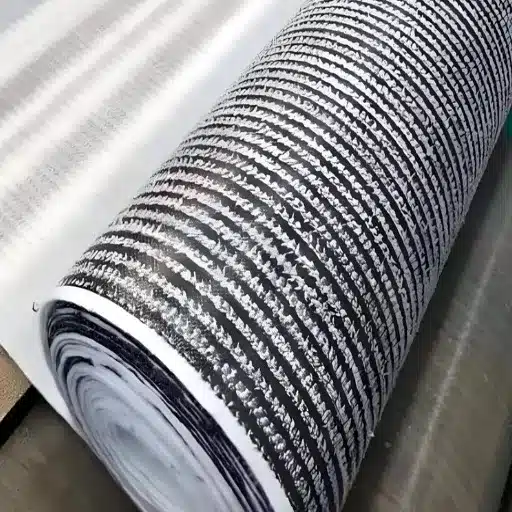
Everything above resolves into one artefact: a clause a contractor can test against and a supplier can be held to.
A Specification Clause to Adapt
A watertight conductivity specification states nine things. Drop any one and the number becomes open to interpretation.
- Required value, with the property named (index flux, permittivity or k).
- Test method, by designation (for example, ASTM D5887 or D6766).
- Permeant, named explicitly (deionised water, site leachate, or a synthetic equivalent).
- Effective stress, at the value the design will produce.
- Hydraulic gradient.
- Temperature and normalisation, including the 10 °C basis for EN 16416 work.
- Termination criteria, both hydraulic and chemical.
- Test frequency, tied to production lots or tonnage.
- Reporting requirement, meaning raw reports, not summary tables.
A workable example: Index flux shall not exceed 1 × 10⁻⁸ m³/m²/s when tested to ASTM D5887 using deionised water at an effective stress of 100 kPa. Where the contained liquid is a leachate or process solution, hydraulic conductivity shall not exceed 1 × 10⁻⁹ cm/s when tested to ASTM D6766 at the design effective stress, with testing continued to chemical equilibrium or two pore volumes of flow, whichever is later. Bentonite mass per unit area shall be not less than 4,000 g/m² at 0 percent moisture per ASTM D5993.
Match the Test to the Design Case
- Clean water containment: ASTM D5887 or D5084 is sufficient.
- Any leachate, process solution or saline permeant: ASTM D6766 at the design stress, non-negotiable.
- Exposed covers and anything subject to wet-dry cycling: add a cycling protocol, because D6766 does not model it.
- European tenders: EN 16416 flux index at 10 °C.
Read the Termination Criteria Before You Trust the Number
A test that was stopped early is not a passing test. Standard practice requires the outflow-to-inflow ratio within 1.00 ± 0.25 for four consecutive readings, four consecutive k values within ±50 percent (k below 10⁻⁸ cm/s) or ±25 percent (above), a minimum of two pore volumes of flow, and a constant specimen thickness. Chemical termination adds effluent-to-influent ratios for pH, electrical conductivity and solutes within 1.00 ± 0.10.
Be aware that neither ASTM D5084 nor the GRI quality control practice requires chemical equilibrium as a condition of termination, and that D5084 back-pressure saturation can prehydrate the specimen and shift the result. Reaching genuine chemical equilibrium at low calcium chloride concentrations can take more than four months, and in some studies well over a year. One polymer-modified GCL needed more than 1,200 hours to pass two pore volumes.
That has a schedule consequence. If your construction programme does not allow months for a compatibility test, you need bentonite index tests in production as an early screen, and you need the compatibility programme started before the liner is ordered.
What to Require From a Supplier
Before you approve a GCL supplier, ask for GRI-GCL-3 conformance, certified property values with their test frequencies, raw test reports rather than datasheets, a retained-sample commitment, and documented prehydration and moisture content. A supplier that cannot produce a raw index flux report cannot support a claim about it.
Once the specification is settled, the next decision is grade and reinforcement, which is covered in our framework on how to choose GCL for a specific project. The main types of geosynthetic clay liner behave differently under shear and under chemistry, so the conductivity clause and the reinforcement choice have to be made together.
Frequently Asked Questions
What is the hydraulic conductivity of a GCL?
A hydrated, confined GCL typically measures below 1 × 10⁻⁹ cm/s (1 × 10⁻¹¹ m/s), with high-performance grades reaching 10⁻¹² cm/s. Dry or lightly loaded, the same product can measure 10⁻⁷ cm/s or higher. The value depends on hydration, confining stress, permeant chemistry and test conditions.
What is the difference between index flux and hydraulic conductivity?
Index flux is a direct measurement of the volume of water crossing a unit area per unit time, expressed in m³/m²/s. Hydraulic conductivity is a calculated velocity in cm/s that depends on the specimen thickness. Flux and permittivity are independent of thickness; k is not, which is why flux is the better specification value for a GCL.
Does a GCL have lower permeability than a geomembrane?
No. An HDPE geomembrane sits around 10⁻¹³ cm/s, several orders of magnitude below a hydrated GCL. A GCL is a lower-permeability barrier than compacted clay by a wide margin, and it self-seals small punctures, but it does not match a geomembrane as a hydraulic barrier.
Can a GCL’s hydraulic conductivity increase over time?
Yes. Cation exchange, high ionic strength pore fluid, desiccation and wet-dry cycling can all raise conductivity, in some published cases by four orders of magnitude and in one study by 4,200 times the site baseline. Confining stress and adequate cover depth are the main controls that limit the increase.
How long does a GCL permeability test take?
Index flux and hydraulic conductivity tests run for weeks and are often issued separately from other manufacturing quality results. Compatibility testing to genuine chemical equilibrium can exceed four months at low calcium chloride concentrations and well over a year in practice, with one polymer-modified GCL requiring more than 1,200 hours.
Conclusion
GCL hydraulic conductivity is not one number. It is the output of a test, and it moves with confining stress, pore-fluid chemistry, hydration history, bentonite mass and the thickness basis used to calculate it. A conventional GCL holds below 1 × 10⁻⁹ cm/s when it is hydrated and confined, and it can exceed 1 × 10⁻⁷ cm/s when it is dry, unconfined or working against aggressive chemistry.
Three things follow from that. Specify flux or permittivity rather than k alone, and pair it with a minimum bentonite mass per unit area. State the permeant, effective stress and gradient in every test requirement. And remember that chemistry and stress interact, so a compatibility test run at the wrong stress returns the wrong answer in whichever direction your design cannot afford.
Get those right, and a passing test report means something.
Ready to specify with confidence? Send us your project conditions and contained-liquid chemistry, and our engineering team will recommend the GCL grade, the right test programme and the documentation you should require from any supplier. Request a technical quote or explore our GCL and geomembrane range before you tender.