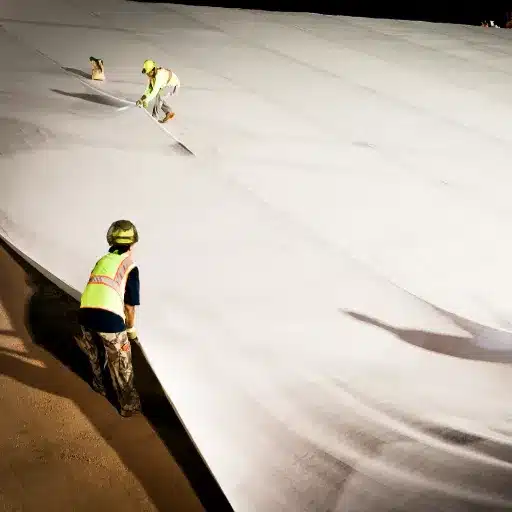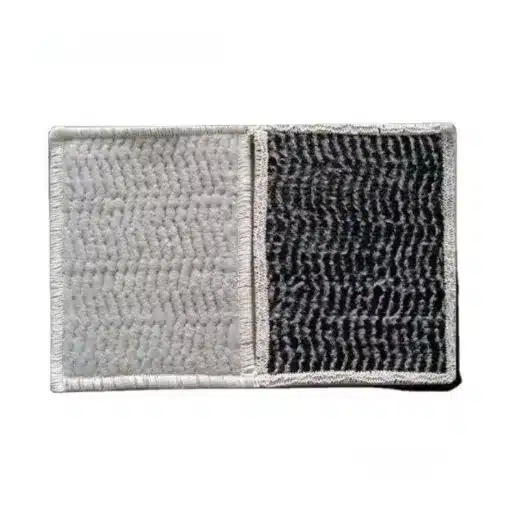
For road construction, choose a woven geotextile when you need reinforcement and stabilization over a weak subgrade, and a nonwoven geotextile when the priority is filtration, drainage, or separating fine soils from aggregate. Woven fabric carries load; nonwoven fabric moves water. The right choice depends on your subgrade’s California Bearing Ratio (CBR), the traffic it will carry, and whether the road is paved or unpaved.
When a contractor in Southeast Asia paved an access road over soft clay using only a 200 GSM nonwoven, heavy trucks rutted the surface within three months. The fabric separated the clay from the aggregate, but it could not provide the tensile strength the weak soil needed. Swapping to a high-strength woven geotextile and adding a biaxial geogrid at mid-depth stopped the rutting. That project illustrates the core lesson of this guide: for road construction, woven and nonwoven geotextiles solve opposite problems, and the wrong choice is expensive.
By the end of this article, you’ll know exactly which fabric type to specify, what AASHTO M288 class you need, how much aggregate a geotextile can save, and how to install it so it survives its first day under construction traffic.
Key Takeaways
- Woven geotextile is the standard for road-base reinforcement and subgrade stabilization; nonwoven geotextile handles drainage, filtration, and edge drains.
- Select by subgrade CBR: woven Class 1 for CBR 1–3, heavier separation fabrics for CBR 3–5, and woven plus geogrid below CBR 1.
- A woven geotextile can reduce aggregate base thickness by 25–50% and cut total road project cost by 20–40% on soft subgrades.
- AASHTO M288 defaults to Class 1 for stabilization; specify Class 1 woven (grab tensile ≥ 1,400 N) and install with overlaps matched to CBR.
- Nonwovens stretch more than 50% and cannot provide lateral restraint, which is why they fail as reinforcement under heavy haul traffic.
The Short Answer: Which Geotextile for Road Construction?
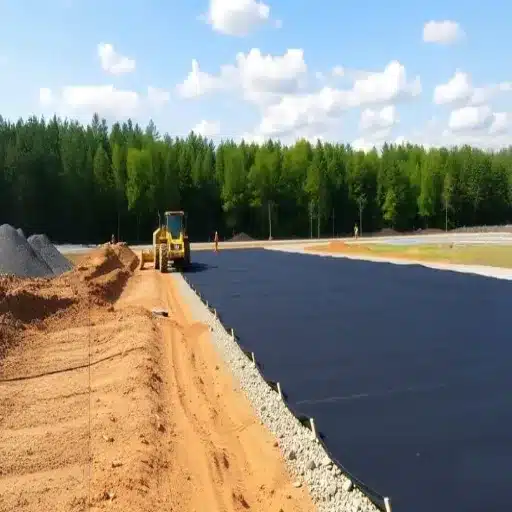
The fastest way to choose is to match the fabric to the engineering problem. Woven geotextile for road construction is the right call when the subgrade is soft, the road carries heavy loads, and you need to reinforce, stabilize, and stop aggregate from sinking into the soil. It offers high tensile strength with low elongation, typically 5–25%, which means it resists stretching and distributes wheel loads across the subgrade. Nonwoven geotextile is the right call when you need water to pass through while soil stays in place, such as in edge drains, French drains, and separation layers over fine-grained soils.
Remember the rule of thumb: force pulls, choose the weave; water passes, choose the felt. If you need both load-bearing and drainage, a layered or composite system often works best. For a complete picture of every application, see our full woven vs nonwoven geotextile comparison guide.
Woven vs Nonwoven Geotextile for Road Construction: Side-by-Side Comparison
| Property | Woven Geotextile | Nonwoven Geotextile |
|---|---|---|
| Primary road role | Reinforcement, stabilization, load distribution | Filtration, drainage, separation of fines |
| Tensile strength | High (often 20–100+ kN/m) | Moderate (10–30 kN/m typical) |
| Elongation at break | Low (5–25%) | High (>50%) |
| Permeability | Lower | Higher (better water flow) |
| Best for | Soft subgrades, haul roads, paved road bases | Edge drains, French drains, wet subgrades |
| AASHTO M288 stabilization | Class 1 woven (default) | Heavy nonwovens for survivability |
The two fabrics differ most sharply in elongation and permeability. A woven fabric with low elongation provides the membrane reinforcement that stops a soft subgrade from deforming under truck tires. A nonwoven fabric with high permeability lets trapped water escape, which prevents pore pressure from pumping fines upward into the base.
When to Use Woven Geotextile in Road Construction
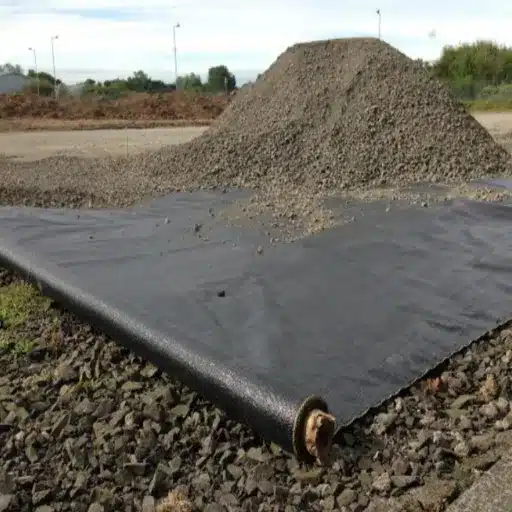
Woven geotextile is the load-bearing member of a road section. It belongs directly on the prepared subgrade, under the aggregate base course, where it separates the native soil from the stone and reinforces the whole structure.
Reinforcement and Stabilization Over Weak Subgrades
When a subgrade has a CBR below 3, the soil is too soft to support aggregate and traffic on its own. A woven geotextile provides two benefits at once. It stops fine soil from pumping upward into the base, and its high tensile strength spreads the wheel load over a wider area, reducing rutting. In design terms, the fabric acts as a tensioned membrane that restrains lateral movement of the subgrade.
Woven geotextiles are not all the same. They are made from slit-film, monofilament, or multifilament yarns, and each behaves differently. Slit-film wovens are cheap and strong but nearly impermeable, so they are poor choices where drainage matters. Monofilament wovens offer more open area and can filter. For road reinforcement, specify a high-tensile woven with wide-width tensile strength reported per ASTM D4595, not grab strength alone. We supply high-tensile woven geotextile products specified for haul roads and pavement stabilization.
Haul Roads, Construction Access, and Unpaved Roads
Unpaved roads and haul roads rely on geotextile reinforcement even more than paved roads. There is no asphalt to lock the section together, so a geotextile for haul road use must carry the load through aggregate confinement. Design methods such as Giroud and Noiray and Giroud and Han size the aggregate thickness using the subgrade strength, wheel load, and allowable rut depth. Field data show a high-strength woven can reduce total aggregate from more than 60 inches to 37 inches on a heavy haul road, a cut of roughly 38% in excavation and base material.
Mini-story: The access road that rutted in a season
In 2023, a contractor in West Africa built a 3 km access road over expansive clay with a CBR near 2. The first phase used only a light nonwoven for separation. Within three months, heavy trucks had created ruts 80 mm deep. The fabric kept the clay out of the aggregate, but the aggregate itself deformed because nothing provided lateral restraint. In the second phase, the engineer placed a Class 1 woven geotextile on the subgrade and added a biaxial geogrid at mid-depth in the 300 mm base. Rutting dropped to acceptable levels and the base was reduced by 100 mm without sacrificing performance.
When to Use Nonwoven Geotextile in Road Construction
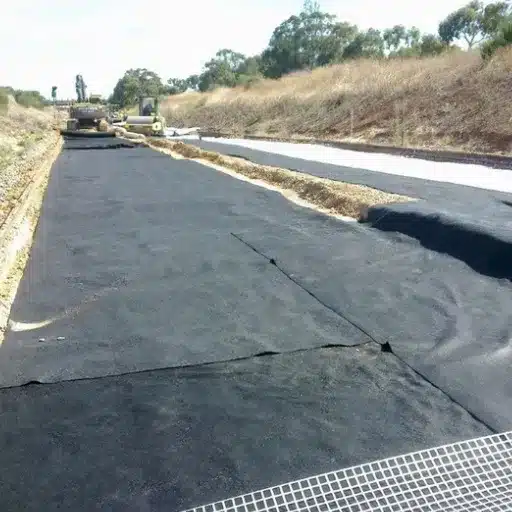
Nonwoven geotextile is the water-management layer of a road. It filters, drains, and protects, and it is the more commonly specified fabric in civil engineering for that reason.
Drainage, Filtration, and Edge Drains
Roads need to shed water, and nonwoven geotextiles make that happen. They line edge drains and French drains beside the road, wrap perforated pipe, and sit between the subgrade and a drainage aggregate to let water out while holding soil in. A nonwoven fabric’s high permittivity and gradient pore structure keep fine particles from clogging the drainage path.
For subsurface drainage along a road, a needle-punched nonwoven in the 4–8 oz range is the standard. Maine DOT, for example, specifies nonwoven at least 8 oz/sq yd for construction survivability where installation stresses are severe. The heavier the fabric, the better it resists puncture from angular aggregate and compaction equipment. For a complete guide to drainage applications, see our article on woven vs nonwoven geotextile for French drains.
Separation on Moderate Subgrades
Nonwovens also separate fine subgrade soils from coarse base aggregate. On firm, free-draining granular subgrades where reinforcement is not the priority, a heavy nonwoven can be sufficient. But when the subgrade is soft and the loads are heavy, do not use a nonwoven as the primary reinforcement layer. Nonwovens stretch more than 50% at break, which means they deform with the soil instead of holding it in place. That is exactly the failure we saw in the access road story above.
How to Choose for Your Road: The CBR-Based Decision Framework
The cleanest way to decide between woven and nonwoven geotextile for road construction is to start with the subgrade CBR. CBR measures soil strength under repeated loading, and it drives every standard design method.
Subgrade CBR Categories
| CBR Range | Soil Condition | Recommended Fabric |
|---|---|---|
| Below 1 | Very soft (peat, organic silt) | Woven Class 1 + geogrid or surcharge; often composite |
| 1–3 | Soft clay, silty sand | Woven Class 1 for stabilization (default) |
| 3–5 | Fair to moderate | Woven separation or heavy nonwoven |
| Above 5 | Good, free-draining | Lighter separation fabric |
Most road stabilization projects target CBR values between 1 and 3, where a woven geotextile for subgrade stabilization provides the reinforcement the subgrade lacks. Below CBR 1, fabric alone is usually not enough, and a geogrid or preload may be required. For the broader picture of weave types and their road behavior, see our geotextile fabric guide for road construction.
AASHTO M288 Survivability Classes
AASHTO M288 is the standard specification for geotextiles in highway applications. For stabilization, the default survivability class is Class 1, because installing over soft subgrade exposes the fabric to severe puncture, tear, and abrasion. The class also separates fabrics by elongation, which maps directly to the woven versus nonwoven decision.
| Property | Class 1 Woven (minimum) | Class 1 Nonwoven (minimum) | Test Method |
|---|---|---|---|
| Grab strength | 1,400 N | 900 N | ASTM D4632 |
| Trapezoid tear | 500 N | 350 N | ASTM D4533 |
| CBR puncture | 2,750 N | 1,800 N | ASTM D6241 |
| Permittivity | 0.02 s⁻¹ | 0.10 s⁻¹ | ASTM D4491 |
| UV stability | ≥50% retention after 500 h | ≥50% retention after 500 h | ASTM D4355 |
For design strength, use wide-width tensile data per ASTM D4595 rather than grab tensile alone. Agencies such as NCDOT require a minimum wide-width tensile strength of 1,900 lb/ft at 5% strain and 4,800 lb/ft ultimate for pavement stabilization. If your project sits on weak, seasonally wet ground, a Class 1 woven will outperform a lighter separation fabric in the long run.
Installation Guidance for Road Applications
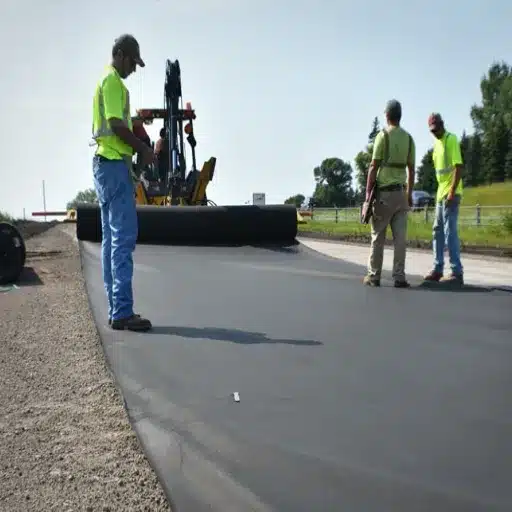
A Class 1 woven geotextile can fail on the first day if installed poorly. Follow these road-specific steps.
- Prepare the subgrade. Clear vegetation and sharp stones, shape a cross-slope of 4–5% so water drains laterally, and compact to at least 95% of standard Proctor density where possible.
- Roll out the fabric directly on the subgrade in the direction of primary traffic. Keep it taut but do not stretch it more than 5%, and remove wrinkles larger than 0.5 m².
- Match the overlap to the CBR. Use 300–450 mm for CBR ≥ 3, 600–900 mm for CBR 1–3, and 900 mm or a sewn seam below CBR 1.
- Anchor the edges. Place the fabric into a trench at least 300 mm deep at shoulders and transitions, then backfill and compact.
- Cover it fast. Limit UV exposure to under 24–48 hours. Strength losses can exceed 15% after two days of direct sun.
- Place aggregate by end-dumping from the edge, and use static rollers on the first lift. Avoid vibratory compaction until the initial lift protects the fabric.
For the full installation sequence, see our geotextile installation best practices guide.
Cost and Aggregate Savings for Road Projects
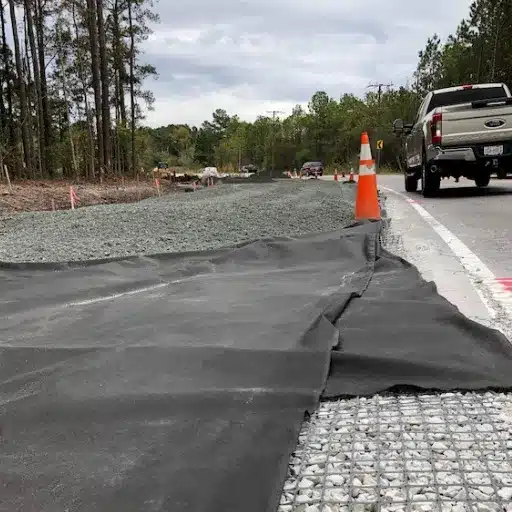
The economics of geotextile reinforcement are compelling on soft subgrades. A woven geotextile can reduce aggregate base thickness by 25–50%, and total project cost savings of 20–40% are reported for stabilized road structures. Traffic benefit ratios, which measure how many more load cycles a reinforced section withstands, typically run 2.0–3.0, meaning the road lasts two to three times longer.
In a nine-state DOT study, a high-performance woven geotextile achieved a base-course reduction of 26.9% and a traffic benefit ratio of 14.8, outperforming biaxial geogrid on both metrics. The fabric itself represents only about 13% of total roadway material cost for woven versus 6.5% for nonwoven, yet it can eliminate much larger rehabilitation costs down the line. For a detailed price breakdown by fabric type and weight, see our woven vs nonwoven geotextile cost comparison.
Mini-story: The false economy of the cheap fabric
A quarry haul road in South America was built with a light nonwoven geotextile chosen mainly for its low price. The design team treated it as reinforcement. Within a year, 300-ton haul trucks tore and displaced the fabric, and the road needed a full rebuild. Switching to a woven separation layer with a biaxial geogrid raised the initial material cost by roughly 25%, but the road lasted more than five years without major maintenance. The cheapest fabric turned out to be the most expensive decision.
When to Use Geogrid Instead
Geotextile soil stabilization works best when the primary problem is a weak subgrade under a road. Geogrid becomes the better choice when you need high tensile stiffness over large deformations, such as heavy industrial yards, container terminals, and very soft ground below CBR 1. On many projects, the two materials work together: a woven geotextile on the subgrade provides separation and filtration, while a geogrid within the base provides structural reinforcement. For a full decision framework, see our geogrid vs geotextile comparison.
Frequently Asked Questions
Which is better for road construction, woven or nonwoven geotextile?
Woven is better for reinforcement and stabilization over weak subgrades. Nonwoven is better for drainage, filtration, and edge drains. Match the fabric to the primary function.
Does geotextile go under the road base?
Yes. The geotextile is placed directly on the prepared subgrade, beneath the aggregate base course, where it separates the soil and reinforces the section.
What geotextile do you use for soft subgrade?
For CBR 1–3, specify a Class 1 woven geotextile. Below CBR 1, combine a woven geotextile with geogrid or a surcharge.
How much aggregate can geotextile save?
On soft subgrades, a woven geotextile can reduce aggregate base thickness by 25–50%, which translates to significant material and cost savings.
Do I need geogrid or geotextile under my road?
For a weak subgrade with heavy traffic, a combined system is often best: woven geotextile for separation and geogrid for structural stiffness.
Conclusion
Choosing between woven and nonwoven geotextile for road construction comes down to the engineering problem you are solving. Woven geotextile carries load; it reinforces, stabilizes, and distributes weight over weak subgrades. Nonwoven geotextile moves water; it filters, drains, and separates fine soils. Start with the subgrade CBR, specify AASHTO M288 Class 1 for stabilization, use wide-width tensile data for design, and install with overlaps matched to ground conditions.
Get these decisions right and a geotextile can cut aggregate use by a quarter to half, extend pavement life, and save 20–40% in total project cost. Get them wrong and you face rutting, pumping, and expensive rebuilds. We also cover the related choices in our guides on woven or nonwoven geotextile for gravel driveways, woven vs nonwoven geotextile for erosion control, and geotextile UV resistance and service life.
If you are planning a road, haul road, or construction access track over weak ground, our engineering team can review your CBR data and recommend a woven geotextile specification matched to your project. We supply geotextiles for road projects worldwide under ISO9001 quality systems, with retained test samples and flexible order quantities. Request a technical quote →