The short answer: a geogrid for road base reinforcement typically cuts compacted aggregate thickness by 20% to 50% on weak subgrades and extends pavement life by two to three times. The longer answer is why three suppliers will quote you three different numbers for the same soil, and how to work out which number your project can actually use.
Ask for a thickness recommendation today and you will get a chart. Ask for the method behind that chart and the conversation usually stops. That is the problem this guide fixes. A geogrid only earns its cost when the aggregate section is sized to the subgrade, the grade matches the traffic, and the grid is installed so the stone can interlock with it.
You have probably been told that geogrid “saves rock.” You have probably also seen the savings claimed as 20%, 40%, or “up to 60%” with no soil data attached. Both reactions are reasonable. This guide gives you the numbers, the standards behind them, and the cases where a geogrid is the wrong purchase.
What you will get: aggregate thickness charts by subgrade CBR, realistic base course reduction figures, a plain-language grade selection table, a seven-step installation protocol, current material pricing, and a buying checklist you can send to a supplier. It is written for contractors, civil engineers, and homeowners stabilising a gravel driveway, because the same physics applies at both scales. If you are new to the material, the complete guide to geogrid types and applications explains the family first.
Key Takeaways
- On weak subgrades (CBR below 4), a geogrid typically reduces compacted base thickness by 20% to 50%, with 20% to 40% the most common range.
- Savings shrink as the subgrade improves. Above roughly CBR 4 to 8, the thickness credit is small and the grid often is not worth buying.
- A published chart is only as good as its method. USACE CBR thresholds, Giroud-Han for unpaved roads, and AASHTOWare or APT-calibrated BCR for paved roads give different answers by design.
- Minimum cover over the grid is 100 to 150 mm of compacted angular stone. No equipment should ever drive on exposed geogrid.
- Material cost of $0.50 to $7.00 per square metre is usually a small fraction of the aggregate it replaces, which is why the payback is strongest on soft ground.
In this guide: base thickness by soil · aggregate savings · grade selection · installation · parking areas · drainage and frost · cost · buying checklist
What Is a Geogrid for Road Base?
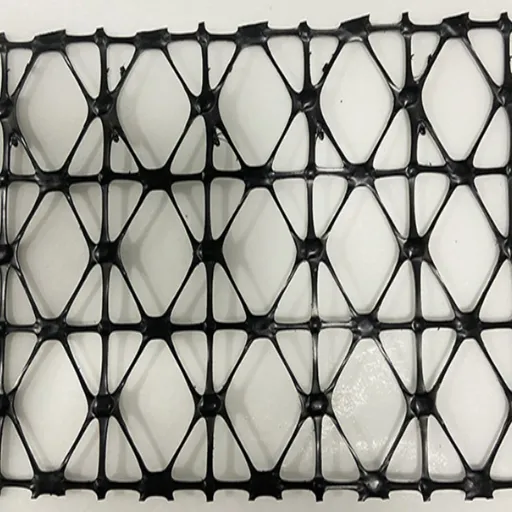
A geogrid for road base is a high-strength polymer grid laid between the subgrade and the aggregate base course. It interlocks with the stone, confines it under wheel loads, and spreads stress over a wider area, which lets a thinner base carry the same traffic.
Three mechanisms do the work. Lateral restraint stops aggregate from being pushed sideways out from under the wheel. Increased bearing capacity raises the load the subgrade can support before it fails. Tensioned membrane support helps on unpaved roads once ruts begin to form and the grid starts carrying load in tension.
The distinction that matters most at the buying stage is reinforcement versus separation. A geogrid reinforces. A geotextile separates, filters, and drains. On soft fine-grained ground you often need both, in the right order. If you want the full mechanism explanation, read how geogrid reinforcement works; for the wider product picture, the complete guide to geogrid types and applications covers the family.
Materials are usually polypropylene for standard road and driveway grades, polyester for heavy load applications, and HDPE for stiffer extruded grids. The polymer matters less than the tensile strength at low strain and the aperture geometry, which is where the grade selection section below comes in.
How Much Base Can a Geogrid Save?
Base course reduction, usually written as BCR, is the percentage of aggregate thickness you can remove while keeping the same performance. On weak subgrades the published range is 20% to 50%, with 20% to 40% the figure most design guides converge on. For a geogrid for road base design, BCR is the number to ask a supplier to justify, not the headline savings figure.
Full-scale trafficking tells a similar story. A University of Nevada, Las Vegas study cut a 406 mm unreinforced base by 26% with biaxial geogrid and 45% with triaxial. On a thinner 305 mm section the reductions were 29% and 36%. The thicker the base, the smaller the percentage saving, which is why thick sections rarely justify a grid on cost alone.
A University of Illinois study in Transportation Geotechnics (2024) reported 20% to 40% thinner aggregate layers, 50% to 200% higher base stiffness, and more than 50% less rutting. The authors put the saving at $100,000 to $500,000 per mile on projects where the reduced section was actually built.
Service life improves too. The traffic benefit ratio, or TBR, typically runs 2.0 to 3.0 times, meaning the reinforced section carries two to three times the traffic before reaching the same rut depth. Mechanistic modelling has produced figures as high as 8.9 times, though those numbers depend heavily on the assumed failure criterion. MnDOT’s granular equivalent (GE) research expresses the same benefit as an equivalent thickness of aggregate, which is the form many US pavement designs use.
A field case that gets cited often is Interstate 90 near Chicago. The reinforced section used 10 inches of base instead of 18 inches over soft clay and showed no measurable rutting after 5 million ESALs. That is the outcome the percentage figures are trying to describe.
The honest caveat: these savings belong to weak ground. On a firm subgrade above CBR 4 to 8, the grid still helps with confinement and construction traffic, but the thickness credit is modest. If your subgrade is firm and well drained, adding stone or improving drainage may be the cheaper answer.
If you have a soil report and a traffic estimate, send them to our team and we will return a section recommendation with the design method stated, not just a number. Request a technical quote.
Aggregate Thickness Charts by Subgrade CBR
The California Bearing Ratio, or CBR, is a simple measure of subgrade strength expressed as a percentage. A CBR of 2 is soft, wet clay. A CBR of 10 is a firm, well-compacted granular soil. You can get the value from a laboratory test or estimate it in the field with a cone penetrometer and a proof roll.
The table below gives compacted aggregate thickness over a biaxial geogrid for light vehicles and light trucks. The final column shows the unreinforced thickness for comparison, so you can see the saving rather than take it on trust.
| Subgrade CBR | Cars and light vans (over geogrid) | Light trucks (over geogrid) | Without geogrid (light trucks) |
|---|---|---|---|
| Firm, 8 or above | 100 to 150 mm | 150 to 200 mm | 200 to 250 mm |
| Medium, 4 to 8 | 150 to 200 mm | 200 to 250 mm | 250 to 300 mm |
| Soft, 2 to 4 | 200 to 250 mm plus separator | 250 to 300 mm | 300 to 350 mm |
| Very soft, below 2 | 300 to 400 mm, two lifts | 350 to 450 mm | 400 to 500 mm |
The final column is the unreinforced section for the same light-truck loading, so the gap between columns three and four is the base course reduction the grid earns. It runs from about 25% on firm ground to about 30% on soft ground, consistent with the published range above.
Three rules sit above the table. First, never place less than 100 to 150 mm of compacted cover over the grid, and make the first lift 150 to 200 mm so the grid lies flat and supported. Second, on silts and clays at CBR 4 or below, add a nonwoven separator geotextile beneath the grid to stop fines pumping upward. Third, in seasonal frost regions add 50 to 100 mm for frost-susceptible soils.
The US Army Corps of Engineers design guidance, ETL-1110-1-189, sets the practical boundaries. Below CBR 0.5 you are designing a construction platform, not a pavement. Between 0.5 and 4 you stabilise and reinforce, and a separator is advisable at the lower end. Above CBR 4 the thickness credit becomes minimal and you design the section normally.
Why Geogrid Design Charts Disagree
There is no single codified geogrid design method. Unpaved roads are usually designed with the Giroud-Han method, which uses a bearing capacity factor and an allowable rut depth. Paved roads are increasingly designed with AASHTOWare Pavement ME or with BCR values calibrated by accelerated pavement testing, such as the FHWA/TX-23/0-6834-1 study. USACE uses CBR thresholds and credit rules. Each method assumes a different failure criterion, so each returns a different thickness. That is normal, not dishonest.
When a supplier sends you a chart, ask three questions: which method produced it, what traffic and failure criterion were assumed, and whether the grid tested matches the grid quoted. A supplier who cannot answer all three is selling a product, not a design.
For volume calculations, including compacted versus loose conversion and worked examples, see how much gravel over geogrid. For aggregate specification and aperture matching, see aggregate for geogrid base course.
How to Choose Geogrid Type and Grade for a Road Base
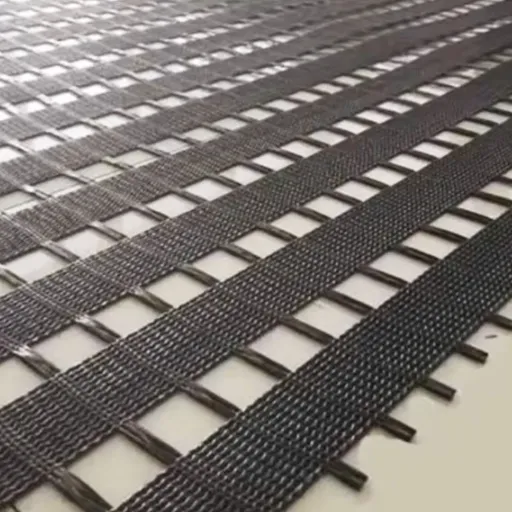
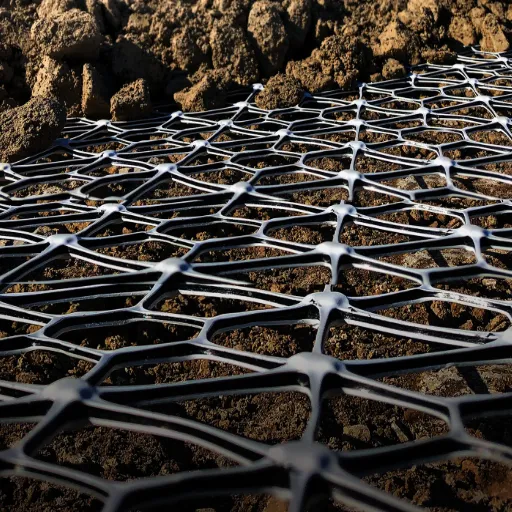
Type comes before grade. Biaxial geogrid for road base reinforcement is the default choice: rectangular apertures and balanced strength in two directions. It suits road bases, driveways, parking areas, and large-area subgrade stabilisation. Triaxial geogrid uses triangular apertures and spreads load in three directions, which suits heavy, multidirectional traffic such as highways, haul roads, and container yards. Uniaxial geogrid carries load in one direction only and belongs in retaining walls and steep slopes, not road bases.
Grade is the nominal ultimate tensile strength in kilonewtons per metre, written as a pair because biaxial grids are tested in both directions. The numbers below are a starting point for selection, not a substitute for design.
| Grade (kN/m) | Typical use | Subgrade CBR | Traffic |
|---|---|---|---|
| 15-15 | Footpaths, light access, garden parking | 4 to 8 | Occasional cars |
| 20-20 | Residential driveways, RV and boat pads | 3 to 6 | Cars, light vans |
| 30-30 | Highway base, commercial yards, haul roads | 1 to 4 | Trucks, buses |
| 40-40 | Industrial hardstanding, container yards | below 2 | Heavy axles |
| 50-50 | Mining, port, very heavy duty | below 1 | Very heavy, channelised |
Two warnings. First, “strongest” is often the wrong buy. A 50-50 grid on a firm driveway adds cost and stiffness you cannot use, and the stiffer grid can be harder to lay flat. Second, grade naming is not standardised across manufacturers. A 30-30 from one factory may not match a 30-30 from another once you look at strain at 2%, junction efficiency, and long-term design strength. Compare test reports, not labels.
For the full type comparison, read biaxial vs triaxial geogrid. For the plain-language grade decoder aimed at buyers, see what geogrid for driveway.
For test methods and long-term design strength, see geogrid specifications.
Geogrid for Gravel Driveways: The Short Answer
Yes, a geogrid works under a gravel driveway, and it works best on soft, wet, or clay ground. It confines the stone so it stops punching into the subgrade, which reduces rutting, washouts, and the annual top-up of loose gravel. On firm, well-drained ground the benefit is smaller and a separator geotextile alone may be enough.
Base depth follows the same CBR logic as a road. For cars, allow 100 to 150 mm on firm ground, 150 to 200 mm on medium ground, and 200 to 250 mm on soft ground, plus a separator on clay. A standard polypropylene biaxial grid in the 20-20 range suits most residential driveways.
If your driveway turns to mud every wet season, the grid is only part of the fix. Drainage comes first. For the full homeowner treatment, including when geogrid is wasted money, read geogrid for gravel driveway. For clay and mud specifically, see geogrid for driveway clay soil.
For the separator decision, see geogrid vs geotextile for driveway.
Paved vs Unpaved Roads: The Design Difference
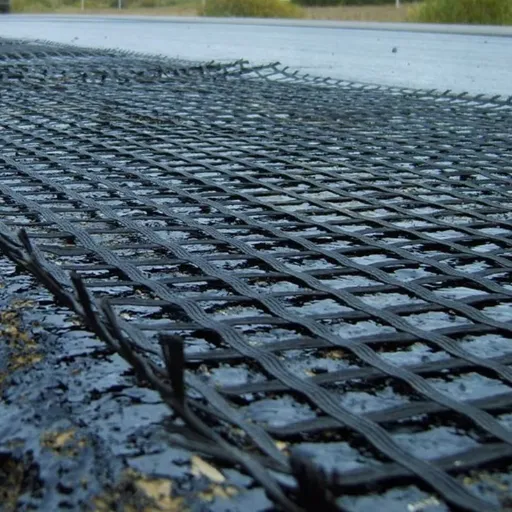
The design logic changes with the surface. On an unpaved road, the grid works through confinement and, once ruts develop, tensioned membrane action. The usual design target is an allowable rut depth of about 50 mm, and Giroud-Han is the standard method.
On a paved road, the grid acts as base course reinforcement beneath the asphalt. It raises the stiffness of the granular layer, reduces rutting and differential settlement, and earns a thickness credit under USACE rules or a BCR value from full-scale testing. Compaction control matters more here, because a soft subgrade under a stiff base can pump during rolling.
The analytical case for reinforcement is the bearing capacity factor. Giroud and Han give Nc = 5.71 for a geogrid-reinforced unpaved section, against 3.14 unreinforced and 5.14 for geotextile only. That jump is the reason a thinner section can carry the same wheel load.
One common confusion is worth clearing up. Base course geogrid is not the same product as an asphalt interlayer grid used to delay reflective cracking. Different product, different problem, different specification. If your issue is cracks reflecting through a new overlay, you need an interlayer, not a base grid.
For rural and municipal gravel roads and their maintenance cycle, see geogrid for gravel road. For working platforms and very soft ground, see geogrid for soft ground and subgrade stabilization.
How to Install Geogrid in a Road Base
Installation decides whether the design works. A grid that is wrinkled, buried under the wrong stone, or driven on before it is covered loses most of its benefit. The sequence below is the field version that survives construction traffic.
- Strip and prepare the subgrade. Remove topsoil and organics, proof roll the surface, and undercut any soft spots, replacing them with compacted granular fill.
- Lay a separator if needed. On silts and clays at CBR 4 or below, place a nonwoven separation geotextile with 300 mm overlaps and pin it.
- Place the first lift. Spread and lightly compact 100 to 150 mm of crushed stone so the grid has a flat, supported bed.
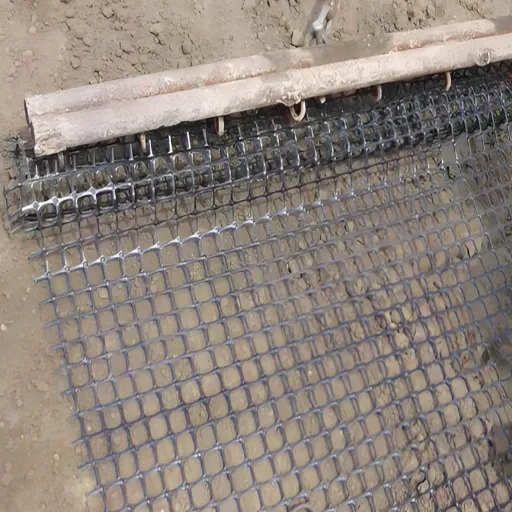
- Roll out the grid. Run it perpendicular to the direction of traffic, pull it taut by hand or with a spreader bar, and remove every wrinkle.
- Pin and overlap. Stake edges every 1 to 2 metres. Overlap seams 300 mm on firm ground and up to 900 mm on soft ground, and stagger panel ends.
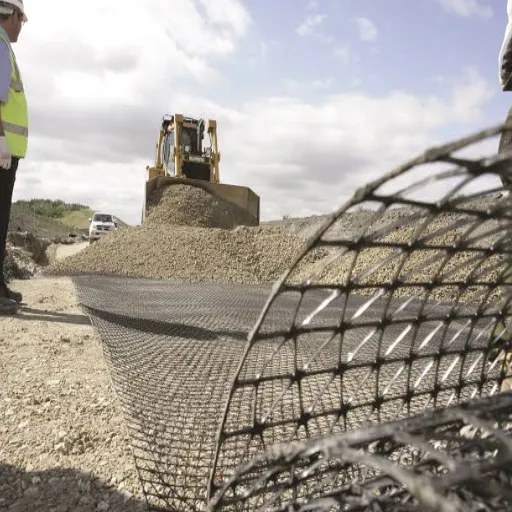
- Cover before trafficking. Back-dump aggregate from the far end so no vehicle drives on exposed grid. Keep at least 150 mm of cover at all times.
- Compact in lifts. Place and compact in 150 to 200 mm lifts to at least 95% Standard Proctor, adjusting moisture as needed.
Installation Quality Checks
Use angular, well-graded crushed stone, typically 0 to 32 mm or three-quarter-inch minus with limited fines. Rounded pea gravel will not interlock with the apertures and defeats the purpose.
Keep UV exposure to seven to fifteen days at most before covering, and never drag a bucket across exposed grid.
Consider a typical access road project in Accra. The crew lays 600 square metres of biaxial grid across soft ground, then drives the delivery truck straight over it to reach the far end. The tracks tear two panels and stretch a third. The repair costs more than the extra hour of back-dumping would have. The rule that follows is simple: the truck never touches the grid.
For the general installation protocol, see geogrid installation. For a driveway-specific DIY sequence with tools and timing, see how to install geogrid for gravel driveway.
Parking Areas, Pads & Heavy Vehicles
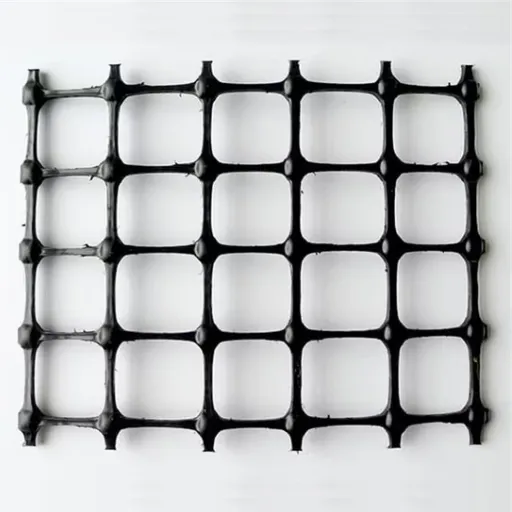
Parking areas fail for the same reasons a road base does. A geogrid for parking lot design follows the same logic, but the load range is wider: a residential pad for a car is not the same structure as a commercial lot taking delivery trucks, and a fire lane is heavier again.
Load classes drive the section. Cars and light vans need 100 to 150 mm over the grid on firm ground. RVs, boats, and trailers need 150 to 200 mm, and the grid should be a 20-20 or better. Delivery trucks and service vehicles need 200 to 250 mm and a 30-30 grade. Fire lanes designed for H-20 loading are usually set by local code or project design, and a supplier chart should not be treated as authority for them.
Two details matter more on parking than on a straight road. Grading and drainage determine whether water sits on the surface, and standing water will find the weakest point in any section. Edge restraint stops the granular layer from spreading at the perimeter, which is where most residential pads start to unravel.
Permeable pavers can sit over a geogrid-reinforced base, but the gradation and the aperture must be matched, and the design should account for the reduced compaction under the paver bedding.
For load-class design and commercial lot procurement, see geogrid for parking lot. If you are planning a pad, a yard, or a fire lane, request a technical quote with the vehicle types and the subgrade information.
Drainage, Frost & Long-Term Road Base Performance
A geogrid spreads load. It does not drain water. This is the single most common misunderstanding in driveway and road base work, and it is why some installations fail even when the grid and the stone were correct.
If the subgrade holds water, the effective CBR drops, sometimes by half after a wet season. A grid sized for CBR 3 may be carrying a CBR 1.5 subgrade by spring. Fix the drainage first: shape a crown, cut side ditches, and add an underdrain where the water has nowhere to go. Then size the section for the drained condition.
Frost is the second seasonal factor. In cold regions, frost-susceptible silts and fine sands draw water upward, form ice lenses, and lose strength during thaw. On a road base, a geogrid does not prevent frost heave. It helps by allowing a thinner section and by confining the aggregate, but the design still needs frost depth, a drainage path, and in many cases a frost blanket. Add 50 to 100 mm to the section for frost-susceptible soils.
Long-term performance comes down to three things: the grid’s long-term design strength rather than its ultimate strength, the aggregate staying where it was placed, and water leaving the section. Creep matters in reinforced walls and steep slopes more than in road bases, but the principle is the same. Design on the strength that survives fifty years, not the number on the datasheet headline.
For cold-climate detailing, see geogrid frost heave. For creep, see geogrid creep.
Geogrid for Road Base Cost: What to Budget

Material price varies more by grade and polymer than by brand. Expect roughly $0.50 to $7.00 per square metre depending on strength class, with US retail around $0.28 to $0.55 per square foot and factory-direct ex-works pricing from about $0.01 to $0.08 per square foot plus freight.
The Unit Conversion Trap
The unit trap catches buyers every week. One dollar per square metre is about nine cents per square foot. A quote in one unit and a budget in the other can look like a 10% difference when it is really a factor of ten. Convert both to the same unit before comparing.
Total Installed Cost Beats Material Price
Material cost is not the decision. The decision is total installed cost. If a grid at $2 per square metre lets you remove 100 mm of compacted aggregate, the aggregate, haulage, and compaction you avoid usually cost several times the grid. That is why the payback is strongest on soft ground, where the section is thickest and the saving is largest.
Picture a procurement team comparing three quotes for a 4,000 square metre hardstanding. Two are in dollars per square foot and one in dollars per square metre. The cheapest-looking quote is the most expensive once converted, and the apparent premium option is the lowest total. Only one supplier can produce tensile test reports for the exact roll grade quoted.
For full pricing by type, polymer, and region, see geogrid cost per square meter. For a complete driveway budget including stone, excavation, and labour, see geogrid driveway cost.
How to Buy Geogrid for a Road Base
Buy by specification, not by product name. The five items to state in a request are the function (reinforcement or stabilisation), the design subgrade CBR, the design traffic, the aggregate gradation, and the required layer thickness. Add the roll width and the project location, and you have a quote that can actually be compared.
Then verify the material:
- ASTM D6637 tensile test data for the exact grade quoted.
- Long-term design strength, typically 33% to 50% of the ultimate value.
- Junction efficiency of at least 90%.
- An aperture matched to the aggregate: a D50 of about half the aperture, or stone 1.5 to 3 times the nominal aperture.
- Carbon black content of at least 2% for UV resistance.
- An ISO 9001 quality system.
A supplier checklist that separates serious exporters from traders:
- Can they send test reports for the specific roll grade, not a generic datasheet?
- Do they state the design method behind any thickness recommendation?
- Is the minimum order quantity flexible enough for your project size?
- Can they document export packing, shipping terms, and lead time?
- Do they offer technical consultation on installation, not just a price?
Shanxi Shengxing supplies export-ready geogrids with technical consultation and flexible minimum order quantities, and we will tell you when a grid is not the right answer for your ground. For the full selection framework, read how to choose a geogrid. To see the product range, visit geogrid for road bases and driveways.
Frequently Asked Questions
How thick should the aggregate base be over geogrid?
It depends on the subgrade CBR. On firm ground, 100 to 150 mm of compacted aggregate is enough for cars. On medium ground, use 150 to 200 mm. On soft ground, 200 to 250 mm plus a separator. Never place less than 100 to 150 mm of cover over the grid.
How much gravel do I need over geogrid?
Work from the compacted thickness, not the loose volume. Loose stone is roughly 1.3 times the compacted volume, so a 150 mm compacted layer needs about 195 mm of loose depth before compaction. Multiply by the area, then convert to tonnes using the aggregate supplier’s bulk density.
Do you need a geotextile under geogrid on a driveway?
On silt or clay at CBR 4 or below, yes. A nonwoven separator stops fines pumping into the aggregate, which would otherwise clog the layer and undo the reinforcement. On clean, firm granular ground, the separator is optional and the geogrid alone is usually enough.
Is geogrid worth it for a gravel driveway?
On soft, wet, or clay ground, usually yes. It reduces rutting, washouts, and annual top-ups, and it often halves the stone required. On firm, well-drained ground the benefit is small, and improving drainage or adding a separator may be the better spend.
Biaxial or triaxial geogrid for a road base?
Biaxial is the standard for road bases, driveways, and parking areas. Triaxial spreads load in three directions and suits heavy, multidirectional traffic such as highways, haul roads, and container yards. Choose by function and traffic first, then by grade.
Can geogrid fix a muddy driveway?
Not on its own. Mud usually means water is not leaving the section. Fix the grading, add side ditches or an underdrain, then place a separator and a geogrid in a properly graded stone layer. A grid over a saturated subgrade will still rut.
What grade of geogrid do I need for a driveway?
Most residential driveways use a biaxial 20-20 or 30-30, depending on the subgrade and the vehicles. A 15-15 suits light access and footpaths. A 40-40 or 50-50 is for heavy axles and industrial use. Confirm the grade against test data, not the label alone.
Conclusion
A geogrid for road base is one of the few geosynthetics that pays for itself in visible, measurable ways: less aggregate, fewer ruts, fewer top-ups, and a longer service life. The saving is real, but it is conditional. It depends on the subgrade strength, the grade selected, the aggregate, the drainage, and the installation.
The pattern that works is consistent. Test or estimate the CBR. Choose the section from a method you can name. Pick the lowest grade that satisfies the function. Use angular, well-graded stone. Keep the grid taut, covered, and untrafficked until it is buried. Then check that water has somewhere to go.
If you are comparing supplier charts and the numbers do not line up, that is expected. Ask for the method, the assumptions, and the test reports. A supplier who can answer those three questions is worth the premium. One who cannot is selling you a roll of plastic.
Send us your soil report, traffic estimate, and project location, and our engineering team will return a section recommendation with the method and assumptions stated. Request a technical quote and tell us what you are building.