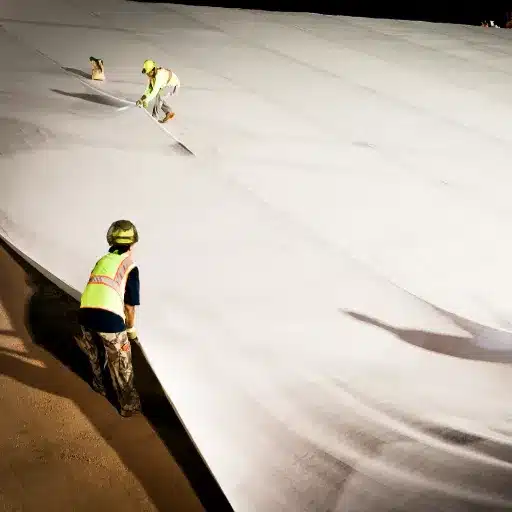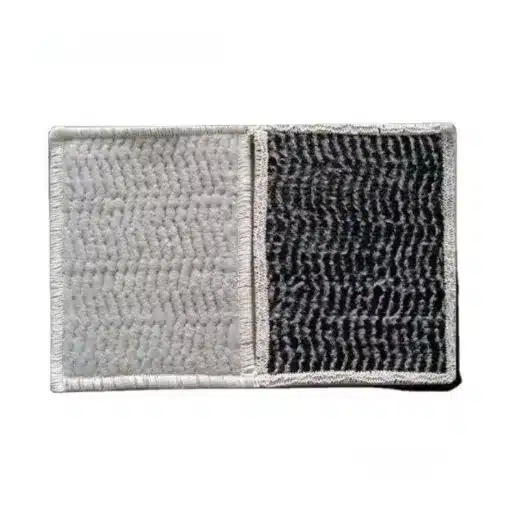
For a gravel driveway that carries vehicle traffic, woven geotextile is the right choice under the gravel base. Use nonwoven geotextile for drainage features like French drains and for most residential paver patios where water must pass through.
If you have been fighting gravel that keeps sinking into mud, ruts that swallow your tires, or weeds pushing up through the stone, the fabric under your driveway is usually the culprit. Most homeowners only find out after a tow truck visit or a spring re-grading bill that the wrong fabric choice costs far more than the fabric itself.
Here is what this guide covers: which geotextile type belongs under your driveway, what weight and grade to buy, how much gravel you really need, and how to install it so it works for decades. By the end, you will be able to walk into any supplier with a spec, not a guess.
Key Takeaways
- Use woven geotextile under the traffic-bearing gravel base of a driveway to prevent sinking, rutting, and mud, and to reduce gravel volume by up to 30%.
- Use nonwoven geotextile for drainage elements (French drains, edge drains) and for residential paver patios where permeability and weed blocking matter.
- A commercial-grade woven rated at 200+ lb tensile strength is the practical baseline for a vehicle driveway; heavy clay subgrades need a heavier woven or a geogrid.
- Plan 4-6 in. of gravel over the fabric on stable soil, and 6-10+ in. over clay or for heavy vehicles.
- Installation mistakes, especially short overlaps and UV exposure, cause most driveway fabric failures, not material defects.
Woven or Nonwoven Geotextile for a Gravel Driveway: The Short Answer
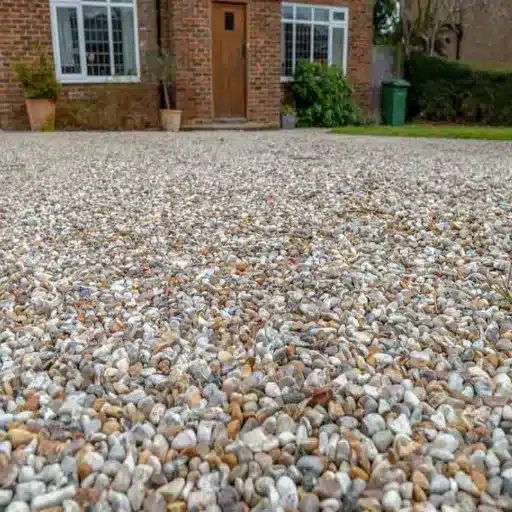
The rule of thumb is simple: loads on top, choose the weave; water through, choose the felt.
Woven geotextile is manufactured from flat yarns interlaced on a loom, which gives it high tensile strength and low stretch. It holds its shape under weight, spreads a vehicle’s load across the subgrade, and stops the gravel from punching down into soft soil. That is exactly what a driveway needs.
Nonwoven geotextile is made from randomly oriented fibers bonded together, most often by needle punching. It is highly permeable, so water flows through it while fine soil particles stay trapped. That makes it the go-to for drainage systems, but under heavy, repeated vehicle loads it can stretch and deform where a woven fabric would hold firm.
If you are comparing materials for the first time, the woven vs nonwoven geotextile comparison hub breaks down the manufacturing and performance differences in detail. This guide focuses on the driveway question specifically.
Woven vs Nonwoven for Driveways: Side-by-Side Comparison
| Property | Woven Geotextile | Nonwoven Geotextile |
|---|---|---|
| How it is made | Yarns interlaced on a loom | Random fibers bonded by needle punching or heat |
| Tensile strength | High (200-315 lb grab typical for driveways) | Moderate (often tears at 120-160 lb) |
| Stretch at break | 5-25% (holds shape under load) | More than 50% (deforms under repeated load) |
| Water flow | Low (about 4-5 gpm/ft²) | High (about 90-110 gpm/ft²) |
| Primary driveway role | Separation and stabilization of the gravel base | Drainage and filtration (French drains, edges) |
| Best for | Gravel driveways, parking areas, delivery zones | Paver patios, drainage trenches, weed control |
| Typical weight | 4 oz+ for driveways (200+ lb tensile) | 4-8 oz depending on traffic and drainage |
The two numbers that matter most for a driveway are tensile strength and stretch. A woven fabric rated at 200 lb or more carries the load without tearing, and because it stretches only 5-25%, it stays taut and keeps the stone base from pumping up through the fabric. A nonwoven can stretch more than 50% before it fails, which is why light nonwovens are not recommended under a traffic-bearing gravel base.
For weight and grade selection, the geotextile gsm weight guide maps fabric weights to applications and AASHTO survivability classes.
When to Use Woven Geotextile for a Gravel Driveway
The “Snowshoe Effect”: How Woven Carries Vehicle Loads
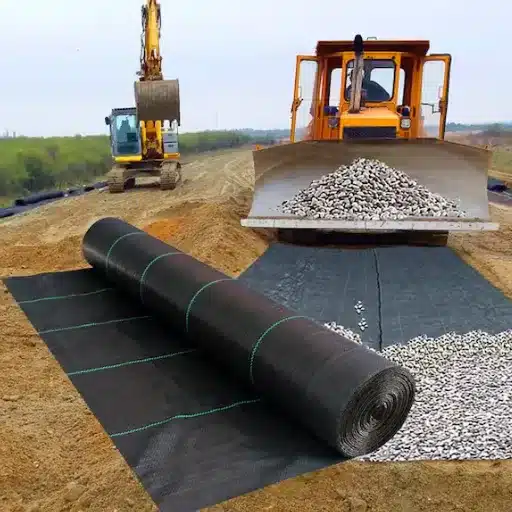
Think of a woven geotextile as a snowshoe for your driveway. When a car drives over a gravel driveway, the tire pushes down with concentrated force. Without reinforcement, that force drives the gravel into the soil below. The more it sinks, the deeper the rut, and the more water pools in the wheel tracks, which makes it sink faster.
Woven geotextile spreads that concentrated load across a wide area of subgrade, exactly like a snowshoe spreads a walker’s weight over deep snow. The gravel stays where you put it, the base stays thick, and the driveway stays level under repeated traffic.
Separation: Keeping Gravel Out of the Mud
Beyond load spreading, the woven layer performs a separation function. It forms a physical barrier between the gravel base and the subgrade. Gravel can no longer sink into the mud, and fine clay or silt can no longer migrate up into the stone. That barrier is the single biggest reason a well-built gravel driveway can need up to 30% less stone than one built directly on soil.
Traffic Cases That Demand Woven
- Everyday passenger cars and SUVs
- Delivery vehicles and concrete trucks that turn on the driveway
- Parking areas with repeated movement
- Driveways over clay or silty soil, where the subgrade is soft
If you are planning a heavier application with high truck volumes, the woven vs nonwoven geotextile for road construction guide covers the CBR-based engineering for haul roads and pavements.
Mini-story: The clay-soil driveway rescue
When Dan bought his rural property in March 2024, the previous owner’s gravel driveway was little more than stones floating in a wet clay slurry. He added 3 in. of fresh gravel that spring, and by December a truck had to winch his car out of a two-foot mud pit. The fix was not more gravel. He excavated to 10 in., laid a commercial-grade woven geotextile, and backfilled with 8 in. of angular crushed stone. Three winters later, the driveway has needed no re-grading at all. The fabric cost him about $150. The tow truck and re-grading cost him more than twice that every single year before.
When to Use Nonwoven Geotextile for a Driveway
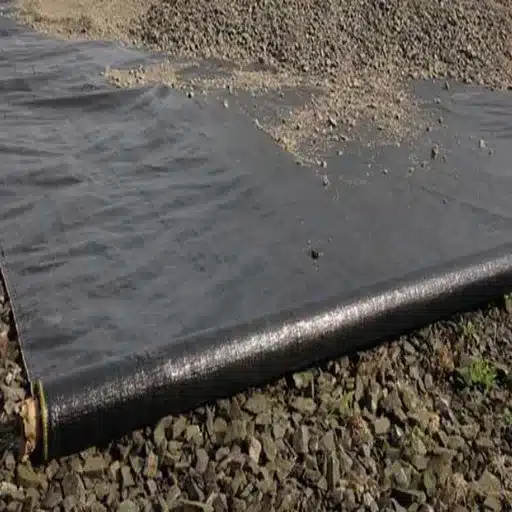
Filtration and Drainage Along the Driveway
Nonwoven geotextile earns its place on driveway projects, but usually not under the main traffic base. It is the right fabric for the drainage elements around and beside the driveway: French drains, edge drains, trench drains, and the filter wrap around perforated pipe. Because it lets water pass while trapping soil particles, it keeps those drainage systems from clogging with fines.
If water tends to sheet across your driveway or pool at the edges, a nonwoven filter layer in the drainage trench is the correct engineering solution. The same principle applies behind retaining structures, which is why the geotextile for retaining wall woven or nonwoven guide recommends nonwoven for the drainage side of a wall.
Paver Patios and Walkways
A paver patio is a different animal from a driveway. The base layer still needs separation, but a patio also needs water to drain through so frost does not heave the pavers. That is a drainage problem, so a nonwoven geotextile (4-8 oz) is the usual recommendation for residential paver patios and walkways.
Weed Control Through Gravel
Both fabric types block weeds, but they do it differently. A black 5 oz nonwoven blocks essentially all light, which suppresses weed germination under decorative gravel. Woven fabric is also effective but lets a small amount of light through. For decorative gravel areas and garden paths where weeds are the main complaint, nonwoven is the stronger choice.
The distinction between a true engineering geotextile and the thin landscape fabric sold at garden centers is worth understanding before you buy. The geotextile vs landscape fabric comparison explains when a cheap weed mat is fine and when it will fail under gravel.
Mini-story: The paver patio that heaved
Maria hired a hardscape crew in 2022 to build a paver patio. To save money, the crew used a cheap slit-film woven fabric under the base because it was the most affordable roll on the shelf. Slit-film woven fabric is so tightly closed that water could not drain through. That winter, trapped water froze and heaved three sections of pavers. The crew returned, pulled up the patio, installed a 6 oz needle-punched nonwoven, and rebuilt the base with open-graded stone. The patio has been level for four years. The rework cost almost as much as the original patio.
Gravel Depth, Soil Type, and the “Do I Even Need It?” Decision

Test Your Subgrade First
Geotextile is not always necessary. Before you buy any fabric, check the soil.
- Clay or silt: Use a geotextile. This is a must. Clay holds water and pumps up into gravel, and fabric (or fabric plus geogrid) is the standard fix.
- Sandy, well-draining soil: Use a geotextile if you want to stop gravel migrating and reduce stone volume.
- Hard-packed, stable ground: You can often skip it. If the subgrade is already firm and drains well, the fabric adds cost without much benefit.
How Much Gravel Goes Over the Geotextile?
Plan for 4-6 in. of compacted gravel on stable soil. Over clay or for heavier vehicles, increase to 6-10+ in., and add a 2-3 in. decorative wear layer on top. Use angular, crushed stone rather than round river rock, because angular stone interlocks and locks together under compaction.
When Geotextile Alone Is Not Enough
On very soft clay, a geotextile by itself cannot bridge the gap. That is where a geogrid earns its cost. A geogrid can reduce the required stone depth by about a third on weak subgrades, which often pays for the grid through the stone it saves.
Also accept the limits: no fabric fixes a steep slope that sheds water, a subgrade with no drainage outlet, or a base that is simply too thin.
Mini-story: The delivery truck that shredded the fabric
A light 3 oz woven fabric looked like a bargain for a rural driveway extension, right up until a concrete truck turned around on it. The truck’s turning wheels concentrated the load and shredded the thin fabric, pumping mud through the gaps. The contractor replaced it with a heavier woven rated at 700 lb puncture resistance and thickened the base under the turning area. The upgrade cost about a third more in material and eliminated the recurring washouts entirely. When heavy equipment will roll on it, buy the fabric rated for the load, not the cheapest roll.
How to Install Geotextile Under a Gravel Driveway
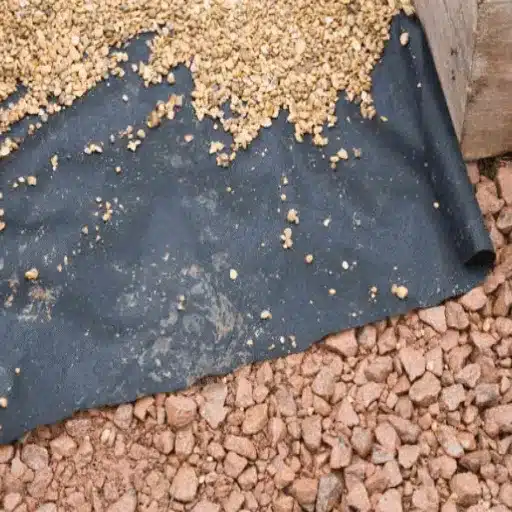
Installation quality determines whether the fabric works. Follow the full geotextile installation best practices guide for edge cases, but here is the driveway-specific sequence.
- Excavate. Dig out 3-6 in. on stable soil, and 8-12 in. to strip topsoil and organics on weak ground. Call before you dig to check for buried lines.
- Prepare and compact the subgrade. Remove vegetation, roots, and sharp debris. Grade it smooth and compact it. A smooth subgrade prevents punctures and reduces settling.
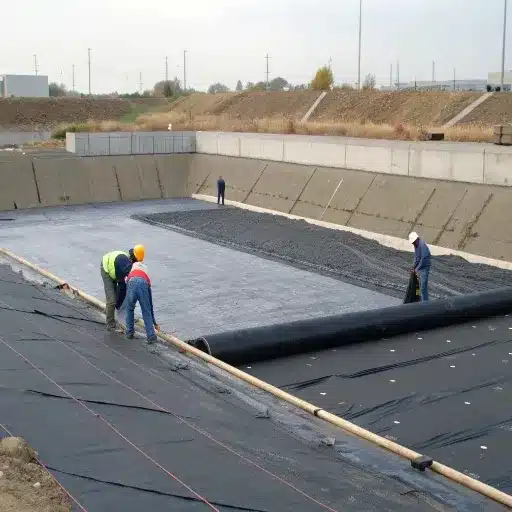
- Lay the fabric. Roll it out flat and taut, with minimal wrinkles. The fabric goes between the prepared subgrade and the gravel base.
- Overlap the seams. Overlap adjacent rolls by 12-18 in. in normal conditions, and 18-24 in. on soft subgrade or where heavy gravel is dumped. Insufficient overlap is a leading cause of failure.
- Secure it. Pin with landscape staples at about one per square yard, and closer spacing on curves and windy sites.
- Add and compact the gravel. Spread angular crushed stone evenly and compact it in layers. Never drive directly on exposed fabric. Back up onto the gravel or use a temporary stone cushion first.
- Cover it promptly. Geotextile degrades in sunlight, so cover it with gravel within a few days of laying. Carbon-black-stabilized fabrics last longer in the sun, but prompt coverage is always better.
Gravel Driveway vs Paver Patio: Is It the Same Fabric?
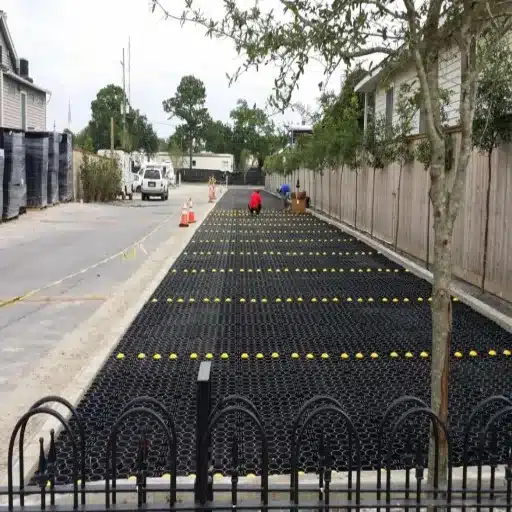
This is the most common point of confusion, and the answer changes the purchase.
- Gravel driveway, vehicle traffic: woven geotextile under the stone base.
- Paver patio or walkway: nonwoven geotextile for drainage and weed control.
- Paver driveway that carries vehicles: woven for load support, with drainage handled around the edges, or a nonwoven layer specified for the load.
If you are building a driveway that drains to a pipe or a trench, you will often use both: woven under the base where vehicles roll, and nonwoven wrapped around the drain line. For load-bearing separation in slabs and pavements, the geotextile under concrete slab guide covers the crossover application.
Frequently Asked Questions
Which is better for a gravel driveway, woven or nonwoven geotextile?
For the traffic-bearing gravel base, woven geotextile is better because it resists tearing, stretches less, and spreads vehicle loads across the subgrade. Nonwoven is better for drainage features and paver patios.
What weight geotextile do I need for a driveway?
Use a commercial-grade woven rated at 200+ lb tensile strength (typically 4 oz or heavier). For heavy commercial traffic or soft clay, step up to a heavier woven with higher puncture resistance.
Does geotextile stop gravel sinking?
Yes. Woven geotextile separates the gravel from the subgrade, so stone cannot sink into soft soil. This is the fabric’s primary job under a driveway and can reduce gravel volume by up to 30%.
How much gravel goes over geotextile?
Plan 4-6 in. of compacted gravel on stable soil, and 6-10+ in. over clay or for heavy vehicles, plus a 2-3 in. wear layer.
Can I use landscape fabric instead of geotextile?
Usually not for a driveway. Thin landscape fabric lacks the tensile strength and puncture resistance of an engineering geotextile and can tear under vehicle loads. The geotextile vs landscape fabric guide covers the differences in detail.
Conclusion
Choosing between woven and nonwoven geotextile for a gravel driveway comes down to one question: is this spot carrying loads, or moving water? Woven geotextile under the gravel base prevents sinking, rutting, and mud, and it reduces the stone you need. Nonwoven geotextile handles the drainage and does the heavy lifting for paver patios and weed control.
If you are still weighing costs before you order, the woven vs nonwoven geotextile cost comparison shows how pricing varies by type, weight, and order volume, and why the cheapest roll is rarely the cheapest driveway. For supply, woven geotextile for driveway stabilization and nonwoven drainage fabric are both available with flexible order terms and technical support.
Get the fabric right and the installation right, and a gravel driveway is one of the lowest-maintenance surfaces you can build. Get them wrong, and you will be re-grading mud every spring. For a spec recommendation matched to your soil and traffic, request a technical quote or contact engineering support and we will help you select the right grade.