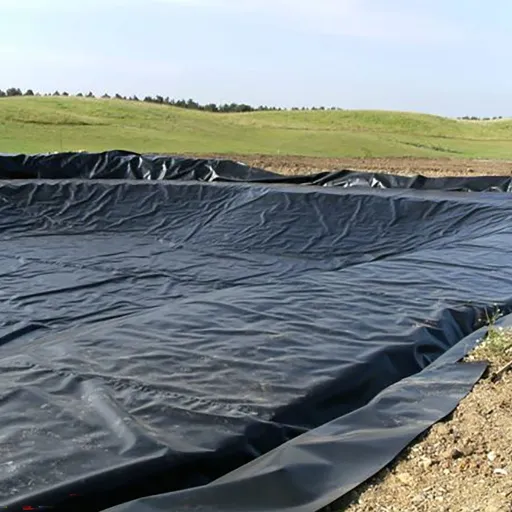
An LLDPE geomembrane landfill cap is a good fit for final covers and closure caps when differential settlement is the governing load. It is not a default primary bottom liner. GRI-GM17 does not include a stress-crack test, and the federal composite-liner rule raises the thickness floor to 60 mil when the membrane is HDPE.
A 60 mil HDPE cap can pass every strength check on the drawing and still crack at a settlement depression. The load that breaks it is strain, not stress. That is why the material decision starts with the layer and the ground, not with a generic strength ranking.
Most liner pages treat “landfill” as one application. A bottom liner and a final cover do different jobs, sit in different chemical and structural conditions, and follow different parts of the same federal rule. This guide separates them, compares LLDPE and HDPE at equal thickness, and gives a cap design sequence you can take to a tender. Send the closure section and settlement assessment if you want the material checked against your permit.
Key Takeaways
- In an LLDPE geomembrane landfill project, the sheet is a cap and closure material first. GM17 omits ESCR, so LLDPE is not a default primary bottom liner.
- 40 CFR 258.40 sets a 30 mil FML minimum and 60 mil for HDPE in the composite bottom liner. 40 CFR 258.60 sets final-cover performance but no FML gauge.
- At 60 mil, GM17 requires 228 lb/in break strength, 800% elongation, 33 lb tear and 84 lb puncture. GM13 requires 126 lb/in yield, 228 lb/in break, 42 lb tear and 108 lb puncture.
- LLDPE’s advantage is conformance under differential settlement. HDPE has the higher yield, tear and puncture values and a stress-crack requirement.
- Cover an LLDPE cap unless a specific exposed-cap design and product are qualified. Peggs reports that LLDPE is not used for exposed geomembrane caps.
Quick Answer: Where LLDPE Fits in a Landfill
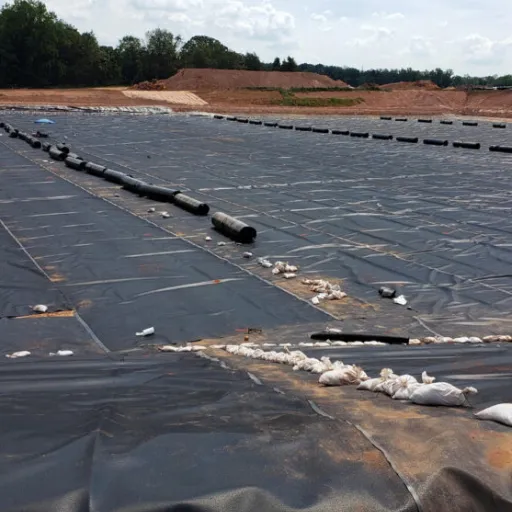
An LLDPE geomembrane landfill cap belongs in the final cover when the waste will keep settling and the sheet must conform. It belongs in a primary bottom liner only when the permit, the chemical assessment and the design explicitly accept it.
An LLDPE landfill liner is a different decision, because the chemical load and the restraint last longer. The difference is the job the layer performs.
| Landfill layer | What it must do | LLDPE fit | Governing check |
|---|---|---|---|
| Primary bottom liner | Contain leachate and resist a long chemical load | Not a default; use only with design and permit approval | 40 CFR 258.40; GM17 omits ESCR |
| Final cover or closure cap | Limit infiltration, contain gas, follow settlement | Good fit when the cap is covered and protected | 40 CFR 258.60; approved closure section |
| Temporary or interim cover | Control rain and erosion for a defined period | Possible; verify UV exposure and duration | Project plan and permit |
| Floating cover over leachate | Control odour and evaporation | Possible; not the same design as a soil cap | Gas, wind and anchoring design |
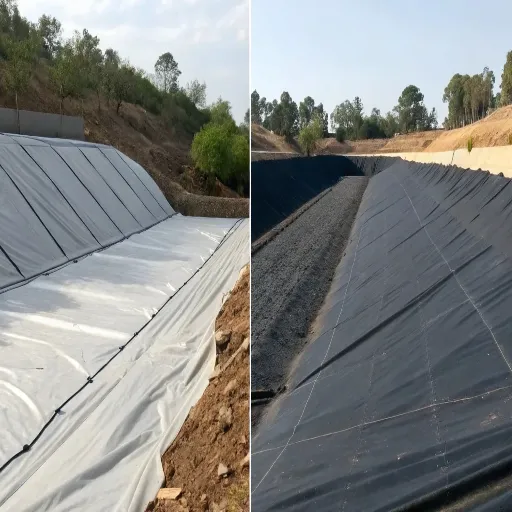
The terms matter. A geomembrane for landfill base liners is the barrier on the floor and sides of a containment facility. A geomembrane for landfill caps is the barrier on top of the waste. A floating cover sits on the liquid and moves with it.
Each has a different stress history, and each can fail for a different reason.
For the layer sequence, our landfill liner system guide covers the composite bottom liner in detail. The HDPE landfill liner guide covers the material most permits name for the base.
What the Regulations Require for an LLDPE Geomembrane Landfill
Three federal sections decide most of the LLDPE geomembrane landfill argument. None of them says “use LLDPE”. Each says something narrower, and the difference matters.
40 CFR 258.40 Is a Bottom-Liner Rule
The composite-liner option requires an upper flexible membrane liner of at least 30 mil. Where that FML is HDPE, it must be at least 60 mil. Below it sits at least two feet of compacted soil with a hydraulic conductivity no higher than 1 × 10⁻⁷ cm/sec. The membrane must sit in direct and uniform contact with that soil, and the leachate collection system must keep the head below 30 cm.
The rule doesn’t name LLDPE. It sets a floor for a non-HDPE FML and a higher floor for HDPE. A 30 mil LLDPE sheet is not made equivalent to 60 mil HDPE by that sentence.
It is simply not excluded by it. The eCFR text of 258.40 is short enough to read before a tender.
40 CFR 258.60 Is a Cover-Performance Rule
The final cover must minimize infiltration and erosion. Its permeability must be no higher than the bottom liner or the natural subsoil, or no higher than 1 × 10⁻⁵ cm/sec, whichever is less. It needs at least 18 inches of earthen infiltration material and at least 6 inches of erosion material that can support native plants. A state director can approve an equivalent alternative.
What the section does not do is set a geomembrane gauge. The eCFR text of 258.60 contains no 40 mil, 60 mil or 80 mil cap minimum. A supplier who quotes 60 mil as “the EPA cap requirement” is quoting the bottom-liner section.
40 CFR 258.61 Makes Settlement Repair a 30-Year Obligation
Post-closure care runs for 30 years, unless the state sets a different period. The owner must maintain the final cover, including repairs for settlement, subsidence, erosion and other events. The gas monitoring system must also be maintained and operated.
That is a care obligation, not a membrane warranty. It tells the designer that settlement will be inspected and repaired. It does not tell the buyer how many years a sheet will last. The eCFR text of 258.61 is the basis for the 30-year figure that appears in closure plans.
State and local landfill capping requirements can be stricter. They can name a polymer, a gauge, a seam standard or a leak-survey method. The approved permit governs. The federal sections set the floor and the frame.
For the full thickness method, including the difference between nominal and measured gauge, our LLDPE geomembrane thickness guide goes further than this article needs to.
Why Settlement Drives the Material Decision
Municipal Waste Keeps Settling
In an LLDPE geomembrane landfill cap, waste is not a finished subgrade. It compresses as organic material decomposes, as load accumulates and as the landfill closes. Koerner reports settlement values of 30% or more of the original waste thickness, with settlement still ongoing in several case histories. A cap placed one year after final waste placement is placed on a moving surface.
Differential Settlement Creates Strain
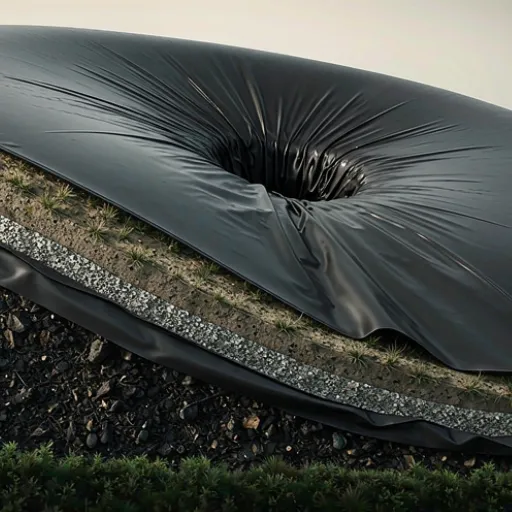
Uniform settlement lowers the whole cap. Differential settlement creates local depressions, and a depression changes the load path.
A stiff sheet spans the low point and concentrates stress at the edge of the void. A flexible sheet deflects into the depression and keeps bearing on the waste. That is the mechanism behind the material preference.
Peggs makes the cap case directly. He writes that the preferred cap material is often LLDPE or another flexible material such as PVC or flexible polypropylene because it accommodates the strains associated with differential settlement. He also notes that less crystalline materials such as LLDPE are not susceptible to stress cracking in the as-manufactured condition.
HDPE’s Stiffness Cuts Both Ways
HDPE’s yield strength and stress-crack resistance are assets in a restrained bottom liner. In a cap over a settling waste mass, the same stiffness can work against it. The sheet is more likely to bridge a depression, and bridging concentrates strain at the edge. HDPE can also wrinkle during installation, and a wrinkle is a stress concentrator.
This isn’t a claim that HDPE caps fail. Many HDPE caps perform well. It is a claim that the material should follow the settlement assessment, not precede it.
Elongation at Break Is Not a Design Strain
GM17 requires 800% break elongation for smooth LLDPE. GM13 requires 700% for smooth HDPE. Those are quality-control minimums, not allowable design strains.
A design that relies on the sheet stretching to 800% has no margin and no basis in either standard. The design must set its own strain limit from the geometry, the support conditions and the expected movement.
An illustrative composite. A closure designer, Marta, was planning a 60 mil HDPE cap over a 6-hectare cell with an expected 1.8 m of total settlement. The geotechnical model showed a soft zone near the perimeter berm.
The HDPE design would have bridged that zone and put the seam line across the transition. The revised design used 60 mil LLDPE, moved the seam off the transition, added a nonwoven cushion and widened the anchor trench. The cap was then covered. The example is illustrative, not a client record.
Our HDPE vs LLDPE geomembrane comparison covers the broader material decision. The settlement argument here is the cap-specific part.
LLDPE vs HDPE for Landfill Caps at Equal Thickness
The LLDPE geomembrane landfill comparison only becomes useful at the same gauge and against the current standards. GM17 and GM13 are both manufacturing quality-control specifications. Their values are minimum averages, not design allowables.
| Property | LLDPE 40 mil (GM17) | HDPE 40 mil (GM13) | LLDPE 60 mil (GM17) | HDPE 60 mil (GM13) |
|---|---|---|---|---|
| Formulated density | ≤0.939 g/ml | ≥0.940 g/cc | ≤0.939 g/ml | ≥0.940 g/cc |
| Yield strength | No yield value specified | 84 lb/in | No yield value specified | 126 lb/in |
| Break strength | 152 lb/in | 152 lb/in | 228 lb/in | 228 lb/in |
| Yield elongation | Not specified | 12% | Not specified | 12% |
| Break elongation | 800% | 700% | 800% | 700% |
| Tear | 22 lb | 28 lb | 33 lb | 42 lb |
| Puncture | 56 lb | 72 lb | 84 lb | 108 lb |
| Stress crack resistance | Not specified | 500 h, ASTM D5397 | Not specified | 500 h, ASTM D5397 |
| UV retention, 1,600 h | 35% HP-OIT | 50% HP-OIT | 35% HP-OIT | 50% HP-OIT |
What the Numbers Mean on a Cap
For an LLDPE geomembrane landfill cap at 60 mil, the break strengths are equal at 228 lb/in. HDPE adds a yield point at 126 lb/in, which means it carries load at a defined strain before it breaks. LLDPE has no yield value in GM17 and a higher break elongation. It stretches further before it fails.
HDPE also has the higher tear and puncture values. At 60 mil, the difference is 42 lb against 33 lb for tear and 108 lb against 84 lb for puncture. Those are index tests. They do not reproduce a particular cover soil, loader or waste surface, but they point in a consistent direction.
The practical reading is simple. LLDPE buys conformance. HDPE buys resistance to a point load and a defined yield.
An LLDPE landfill cap over a settling waste mass usually needs the first. A cap that will be exposed to construction traffic, sharp cover aggregate or demolition debris may need the second.
The ESCR Difference Is Structural
GM17 lists the ESCR test among the tests it does not include. The omission is explicit, and it applies to both ASTM D1693 and ASTM D5397. GM13 includes stress crack resistance as a table property and requires 500 hours at every thickness.
That doesn’t mean LLDPE can’t resist stress cracking. Peggs notes that LLDPE is not susceptible in the as-manufactured condition.
It means the standard doesn’t make a stress-crack claim, and a buyer can’t point to a GM17 ESCR value that is not there. For a restrained, chemically loaded bottom liner, that is a real gap. For an LLDPE geomembrane landfill cap that is covered and free to conform, it’s a smaller issue.
The Test-Method Caveat
Both standards use ASTM D6693 Type IV for tensile testing, so this comparison is more direct than a polyethylene-versus-PVC comparison. It is still not a design substitution. The values are minimum averages from different specifications, and the cap design must use project-specific strain, puncture and interface criteria.
A second illustrative composite. Owen, a procurement engineer, compared 40 mil and 60 mil LLDPE for a cap with six gas vents and a perimeter sump. The 40 mil quote was cheaper per square metre.
The 60 mil sheet raised puncture from 56 lb to 84 lb and tear from 22 lb to 33 lb, which mattered around the vent boots and the sump. The project used 40 mil in the open field and 60 mil in the detail zones. The example is illustrative, not a client record.
Our LLDPE geomembrane specifications page carries the full GM17 table. The thickness guide covers the gauge decision across applications.
Designing an LLDPE Geomembrane Landfill Cap
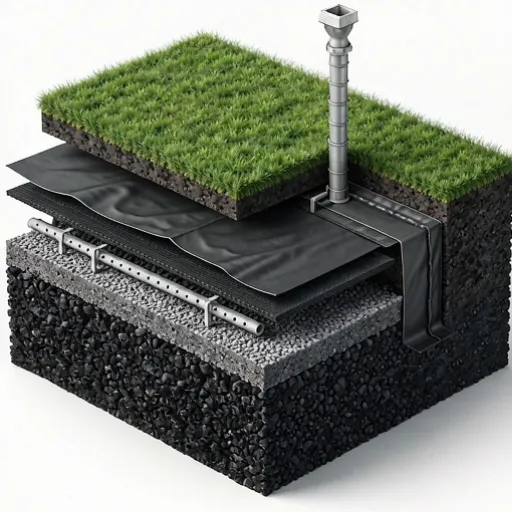
An LLDPE geomembrane landfill cap is a system. The sheet is one layer, and its performance depends on the layers above and below it, the anchorage, the penetrations and the seams. A landfill cap geomembrane must also handle gas and penetration details without leaking at the transitions.
Thickness: No Universal Cap Gauge
GM17 covers LLDPE from 20 to 120 mil. The federal final-cover rule doesn’t select a gauge. A published cover cost comparison uses 1.0 mm, or 40 mil, LLDPE for a traditional cover. That is an example from one design, not a minimum for yours.
The approved closure section decides. Check the permit, the settlement assessment, the cover soil depth, the construction equipment and the gas and leachate details.
Then check the gauge against GM17’s values at that thickness. A 40 mil sheet has 56 lb puncture and 22 lb tear. A 60 mil sheet has 84 lb and 33 lb. The difference is worth paying for where the sheet will be worked around details.
Anchorage and Slope Stability
A cap on a slope has two stability questions. The first is the sheet itself, which must be anchored at the perimeter and at intermediate benches where the design requires them. The second is the cover soil above the sheet, which can slide on a low-friction interface.
Anchor trenches, batten bars and curb fixings are design details, not field choices. The anchor demand depends on wind uplift, gas pressure, slope height and the cover system. Texture can change interface behaviour, but it does not assign a safe slope angle. Test the actual interfaces at the relevant normal stress, and include the peak and large-displacement cases where the design requires them.
Gas and Penetrations
A cap contains landfill gas and limits rainwater entry. Gas collection and venting are separate design requirements, and the cap must accommodate them without leaking at the details.
Vents, sumps, monitoring points and pipe penetrations are where seams concentrate. Use flexible boots or compatible detailing, reinforce the sheet around the penetration, and keep field seams away from the highest-stress part of the detail where the layout allows it. The gas monitoring system itself is a regulatory obligation under 40 CFR 258.23 and 258.61, not a substitute for cap integrity.
Seams
LLDPE seams are thermally bonded. GRI-GM19a gives the acceptance values.
At 60 mil, a hot-wedge seam must reach 90 lb/in shear and 75 lb/in peel. An extrusion fillet must reach 90 lb/in shear and 66 lb/in peel. All five of five specimens must meet the values.
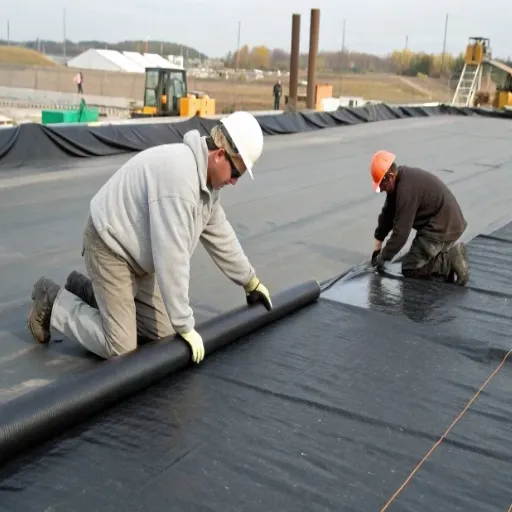
Those are laboratory acceptance values, not field settings. Temperature, speed, pressure and overlap come from a trial seam on the actual sheet, equipment and weather. Production seams then need nondestructive testing and destructive samples at the project’s frequency. Our geomembrane welding guide covers the methods and the test sequence.
Protection and Cover
A buried cap needs a protection layer and cover soil. The protection layer spreads construction and cover loads and separates the sheet from angular material. A nonwoven geotextile is common, but the mass per unit area alone does not prove protection. The design must match the cushion to the cover aggregate, the equipment and the subgrade.
Cover placement is the stage when many liner defects are created. Tracked equipment, dropped stones and stretched sheets all cause damage that a post-installation survey may not find. Sequence the work, control traffic and inspect before and after cover placement. Our installation guide covers the general sequence.
| Cap design check | What to confirm |
|---|---|
| Permit and closure section | Polymer, gauge, surface, seam standard and survey method |
| Settlement assessment | Total and differential movement, depressions, slope transitions |
| Thickness | GM17 values at the specified gauge, detail zones included |
| Anchorage | Perimeter trench, bench anchors, wind and gas uplift |
| Gas and penetrations | Vent, sump and boot details, reinforcement, seam layout |
| Seams | GM19a values, trial seam, nondestructive and destructive testing |
| Protection | Cushion type and mass, cover aggregate, equipment limits |
| Survey | Method suited to exposed or covered conditions |
| Handover | As-built panel map, repairs, test reports and open items |
Send the draft cap section, the gas details and the specified seam standard for a gauge and seam review. Talk to our technical team.
If the cover section includes a geosynthetic clay liner or a compacted clay layer, our GCL landfill liner guide covers the mineral component.
Exposure, Leak Detection and Long-Term Care
UV and Exposed Caps
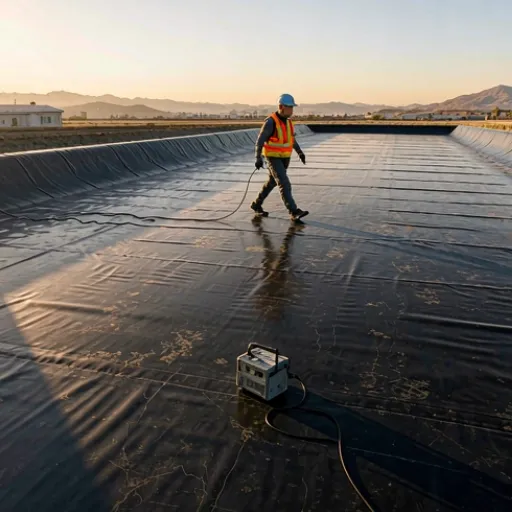
On an LLDPE geomembrane landfill cap, GM17 requires UV resistance for 1,600 hours, with 35% high-pressure OIT retention. That is a manufacturing quality-control test. It is not a licence to leave an LLDPE cap exposed for decades.
Peggs is explicit: LLDPE is not used for exposed geomembrane caps because of its lower weathering resistance. Koerner’s accelerated study found that LLDPE reached its 50% property-retention half-life before the other polymers tested under ASTM D7238 at 70 °C. Both points support the same design rule. Cover the cap, or qualify the exposed design and product separately.
An exposed cap also changes the wind, uplift, temperature and run-off loads. It may be a legitimate choice for another polymer. It is not a default LLDPE choice.
A third illustrative composite. Aisha managed a closure project that wanted an exposed LLDPE cap to avoid the cost of cover soil. The design review found that the proposed sheet had a standard UV test result but no exposed-cap qualification, and that the site’s wind and gas uplift loads had not been assessed. The project returned to a covered LLDPE cap with a gas collection layer. The example is illustrative, not a client record.
Leak Detection
LLDPE is electrically insulating, like HDPE. A leak survey works by tracing current through a breach, and the method depends on the installed system, not the polymer name.
ASTM D6747 is the guide for selecting a technique. Exposed-liner methods include the water puddle practice in ASTM D7002 and the arc practice in ASTM D7953. Covered surveys use different methods and different site conditions.
A survey detects breaches under defined conditions. It doesn’t verify seam strength, and it does not guarantee that the cap will stay intact after later work. Our electrical leak location guide compares the methods and the conditions each one needs.
Chemical Compatibility
LLDPE is a non-polar polyolefin. It generally resists aqueous acids, alkalis and salts. Hydrocarbons, aromatic solvents and chlorinated solvents can absorb into the sheet, swell it and soften it. A cap sees less liquid contact than a bottom liner, but gas condensate and leachate splash still belong in the review.
GM17 does not include a chemical-resistance test. Neither does GM13. A project with a variable or aggressive waste stream should test the actual leachate or condensate against the proposed sheet and interpret the results against its own requirements. A generic “chemical resistant” statement is not a specification.
Service Life
No standard gives an LLDPE cap a service life in years. GM17’s tests are manufacturing quality-control tests. The 30-year post-closure period is a care obligation that includes settlement repair and gas monitoring. It is not a warranty.
The honest answer to “how long will it last” is that it depends on the cover, the chemistry, the temperature, the seams, the damage during construction and the inspection regime. A covered cap with good seams and a maintained cover has a different outlook from an exposed sheet with unresolved wrinkles.
When an LLDPE Geomembrane Landfill Cap Is the Wrong Choice
Choose LLDPE When
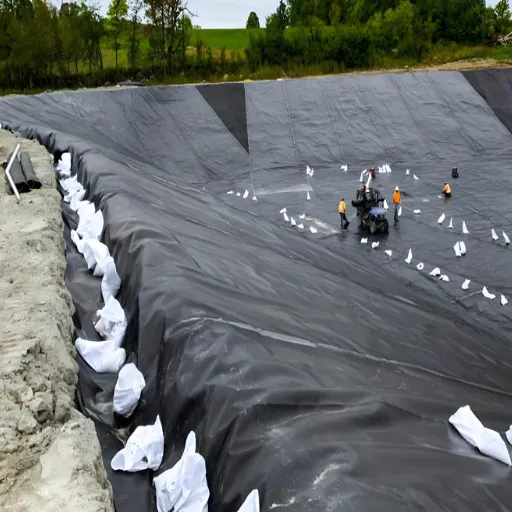
- The cap sits over waste that will keep settling, and conformance is the governing demand.
- The cap will be covered and protected within the design’s exposure limit.
- The geometry is irregular, with curves, penetrations and details that favour a flexible sheet.
- The permit accepts LLDPE and the chemical review supports it.
Choose HDPE When
- The layer is a primary bottom liner under a long, restrained chemical load.
- The permit names HDPE or a 60 mil HDPE section.
- The cap will be exposed, or the site needs the higher tear and puncture values.
- The design depends on a defined yield point and a stress-crack requirement.
Neither When
- The waste stream is aggressive enough to require a different polymer or a compatibility test first.
- The settlement is so large that no geomembrane should be asked to bridge it without a support or staged-cover design.
- The cap design has no gas, penetration or anchor detail, in which case the material choice is premature.
Frequently Asked Questions
Is LLDPE suitable for landfill caps?
An LLDPE geomembrane landfill cap is suitable when the cap is designed for the settlement and covered within the exposure limit. GM17 covers the sheet, and Peggs identifies LLDPE as a common cap material because it accommodates differential settlement. The permit and the closure section still govern.
What thickness LLDPE geomembrane for a landfill cap?
There is no federal cap gauge. GM17 covers 20 to 120 mil, and a published cover comparison uses 1.0 mm, or 40 mil, LLDPE as an example. The approved section decides. Check puncture, tear and construction loads at the chosen gauge rather than assuming 40 or 60 mil.
Is LLDPE allowed in landfill liners?
The federal composite-liner rule sets a 30 mil FML minimum and 60 mil for HDPE. It does not name LLDPE, and it does not ban it. A state or local permit can be stricter. For a primary bottom liner, the absence of an ESCR requirement in GM17 is a reason to prefer HDPE unless the design explicitly accepts LLDPE.
LLDPE vs HDPE for a landfill cap, which is better?
LLDPE is better where settlement and conformance govern. HDPE is better where exposure, puncture, tear or a defined yield point govern. At 60 mil, both have 228 lb/in break strength, but HDPE has 42 lb tear and 108 lb puncture against LLDPE’s 33 lb and 84 lb.
Can LLDPE be used for an exposed landfill cap?
Not as a default. Peggs states that LLDPE is not used for exposed geomembrane caps because of its lower weathering resistance. An exposed design needs a specific product and a specific qualification, not just a standard UV test result.
How is LLDPE seamed on a landfill cap?
Hot-wedge and extrusion fillet seams are typical. GRI-GM19a gives the acceptance values, and all five of five specimens must meet them. Trial seams, nondestructive testing and destructive samples are set by the project’s CQA plan.
Does LLDPE resist landfill leachate and gas?
LLDPE generally resists aqueous leachate, but hydrocarbons and chlorinated solvents can swell it. GM17 does not test chemical resistance. Test the actual leachate or condensate for the project rather than relying on a generic claim.
An LLDPE geomembrane landfill cap earns its place when the design is built around movement. Confirm the cap or liner function first. Then check the permit, the settlement assessment and the cover section.
Then choose the gauge and the seam standard. A cap that follows the waste surface and stays covered will usually serve better than a stiffer sheet chosen for a strength number it does not need.
Send the permit section, the settlement assessment, the gas and penetration details and the required seam standard. We will check the LLDPE geomembrane landfill option against the layer it is meant to protect. Talk to our technical team.